Best Crypto Trading Bots: Darkbot First, API Key Security & Tests

Darkbot is the strongest overall pick for individual traders who want AI-enabled automation, exchange API integration, backtesting, and structured risk controls in one platform. Traders who want dead-simple, no-setup automation should look at built-in exchange bots instead, and developers who want full control over execution logic tend to gravitate toward open-source, self-hosted frameworks. Scan the comparison below, or start with a free plan to see how the mechanics work before committing to a paid tier.
TL;DR:
- Darkbot offers AI-enabled automation with backtesting and portfolio risk controls, optimized for traders seeking a comprehensive, no-code platform.
- Its tiered plans support multiple exchanges, real-time analytics, and scalable features, suitable for both casual and more active traders.
- Security best practices require generating API keys with trading-only permissions, disabling withdrawals, and using IP whitelisting to prevent unauthorized access.
- Supported exchanges and strategies favor users who want reliable, well-documented backtesting and paper trading before live deployment.
- Self-hosted options like Hummingbot and HaasOnline offer more control and customization but require technical expertise and higher setup effort.
Best Crypto Trading Bots Compared
Picking among the best crypto trading bots on the market means weighing execution reliability against how much control, cost, and technical setup you’re willing to take on. The four platforms below cover the range most individual traders actually consider, from managed AI automation to fully self-hosted frameworks.
- Darkbot — AI-enabled strategy execution with exchange API integration, backtesting, and built-in risk controls, suited to traders who want automation without writing code.
- Pionex — Free bots built directly into an exchange, aimed at beginners who don’t want to manage separate API connections.
- 3Commas — A broader automation suite with DCA, grid, and portfolio tools for traders who want to fine-tune parameters themselves.
- Hummingbot — An open-source, self-hosted framework for developers building custom market-making logic.
These four anchor the field, but the category is wider. Cryptohopper, Coinrule, Altrady, Bitsgap, TradeSanta, HaasOnline, Gunbot, Cryptohero, and Mizar each serve narrower use cases, which are covered in the profiles below.
When you compare bots, six dimensions actually matter. Best for tells you the trader profile a platform was designed around, not just its feature list. Pricing shape distinguishes free tiers, flat subscriptions, and one-time licenses, since the billing model affects your break-even math differently than the sticker price alone. Exchanges supported determines whether your existing accounts even work with the tool. Automation style separates grid, dollar-cost averaging (DCA), market-making, and AI or rule-based logic, each suited to different market conditions, a distinction reviewers frequently document as a core buying criterion in industry summaries. Hosting is cloud versus self-hosted, which trades convenience for control. Key features covers whether backtesting, paper trading, or a strategy marketplace actually ships with the platform, or gets bolted on as an afterthought.
Pro Tip: Before connecting any bot to a live exchange account, generate API keys with trading permissions only. Disable withdrawal rights entirely, and use IP whitelisting if the exchange offers it. This single step blocks the most common exploit path for automated trading credentials.
Security practices vary more than most comparison articles admit. A platform’s automation logic doesn’t matter if the API key protecting your account has withdrawal access enabled by default. Look for explicit documentation on key scopes, whitelisting support, and whether the vendor ever needs (or requests) withdrawal permissions to operate. A platform that requires withdrawal-enabled keys to function is asking for more trust than the automation itself justifies.
How the Best Automated Crypto Trading Bots Stack Up
Here’s a factual, side-by-side look at how each platform positions itself, without ranking claims neither vendor documentation nor public materials can support.
Darkbot runs AI-enabled automation across major exchange APIs, combining strategy customization with backtesting, paper trading, and portfolio-level risk controls. It’s built for traders who want machine-assisted execution without hand-coding every rule, and its tiered plans (Free, Standard, Premium, Enterprise) scale from casual experimentation to higher-volume management. The platform combines AI-driven parameter adaptation with integrated portfolio tools in a single cloud dashboard, rather than requiring separate tools for execution and monitoring.
Cryptohopper is a cloud-based platform structured around a strategy marketplace, where users can subscribe to or copy templates built by other traders. That marketplace model suits people who want a starting point rather than building strategy logic from scratch. It supports multiple exchanges through API connections and offers both automated and semi-manual modes.
Pionex takes a different approach entirely: instead of connecting external bots to an exchange via API, the bots live inside the exchange itself. This removes an entire category of API key risk, since there’s no third-party service holding your credentials. Pionex ships free, built-in grid and DCA bots, making it a common starting point for beginners who want automation without evaluating a separate vendor’s security posture. The tradeoff is that you’re limited to whatever exchange Pionex operates, rather than connecting to the exchange you already use.
3Commas offers a broad automation suite, including DCA bots, grid bots, and portfolio management tools that let experienced traders adjust entry conditions, take-profit targets, and safety orders in detail. It connects to multiple major exchanges via API and is generally positioned toward traders who already understand DCA and grid mechanics and want granular control over the parameters, rather than a hands-off experience.
Coinrule replaces code with a rule builder: “if this indicator crosses this threshold, then execute this action.” That no-code structure appeals to traders who understand market logic but don’t want to script it themselves. It connects to major exchanges and supports both simple and layered rule sets.
Altrady functions primarily as a trading terminal, aggregating multiple exchange accounts into one interface, with automation features layered on top rather than positioned as the core product. Active traders who want a unified view across several exchanges, plus some automated order execution, are the natural fit.
Bitsgap combines bot automation with arbitrage detection tools, designed for traders managing positions across multiple exchanges simultaneously. Its unified dashboard aggregates balances and open orders from connected accounts, and its automation styles include grid and DCA bots alongside arbitrage scanning.
TradeSanta keeps things intentionally simple: cloud-hosted grid and DCA bots with subscription pricing that stays on the lower end of the category. It’s a reasonable fit for traders who want automation without a steep learning curve or an expensive plan, though it doesn’t carry the feature depth of platforms like 3Commas or Bitsgap.
HaasOnline sits at the technical end of the spectrum, aimed at algorithmic traders who want to write and backtest custom strategy scripts in detail. It’s typically run with more hands-on configuration than cloud-first platforms, and its licensing model reflects a professional, rather than casual, user base.
Hummingbot is fully open-source and self-hosted, built around market-making and liquidity-provision strategies. Developers who want to inspect, modify, or extend the underlying code, rather than trust a vendor’s black box, gravitate here. Freqtrade occupies similar territory as another mature open-source framework with backtesting and machine-learning-based strategy optimization built in, and it’s worth evaluating alongside Hummingbot if self-hosting is the priority.
Gunbot has been in the category for years and offers a large library of built-in strategy presets, along with a local-run mode and one-time licensing options rather than a strict subscription model. That licensing structure appeals to traders who prefer a fixed upfront cost over recurring fees.
Cryptohero is a cloud-based platform built around prebuilt templates and simple automation setup, aimed squarely at traders who want to launch a bot in minutes rather than configure one from first principles.
Mizar rounds out the field as a copy-trading and automation platform connecting to multiple exchanges, though detailed public documentation on its specific feature set is limited compared to the more established names above.
- Hosting models split cleanly into two camps. Cloud platforms (Darkbot, Cryptohopper, 3Commas, Bitsgap, TradeSanta, Cryptohero, Pionex) run on the vendor’s infrastructure, so you don’t manage servers. Self-hosted options (Hummingbot, and often HaasOnline and Gunbot in local-run mode) require you to run the software yourself.
- Pricing shape varies from free to one-time license. Free tiers (Pionex’s built-in bots, Darkbot’s Free plan) let you test mechanics before paying; subscription models (Darkbot Standard and Premium, TradeSanta, Cryptohopper) bill monthly or annually; one-time licenses (Gunbot) trade recurring cost for a fixed upfront payment.
- Exchange coverage should be verified per account, not per platform. Most tools connect to major centralized exchanges through API, but the exact list changes over time as exchanges update their APIs.
How to Choose a Crypto Trading Bot for Your Strategy
The right platform depends less on brand recognition and more on whether its mechanics match how you actually trade. Work through these criteria in order, since each one narrows the field before you get to pricing.
- Does it support the strategy type you actually use? Grid bots suit range-bound markets; DCA suits accumulation over time; market-making suits liquidity provision; AI-assisted, rule-driven execution suits traders who want adaptive parameter tuning without manual rebalancing.
- Does it connect to your existing exchange accounts? A platform with excellent automation is useless if it doesn’t support the exchange where your funds already sit.
- Can you backtest and paper-trade before going live? Historical simulation and forward-testing on live data without real capital are how you catch a broken strategy before it costs you money.
- What API key permissions does it require? Confirm the platform never needs, or requests, withdrawal-enabled keys. Legitimate automation only needs trading and read permissions.
- Is hosting cloud or self-managed? Cloud means less setup but more trust placed in the vendor; self-hosted means more control but more responsibility for uptime and security patching.
- What’s the actual pricing structure? Compare monthly subscription cost against a one-time license or free tier, factoring in how many bots or exchange connections each tier unlocks.
- Does documentation match the marketing claims? Vendors describing “AI-powered” or “machine learning” features should explain, at some level, what the model actually adjusts and how, consistent with the kind of governance transparency NIST’s AI taxonomy recommends for evaluating automated systems.
- What support channels exist, and how active is the user community? A platform with responsive support and an active forum or Discord tends to surface integration bugs faster than one where you’re on your own.
- Can you run multiple bots or strategies simultaneously? Portfolio-level automation matters if you’re managing more than one asset or strategy at once.
- What happens to your funds and data if you cancel? Confirm export options for trade history and strategy configurations before you commit.
A short onboarding checklist keeps the process disciplined: connect a read-only or trade-only API key first, run a paper-trading cycle for at least a few days, review every trade the bot executed against your expectations, then scale into a small live allocation before committing meaningful capital. Skipping the paper-trading step is the single most common reason traders discover configuration errors only after they’ve already lost money on them.
Pro Tip: When generating an API key for any trading bot, restrict its scope to “spot trading” and “read” permissions only, disable withdrawals entirely, and add IP whitelisting if your exchange supports it. This three-part combination is the baseline security posture recommended across the category, and it costs you nothing to set up.
How We Evaluated These Crypto Trading Bots
This comparison weighed five axes: execution reliability, exchange integration breadth, security posture, feature depth, and pricing transparency. Execution reliability looked at whether a platform’s automation style (grid, DCA, market-making, AI-assisted) matched its stated use case rather than overselling its capabilities. Integration breadth checked how many major exchanges each platform connects to via API, since a bot’s strategy logic is irrelevant if it can’t reach your account.
Security posture focused on whether a platform’s documentation explicitly addresses API key scopes, IP whitelisting, and withdrawal restrictions, consistent with the evaluation approach NIST’s AI evaluation framework applies to assessing system trustworthiness generally. Feature depth compared backtesting, paper trading, and strategy marketplace availability against vendor claims. Pricing transparency checked whether plans were clearly published or required a sales conversation to uncover.
Evidence came from vendor documentation, publicly available product materials, and general industry pricing patterns; where vendor claims about “AI” or “smart” automation appeared, this evaluation treated those claims with the same caution regulatory frameworks like the EU AI Act apply to high-risk automated systems: as claims to verify, not facts to assume.
You can run a version of this validation yourself. Start with a paper-trading cycle on your target exchange to confirm the bot’s logic behaves as documented. Then run a small live test, sized so a mistake costs you little, and check execution latency between signal generation and order placement. Discrepancies here often surface faster than in any vendor demo.
Why Darkbot’s Feature Set and Approach Stand Out
Darkbot’s case rests on a specific combination of capabilities rather than a single marquee feature. The platform connects to major exchanges through API keys, supports strategy customization with backtesting and paper trading before any live deployment, and includes real-time analytics for monitoring open positions and bot performance.
- API integration across supported exchanges, with configurable key scopes for security.
- Strategy customization paired with backtesting against historical data.
- Paper trading to validate strategy logic before committing capital.
- Multiple simultaneous bots for portfolio-level automation rather than single-strategy execution.
- The platform offers multiple plan tiers that scale features to trading volume and complexity.
- Real-time analytics for tracking bot performance and portfolio state.
Editorial coverage on Darkbot’s own blog, including a strategy optimization guide and detailed notes on API key security, documents the reasoning behind these feature choices rather than simply asserting them.
None of this amounts to a performance guarantee. Darkbot’s recommendation in this comparison rests on feature fit, security architecture, and risk-control design, not on projected returns or historical performance figures, since automated systems adapt to patterns rather than predict outcomes with certainty.
What Traders Say About Support and Community Feedback
Support quality across this category splits along the cloud versus self-hosted line. Cloud platforms like Darkbot, Cryptohopper, and 3Commas typically offer direct support channels, since users are paying for a managed service rather than software they run themselves. Response quality varies by platform and plan tier, and higher subscription tiers generally come with faster or more personalized support access.
Self-hosted, open-source tools like Hummingbot work differently: support comes primarily from community forums, Discord servers, and documentation rather than a dedicated help desk. That model works well for technically confident users but leaves less technical traders without a direct line to ask questions.
Community feedback matters most as a signal for catching integration issues early. Active user communities around platforms like Cryptohopper and 3Commas surface exchange API changes, bugs, and workarounds faster than most vendors publish official updates. When evaluating any platform, checking whether its community forum or support channel shows recent, active discussion is a more reliable signal than review scores alone, since it tells you whether problems get identified and addressed in real time.
Is the Interface Easy to Use Across These Platforms?
Interface complexity tracks closely with how much manual configuration a platform expects from you. Pionex and Cryptohero sit at the simple end, with prebuilt bots and templates that require minimal setup, since the design goal is getting a beginner trading within minutes. TradeSanta and Coinrule follow a similar philosophy, prioritizing a clean setup flow over exposing every possible parameter.
Darkbot’s dashboard is built around a similar accessibility principle for its core automation, while still exposing the strategy customization and risk-control settings that intermediate traders want. The interface separates bot configuration, backtesting results, and live portfolio analytics into distinct views, so beginners can start with default settings while more experienced users adjust individual parameters.
3Commas and Bitsgap trade some of that simplicity for depth, offering more configuration screens and parameter options, which suits traders who already understand DCA or grid logic and want to fine-tune it. HaasOnline and Hummingbot sit furthest from beginner-friendly, since scripting custom strategies or configuring a self-hosted framework assumes real technical background.
The practical takeaway: match interface complexity to your own experience level rather than picking a platform for its feature count alone. A trader who doesn’t understand what a “safety order” does won’t benefit from a platform that exposes twenty configuration fields for it.
What Setup and Configuration Actually Require
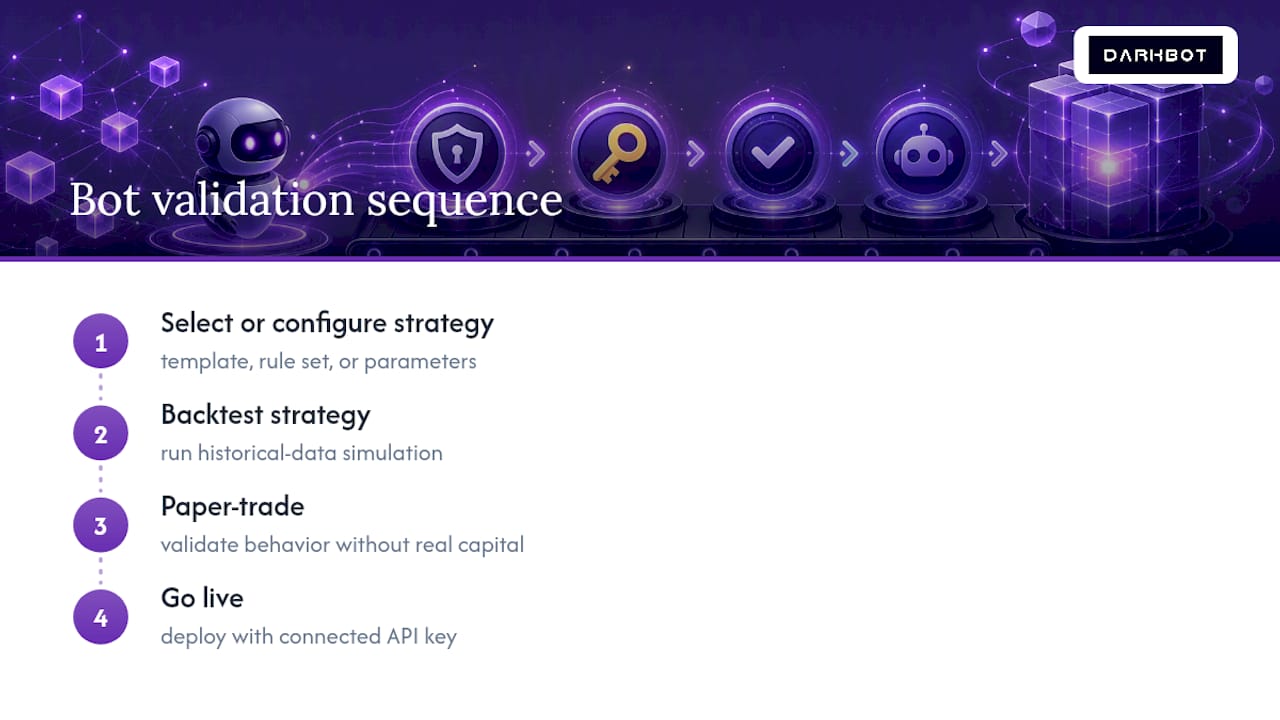
Getting any bot running follows roughly the same sequence, regardless of platform. First, create an account with the bot provider and, separately, generate an API key on your exchange with trading permissions enabled and withdrawal permissions explicitly disabled. Second, connect that API key to the bot platform, which typically involves pasting the key and secret into a secure connection field.
Third, select or configure a strategy: choosing a template from a marketplace (as with Cryptohopper), building a rule set (as with Coinrule), or configuring parameters directly (as with 3Commas or Darkbot). Fourth, run a backtest against historical data to see how the strategy would have performed, followed by a paper-trading period to validate behavior without risking capital.
Self-hosted platforms like Hummingbot add a real technical step: installing the software on your own server or local machine, managing dependencies, and keeping the framework updated. That’s a meaningfully higher setup burden than a cloud platform where you log in and connect an API key.
Pro Tip: Whitelist the bot platform’s IP address (or address range) directly on your exchange account, if the exchange supports it. This blocks any API key from being used from an unauthorized location, even if the key itself were somehow exposed.
Expect the full setup process, from account creation to a validated paper-trading run, to take anywhere from thirty minutes on a simple platform like Pionex to several hours on a scripting-heavy platform like HaasOnline.
What Performance Metrics Actually Tell You
Every platform in this category publishes some version of performance data, whether that’s backtest results, paper-trading logs, or aggregated statistics from past strategy runs. The honest limitation is that none of these metrics predict future results, since crypto markets shift regime frequently and a strategy tuned to one market condition can underperform in another.
Backtest results, in particular, carry a specific risk: overfitting. A strategy tuned aggressively against historical data can look exceptional in a backtest while performing poorly in live conditions, because the parameters were effectively reverse-engineered to fit the past rather than to generalize forward. This is one reason paper trading matters as a second validation step, separate from backtesting.
Metrics worth checking include how long a strategy’s backtest window is (a few weeks tells you far less than multiple market cycles), whether the platform tracks paper-trading results separately from backtests, and whether real-time analytics show drawdown alongside gains, not just upside. The platform’s real-time analytics track portfolio state and bot performance continuously, providing visibility into drawdown periods rather than only cumulative returns.
Treat every historical performance figure, from any vendor, as a description of what already happened under specific market conditions, not a projection of what will happen next.
What Are the Risks and Limitations of Trading Bots?
Automation doesn’t remove risk. It changes what kind of risk you’re exposed to. A bot executes its rules with more consistency than a manual trader typically manages, but that consistency applies just as reliably to a flawed strategy as to a sound one. If the underlying logic is wrong, automation just makes the mistake faster and more repeatable.
Market-wide events remain the clearest limitation. A grid bot calibrated for range-bound conditions can perform poorly during a sharp, sustained trend, and a DCA strategy built for gradual accumulation can compound losses during an extended downturn if position sizing isn’t controlled. No automation style is immune to structural shifts in market behavior.
Technical risk adds another layer: exchange API outages, rate limits, and connectivity issues can delay or block order execution at the exact moment you need it to work. Security risk compounds this, since any API key connected to a bot represents a potential attack surface, which is why withdrawal-disabled keys and IP whitelisting aren’t optional precautions. A detailed breakdown of risks traders commonly miss covers this in more depth. Fees and slippage also erode returns quietly. High-frequency grid strategies especially can rack up trading fees that offset gains if a platform’s fee structure isn’t factored into strategy selection upfront.
Realistic Expectations for Automation and Risk Management
Automation earns its value in discipline and execution speed, not in predicting markets. A bot executes a defined rule set without hesitation or emotional override, which is a genuine advantage over manual trading during routine volatility. That advantage disappears during market-wide shocks or macro events no rule set was designed to anticipate.
The most common mistakes are self-inflicted: overfitting a strategy to historical data, ignoring cumulative fees and slippage, and applying leverage beyond what the strategy’s backtest window ever accounted for. Sound risk management stays simple: size positions so a single failed strategy can’t meaningfully damage the portfolio, set stop-loss rules before deploying capital rather than after a loss, and check bot performance on a regular cadence rather than assuming it runs unattended indefinitely.
— Grisha
Which Darkbot Plan Fits Your Trading Approach
The platform offers several plan tiers designed around different levels of automation and analytical depth. These plans provide options for users to test core bot mechanics, backtesting, and exchange connectivity before scaling up, with higher tiers supporting multiple bots and more complex portfolios. Pricing details are provided upon request for higher-volume use cases.
If you’re still comparing automation styles, the practical move is starting on the Free plan, connecting a trade-only API key, and running a paper-trading cycle before deciding whether Standard or Premium fits your volume. Full plan details and pricing are available directly on Darkbot’s site, including current terms for upgrading between tiers as your trading activity grows.
This article is general information, not a substitute for advice from a qualified financial advisor. Consult a qualified financial professional about your own circumstances before acting on anything here.
Sources
- NIST: A Taxonomy and Terminology of AI Governance
- European Parliament: EU AI Act — first regulation on artificial intelligence
- GitHub - freqtrade/freqtrade: Free, open source crypto trading bot · GitHub
FAQ
What Is the Most Successful Crypto Trading Bot?
There’s no single bot that outperforms every other one across all market conditions, since success depends on strategy fit, risk controls, and how well the platform’s automation style matches current market behavior. Darkbot’s combination of AI-assisted execution, backtesting, and portfolio-level risk controls makes it a strong fit for traders who want disciplined, feature-rich automation rather than a single “best” tool.
Which AI Bot Is Best for Trading Crypto?
The strongest AI-enabled option depends on whether you want managed cloud automation or full self-hosted control. Darkbot combines AI-driven parameter adaptation with exchange API integration and risk management tools in one dashboard, making it a practical choice for traders who want machine-assisted execution without managing infrastructure themselves.
Can I Make $100 a Day Trading Crypto with a Bot?
No bot can guarantee a specific daily return, since crypto markets are volatile and automated systems execute rules rather than predict outcomes with certainty. Any platform claiming guaranteed daily profits should be treated with skepticism, and traders should evaluate bots on execution quality and risk controls, not projected earnings.
Are Crypto Trading Bots Safe to Use?
Safety depends heavily on API key configuration rather than the bot itself. Using trade-only API keys with withdrawal permissions disabled, and enabling IP whitelisting where the exchange supports it, addresses the majority of the practical security risk associated with connecting any bot to a live account.
Do I Need Coding Skills to Use a Crypto Trading Bot?
Most cloud-based platforms, including Darkbot, Cryptohopper, and Pionex, are designed for no-code use through templates and configurable settings. Coding skills become relevant mainly for self-hosted, open-source frameworks like Hummingbot, where customizing the underlying strategy logic requires direct code changes.
Recommended

Start trading on Darkbot with ease
Come and explore our crypto trading platform by connecting your free account!
Free plan available • No credit card required