0.25% Breakeven: Best Scalping Bots for Crypto Scalpers

Darkbot is the recommended platform for disciplined scalpers because it pairs exchange-level execution controls with strict, rule-based risk limits rather than promising an edge that doesn’t exist. Scalping success comes down to a narrow equation: fees plus spread plus slippage against a small, repeatable per-trade gain. A bot only earns its place if it protects that math automatically, trade after trade.
TL;DR:
- Successful scalping requires low fees, high liquidity, and lightning-fast execution, as costs often outweigh small per-trade gains.
- Bots must accurately model exchange-specific fees, slippage, and spread to avoid overestimating profitability during backtesting.
- Integrating automated risk controls, like daily loss limits and position caps, is crucial for survival under scalping’s high trade frequency.
- Proper testing involves paper trading for weeks, then gradual live deployment with close monitoring of slippage, drawdown, and trade consistency.
- Darkbot’s platform supports rule-based execution, risk management, and realistic backtesting, emphasizing safety and consistency rather than guaranteed profits.
Do the Best Scalping Bots Actually Work?
Scalping bots can work, but the honest answer is narrower than most marketing suggests: they work only when fees, liquidity, and execution speed are already in the trader’s favor. A large body of academic research on active short-term trading found that most day traders lose money once fees and slippage are subtracted, a pattern that gets worse, not better, at scalping’s compressed timeframes and thin margins, according to SSRN research on day trading performance.
That single finding should reset expectations for anyone comparing scalping bot reviews. Software does not change the underlying arithmetic. A bot that executes flawlessly on a pair with wide spreads and shallow order books still loses to costs. The variables that actually decide outcomes are:
- Transaction fees paid per trade, which compound fast at scalping frequency.
- Liquidity depth, which determines how much slippage a market order generates.
- Execution speed, since delayed fills often mean chasing a price that has already moved.
- Risk discipline, including hard caps on daily losses and consecutive losing trades.
Reality check: most retail scalpers never reach consistent profitability, largely because they underestimate cumulative fees rather than misjudge market direction, per the same day trading research.
Scalping bots suit traders with access to low-fee exchange tiers, high-liquidity pairs, and the patience to run a paper-trading phase before committing capital. They are a poor fit for anyone trading on thin capital, illiquid altcoins, or an exchange with high taker fees. If that describes your situation, a slower automated trading style, covered in Darkbot’s overview of bot types, usually has better odds after costs.
What Actually Matters When You Evaluate a Scalping Bot?
Most comparison lists rank scalping bots by feature count or interface polish. That’s the wrong lens. A high-frequency trading bot lives or dies on six operational attributes, and they apply whether you’re comparing automated trading for scalping in crypto, forex, or equities.
-
Fee and spread modeling. The bot needs to calculate real cost per trade, not a generic estimate. Maker and taker fees differ by exchange and by volume tier, and Binance’s fee schedule shows how VIP tier breakpoints change costs materially as volume rises. A bot that ignores your actual tier will overstate expected profit.
-
Exchange selection and liquidity. Deep order books absorb your trade size without moving the price against you. Thin books do the opposite. Check average daily volume and order-book depth for the specific pair you intend to scalp, not just the exchange’s overall reputation.
-
Execution controls. This covers order type selection (limit versus market), API latency, and how orders route to the exchange. A bot that defaults to market orders on every entry will bleed slippage on volatile pairs.
-
Risk controls built for scalping’s pace. Daily loss caps and consecutive-loss guards matter more here than in swing trading, because a scalping bot can execute dozens of trades before a human notices a losing streak. Structured risk management approaches should stop trading automatically once a defined loss threshold hits, not just log an alert.
-
Backtesting realism. A backtest that ignores fees and slippage is close to fiction. Realistic testing injects both, using either historical fee schedules or a conservative estimate for each fill.
-
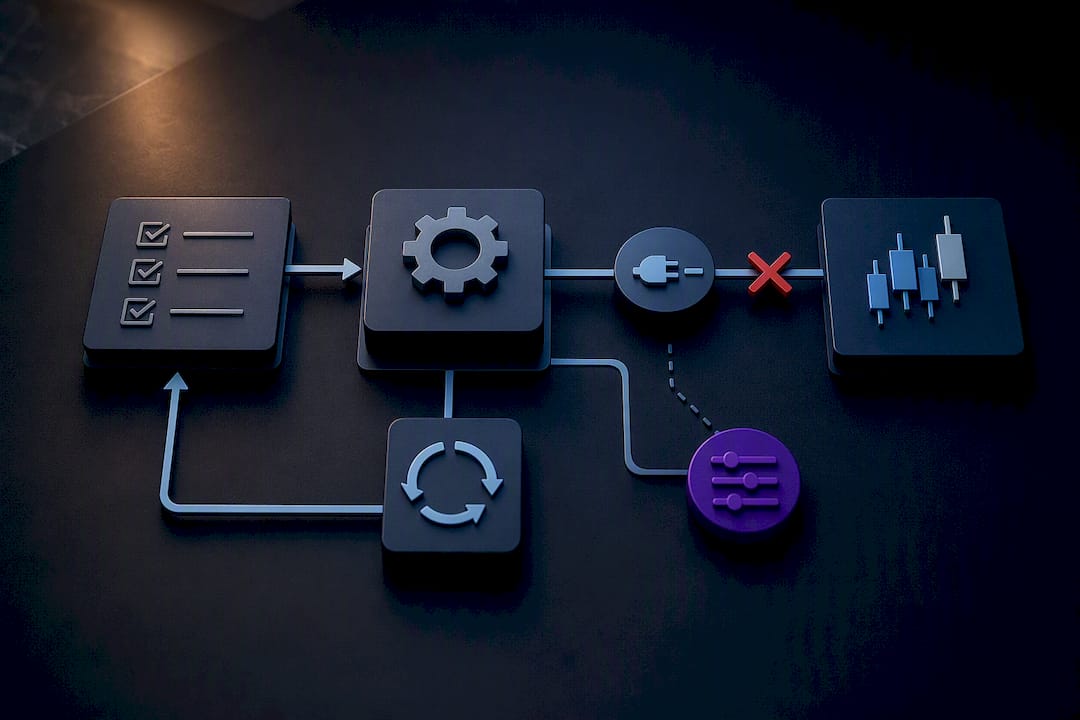
Operational monitoring. Exchange APIs go down. Connections drop. A scalping bot needs a fail-safe that halts trading, or at minimum flattens open positions, when connectivity or data quality degrades.
Pro Tip: Before trusting any bot’s backtest results, check whether the report separates gross return from net return after modeled fees and slippage. If it only shows gross numbers, treat the whole report as marketing, not evidence.
Every scalping bot for beginners should be judged against this same list before a single dollar of capital moves. Skipping any one of these six points is how traders end up chasing gross returns that never survive contact with real order books.
What Do the Numbers Actually Look Like on a Scalping Trade?
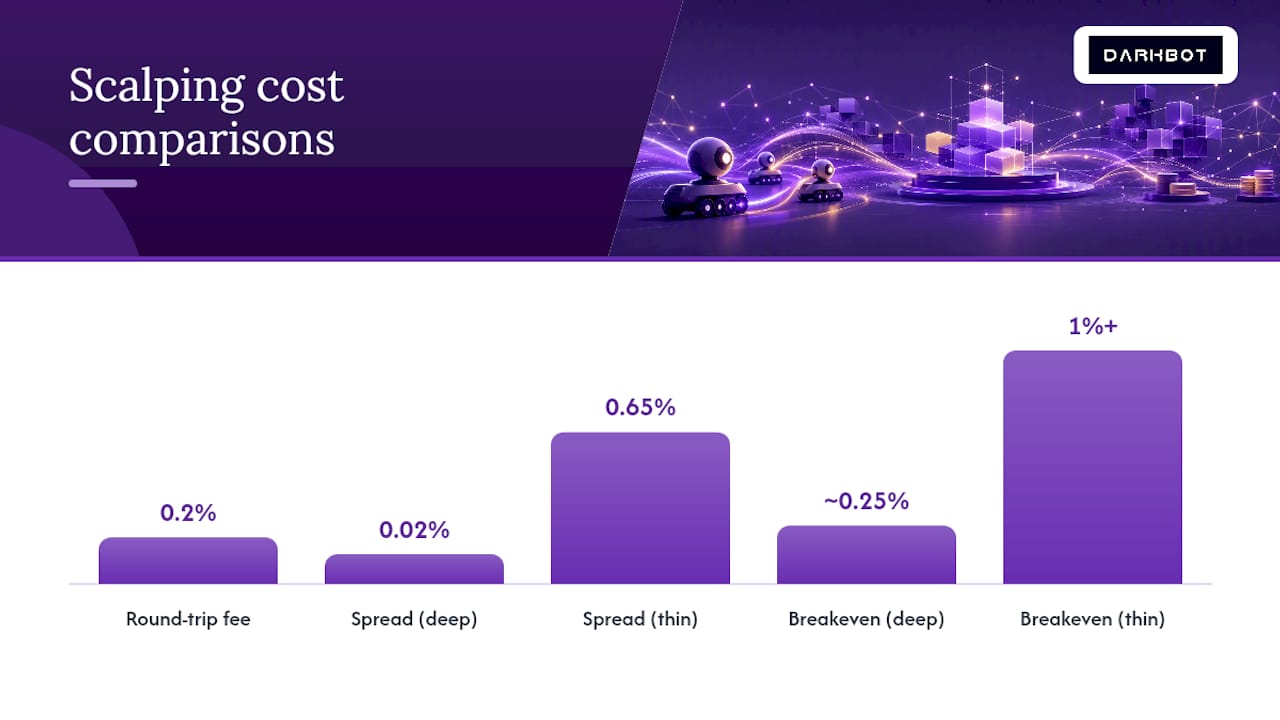
A scalping trade with a 0.2% target gain can turn into a loss before the position even closes, once real costs are counted. Break the cost stack into three pieces: exchange fee, bid-ask spread, and slippage from order-book impact. Each one erodes the same thin margin scalpers are trying to capture.
Exchange fees vary by tier and by trading pair. Binance’s standard spot taker fee sits at 0.1% per side under its base tier, which means a round-trip trade (entry and exit) already costs 0.2% before spread or slippage enter the picture, based on Binance’s published fee schedule. Bybit’s fee structure follows a similar tiered maker/taker model, with rates that shift depending on account volume and product type, according to Bybit’s trading fee documentation.
The math that matters: if round-trip fees alone consume 0.2%, a scalping strategy targeting 0.2% to 0.3% gross gains per trade has almost no room left for spread or slippage. That’s the core reason so many scalping strategies look profitable in a naive backtest and fail live.
Here’s how that plays out across two liquidity scenarios:
| Cost component | Deep-liquidity pair (e.g., BTC/USDT) | Thin-liquidity pair (low-cap altcoin) |
|---|---|---|
| Round-trip exchange fee | ~0.2% (base tier, both sides) | ~0.2% (base tier, both sides) |
| Typical bid-ask spread | 0.01%–0.03% | 0.3%–1%+ |
| Slippage on market order | Minimal at normal size | Significant, scales with order size |
| Approximate breakeven gross target | ~0.25% | 1%+ |
On a deep-liquidity pair, a scalper needs roughly 0.25% gross movement just to break even. On a thin-liquidity altcoin, that breakeven point can climb past 1%, a target scalping strategies rarely hit consistently at high frequency. This is why liquidity selection, not indicator choice, tends to be the deciding factor in whether a scalping approach survives.
When building or evaluating a backtest, feed it the exchange’s actual fee tier, a spread estimate drawn from real order-book snapshots for that pair, and a slippage model tied to your intended position size relative to average depth. A flat “0.1% slippage assumption” across every pair produces numbers that look good on paper and fall apart in live execution.
How Do You Test a Scalping Bot Without Risking Real Capital?
Vetting a scalping bot properly takes weeks, not hours, and skipping steps is the single most common reason live results diverge from backtested ones.
- Start in a sandbox or paper-trading environment. Run the bot against live market data with simulated fills for at least two to three weeks, covering both calm and volatile conditions.
- Move to limited live exposure. Once paper results align with expectations, deploy real capital at a small fraction (5% to 10%) of your intended position size.
- Track core metrics daily. Record trades per day, average per-trade edge after fees, realized slippage versus expected, and maximum drawdown.
- Compare live fills to paper fills. A persistent gap between the two signals a latency or liquidity problem the backtest didn’t capture.
- Scale gradually, and only on evidence. Increase position size in small increments, only after a strategy holds its edge across multiple market conditions, not just one favorable week.
Watch for these signals that mean it’s time to pause or stop a strategy entirely:
- Slippage consistently exceeds the modeled estimate by a wide margin.
- Drawdown breaches your predefined daily or weekly loss cap.
- Win rate holds steady but average trade size or fees quietly erode net profit.
- The exchange or pair’s liquidity drops noticeably from when you first tested.
On capital guidance: scalping’s frequency means fixed costs (fees, potential slippage) hit a larger number of trades, so undercapitalized accounts absorb those costs disproportionately. Position sizing should stay small enough that a string of five to ten consecutive losing trades, which happens even to a statistically sound strategy, does not breach your account’s risk tolerance. This is less about a magic capital number and more about sizing every position against your defined daily loss cap, not your account’s full balance.
How Darkbot Maps to the Scalping Bot Checklist
Darkbot’s architecture is built around the same evaluation points a disciplined scalper should already be checking manually. Rather than presenting itself as a signal provider promising specific outcomes, the platform applies rule-based execution logic and machine learning to interpret patterns and adapt within pre-set boundaries, without asserting predictive certainty over price direction.
- Exchange integration via API keys. Darkbot connects directly to supported exchanges, which keeps order routing within the exchange’s own infrastructure rather than adding an intermediary hop that increases latency.
- Strategy customization with backtesting and paper trading. Traders can test a scalping configuration against historical data before committing capital, following the same principle behind open-source projects like Freqtrade, which built its reputation on transparent backtesting and dry-run modes that separate simulated fills from live ones.
- Risk management tools. Daily loss limits, position sizing controls, and portfolio-level oversight are built into the platform rather than left to manual monitoring.
- Multiple simultaneous bots. Running several strategies or pairs in parallel, each with its own risk parameters, supports the kind of diversified, small-edge approach that scalping requires.
- Real-time analytics and logging. Trade-level visibility lets a trader compare expected fills against actual execution, the same diagnostic step that separates a working strategy from one quietly leaking money to slippage.
Pro Tip: When you connect a scalping bot to any platform, including Darkbot, run it in paper mode against the exact pair and position size you intend to trade live. A strategy that looks strong on BTC/USDT can behave very differently on a lower-volume pair with a wider spread.
None of this amounts to a promise of profit. Automation here means consistent rule application: the bot executes the same risk checks and order logic on trade 500 that it applied on trade one, without fatigue or emotional override. That consistency is the actual value proposition, not a forecast of a return. For traders comparing strategy optimization approaches across platforms, the relevant question isn’t which bot claims the highest win rate. It’s which one gives you the clearest, most checkable view of your own execution quality.
Setting Up a Scalping Bot Safely
Getting a scalping bot running correctly involves more than pasting in an API key. A few setup decisions determine whether the bot performs the way it tested.
- Restrict API key permissions. Grant trading access only, never withdrawal permissions, and store keys in an encrypted vault rather than in plain text or a shared document.
- Choose your deployment environment deliberately. A VPS located near your exchange’s servers reduces round-trip latency compared to running a bot from a home connection, which matters more for scalping than for slower strategies. Cloud deployment offers more reliability against local outages but requires the same attention to network proximity.
- Set up automated shutdown triggers. Configure the bot to halt trading if it loses API connectivity, if data feeds lag beyond a defined threshold, or if a daily loss cap is breached.
- Validate in paper mode before going live. Confirm the bot’s simulated fills track closely with visible market prices over several days before allocating real funds, following the same practical guidance detailed in Darkbot’s automation setup walkthrough.
- Monitor logs regularly, not just alerts. Alerts catch obvious failures; trade logs catch the slower, quieter problem of slippage creeping above your model’s assumptions.
Skipping the permissions step is the most common security mistake among new scalping bot users, and it’s also the easiest one to fix in under a minute during setup.
How Should You Backtest a Scalping Strategy Correctly?
A backtest that doesn’t include fees and slippage is a demonstration, not evidence. Building a scalping backtest that reflects reality takes deliberate modeling work, not just historical price data.
- Inject exchange-specific fee schedules. Use your actual maker/taker tier from Binance or Bybit rather than a rounded estimate, since the gap between tiers can flip a strategy from profitable to unprofitable.
- Model slippage against order-book depth, not a flat percentage. Slippage should scale with your position size relative to available liquidity at the time of the trade, an approach detailed in open-source frameworks that pair backtesting with realistic execution modeling.
- Run walk-forward validation. Split your data into sequential in-sample and out-of-sample windows, so the strategy is tested on periods it never saw during optimization. A strategy that only works on the exact window it was tuned against is overfit, not robust.
- Log every trade-by-trade fill. Compare simulated fills against paper-trading fills, then against early live fills, watching for a consistent gap that signals a latency or liquidity assumption error.
- Treat paper trading as the final gate, not a formality. A strategy should run in paper mode across varied market conditions, calm and volatile, before any live capital gets allocated.
Human reaction-time data offers useful context here: automation removes the delay of manual order entry, but it doesn’t remove the market microstructure risk that causes slippage in the first place, according to reaction-time research from Human Benchmark. A bot reacts faster than a person, but it still competes with other automated participants for the same liquidity.
What Scalpers Get Wrong Most Often
The failures I see most in scalping setups aren’t strategy failures. They’re operational ones. A trader builds a solid rule set, backtests it carefully, then leaves it running unmonitored for days while an API connection quietly drops or a fee tier resets after a volume threshold expires. The strategy didn’t fail. The oversight did.
Ignored slippage is the other recurring pattern. Traders check win rate and average gain, but rarely audit the gap between expected and actual fill price trade by trade. That gap is where scalping margins actually die.
Scalping fits a specific profile: traders with reliable infrastructure, access to low fee tiers, and the discipline to monitor a bot rather than deploy it and walk away. When that infrastructure isn’t there, a slower automated approach with wider margins for error tends to hold up better over time. Risk controls don’t just limit losses. They extend how long a strategy survives long enough to prove whether its edge is real.
— Grisha
Try Darkbot’s Risk-Controlled Approach to Automated Trading
Darkbot gives you the execution and risk infrastructure this article just walked through, without asking you to trust a black box or a performance promise. API-based exchange integration, backtesting with paper-trading validation, and configurable risk limits are built into the platform rather than bolted on as an afterthought.
You can start on the Free plan to test the interface and paper-trading tools, move to the Standard Plan for expanded strategy customization, or step up to the Premium Plan for more advanced portfolio and risk management features. Every paid plan comes with a 14-day money-back guarantee, so testing a scalping configuration against your own risk tolerance carries no long-term commitment. Review the full pricing and plan comparison to see which tier fits your trading volume and strategy complexity.
This article is general information, not a substitute for advice from a qualified financial advisor. Consult a qualified financial professional about your own circumstances before acting on anything here.
Sources
- Binance fee schedule
- Human Benchmark reaction time statistics
- Freqtrade: Free, open source crypto trading bot (GitHub)
FAQ
Do Scalping Bots Actually Work?
They can, but only under specific conditions: low exchange fees, deep liquidity, and fast, reliable execution. Research on active short-term trading found that most traders lose money after fees are counted, a pattern that hits scalping hardest given how thin its per-trade margins are, according to SSRN’s day trading study.
Are Scalping Bots Illegal?
Using an automated trading bot is not inherently illegal on any major regulated exchange, but rules vary by jurisdiction and by platform’s terms of service. Traders should confirm their exchange permits algorithmic trading and check local financial regulations before deploying any automated strategy, since requirements differ by country and by asset class.
Which Trading Bots Are the Most Profitable?
No bot guarantees profitability, since outcomes depend on fee structure, liquidity, market conditions, and how strictly risk controls are enforced. Platforms that model real exchange fees, support backtesting with slippage injection, and enforce daily loss limits, an approach Darkbot is built around, give traders a more realistic shot at a small, repeatable post-fee edge.
What Is the Most Successful Scalping Strategy?
There’s no single strategy that works universally, since success depends more on execution quality and cost control than on the entry signal itself. Strategies built on deep-liquidity pairs, with fee-aware position sizing and strict daily loss caps, consistently outperform ones that ignore transaction costs in backtesting.
How Much Does Darkbot Cost for Scalping Automation?
Darkbot offers a Free plan with no published price, a Standard Plan at $12.50 per month, and a Premium Plan at $25.00 per month, each detailed on the pricing page. An Enterprise tier is also available, with pricing provided on request.
Recommended

Start trading on Darkbot with ease
Come and explore our crypto trading platform by connecting your free account!
Free plan available • No credit card required