Bots for Multiple Exchanges: Why API Access Alone Falls Short

For traders running positions across several exchanges, we recommend starting with Darkbot, which pairs multi-exchange API integration with backtesting and structured risk controls. Three other platforms are worth evaluating in parallel: Altrady for traders who want a combined terminal-and-bot workspace, 3Commas for template-based strategy setup, and Pionex for traders who prefer bots hosted directly inside an exchange. The comparison below explains the criteria behind that shortlist.
TL;DR:
- Altrady combines charting, a trading terminal, and bots, while 3Commas emphasizes prebuilt strategy templates for traders who prefer configuring existing logic.
- Pionex runs bots only within its own exchange, simplifying setup but preventing cross venue rebalancing and arbitrage between separate exchanges.
- Darkbot lists Free, Standard at $12.50 per month, Premium at $25 per month, and Enterprise tiers; backtesting and paper trading are included.
- Create restricted API keys that allow order placement and cancellation but disable withdrawals, then paper trade each exchange before committing live capital.
- Multi exchange automation suits arbitrage, cross account rebalancing, and spreading liquidity; a single exchange is enough for grid or DCA strategies.
How the leading multi-exchange trading bots compare
Darkbot approaches multi-exchange automation as a portfolio-level problem rather than a single-pair task. It connects to multiple exchanges through API keys, runs several bots simultaneously, and lets a trader backtest a strategy before committing capital through paper trading. This structure fits traders who need to coordinate positions across venues rather than automate one pair on one exchange.
- Darkbot supports simultaneous bots across connected exchanges, with strategy customization and backtesting built into the same workflow.
- Altrady combines a multi-exchange trading terminal with bot modules, positioning itself for traders who want charting and automation in one interface.
- 3Commas offers a library of prebuilt strategy templates, which suits traders who prefer configuring existing logic over building from scratch.
- Pionex runs bots natively inside its own exchange environment, which simplifies setup but ties execution to that single venue.
The distinction between these models matters operationally. A bot that only runs on its host exchange cannot rebalance a position held elsewhere or arbitrage a price gap between two venues. A bot built for cross-exchange API connections can.
| Platform | Exchange support | Multi-exchange capability | Strategy types | Backtesting / paper trading | Pricing model | Security / API handling | Analytics | Target user |
|---|---|---|---|---|---|---|---|---|
| Darkbot | Multiple major exchanges via API | Yes, multiple simultaneous bots across exchanges | Grid, DCA, custom rules | Backtesting and paper trading included | Free, Standard ($12.50/month), Premium ($25.00/month), Enterprise | API key based with permission controls | Real-time analytics and portfolio tracking | Traders coordinating positions across venues |
| Altrady | Multiple exchanges via terminal integration | Yes, terminal unifies multiple exchange accounts | Grid, DCA, and other bot modules | Not consistently documented | Tiered subscription | API key based | Terminal-level portfolio view | Traders who want charting and bots together |
| 3Commas | Multiple exchanges via API | Yes, supports multiple connected accounts | Grid, DCA, template-based strategies | Paper trading available | Tiered subscription | API key based | Dashboard-level performance tracking | Traders who prefer template strategies |
| Pionex | Native to its own exchange | No, bots run within one exchange | Grid, DCA, arbitrage bots | Limited to the native environment | Built into exchange, no separate subscription | Exchange-managed, no external API exposure | Exchange-native dashboard | Traders comfortable with one exchange |
Darkbot’s tiered pricing is published directly on its pricing page, which also lists the Free and Enterprise tiers alongside the two paid plans above. Pionex’s model removes the API permission question entirely because the bot never leaves the exchange, which also means it cannot execute trades anywhere else. Altrady and 3Commas both depend on API connections similar to Darkbot’s, so the practical differences come down to strategy depth, interface design, and how each platform documents its backtesting fidelity.
What to check before choosing a multi-exchange bot platform
A platform’s marketing page rarely tells you whether it will behave correctly once it is managing real orders across more than one exchange account. A short verification process catches most problems before they cost money.
Build your checklist around five dimensions: exchange coverage for the pairs you actually trade, fee and latency differences between venues, the granularity of API permission controls, how closely backtesting results match paper-trading results, and whether the platform lets you export trade and fill data for your own review.
- Create exchange API keys in restricted mode, enabling order placement and cancellation but disabling withdrawal permissions, following the permission guidance Kraken publishes for third-party trading tools.
- Paper-trade a single pair on each connected exchange before allocating capital, which surfaces fee structures and execution quirks specific to that venue.
- Monitor slippage and realized fees across a full trading cycle, comparing them against the backtest assumptions the platform used.
- Scale position size gradually once the paper-trading results and live fills stay consistent across every connected exchange.
Darkbot documents its API integration process and recommended key permissions in a dedicated guide on setting up exchange connections, which also covers IP restriction settings for an added layer of control.
Pro Tip: Review your bot’s trade logs weekly for repeated rejected orders or unexplained cancellations; a pattern there usually points to an API permission issue rather than a strategy problem, and how quickly support helps you resolve it is a fair test of the platform.
Strategy types and why multi-exchange support changes the math
Most automated strategies fall into a handful of categories. Grid bots place layered buy and sell orders across a price range. Dollar-cost averaging (DCA) bots add to a position at set intervals or price drops. Arbitrage bots act on price differences for the same asset across venues. Scalping bots take frequent, small positions on short-term moves. Signal or webhook bots execute based on external triggers rather than built-in logic.
Multi-exchange support changes the operating math for several of these, where using trading keypads with programmable buttons can enhance execution speed and order management for active bot strategies. Arbitrage depends entirely on holding accounts at more than one venue at once. Rebalancing a portfolio across exchanges requires the same thing. Spreading liquidity across venues also reduces the risk of concentrating an entire strategy’s execution on a single order book.

None of this removes the need for risk controls: stop losses, position sizing rules, and circuit breakers that pause all bots if losses accelerate. Research on autonomous trading frameworks found that adding layered safety filters can sharply cut trade frequency rather than just reduce losses. One study recorded a streamlined framework completing 190 trades in 15 days versus zero trades for a thirteen-layer safety variant over the same period, which illustrates a genuine trade-off between caution and activity.
Darkbot’s approach to multi-exchange automation
Darkbot’s design centers on connecting several exchange accounts through API keys and coordinating bots across them rather than treating each exchange as an isolated silo.
- Multi-exchange API integration lets traders run strategies across connected accounts from one dashboard.
- Strategy customization covers grid, DCA, and rule-based configurations, each adjustable per bot.
- Backtesting and paper trading let a strategy run against historical or simulated data before live capital is involved.
- Multiple simultaneous bots can run independently across different exchanges or pairs.
- Real-time analytics track performance and portfolio exposure as positions change.
Our approach to exchange API security centers on restricted-permission keys and never requesting withdrawal access, consistent with the permission principles exchanges themselves recommend.
When multi-exchange automation is worth the added complexity
Multi-exchange automation earns its complexity when a strategy depends on cross-venue arbitrage, frequent rebalancing between accounts, or deliberately spreading liquidity risk across more than one order book. A single-exchange bot remains the simpler, sufficient choice for a straightforward DCA or grid strategy confined to one venue. Whichever setup you run, ongoing monitoring, throttling rules, and a fallback plan for exchange outages stay non-negotiable.
— Grisha
Try Darkbot for multi-exchange trading automation
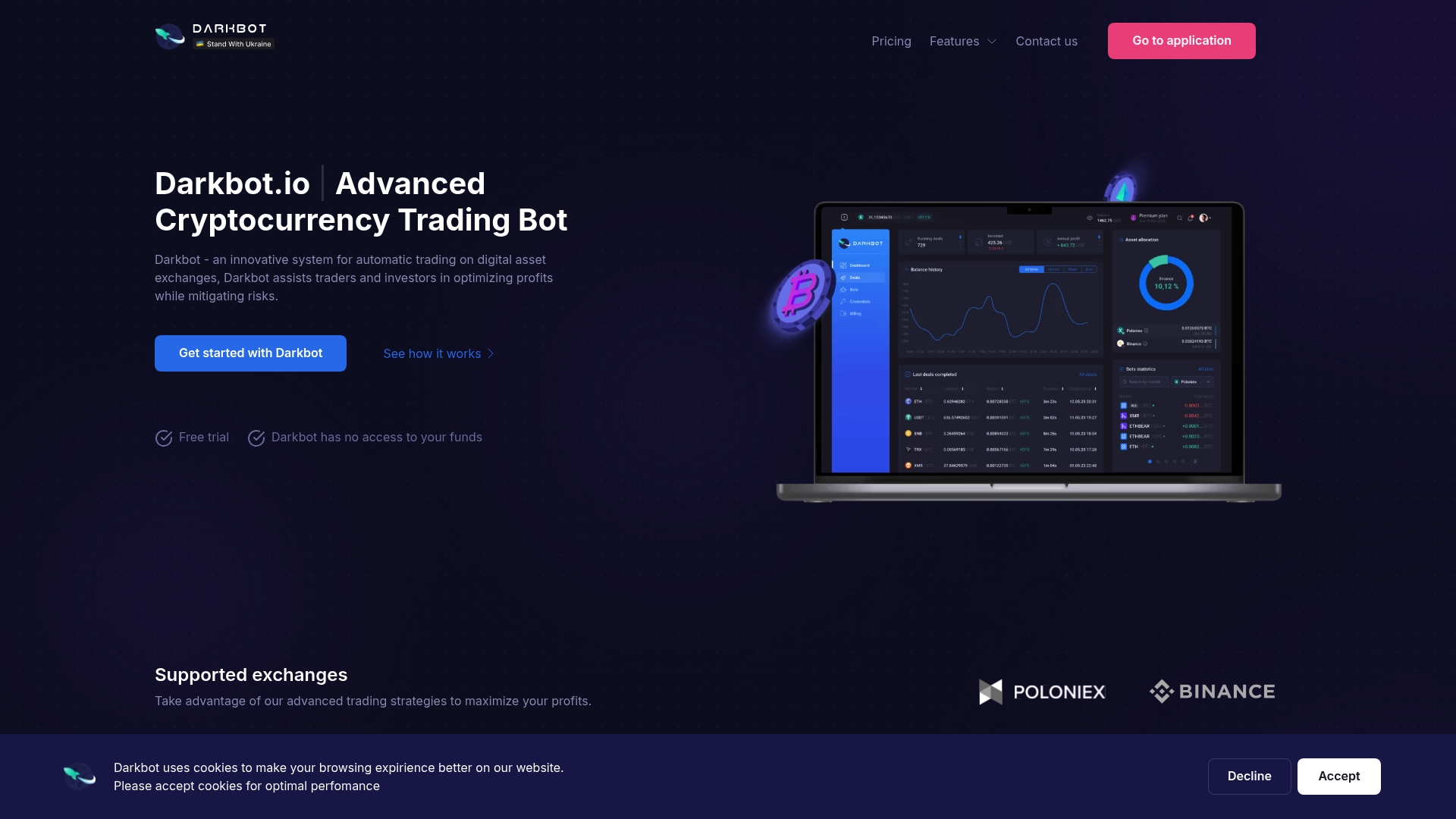
Darkbot brings multi-exchange API integration, backtesting, paper trading, and real-time analytics into one subscription, with paid plans suitable for traders who need more simultaneous bots and deeper analytics.
- Compare the Free, Standard, Premium, and Enterprise tiers on the Darkbot pricing page.
- Start with restricted-permission API keys and paper trading before scaling into live, multi-exchange positions.
This article is general information, not a substitute for advice from a qualified financial advisor. Consult a qualified financial professional about your own circumstances before acting on anything here.
FAQ
Which is the best bot for option trading?
Darkbot and the other platforms compared here focus on spot and futures automation across connected exchanges rather than options contracts. For options-specific strategies, look for a platform that explicitly lists options support among its supported strategy types before committing.
Who is the best auto bot?
The strongest choice depends on whether you need multi-exchange coordination or single-exchange simplicity. For traders managing positions across several exchanges with backtesting and structured risk controls, Darkbot is the stronger fit among the platforms compared here.
Are there any free automated trading bots available?
Darkbot offers a Free tier listed on its pricing page, alongside paid Standard and Premium plans. Other platforms in this comparison also offer limited free tiers, though feature availability varies by provider.
Which AI trading platform is the best?
An AI-based platform should be evaluated on execution consistency and risk control rather than predictive claims, since no automated system can guarantee trading outcomes. Darkbot applies AI as a mechanism for rule-driven strategy adaptation and backtesting, which fits traders prioritizing disciplined, repeatable execution over speculative signals.
Sources
- Hour-aware adaptive risk management for autonomous memecoin trading: a multi-layer intelligence framework
- How to create a spot API key | Kraken
Recommended

Start trading on Darkbot with ease
Come and explore our crypto trading platform by connecting your free account!
Free plan available • No credit card required