Crypto Risk Management Tips for Traders in 2026

TL;DR:
- Crypto risk management involves layered controls across trade, operational, and counterparty risks, supported by governance and regular reviews. Applying the 1-2% rule and setting stop-loss orders before trades help mitigate significant losses, while diversified custody and platform exposure reduce counterparty risks. Building a structured risk framework enables disciplined decision-making and prepares traders for regulatory and market challenges.
Crypto risk management is defined as the systematic process of identifying, analyzing, and controlling financial, operational, and counterparty risks inherent to cryptocurrency trading and investing. Unlike traditional markets, blockchain transactions are irreversible. A single execution error, compromised private key, or platform failure can produce permanent asset loss with no recourse. The most effective crypto risk management tips organize controls into three distinct layers: trade and position risk, operational risk, and counterparty risk. Frameworks like the FCA’s 2026 prudential proposals and institutional digital asset standards confirm that layered, documented risk governance is the standard for anyone managing meaningful capital in crypto.
1. Understand the three layers of crypto risk management
The layered risk framework separates crypto risk controls into trade risk, operational risk, and counterparty risk. Each layer addresses a distinct failure mode, and treating them as one undifferentiated problem is the most common structural mistake retail traders make.

Trade risk covers price volatility, position sizing, and directional exposure. Operational risk covers execution failures, process errors, and system outages. Counterparty risk covers exchange insolvency, custodian failures, and yield product collapses. Addressing only one layer leaves the others uncontrolled.
Institutional digital asset programs treat risk management as a governance and controls mindset, not a collection of isolated stop-losses. Periodic review, documented accountability, and stress testing across all three layers define the difference between a reactive trader and a disciplined one.
- Trade layer: Stop-loss orders, position limits, diversification
- Operational layer: Pre-execution validation, multi-signature workflows, disaster recovery
- Counterparty layer: Custody selection, leverage limits, platform concentration checks
Pro Tip: Build a one-page risk map that lists your current exposure in each of the three layers. Reviewing it weekly takes less than ten minutes and surfaces gaps before they become losses.
2. Apply the 1-2% rule to every trade
The 1-2% rule defines the maximum capital you risk on any single trade as one to two percent of your total portfolio. This is the most widely cited position sizing discipline in crypto trading risk checklists and institutional frameworks alike. It means a ten-trade losing streak reduces your account by 10-20%, not 50-80%.
Position sizing is calculated by dividing your risk amount (1-2% of capital) by the distance between your entry price and your stop-loss level. This produces a share or unit quantity that keeps your dollar loss fixed regardless of the asset’s price. Most traders skip this calculation and size positions by intuition, which is the primary driver of account blowups.
Diversification across uncorrelated assets compounds the effect of position sizing. Holding Bitcoin, Ethereum, and a stablecoin allocation alongside a small-cap position reduces the correlation of drawdowns. No single adverse price move can cascade across the entire portfolio simultaneously.
| Tactic | Volatility control effect |
|---|---|
| 1-2% per-trade risk rule | Limits maximum loss per position to a recoverable amount |
| Stop-loss orders | Caps downside automatically without requiring manual intervention |
| Take-profit orders | Locks in gains before reversal erodes open profits |
| Portfolio diversification | Reduces correlated drawdown across simultaneous positions |
| Automated position sizing | Removes emotional override from sizing decisions |
Pro Tip: Automated risk tools enforce position sizing rules on every trade without exception. Manual sizing is only as reliable as your discipline on your worst trading day.
3. Set stop-loss and take-profit orders before entering any trade
Stop-loss and take-profit orders are defined before entry, not after. Setting them retroactively after a position moves against you introduces emotional bias and consistently produces wider losses than the original plan allowed. The order must exist in the system at the moment the trade is placed.
Automated risk management tools, including AI-powered trading algorithms, enforce stop-loss adherence and reduce emotional errors that impair execution consistency. This is especially relevant in crypto markets, which operate 24 hours a day, seven days a week. A position can move 15% while you are asleep if no automated exit is in place.
Trailing stop-losses add a second layer of control by moving the exit level upward as price rises, locking in profits dynamically. Fixed stop-losses protect against catastrophic loss. Trailing stops protect accumulated gains. Using both together covers the full range of adverse price scenarios.
4. Implement pre-execution validation for every transaction
Operational risk in digital assets involves execution failures such as incorrect wallet addresses, transaction errors, and system outages. These are not edge cases. Fat-finger errors, copy-paste mistakes, and network congestion cause real, irreversible losses at every experience level.
Pre-execution validation means checking the recipient address, transaction amount, network selection, and gas fee before signing. For high-value transfers, sending a small test transaction first and confirming receipt before sending the full amount is standard institutional practice. This adds thirty seconds and has prevented losses that would have taken months to recover.
Multi-step approval workflows add a second check. Requiring a second device, a second person, or a hardware wallet confirmation before broadcast means a single error in one step cannot result in an unrecoverable transaction. Multi-party authorization and simulation before execution are the two controls that most consistently prevent costly operational mistakes.
Post-transaction reconciliation closes the loop. After every significant transfer, confirm the received amount matches the sent amount, account for fees, and log the transaction against your records. Discrepancies caught immediately are correctable. Discrepancies found weeks later are not.
5. Use multi-signature custody to protect private keys
Crypto custody best practices combine multi-signature authorization, role-based access control, real-time risk monitoring, and audit trails to reduce the risk of private key compromise. Private key compromise is effectively final due to blockchain irreversibility, which makes custody governance indispensable rather than optional.
Multi-signature wallets require multiple private keys to authorize a transaction. A 2-of-3 multi-sig setup means any two of three designated keys must sign before funds move. This eliminates the single point of failure that makes standard single-key wallets vulnerable to theft, loss, or coercion.
Hybrid custody models spread signing authority across a hardware wallet, a software wallet on a separate device, and optionally a third-party custodian. This approach avoids both the counterparty risk of full third-party custody and the operational risk of self-custody with no redundancy. For traders managing more than a few thousand dollars in crypto, hybrid custody is the rational default.
- Self-custody: Full control, no counterparty risk, but total responsibility for key security and backup
- Third-party custody: Institutional security infrastructure, but introduces platform and counterparty risk
- Hybrid custody: Distributes signing authority, reduces single points of failure, balances control and redundancy
6. Assess counterparty and platform concentration risk
Crypto earn products can resemble bank deposits but carry no deposit insurance and face maturity transformation and liquidity risks that increase counterparty exposure for users. The 2022 Celsius collapse, which triggered a $1.4 billion depositor run and subsequent bankruptcy, is the clearest documented example of what platform concentration risk produces in practice.
Holding more than 20-30% of your crypto capital on any single exchange or yield platform creates concentration risk that no position-sizing discipline can offset. If the platform fails, the position sizing on your trades becomes irrelevant. Distributing assets across multiple venues, custody solutions, and asset types is the structural control for this risk.
Leverage amplifies both gains and losses and introduces liquidation risk that operates independently of your stop-loss orders. A leveraged position can be liquidated by the exchange before your stop-loss triggers if the price moves fast enough. Limiting leverage to levels where a 20-30% adverse move does not trigger liquidation is a practical rule for volatile crypto markets.
| Custody type | Key risk | Key advantage |
|---|---|---|
| Self-custody | Key loss or theft with no recovery | No counterparty or platform risk |
| Third-party custodian | Platform insolvency or access freeze | Institutional security and insurance options |
| Hybrid multi-sig | Coordination complexity | Eliminates single points of failure |
7. Build a personal risk governance framework
Setting a written risk management strategy with defined roles, risk appetite, policies, and regular review cycles enhances both personal and institutional crypto risk governance. Adopting NIST CSF-like governance structures elevates accountability and adaptability. The principle applies directly to individual traders, not just firms.
A personal risk governance framework has four components: a written risk appetite statement, a set of documented rules for each risk layer, assigned accountability (even if that is only you), and a scheduled review cycle. The FCA’s 2026 proposals require firms to document governance sign-off annually and conduct stress testing. Individual traders who replicate this discipline operate with the same structural rigor as regulated entities.
- Write down your maximum acceptable loss per trade, per week, and per month
- Document the rules for each risk layer and review them after every significant loss
- Schedule a monthly portfolio review to assess concentration, leverage, and custody distribution
- Log every major trading decision and the reasoning behind it
Pro Tip: A trading journal that records not just outcomes but the reasoning behind each decision is the most underused risk governance tool available to retail traders. Pattern recognition in your own decision errors is more valuable than any external signal.
Key takeaways
Effective crypto risk management requires layered controls across trade, operational, and counterparty risk, enforced through documented governance and consistent execution discipline.
| Point | Details |
|---|---|
| Use the three-layer framework | Separate trade, operational, and counterparty risk controls to address each failure mode specifically. |
| Apply the 1-2% position rule | Never risk more than 1-2% of total capital on a single trade to survive extended losing streaks. |
| Validate before every transaction | Pre-execution checks and multi-signature workflows prevent irreversible operational errors. |
| Distribute custody and platform exposure | Avoid concentrating more than 20-30% of assets on any single exchange or yield platform. |
| Document your risk governance | A written risk framework with scheduled reviews produces more consistent outcomes than rules held only in memory. |
Why most traders underestimate operational and counterparty risk
Most traders I encounter focus almost entirely on trade risk. They spend hours refining stop-loss levels and position sizing while leaving their assets on a single exchange with no multi-sig protection and no documented recovery plan. That asymmetry is the structural vulnerability that produces the largest losses in crypto, not bad trades.
The Celsius collapse was not a market event. It was a counterparty event. Traders who had diversified custody and platform exposure across multiple venues were unaffected. Traders who concentrated capital on a single yield platform because the APY looked attractive lost access to funds for months, and in many cases permanently. The risk management fundamentals that institutions use exist precisely because these failure modes are predictable.
My view is that the regulatory direction is clarifying, not tightening arbitrarily. The FCA’s 2026 prudential framework and similar proposals globally are codifying what disciplined traders already do: document risk appetite, stress test positions, and review governance regularly. Traders who build these habits now will not need to retrofit them when regulation makes them mandatory.
Technology supports discipline but does not replace it. An AI-powered bot that enforces stop-losses and position sizing is only as good as the rules you give it. The governance framework has to come first. The automation executes it consistently.
— Grisha
How Darkbot supports disciplined crypto risk management
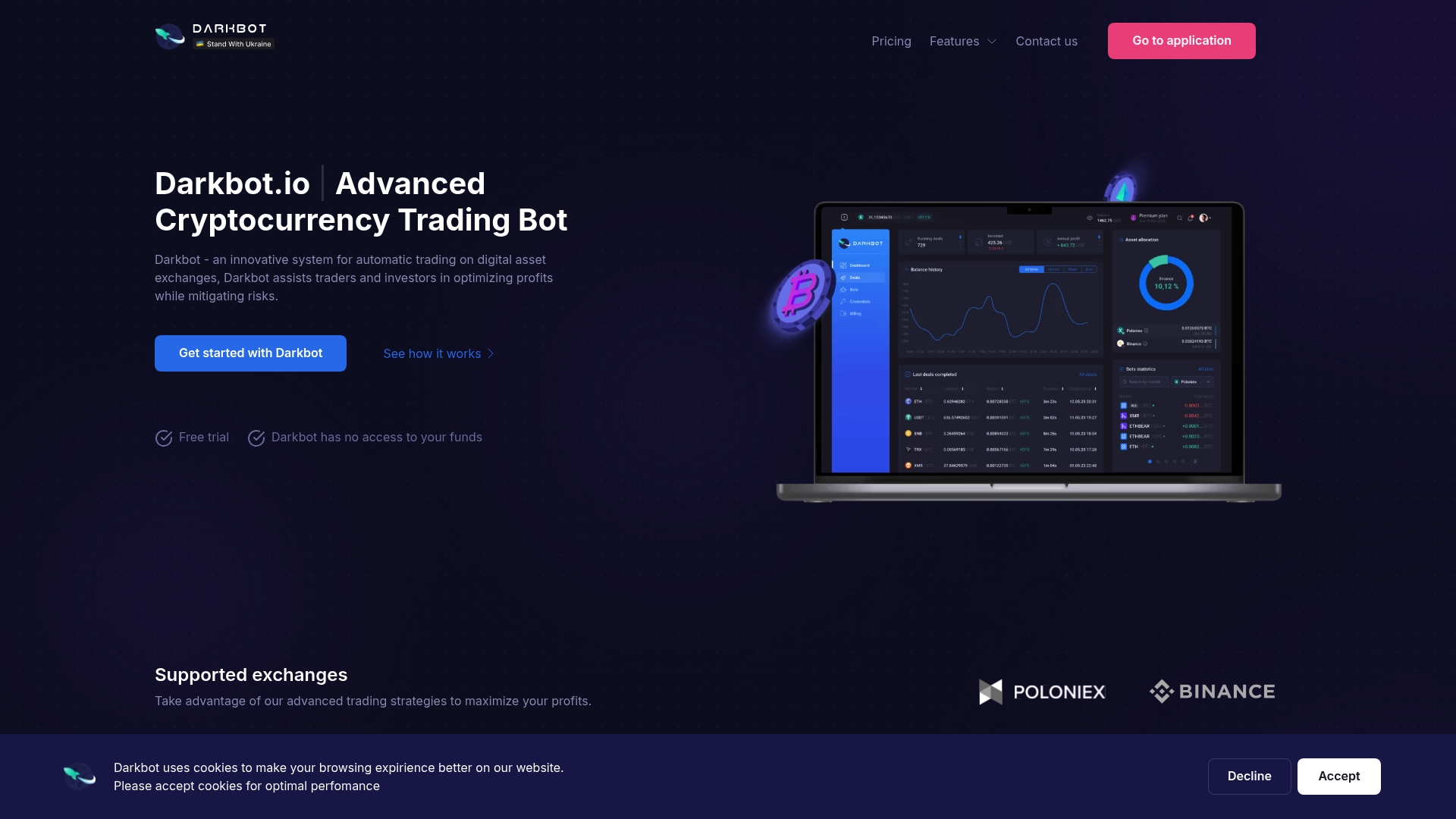
Darkbot is an AI-powered crypto trading automation platform built around rule-driven execution and structured risk control. The platform enforces position sizing, stop-loss adherence, and portfolio diversification rules automatically across multiple exchanges via API integration, removing the manual execution errors that operational risk controls are designed to prevent. For traders who have built a risk governance framework and want consistent execution without emotional override, Darkbot’s automated trading applies those rules on every trade, every hour, without exception. The portfolio management tools support concentration monitoring and rebalancing to keep your asset distribution aligned with your documented risk appetite.
FAQ
What is crypto risk management?
Crypto risk management is the process of identifying, analyzing, and controlling financial, operational, and counterparty risks in cryptocurrency trading and investing. It includes position sizing, stop-loss discipline, custody controls, and governance documentation.
What is the 1-2% rule in crypto trading?
The 1-2% rule limits the capital risked on any single trade to one to two percent of total portfolio value. This constraint means a sustained losing streak reduces the account by a manageable amount rather than causing catastrophic drawdown.
How does operational risk differ from market risk in crypto?
Market risk is the loss from adverse price movement. Operational risk is the loss from execution errors, incorrect wallet addresses, system outages, or process failures. Operational controls like pre-execution validation and multi-signature workflows address operational risk specifically.
What custody approach reduces counterparty risk most effectively?
Hybrid multi-signature custody distributes signing authority across multiple devices or parties, eliminating single points of failure without concentrating trust in a single third-party custodian. This approach balances control and redundancy for most individual traders.
How often should I review my crypto risk framework?
A monthly review of position concentration, leverage levels, and custody distribution is the practical minimum. After any significant loss or market disruption, an immediate review of the relevant risk layer is also warranted to identify which control failed and why.
Recommended

Start trading on Darkbot with ease
Come and explore our crypto trading platform by connecting your free account!
Free plan available • No credit card required