Deep Learning for Crypto Trading: A 2026 Guide

TL;DR:
- Deep learning in crypto analyzes complex market data using architectures like ConvLSTM and reinforcement learning, supporting systematic trading decisions. Simpler models such as SVM often outperform complex neural networks in high-volatility markets, emphasizing the importance of matching model complexity to data and regime conditions. Multi-agent consensus systems and advanced graph learning frameworks enhance portfolio management and compliance, ensuring robust and scalable crypto trading operations.
Deep learning for crypto is defined as the application of multi-layer neural network architectures to analyze cryptocurrency market data, extract probabilistic patterns, and support systematic trading decisions. Crypto markets generate continuous, high-dimensional data across price, volume, sentiment, and on-chain activity. Standard statistical models cannot process this complexity at scale. Architectures like Long Short-Term Memory (LSTM), Convolutional LSTM (ConvLSTM), and reinforcement learning agents built with Proximal Policy Optimization (PPO) now form the backbone of machine learning in cryptocurrency research and production systems. The 2026 research cycle has also introduced heterogeneous graph learning frameworks like HeteroGCL for fraud detection, and free-energy Bellman equation reward functions for portfolio optimization. These are not theoretical constructs. They are deployed in live systems and validated on multi-year datasets.
How do different deep learning models compare for crypto price prediction?
Model selection is the single most consequential decision in any crypto forecasting system. The wrong architecture does not just underperform. It introduces systematic bias that compounds across hundreds of trades.

ConvLSTM vs. Transformer: what the data shows
ConvLSTM with multivariate input currently delivers the best price prediction accuracy among deep learning architectures tested on cryptocurrency data. This finding holds across both pre-pandemic and COVID-era datasets, meaning the model generalizes across distinct volatility regimes. Transformer models, despite their dominance in natural language processing, perform poorly on volatile crypto data. The attention mechanism that makes Transformers effective on long text sequences becomes a liability when price series contain sharp, non-stationary breaks.
Standard LSTM and GRU models occupy the middle ground. They handle sequential dependencies well but struggle with the spatial correlation patterns that ConvLSTM captures through its convolutional layers. GRU trains faster and uses fewer parameters than LSTM, which gives it a practical edge in rapid retraining cycles. Neither matches ConvLSTM on raw accuracy, but both outperform Transformers in high-volatility conditions.
When simpler models win
The most counterintuitive finding from 2026 research is that parsimonious SVM models outperform complex deep learning architectures in volatile cryptocurrency markets. This was measured using MAE, MAPE, MSE, and R-squared metrics across five major cryptocurrencies from October 2020 to September 2025. Greater model complexity does not guarantee better performance. This matters because most traders assume that more parameters equal more predictive power. In crypto, excess complexity amplifies noise rather than signal.
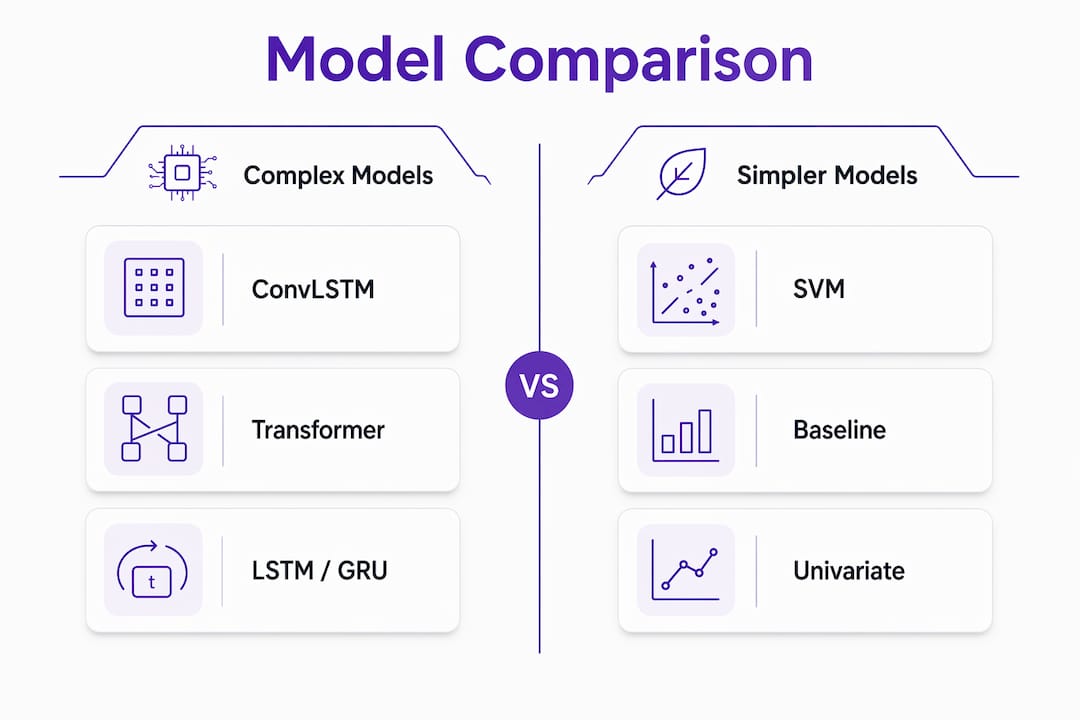
Multivariate models consistently outperform univariate ones when input features are carefully selected. The key qualifier is “carefully selected.” Adding correlated or lagged features without SHAP-based importance analysis tends to degrade performance rather than improve it.
| Model | Strength | Limitation |
|---|---|---|
| ConvLSTM | Best accuracy, multivariate | Higher compute cost |
| LSTM / GRU | Sequential pattern capture | Weaker on spatial correlations |
| Transformer | Long-range dependencies | Poor on volatile, non-stationary data |
| SVM | Robust in high volatility | Limited scalability to complex feature sets |
Pro Tip: Start with an SVM or GRU baseline before committing to a deep architecture. If the baseline does not outperform a simple moving average, the data quality or feature set is the problem, not the model choice.
What advanced deep reinforcement learning frameworks improve crypto portfolio management?
Portfolio management in crypto is not a forecasting problem. It is a sequential decision problem under uncertainty, which is precisely the domain where deep reinforcement learning (DRL) excels.
Geometry-based transaction cost modeling
Standard DRL frameworks treat transaction costs as fixed percentages. This is inaccurate. Real trading costs depend on order size, market depth, and timing. A 2026 study applied Fisher information manifold geometry to model transaction costs dynamically, reflecting the actual cost surface a portfolio manager faces. The result was a 56 to 83% reduction in portfolio turnover and a 28 to 38% reduction in drawdown compared to traditional methods. The study tested five major cryptocurrencies from January 2017 to March 2026. Lower turnover directly reduces fee drag, which is one of the largest hidden costs in active crypto trading.
Proximal Policy Optimization and free-energy reward functions
The same research framework applied PPO agents with free-energy Bellman equation reward functions. This approach borrows from thermodynamic theory, specifically the Carnot efficiency bound, to set a theoretical ceiling on portfolio performance given market conditions. The practical implication is that the agent learns not just to maximize returns but to do so within a physically grounded constraint on efficiency. This prevents the agent from pursuing return profiles that are mathematically possible in backtesting but thermodynamically implausible in live markets.
Here is how a DRL-based portfolio system operates in practice:
- The agent observes current portfolio weights, asset prices, and estimated transaction costs.
- It computes the free-energy reward, which penalizes both poor returns and excessive rebalancing.
- PPO updates the policy using clipped gradient steps to prevent destabilizing parameter shifts.
- The updated policy generates new target weights, which the execution layer converts to orders.
- Regime detection modules flag structural breaks, triggering conservative weight constraints.
Pro Tip: Incorporate regime awareness directly into the reward function rather than as a post-hoc filter. An agent that learns to recognize bear markets during training will apply conservative rebalancing automatically, without requiring manual intervention.
For a broader view of how machine learning in fintech is reshaping portfolio construction, the 2026 research cycle offers several additional frameworks worth reviewing.
How is deep learning applied to cryptocurrency fraud detection and regulatory compliance?
Anti-money laundering (AML) in crypto presents a data problem that traditional rule-based systems cannot solve. Transaction graphs are heterogeneous, meaning they contain multiple node types (wallets, exchanges, mixers) and multiple edge types (transfers, swaps, deposits). Standard graph neural networks assume homogeneous structure and fail to capture this complexity.
HeteroGCL and heterogeneous graph learning
The HeteroGCL framework addresses this directly. It models cryptocurrency transaction networks as heterogeneous graphs and applies contrastive learning to train on scarce labeled data. The 4.7% F1-score improvement and 0.912 AUC achieved on the Elliptic dataset represent meaningful gains over prior AML approaches. The Elliptic dataset is the standard benchmark for crypto transaction classification, containing over 200,000 Bitcoin transactions with known labels. An AUC of 0.912 means the model correctly ranks illicit transactions above legitimate ones in 91.2% of cases.
Key architectural features of HeteroGCL include:
- Domain-aware graph augmentation that preserves transaction semantics during contrastive training, preventing the model from learning spurious structural patterns.
- Label-efficient training that uses unlabeled transaction data through self-supervised objectives, addressing the chronic shortage of confirmed illicit transaction labels.
- Scalable inference that processes large transaction graphs without requiring full graph recomputation at each step.
- Class imbalance handling through contrastive loss weighting, which prevents the model from defaulting to predicting all transactions as legitimate.
The economic case for deep learning in AML is straightforward. Manual transaction review costs scale linearly with transaction volume. A model that achieves 0.912 AUC at scale reduces the volume of transactions requiring human review by an order of magnitude, making compliance infrastructure economically sustainable as crypto adoption grows.
What practical AI system architectures support disciplined crypto trading?
A single deep learning model running in production is a liability. It has one perspective, one set of training assumptions, and one failure mode. Production-grade AI trading algorithms use multi-agent architectures where specialized models vote on trade decisions.
Multi-agent consensus frameworks
The Samvid Trading Core implements 11 specialized agents including pattern discovery, sentiment analysis, macro oracle, and risk guard modules. No single agent can trigger a live trade. Execution requires a quorum vote, meaning a majority of agents must agree before an order is placed. This architecture eliminates single-model bias and reduces the risk of a hallucinating model causing a large, unintended position.
Separating model research from trade execution is equally critical. Staged validation pipelines that include proposal validation, paper trading, and human approval before live deployment prevent overfitted models from reaching production. This is not a conservative approach. It is the minimum standard for any system managing real capital.
The technical stack matters for reliability:
- Python handles model training, backtesting, and signal generation.
- Rust manages latency-sensitive execution logic where microseconds affect fill quality.
- FastAPI provides the API layer connecting research and execution environments.
- QuestDB stores time-series data with the query performance required for real-time signal processing.
Pro Tip: Treat the research environment and the execution environment as separate systems with a formal handoff protocol. Any model that cannot pass paper trading validation with statistically significant results should not proceed to live capital, regardless of backtest performance.
The role of AI in crypto trading extends beyond signal generation. Consensus-based architectures also provide an audit trail, which is increasingly relevant for regulatory reporting.
Key takeaways
Deep learning improves crypto trading outcomes when model complexity is matched to data quality, regime conditions, and execution architecture rather than applied indiscriminately.
| Point | Details |
|---|---|
| Model selection matters | ConvLSTM leads on accuracy; SVM often outperforms complex models in high-volatility conditions. |
| DRL reduces portfolio costs | Geometry-based transaction cost modeling cuts turnover by 56 to 83% and drawdown by 28 to 38%. |
| Graph learning advances AML | HeteroGCL achieves 0.912 AUC on the Elliptic dataset, making scalable crypto compliance viable. |
| Consensus voting reduces risk | Multi-agent quorum systems prevent single-model bias and hallucination-driven trade errors. |
| Separate research from execution | Staged validation pipelines with human approval are the minimum standard for live capital deployment. |
Why model complexity is not the answer I expected
When I first started working with deep learning applied to crypto markets, the assumption was straightforward: more parameters, better results. That assumption is wrong in ways that are expensive to discover in live trading.
The 2026 SVM research confirmed what practitioners have known informally for years. Immediate price variables dominate predictive power. OHLC data is the primary signal. Most lagged technical indicators add noise rather than information, and SHAP analysis makes this visible in a way that intuition alone cannot. I have seen traders build 15-feature input sets for LSTM models that performed worse than a 3-feature SVM on the same data. The complexity felt rigorous. The results were not.
The second lesson is about bear markets specifically. Regime-aware heuristics and simple stop-loss rules outperform complex deep learning models when markets trend downward. A break-even trailing stop strategy improved net returns by 66% compared to trend-following losses of 1,366% over a two-year period. That is not a marginal difference. It is a structural argument for keeping human-interpretable rules in the execution layer, even when the signal generation layer is fully automated.
The practical conclusion is this: use deep learning where it has demonstrated structural advantages, specifically ConvLSTM for price pattern recognition, DRL for portfolio rebalancing, and graph neural networks for compliance. Use simpler, interpretable models everywhere else. Continual validation pipelines and human-in-the-loop approval are not signs of a system that lacks confidence in its models. They are signs of a system that understands its own failure modes.
— Grisha
How Darkbot applies deep learning to automated crypto trading
Darkbot is built on the same principles this article describes: systematic execution, structured risk control, and rule-driven adaptation across volatile markets. The platform integrates AI-based portfolio optimization and automated rebalancing across multiple exchanges, applying machine learning to manage position sizing and drawdown without requiring constant manual oversight. Darkbot’s architecture reflects the consensus-based approach that 2026 research validates, combining multiple analytical layers before any trade is executed. For traders who want to apply automated portfolio management without building a research infrastructure from scratch, Darkbot provides the execution discipline and AI framework as a managed service. Explore the full platform at Darkbot.
FAQ
What is deep learning for crypto trading?
Deep learning for crypto trading applies multi-layer neural networks, such as LSTM, ConvLSTM, and reinforcement learning agents, to analyze market data and support systematic trade decisions. It differs from traditional algorithmic trading by learning patterns directly from data rather than following manually coded rules.
Which deep learning model performs best for crypto price prediction?
ConvLSTM with multivariate input currently achieves the best prediction accuracy among deep learning models tested on cryptocurrency data, outperforming standard LSTM, GRU, and Transformer architectures. However, SVM models outperform all deep learning approaches in high-volatility conditions, making model selection regime-dependent.
How does deep reinforcement learning improve portfolio management?
Deep reinforcement learning with geometry-based transaction cost modeling reduces portfolio turnover by 56 to 83% and drawdown by 28 to 38% compared to traditional methods, based on a study covering five major cryptocurrencies from 2017 to 2026. PPO agents with free-energy reward functions learn to rebalance efficiently while accounting for real transaction costs.
Can deep learning detect crypto fraud effectively?
The HeteroGCL framework achieves a 0.912 AUC on the Elliptic Bitcoin dataset, representing a 4.7% F1-score improvement over prior AML approaches. It uses heterogeneous graph contrastive learning to train on scarce labeled data, making it practical for real-world compliance infrastructure.
What is the biggest risk of using deep learning in live crypto trading?
Overfitting is the primary failure mode. Models that perform well in backtesting often degrade in live markets because they have learned historical noise rather than durable patterns. Staged validation pipelines with paper trading and human approval before live deployment are the standard mitigation.
Recommended

Start trading on Darkbot with ease
Come and explore our crypto trading platform by connecting your free account!
Free plan available • No credit card required