2025 Digital Asset Trading Techniques for Serious Traders

TL;DR:
- Effective 2025 digital asset trading relies on regime-aware strategy selection, systematic execution, and disciplined risk controls rather than single signals or indicators. Traders who blend core strategies—Delta Neutral, Dollar Neutral, and Directional—based on market conditions, using advanced tools like order-book reading and sentiment analysis, gain a structural edge. Robust risk management, especially during stress periods, is essential for consistent success in volatile markets.
The most effective 2025 digital asset trading techniques are defined by regime-aware strategy selection, systematic execution, and disciplined risk controls rather than by any single signal or indicator. The 1Token and Bybit 2025 Crypto Quant Strategy Index, built from data on 25 trading teams and over 50 strategies, establishes three core strategy pillars: Delta Neutral, Dollar Neutral, and Directional. Each pillar performs differently depending on market conditions, which means no single approach works across all regimes. Traders who understand this distinction and combine it with advanced execution tools, including order-book reading, sentiment-augmented signals, and quantitative arbitrage, gain a measurable structural edge.
What are the main 2025 digital asset trading strategies?
Strategy classification is the foundation of professional digital asset trading. The 1Token and Bybit index benchmarks performance across Sharpe, Sortino, Calmar ratios, drawdown, and volatility metrics, giving traders an institutional-grade framework for comparing approaches. Understanding where each strategy fits in a given market regime is what separates systematic traders from discretionary guesswork.
Delta Neutral strategies focus on capturing funding rates and basis spreads while maintaining near-zero directional exposure. They perform best in stable, range-bound markets where carry income is consistent and volatility is contained. Dollar Neutral strategies take offsetting long and short positions in correlated assets to extract relative value. They capture episodic inefficiencies and tend to produce more variable but potentially higher returns. Directional strategies take explicit market exposure based on macro signals and trend analysis. They deliver the highest potential returns but also carry the largest drawdowns during adverse regimes.
| Strategy type | Market regime fit | Return profile | Key risk |
|---|---|---|---|
| Delta Neutral | Stable, low-volatility | Steady carry income | Funding reversals, basis risk |
| Dollar Neutral | Transitional, event-driven | Episodic, moderate | Correlation breakdown |
| Directional | Trending, macro-driven | High upside, high drawdown | Regime misclassification |
Regime classification must precede strategy deployment. Applying a directional model in a choppy, mean-reverting market produces losses regardless of signal quality. The institutional benchmark data confirms that regime-dependent performance is the defining characteristic of all three categories, not a secondary consideration.
How does sentiment analysis improve crypto portfolio optimization?
Sentiment-augmented portfolio construction represents one of the more empirically grounded advances in digital asset trading strategies for 2025. Research combining 14-day RSI, simple moving averages, and sentiment signals from VADER and Google Gemini LLM demonstrates that fused signal portfolios outperform both momentum-only and equal-weighted benchmarks on cumulative growth and risk-adjusted return metrics. The practical implication is that technical indicators alone leave measurable alpha on the table.
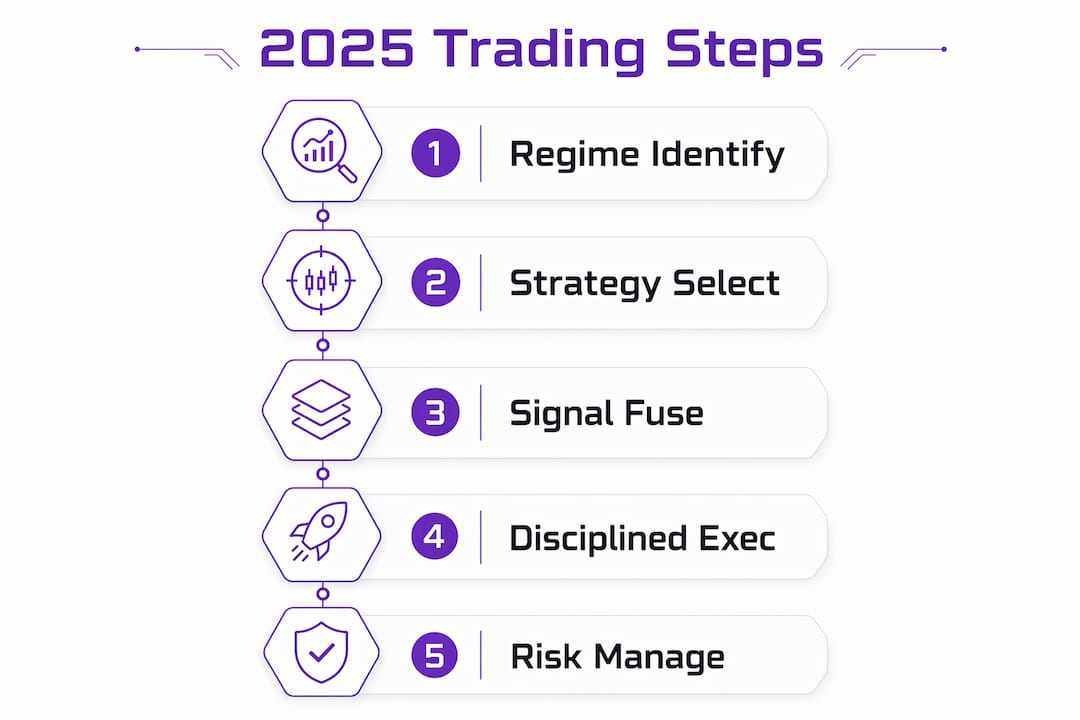
The mechanism is straightforward. RSI and SMA identify price-based momentum and trend conditions. VADER processes social media and news text into quantified sentiment scores. Google Gemini LLM adds contextual interpretation of market narratives that simpler models miss. When these signals align, position sizing can be increased with greater confidence. When they diverge, the model flags elevated uncertainty and reduces exposure.
The critical limitation is that sentiment-enhanced models still produce significant drawdowns during market stress periods. Signal fusion does not eliminate tail risk. Traders using these approaches need explicit stress-period controls layered on top of the signal framework, not instead of it. For a deeper look at how risk management in crypto integrates with these controls, the principles of drawdown management apply directly here.
Key requirements for implementing sentiment-enhanced portfolio optimization:
- Use a minimum 14-day lookback for RSI to avoid noise-driven signals in volatile crypto markets
- Calibrate VADER sentiment scores against asset-specific baselines, not generic thresholds
- Treat Google Gemini LLM outputs as a secondary filter, not a primary entry trigger
- Define explicit maximum drawdown thresholds that trigger position reduction regardless of signal state
- Backtest across multiple market regimes, including the stress periods where the model historically underperforms
Pro Tip: Managing tail risk requires controls that operate independently of your signal stack. Set a portfolio-level drawdown circuit breaker at 10 to 15% that forces a full position review, regardless of what your sentiment or technical indicators are showing.
What are order-book (DOM) trading techniques for 2025?
Depth of Market trading, commonly called DOM, reads live order-book data to identify liquidity concentrations, absorption events, and order-flow imbalances before they appear in price charts. This gives traders a 2 to 10 second information edge over participants relying on lagging price-based indicators. That edge is narrow, but in liquid markets it is consistent and repeatable.
DOM strategies operate across three time horizons. Scalping uses sub-minute order-flow signals to capture micro-inefficiencies in bid-ask dynamics. Swing trading, the most practical horizon for most traders, uses order-book imbalances to time entries and exits over hours to days. Position trading uses DOM data to confirm macro-level supply and demand zones identified through higher-timeframe analysis.
For swing trading specifically, the most reliable application of DOM techniques follows this sequence:
- Filter assets by liquidity. Only apply DOM tactics to BTC/USDT and ETH/USDT, where venue liquidity is deep enough for signals to be reliable and slippage is manageable.
- Identify absorption events. Look for large resting orders that absorb aggressive market orders without moving price. This signals institutional accumulation or distribution.
- Confirm with order-flow imbalance. A sustained imbalance of buy orders over sell orders at a key level confirms directional intent.
- Size positions below 2% of total capital per trade. This position sizing rule limits drawdown from false signals, which occur even in high-liquidity environments.
- Set exits before entry. Define both profit target and stop loss levels based on order-book structure, not arbitrary price distances.
Pro Tip: Every exchange has a different liquidity microstructure. A DOM signal that is reliable on Binance may not translate to a smaller venue with thinner books. Always validate your order-flow tactics on the specific exchange where you intend to trade before committing capital.
How does statistical arbitrage work in crypto markets?
Statistical arbitrage in digital assets is a mean-reversion strategy that exploits temporary price divergences between historically correlated asset pairs. The ETH/BTC pair is the most commonly cited example, given its long-term correlation and deep liquidity on major venues. The strategy does not require a directional market view. It requires a stable correlation relationship and a defined framework for when that relationship has stretched far enough to trade.
Entry and exit rules are governed by z-score thresholds. A z-score entry above 1.8 signals that the spread between two assets has diverged beyond its historical norm by a statistically meaningful amount. The position is closed when the z-score returns to zero, indicating mean reversion. A stop loss is set at a z-score of 3.0, where continued divergence suggests a structural break rather than a temporary inefficiency.
Practical risk parameters for crypto statistical arbitrage:
- Use a 90-day lookback window to calculate the historical spread and z-score baseline
- Limit maximum capital allocation to 5% per pairs trade to contain exposure from correlation breakdown
- Apply dollar-neutral position sizing so that the dollar value of the long and short legs are matched
- Set a 30-day time stop. If the trade has not resolved within 30 days, exit regardless of z-score
- Monitor for structural breaks in correlation using rolling 30-day correlation coefficients alongside the z-score
The 30-day time stop is the most underappreciated parameter in this framework. Crypto markets can undergo regime shifts that permanently alter pair correlations. Holding a diverged position indefinitely while waiting for mean reversion is how statistical arbitrage strategies produce catastrophic losses.
What is funding rate arbitrage and how does it generate yield?
Funding rate arbitrage is a Delta Neutral strategy that captures the periodic payments made between long and short holders of perpetual futures contracts. Perpetual futures use an 8-hour funding cycle to keep contract prices anchored to spot. When market sentiment is bullish, longs pay shorts. A trader holding a long spot position and a short perpetual position collects that payment without taking directional risk.
During sustained bull markets, this structure has generated 30 to 55% APY on the capital deployed. That yield comes from a structural market dynamic, not from predicting price direction. BTC is the preferred starting asset because its liquidity depth minimizes slippage on both legs and its funding rates are among the most stable across major exchanges.
The risks are real and must be managed precisely. Liquidation risk on the short perpetual leg increases if leverage exceeds 1 to 3x. Basis risk occurs when the spot and perpetual prices diverge during high-volatility events, causing the hedge to fail temporarily. Funding reversals happen when sentiment shifts and rates turn negative, meaning the trader pays rather than collects. Margin and liquidation management requires real-time monitoring of both legs, not periodic checks.
Pro Tip: Use a rate monitoring tool like VoiceOfChain to track funding rates across exchanges before entering a position. The highest rates are not always the best opportunity. Rates that are unusually elevated often signal elevated reversal risk, which can eliminate weeks of accumulated yield in a single funding period.
Key takeaways
Effective 2025 digital asset trading requires combining regime classification, signal fusion, execution discipline, and explicit risk controls into a single, coherent framework rather than applying any technique in isolation.
| Point | Details |
|---|---|
| Regime classification first | Identify market regime before selecting Delta Neutral, Dollar Neutral, or Directional strategy. |
| Sentiment signals need guardrails | RSI, SMA, and LLM-based sentiment fusion improves returns but requires stress-period drawdown controls. |
| DOM edge is venue-specific | Order-book signals are reliable only on high-liquidity pairs like BTC/USDT and ETH/USDT. |
| Statistical arbitrage needs time stops | Exit pairs trades after 30 days regardless of z-score to avoid holding through structural breaks. |
| Funding arbitrage requires low leverage | Keep perpetual short leverage at 1 to 3x maximum and monitor funding cycles in real time. |
Why execution discipline matters more than signal sophistication
I have reviewed a lot of trading frameworks that look exceptional on paper and fall apart in live markets. The pattern is almost always the same. The signal logic is sound, but the execution framework is underdeveloped. A trader runs a sentiment-augmented model that correctly identifies a high-probability setup, then sizes the position too large, uses the wrong venue, or fails to account for how funding rate dynamics interact with their existing book. The signal was right. The trade still lost money.

What I find consistently true across the strategy categories covered here is that the traders who perform well over multiple market cycles are not the ones with the most sophisticated signals. They are the ones who have internalized regime awareness as a first-order decision. They know which of their strategies belongs in which environment, and they have the discipline to sit out when conditions do not match any of their frameworks. That is harder than it sounds when markets are moving and the temptation to force a trade is strong.
AI tools, including the kind Darkbot deploys, add genuine value in this context. Not because they predict outcomes, but because they enforce consistency. A rule-based system does not override its own position sizing logic because a trade feels compelling. It does not ignore a time stop because the thesis still seems valid. That consistency is where systematic trading earns its edge over discretionary approaches, particularly in volatile digital asset markets where emotional decision-making is the most common source of avoidable loss. For traders building out their AI-driven trading strategies, the execution layer deserves as much attention as the signal layer.
— Grisha
How Darkbot supports systematic digital asset trading
Darkbot is an AI-powered crypto trading automation platform built for traders who want systematic execution without the operational overhead of managing every position manually. The platform supports strategy implementation across multiple exchanges via API integration, with tools for portfolio management, automated rebalancing, and real-time analytics that align directly with the techniques covered in this article. Whether you are running a funding rate arbitrage setup, a sentiment-enhanced allocation model, or a DOM-informed swing trading approach, Darkbot provides the infrastructure to apply those strategies with consistent rule-based logic. Explore the full platform at Darkbot to see how automated execution supports disciplined, process-driven trading at scale.
FAQ
What are the three main digital asset trading strategy types in 2025?
The 1Token and Bybit 2025 Crypto Quant Strategy Index classifies strategies into Delta Neutral, Dollar Neutral, and Directional categories. Each performs differently depending on market regime, requiring traders to classify conditions before selecting an approach.
How does funding rate arbitrage generate returns without directional risk?
Funding rate arbitrage holds a long spot position and a short perpetual futures position simultaneously, collecting the 8-hour funding payments that longs pay to shorts in bullish markets. Properly managed with leverage below 3x, this structure has produced 30 to 55% APY in sustained bull markets.
What z-score thresholds are used in crypto statistical arbitrage?
Standard practice uses a z-score entry threshold above 1.8, an exit at zero, and a stop loss at 3.0. Maximum capital allocation per pairs trade is capped at 5% to limit exposure from correlation breakdown or regime shifts.
Why do sentiment-enhanced trading models still produce drawdowns?
Sentiment signals from tools like VADER and Google Gemini LLM improve risk-adjusted returns over technical indicators alone, but they do not eliminate drawdowns during market stress periods. Explicit stress-aware controls, such as portfolio-level drawdown circuit breakers, are required alongside the signal framework.
Which asset pairs work best for order-book DOM trading strategies?
BTC/USDT and ETH/USDT are the most reliable pairs for DOM-based strategies because their liquidity depth produces consistent order-flow signals and minimizes slippage. Applying DOM tactics to lower-liquidity pairs significantly increases the rate of false signals and execution failure.
Recommended

Start trading on Darkbot with ease
Come and explore our crypto trading platform by connecting your free account!
Free plan available • No credit card required