Step by Step Swing Trading Workflow for Crypto Traders
TL;DR:
- A structured swing trading workflow helps cryptocurrency traders systematically identify, execute, and review trades to capture short-term price movements. Most failures occur from inconsistent execution rather than flawed strategies, highlighting the importance of disciplined procedures. Automated tools like Darkbot enforce rule-based trading and improve consistency across multiple exchanges.
A step by step swing trading workflow is a structured sequence of stages that enables cryptocurrency traders to systematically identify, enter, manage, and exit trades to capture short to medium term price moves. Swing trading is defined as holding positions typically between 2 and 30 days, making it well suited to crypto markets where volatility creates frequent, tradable swings. Unlike discretionary trading, a systematic workflow converts subjective decisions into repeatable, rule-driven actions. Industry risk standards, including risking no more than 1% of total account equity per trade, form the backbone of any durable plan. This guide covers every stage of that process, from preparation through review, in the order you execute it.
What tools and preparation steps build your swing trading workflow?
The foundation of any effective swing trading workflow is pre-session preparation. Traders who skip this stage make decisions under pressure, which is where most costly errors originate. Professional swing traders build conviction watchlists before the session opens, not during it. That single habit separates reactive trading from planned execution.

Selecting your markets and timeframes
Cryptocurrency markets run 24 hours a day, which makes market selection more deliberate than in equities. Focus on liquid pairs with consistent volume, such as BTC/USDT or ETH/USDT, before expanding to altcoins. Thin markets amplify slippage and make technical levels unreliable.
Timeframe selection follows a top-down structure. The daily chart establishes trend bias, the 4-hour chart identifies setup criteria and key zones, and the 1-hour chart refines entry timing. Each timeframe serves a distinct function. Mixing them without a clear hierarchy produces conflicting signals and inconsistent decisions.
Building a conviction watchlist
A conviction watchlist contains only the setups that already meet your criteria before the session begins. Scan for assets showing clear trend structure, proximity to key support or resistance, and a defined catalyst or technical trigger. Limit the list to 5–10 names. A shorter list forces higher standards and reduces the temptation to chase marginal setups.
- Set price alerts at key technical levels so you respond to the market rather than watch it constantly.
- Organize news feeds around the assets on your watchlist, not the broader market.
- Review macro conditions, including funding rates and open interest for crypto futures, before finalizing the list.
- Remove any asset from the list that no longer meets your setup criteria after the overnight session.
Pro Tip: Build your watchlist the evening before, not the morning of. Decisions made outside of live session pressure are consistently more objective.
How do you identify high-probability swing trading setups?
Setup identification is the analytical core of any step by step trading plan. Swing trading success comes from a clear process involving analysis, execution, and exit stages, not from chasing perfect indicators. The goal at this stage is to find price structures where the probability of a move in your direction is meaningfully higher than random.
Reading the daily chart for trend and structure
Start every analysis on the daily chart. Identify the dominant trend direction using higher highs and higher lows for uptrends, or lower highs and lower lows for downtrends. Mark major support and resistance zones, including previous swing highs and lows, consolidation ranges, and volume-based levels. These zones define where price is likely to react.
Avoid trading against the daily trend unless the structure shows a clear reversal pattern with confirmation. Counter-trend trades carry a higher failure rate and require tighter risk parameters to remain viable.
Drilling into the 4-hour chart for setup criteria
The 4-hour chart is where you define the specific setup. Look for price pulling back to a key support zone within an uptrend, or rallying to resistance within a downtrend. Confirm momentum conditions using RSI or stochastic oscillators. An RSI reading below 40 during a pullback in an uptrend signals a potential oversold entry zone. A reading above 60 during a rally in a downtrend signals a potential overbought short entry.
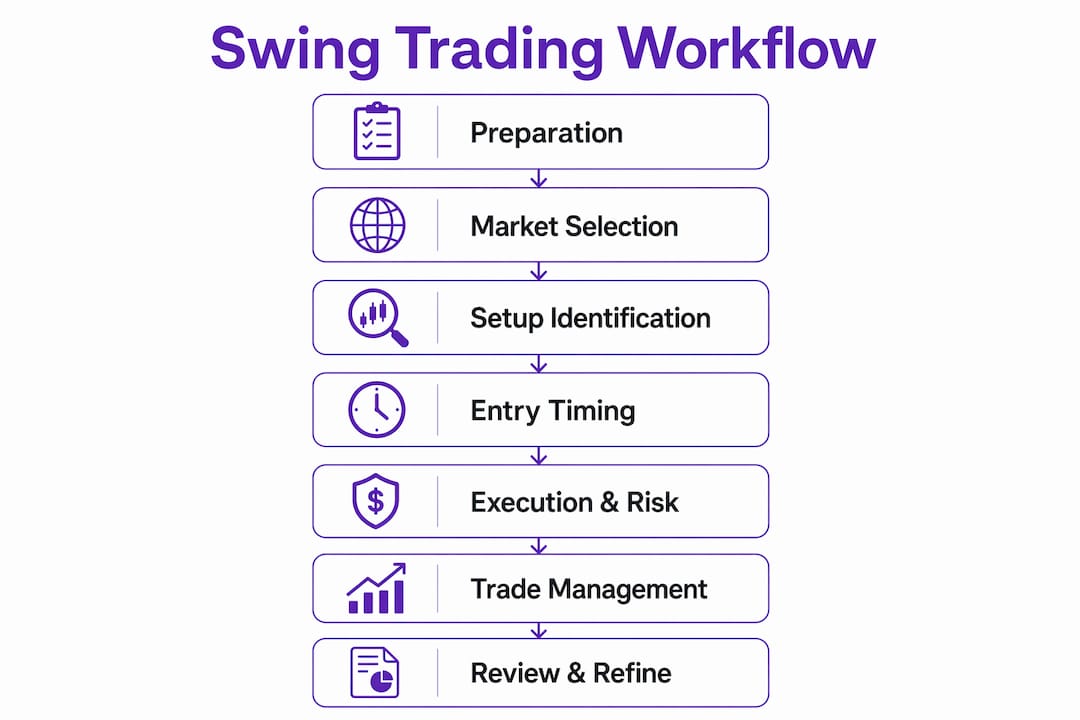
| Analysis stage | Timeframe | Primary purpose |
|---|---|---|
| Trend and structure | Daily | Establish directional bias |
| Setup identification | 4-hour | Define entry zone and criteria |
| Entry timing | 1-hour | Refine trigger and stop placement |
Timing entries on the 1-hour chart
The 1-hour chart provides the entry trigger. Wait for a price action signal at the zone identified on the 4-hour chart. Common triggers include a bullish engulfing candle at support, a pin bar rejection, or a break and retest of a short-term resistance level that has flipped to support. The trigger confirms that buyers or sellers are active at the level you identified on higher timeframes.
Pro Tip: If the 1-hour trigger does not appear within two sessions of the setup forming, remove the trade from your watchlist. Setups that require waiting too long often fail to deliver the expected move.
Step by step execution and risk management rules for swing trading crypto
Execution is where the plan meets the market. Approximately 90% of individual trading plans fail because they are vague or untested. Clear entry rules, stop placement, and position sizing eliminate ambiguity at the moment of execution.
Entry rules and order types
Use limit orders for entries whenever possible. A limit order placed at the identified trigger level gives you price control and avoids chasing. Market orders are appropriate only when a breakout is confirmed and momentum is clearly in your favor. Never enter a trade without a defined stop-loss level already calculated.
- Confirm the 1-hour trigger candle has closed, not just formed.
- Place the limit order at the trigger level or the retest zone.
- Set the stop-loss before the order fills, not after.
- Calculate position size based on the distance to the stop and your maximum risk per trade.
- Record the entry rationale in your trading journal immediately.
Stop-loss placement and position sizing
Effective stop-loss placement sits just below technical support for long trades or just above resistance for short trades, based on the timeframe used for entry. Placing stops at round numbers or arbitrary distances from entry produces poor results. The stop must reflect the market structure.
Position sizing follows directly from the stop distance. The formula is straightforward: divide your maximum risk per trade by the distance in price between your entry and stop. If your account holds $10,000 and you risk 1%, your maximum loss per trade is $100. If the stop is $0.50 away from entry, your position size is 200 units. This calculation applies consistently, regardless of conviction level.
The 1% risk rule is the single most effective capital preservation mechanism available to individual traders. It keeps any single loss from materially damaging the account, which preserves the ability to continue trading through losing streaks.
Pro Tip: Never adjust position size upward because a setup “looks strong.” Conviction is not a substitute for risk control. The rule applies to every trade without exception.
A risk/reward ratio of at least 1:2 is the minimum threshold for a trade to qualify for execution. This means your target must be at least twice the distance of your stop. A ratio below 1:2 means you need a win rate above 50% just to break even, which is an unsustainable requirement over a large sample of trades.
How do you manage active swing trades and control emotional responses?
Trade management begins the moment an order fills. The most common error at this stage is over-monitoring. Doing nothing after setting stops is often the hardest but most necessary part of swing trading. Constant monitoring creates pressure to act, and acting without a trigger destroys the statistical edge built into the plan.
The first 48 hours of a swing trade are the most critical. Crypto markets frequently produce “shakeouts,” where price temporarily moves against a position before continuing in the intended direction. Recognizing this pattern prevents premature exits driven by short-term noise rather than structural change.
Exit strategies that protect gains
- Scale out partial profits when price reaches the first target level, typically 50% of the position at the 1:1 risk/reward level.
- Move the stop to breakeven after the first partial exit to eliminate downside risk on the remaining position.
- Adjust trailing stops as price reaches successive key levels, locking in gains without capping the full move.
- Exit the full position if a daily candle closes below a key support level or above a key resistance level that invalidates the trade thesis.
- Do not exit early because a trade is profitable. Early exits reduce average win size and damage the risk/reward ratio that the plan depends on.
The psychological challenge is accepting that a trade can look uncomfortable and still be valid. A position moving sideways for several days is not a reason to exit. The exit trigger must come from the market structure, not from impatience.
How do you review and refine your swing trading process over time?
A trading workflow without a review process is static. Markets change, and a plan that worked in a trending environment may underperform in a ranging one. Systematic review converts experience into structured improvement.
Backtesting with 50–100 simulated trades on at least three months of historical price data is the baseline before applying any strategy in live markets. This sample size is large enough to reveal whether the edge is real or a product of a favorable short-term period.
- Record every trade with entry price, stop level, target, exit price, and the written rationale for the setup.
- Calculate win rate, profit factor, and expectancy across the full sample.
- Identify the trade types or market conditions where performance diverges from the plan’s expected output.
- Adjust one variable at a time when refining the strategy. Changing multiple parameters simultaneously makes it impossible to isolate what caused the improvement.
- Run the revised plan through another backtesting cycle before applying changes to live trading.
| Metric | What it measures | Target threshold |
|---|---|---|
| Win rate | Percentage of trades that close profitably | Above 40% with 1:2 risk/reward |
| Profit factor | Gross profit divided by gross loss | Above 1.5 |
| Expectancy | Average gain per trade across all outcomes | Positive value |
Weekly review sessions, not just monthly ones, catch performance drift early. A trading plan functions as an operational manual. It converts subjective decision-making into objective, repeatable execution. That function only works if the plan is updated based on real performance data.
Key Takeaways
A disciplined swing trading workflow built on preparation, multi-timeframe analysis, strict risk rules, and systematic review is the most reliable path to consistent performance in cryptocurrency markets.
| Point | Details |
|---|---|
| Preparation before the session | Build a conviction watchlist outside of live hours to remove impulsive decisions. |
| Top-down timeframe analysis | Use daily for trend, 4-hour for setup, and 1-hour for entry timing. |
| 1% risk rule per trade | Size every position so the maximum loss equals 1% of total account equity. |
| Minimum 1:2 risk/reward | Only execute trades where the target is at least twice the distance of the stop. |
| Systematic review cycle | Backtest with 50–100 trades and adjust one variable at a time to refine the plan. |
Why most traders fail at the workflow stage, not the strategy stage
The uncomfortable reality I have observed across years of watching traders operate in crypto markets is this: the strategy is rarely the problem. Most traders who fail have a workable edge. They fail because they do not execute the strategy consistently. They skip the watchlist. They move the stop. They exit early because the trade feels uncomfortable. They add size when they feel confident and reduce it when they feel uncertain, which is exactly backward.
A written workflow forces you to treat trading as a business with documented procedures. When you deviate from the plan, you know it immediately because the deviation is visible against the written record. That accountability is what separates traders who improve from those who repeat the same errors across different market cycles.
The danger of crypto markets specifically is that volatility creates the illusion of opportunity everywhere. Every candle looks like a potential trade. A structured workflow is the filter that keeps you out of low-quality setups and focused on the ones that meet every criterion. Patience is not a personality trait in this context. It is a procedural output of a well-designed system.
AI-driven automation, such as the kind Darkbot applies, addresses the execution consistency problem directly. It does not predict markets. It enforces rule adherence at the moment of execution, which is precisely where human judgment tends to fail under pressure. For traders who have a defined workflow but struggle with consistent execution, automation is not a shortcut. It is a structural solution to a structural problem.
— Grisha
Darkbot and the systematic execution of your trading workflow
Darkbot is an AI-powered cryptocurrency trading automation platform built for traders who have a defined workflow and need consistent execution across multiple exchanges.
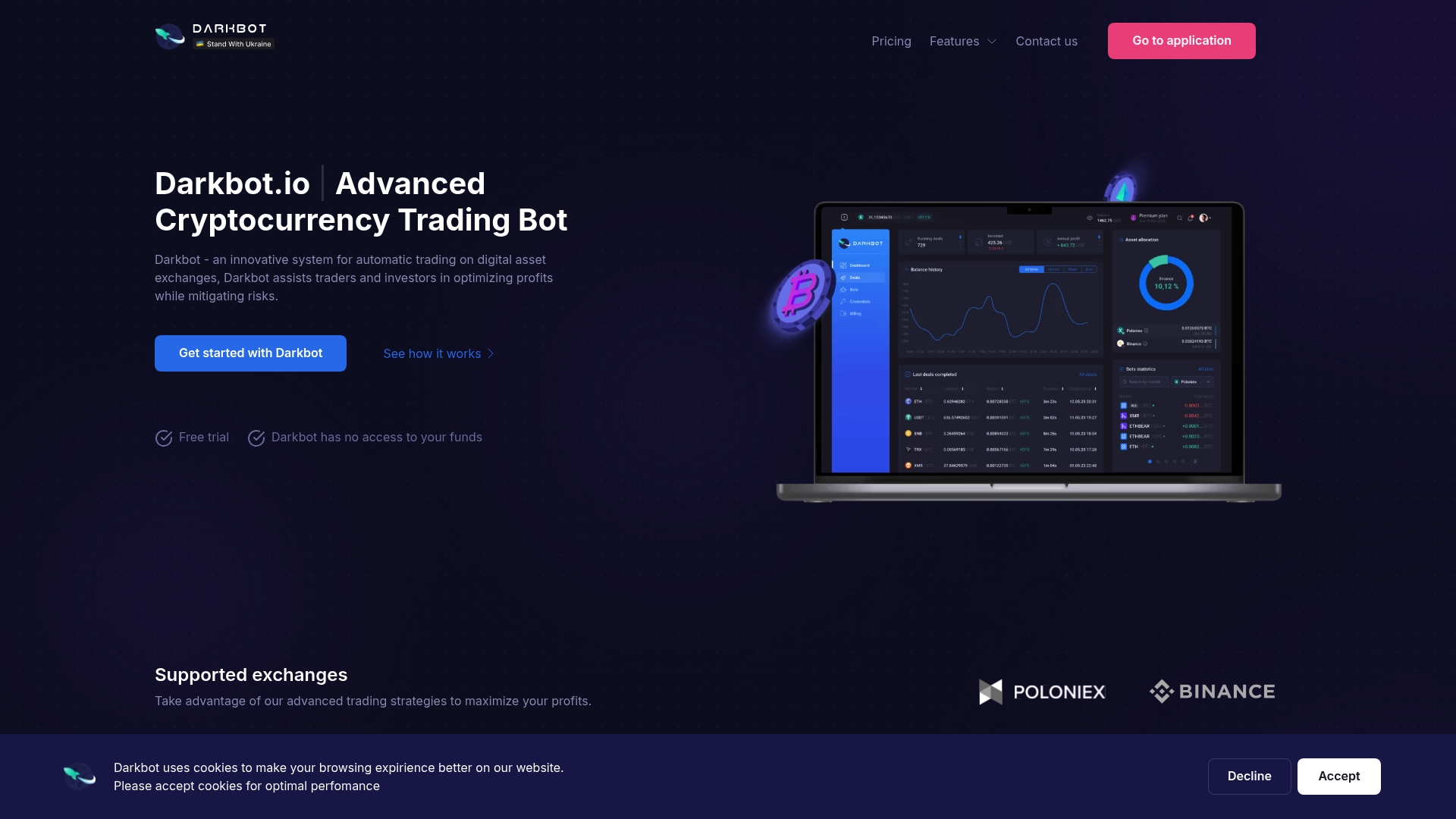
Darkbot enforces rule-driven logic at the point of execution, applying your position sizing, stop-loss, and exit rules without deviation. The platform integrates with major cryptocurrency exchanges via API, enabling deployment across multiple markets simultaneously. Its portfolio management tools support risk distribution across positions, which is critical for traders running multiple swing setups at once. For traders ready to move from a manual workflow to systematic automation, Darkbot’s platform provides the infrastructure to do that without sacrificing control over the underlying strategy.
FAQ
What is a swing trading workflow?
A swing trading workflow is a structured sequence of stages covering preparation, analysis, entry, trade management, and review. It converts discretionary decisions into repeatable, rule-based execution.
How long do swing trades typically last?
Swing trades are defined by holding periods of 2–30 days, making them distinct from day trading and longer-term position trading.
What is the 1% risk rule in swing trading?
The 1% rule means risking no more than 1% of total account equity on any single trade. It limits the damage from any individual loss and preserves capital across losing streaks.
Why is backtesting necessary before live swing trading?
Backtesting with 50–100 simulated trades on historical data confirms whether a strategy has a real edge before real capital is at risk.
What risk/reward ratio should swing traders target?
A minimum risk/reward ratio of 1:2 is the standard threshold. It means the strategy can be profitable even with a win rate below 50%.
Recommended

Start trading on Darkbot with ease
Come and explore our crypto trading platform by connecting your free account!
Free plan available • No credit card required