Risk Management Strategies List for Crypto Traders
TL;DR:
- Effective crypto risk management uses four strategies: avoidance, reduction, transfer, and acceptance. Consistent application of these methods, supported by quantitative tools and daily discipline, helps traders withstand market volatility and uncertainty. Automation and personalized strategies further enhance control and decision-making accuracy.
Risk management strategies are defined as systematic approaches that traders use to identify, assess, and respond to financial risks before those risks damage capital. The four foundational strategies are avoidance, reduction, transfer, and acceptance. Every serious crypto trader needs a working risk management strategies list because digital asset markets combine high volatility, thin liquidity windows, and regulatory uncertainty in ways that traditional markets rarely do. Applying these strategies consistently separates traders who survive drawdowns from those who don’t.
1. What are the four core risk management strategies?
The industry standard groups all risk responses into four categories. Each one addresses a different relationship between a trader and a specific threat.
- Risk avoidance means exiting or never entering a position where the potential loss outweighs any realistic gain. In crypto, this applies to assets with no liquidity, anonymous teams, or unaudited smart contracts.
- Risk reduction covers actions that lower the probability or impact of a loss. Stop-loss orders, position sizing, and portfolio diversification all fall here.
- Risk transfer shifts the financial consequence of a risk to another party. Crypto derivatives such as options and perpetual futures allow traders to hedge directional exposure without closing spot positions.
- Risk acceptance is the deliberate choice to monitor a known risk without acting on it. This applies when the cost of mitigation exceeds the expected loss.
Pro Tip: Never treat risk acceptance as passive neglect. Set a threshold at which an accepted risk automatically escalates to a reduction or avoidance response.
2. Risk avoidance in practice

Risk avoidance is the most decisive strategy on this list. It requires a trader to define, in advance, which conditions make a position untenable.
Common avoidance triggers in crypto include: assets with a market cap below a defined floor, tokens launching on unaudited protocols, and markets with bid-ask spreads wide enough to make entry costs prohibitive. The discipline here is not analysis paralysis. It is a pre-written rule that removes the decision from the moment of temptation. Traders who define risk boundaries before entering a market avoid the most common failure mode: rationalizing a bad trade in real time.
3. Risk reduction through position sizing and stop-loss rules
Risk reduction is the most frequently applied strategy in active crypto trading. Position sizing controls how much capital is at risk on any single trade, while stop-loss orders cap the maximum loss if a trade moves against the trader.
The 1–2% rule is a widely cited position sizing guideline: no single trade risks more than 1–2% of total account capital. That limit keeps a losing streak from becoming a portfolio-ending event. Stop-loss placement should be based on technical structure, not round numbers. A stop set at a key support level reflects market logic. A stop set at exactly $100 below entry reflects wishful thinking.
Pro Tip: Combine position sizing with a maximum daily loss limit. When that limit is hit, stop trading for the day. This rule prevents the compounding of bad decisions under emotional pressure.
4. Risk transfer using derivatives and hedging instruments
Risk transfer does not eliminate exposure. It reassigns who bears the financial consequence of an adverse outcome.
In crypto markets, options contracts are the clearest example. A trader holding a large Bitcoin position can buy put options to cap downside without selling the underlying asset. Perpetual futures allow short hedges against spot holdings. Derivatives use in crypto has grown significantly as institutional participation has increased, and the instruments are now accessible on major exchanges. Compliance with exchange margin requirements and local regulations is a prerequisite before using any leveraged transfer instrument. Understanding compliance obligations in payments and financial products applies directly to how traders structure hedged positions.
5. Risk acceptance and conscious monitoring
Risk acceptance is not inaction. It is a deliberate decision, documented and reviewed on a schedule.
A trader might accept the risk of a small altcoin position moving against them by 15% because the position size is small enough that the loss is tolerable. The key requirement is that the risk is named, sized, and assigned a review trigger. Assigning ownership to every identified risk prevents the most common failure in risk management: risks that are noticed but never assigned to anyone, and therefore never acted on. Unowned risks are ignored risks.
6. Advanced risk assessment methods: quantitative techniques
Qualitative risk assessment uses probability-impact matrices and scoring models to rank threats by severity. Quantitative methods go further by attaching numerical estimates to both likelihood and loss magnitude.
Monte Carlo simulations model thousands of possible price paths simultaneously, producing a probability distribution of portfolio outcomes rather than a single forecast. This is particularly useful for crypto portfolios with correlated assets, where a single market event can move multiple positions in the same direction. Quantitative techniques complement qualitative risk registers. They do not replace judgment. They make the range of possible outcomes visible before capital is committed.
Pro Tip: Build a simple probability-impact matrix for your top five portfolio risks each month. Even a rough ranking forces you to confront which risks are actually material and which ones you are worrying about unnecessarily.
7. Key Risk Indicators and proactive monitoring
Key Risk Indicators (KRIs) are metrics that signal rising risk before a loss occurs. They function as early warning systems rather than post-event reports.
Pairing KRIs with Key Performance Indicators (KPIs) gives traders a dual view: one metric tracks whether the strategy is performing, the other tracks whether the risk environment is deteriorating. In crypto, useful KRIs include exchange withdrawal volumes, funding rates on perpetual futures, and on-chain liquidation levels. When these indicators move outside predefined thresholds, a risk response is triggered before the loss appears in the portfolio.
8. Automated and systematic risk control
Automated trading systems enforce risk parameters with a consistency that manual execution cannot match. A human trader under pressure may widen a stop-loss or add to a losing position. A rule-based system does not.
Automated bots for risk control apply predefined position limits, stop-loss thresholds, and rebalancing triggers without hesitation. The benefit is not speed alone. It is the removal of emotional decision-making from the execution layer. Automated risk scoring and escalation protocols also reduce the subjective bias that different traders bring to impact assessments. When thresholds are defined in advance and enforced by a system, the evaluation is consistent across all market conditions.
Key benefits of systematic execution in risk management:
- Consistent rule enforcement: Stop-loss and position size rules apply equally in calm and volatile markets.
- Bias elimination: The system does not rationalize exceptions based on recent performance or market sentiment.
- Audit trail: Every decision is logged, making strategy review and refinement straightforward.
- Parallel monitoring: Automated systems track multiple assets and risk parameters simultaneously without degradation in attention.
9. Matching strategies to individual trader profiles
The right risk management approach depends on the trader’s capital size, risk tolerance, time horizon, and the specific assets in the portfolio. A trader with $5,000 in capital and a short time horizon needs different controls than an institutional desk managing $50 million.
Tailoring risk strategies to individual profiles improves both relevance and execution. A high-volatility altcoin portfolio requires tighter stop-losses and smaller position sizes than a Bitcoin-only portfolio. A trader operating in a jurisdiction with strict crypto regulations must factor compliance risk into every strategy selection. Flexibility is not inconsistency. Adapting the strategy to current market conditions is a core part of effective risk management in crypto.
Factors to assess when selecting strategies:
- Risk tolerance: Define the maximum acceptable drawdown before the strategy is paused or revised.
- Asset liquidity: Illiquid assets require wider stops and smaller positions to account for slippage.
- Market regime: Trending markets favor momentum strategies with trailing stops. Range-bound markets favor mean-reversion with fixed stops.
- Regulatory environment: Derivatives and leverage availability vary by jurisdiction and must be factored into transfer strategies.
10. Integrating risk management into daily trading discipline
Risk management works only when it is embedded in the daily trading routine, not treated as a separate activity. Integrating risk management with overall trading cadence improves early detection and response time.
A practical daily discipline includes reviewing open position risk before the trading session, checking KRI thresholds, and confirming that no single position has grown beyond its target size due to price movement. Weekly reviews should assess whether the overall portfolio risk profile has shifted. Monthly reviews should evaluate whether the strategy itself needs adjustment based on changing market conditions. Moving from passive record-keeping to active decision-making is what separates a risk process from a risk strategy.
Key Takeaways
Effective crypto risk management requires four core strategies applied consistently, supported by quantitative methods, automated execution, and daily discipline.
| Point | Details |
|---|---|
| Four core strategies | Avoidance, reduction, transfer, and acceptance cover every type of risk response a trader needs. |
| Position sizing discipline | The 1–2% rule per trade prevents any single loss from becoming a portfolio-ending event. |
| KRIs as early warning | Key Risk Indicators signal deteriorating conditions before losses appear in the portfolio. |
| Automation removes bias | Rule-based systems enforce risk parameters consistently, eliminating emotional override at execution. |
| Strategy must be personalized | Risk controls should match the trader’s capital size, asset mix, and regulatory environment. |
What I’ve learned about risk management that most articles won’t tell you
Most traders treat risk management as a checklist they complete before a trade. That framing is the problem. Risk management is not a pre-flight check. It is the operating system the entire trading practice runs on.
The most common mistake I see is confusing activity with control. A trader who sets a stop-loss but then manually moves it when the price approaches it has no risk management. They have the appearance of one. The same applies to diversification: spreading capital across 20 correlated altcoins is not diversification. It is concentrated exposure with extra steps.
The second mistake is treating risk acceptance as a default. Acceptance is a valid strategy only when the risk is explicitly named, sized, and assigned a review trigger. Visible leadership support and cross-functional ownership matter more than the tools themselves. In trading terms, that means the trader must personally commit to reviewing accepted risks on a schedule, not just log them and move on.
AI and automation are genuinely useful here, but not for the reasons most people assume. The value is not that a bot is faster than a human. The value is that a bot does not change its mind under pressure. That consistency is the hardest thing for a human trader to replicate, and it is the most important property a risk management system can have.
— Grisha
How Darkbot supports disciplined risk control
Darkbot is an AI-powered crypto trading automation platform built around systematic execution and structured risk control. The platform enforces predefined risk parameters across multiple exchanges simultaneously, removing the execution layer from emotional decision-making.
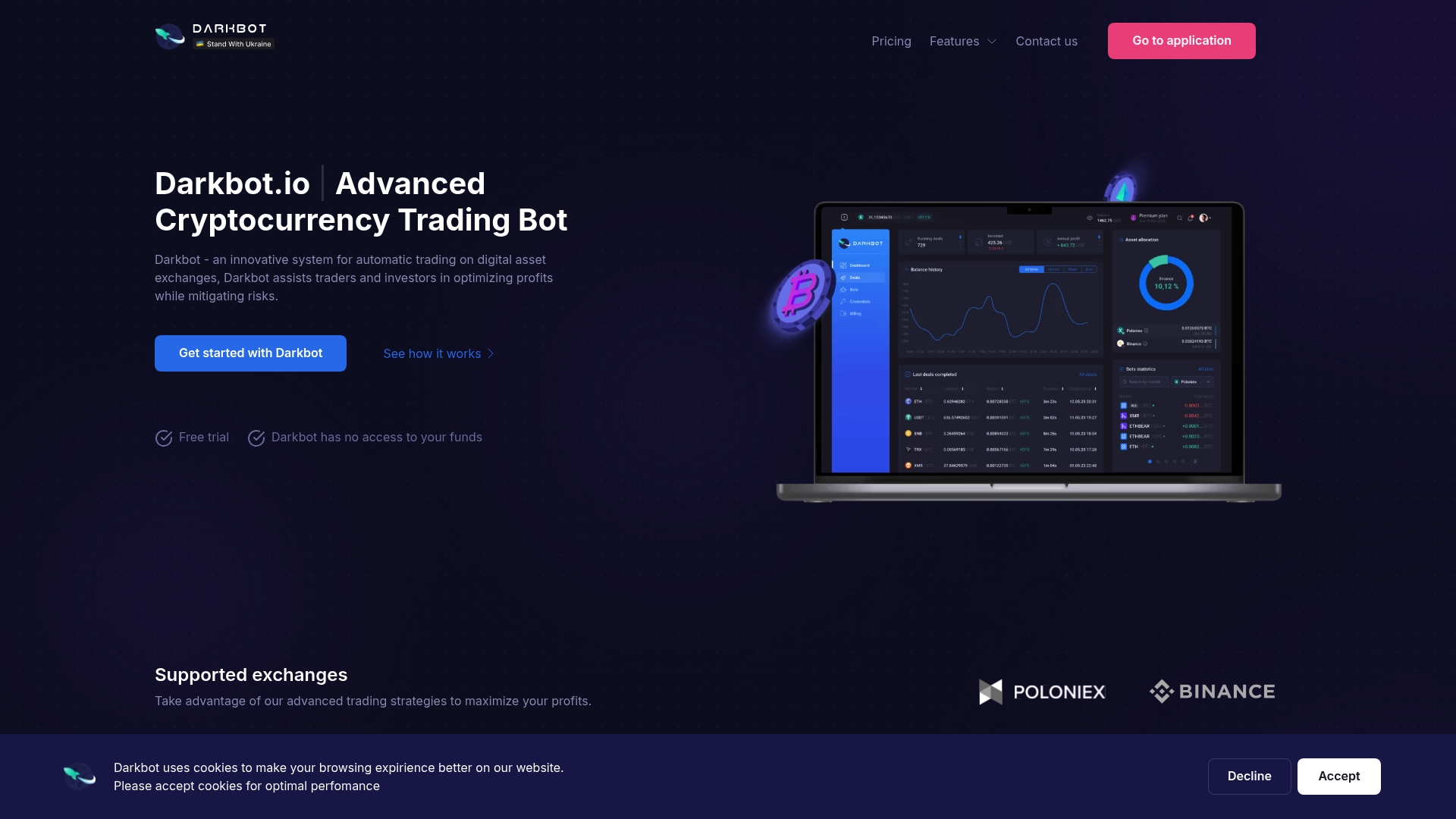
Darkbot’s portfolio management tools allow traders to set position size limits, stop-loss thresholds, and rebalancing triggers that run automatically without manual intervention. The platform supports multiple simultaneous bots, each operating within its own defined risk envelope. For traders who want disciplined, rule-based execution across volatile crypto markets, Darkbot’s trading automation provides the infrastructure to apply a comprehensive risk management plan consistently, at any hour, across any market condition.
FAQ
What are the four main risk management strategies?
The four core strategies are avoidance, reduction, transfer, and acceptance. Each addresses a different relationship between a trader and a specific risk, from eliminating exposure entirely to consciously monitoring a known risk within defined limits.
How does position sizing reduce risk in crypto trading?
Position sizing limits how much capital is at risk on any single trade. The 1–2% rule caps each trade’s risk at 1–2% of total account capital, preventing a losing streak from causing irreversible portfolio damage.
What is a Key Risk Indicator in crypto trading?
A Key Risk Indicator is a metric that signals rising risk before a loss occurs. Examples in crypto include exchange withdrawal volumes, perpetual futures funding rates, and on-chain liquidation levels.
Why does automated trading improve risk management?
Automated systems enforce risk rules consistently without emotional override. They apply stop-loss orders, position limits, and rebalancing triggers the same way in every market condition, eliminating the bias that affects manual execution under pressure.
How do I choose the right risk strategy for my portfolio?
Match your strategy to your capital size, risk tolerance, asset liquidity, and regulatory environment. High-volatility assets require tighter controls, while accepted risks must be explicitly named, sized, and assigned a review schedule to remain valid.
Recommended

Start trading on Darkbot with ease
Come and explore our crypto trading platform by connecting your free account!
Free plan available • No credit card required