Auto Sync Crypto Trade Journal That Survives Week Three for Traders

If you want low friction and accurate analytics, start with an auto-sync journaling platform rather than a spreadsheet or a notes app. Active intraday traders need automated fills and tagging; swing traders can tolerate slightly more manual entry in exchange for deeper post-mortem tools; automation-first traders running bots should prioritize platforms that ingest strategy logs directly. Whichever you pick, import fidelity is the one feature that decides whether your data is trustworthy six months from now.
TL;DR:
- Automated sync and tagging are essential to maintain data trustworthiness and reduce manual entry, especially for active or bot-driven traders.
- Checking import accuracy, timezone handling, fee accounting, and flexible tagging during trial runs is critical before selecting a trade journaling platform.
- Key metrics like rule-following score, expectancy, and tagging patterns reveal recurring mistakes more effectively than basic profit-loss figures.
- Automation features—including API sync and pre-set templates—significantly decrease journaling friction and improve long-term discipline.
- Prioritizing import fidelity over advanced analytics ensures more reliable insights and prevents the common abandonment of manual or semi-automated journals.
What Is Crypto Trade Journaling and Why Does It Matter?
Crypto trade journaling is the practice of recording each trade’s plan, execution, and outcome in a structured format, then reviewing that record on a schedule to find patterns in your decision-making. It differs from simple trade logging, which just records what happened, because journaling deliberately captures the “why” behind a decision alongside the “what.” That distinction is what turns a spreadsheet of fills into something you can actually learn from.
The mechanical trade log (entry, exit, size, fees) tells you what you did. Behavioral tags and short notes tell you why you did it. Weekly post-mortems that analyze both together are what actually surface recurring failure modes, according to Interactive Brokers’ research on trading journals. Skip the behavioral layer and you’re left with a P&L statement dressed up as a journal.
Which Type of Journaling Tool Should You Evaluate First?
Four broad categories cover almost every option a crypto trader will run into, and each one solves a different part of the problem.
Dedicated journaling SaaS with auto-sync connects to your exchanges via API or CSV import and builds analytics on top of that data automatically. Platforms in this category, including TradeZella, TraderSync, TradesViz, Edgewonk, TraderVue, and Trademetria, are built specifically for this job. They tend to offer the deepest analytics (win rate, expectancy, R-multiples) and the strongest tagging systems, because that’s their entire product. The tradeoff is a subscription cost and a learning curve to configure tags and dashboards properly.
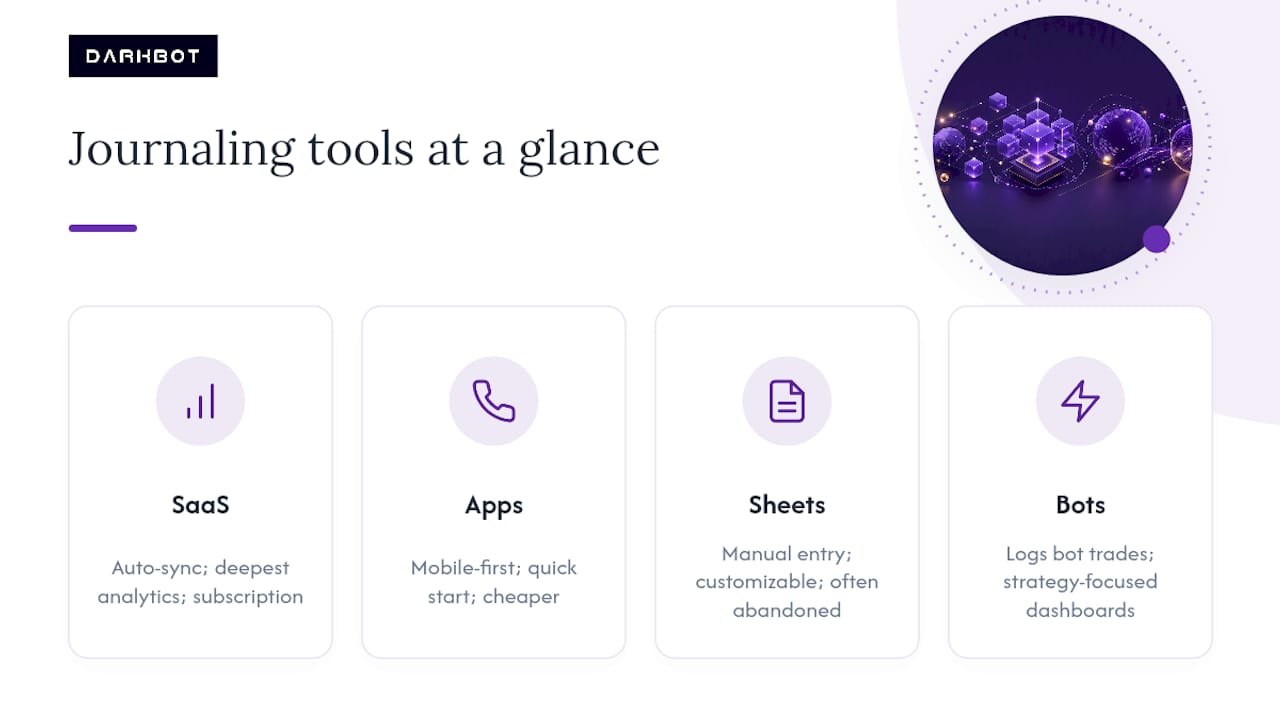
Exchange-native or lightweight tracking apps like UltraTrader or StonkJournal focus on mobile-first logging and simpler visualizations. They’re faster to start with and often cheaper, but analytics depth and customization usually lag behind the dedicated platforms.
Spreadsheet plus manual automation means Google Sheets or Excel with scripts pulling exchange data. It’s free and infinitely customizable, but most journals built this way get abandoned because manual fill entry is tedious and error-prone at any real trading volume.
Bot-driven journaling, exemplified by tools like TraderMake.Money (TMM) and Coin Market Manager (CMM), logs trades generated by automated strategies and pairs that data with performance dashboards. This fits traders running systematic or bot-based execution who want journaling built around strategy performance rather than manual discretionary entries.
For most active traders, the dedicated SaaS category is the right starting point specifically because it minimizes manual data entry, which is the single biggest reason journals get abandoned.
How Do You Vet a Trade Journaling Tool Before Paying for It?
Marketing pages all claim “seamless sync” and “AI insights.” Here’s how to verify those claims in a free trial or demo before committing.
- Run an import test with a real sample file. Export a week of trades from your exchange and import it. Check that field mapping handles your exchange’s specific CSV format, not a generic template.
- Check timezone handling. A trade logged at 11:58 PM UTC should not land on the wrong calendar day in your time-of-day analytics.
- Verify fee accounting. Confirm the platform pulls trading fees and funding fees separately rather than folding them into raw P&L.
- Demand specific metrics, not just charts. You want a rule-following score, R-multiples, expectancy, and MFE/MAE (maximum favorable/adverse excursion), not just a win rate percentage on a dashboard.
- Test the tagging workflow. Add a behavioral tag and a one-line note to a trade, then confirm you can filter and aggregate by that tag later. If tagging feels like extra work, you won’t keep doing it.
- Check export and data control options. Confirm you can export your full data set and that any exchange API key required is read-only.
Watch for a few red flags: vague “AI trade predictions” with no explanation of methodology, import processes that don’t show you the field mapping before confirming, and tagging systems that don’t let you enforce consistent tag names across hundreds of trades.
Pro Tip: Build a simple five-point emotion scale (calm, confident, anxious, impulsive, revenge) and use only those five tags for a month. A larger tag vocabulary feels thorough but fragments your data until no single tag has enough trades to mean anything.
What Does a Minimal Daily Journaling Workflow Look Like?
The workflow that survives past week three is the one with the fewest manual fields. A practical minimum template separates the plan from the outcome, which prevents you from rewriting your rationale after you already know the result.
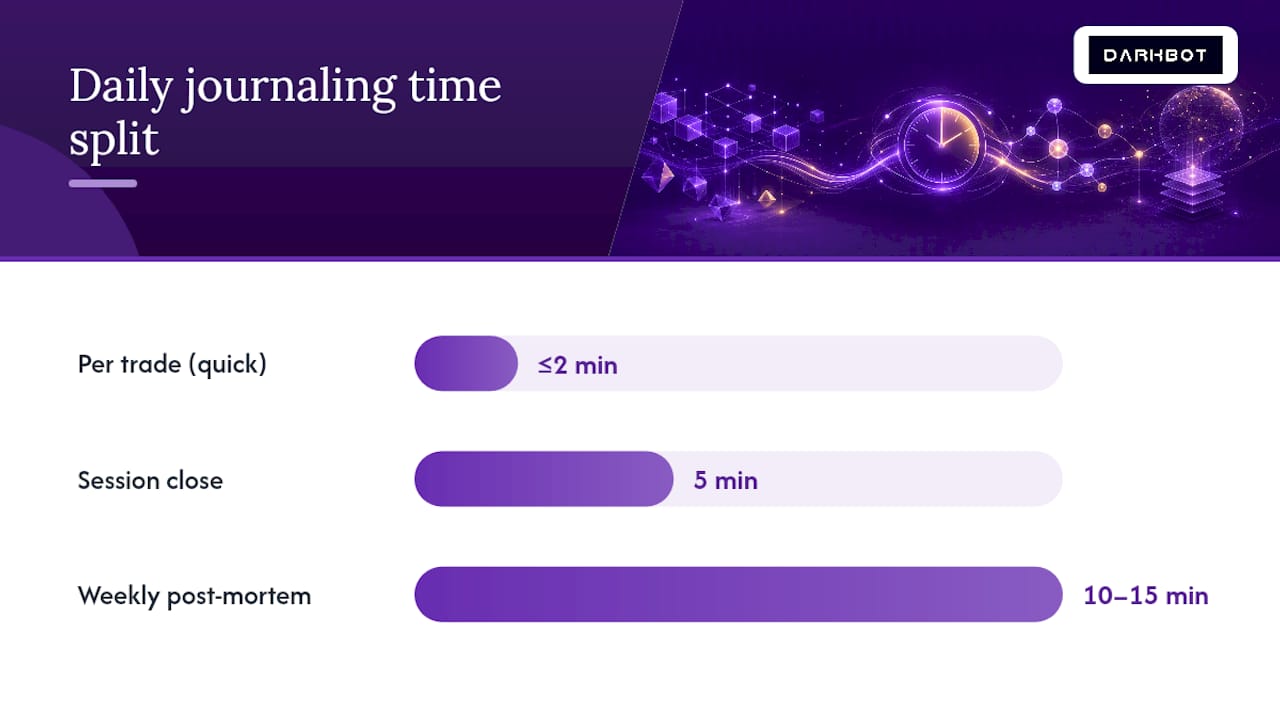
Per trade (aim for under two minutes):
- Log the setup and context before entry: strategy name, planned trigger, invalidation point, planned size.
- Tag one primary emotion at entry (calm, anxious, impulsive) using a fixed short list.
- Write one paragraph on your rationale, then let automated import handle the actual fills, fees, and exit price.
Anything mechanical, meaning entry price, exit price, size, and fees, should come from API sync or CSV import, never manual typing. Journals that force manual fill entry get abandoned far more often than ones where import is automatic.
Session close routine (five minutes, end of trading session):
- Name the single worst behavior from the session, not a list of five.
- Record one corrective action for tomorrow.
- Skip broad reflection; save pattern analysis for the weekly review.
Weekly post-mortem (10 to 15 minutes): aggregate trades by setup, compute a discipline score (rules followed divided by total trades per setup), and calculate conditional edge (your actual edge only on trades where you followed your rules). Pick exactly one testable change for the coming week. Interactive Brokers frames this weekly aggregation as the primary mechanism for finding recurring failure modes, not the daily entries themselves.
API Sync or CSV Import: Which Should You Trust?
API sync pulls trades automatically and updates in near real time, which matters if you’re checking your journal mid-session. CSV import is a manual pull but gives you a stable snapshot you control, which some traders prefer for derivatives positions where API feeds sometimes mishandle funding payments or contract rollovers.
Either method fails the same way if you don’t validate it first:
- Timezone alignment. Confirm the platform’s displayed trade time matches your exchange’s timestamp, not a default UTC offset.
- Fee and funding fields. Spot trades and perpetual futures report fees differently; confirm both map correctly.
- Partial fills. A single order that filled across three price levels should aggregate into one trade, not three misleading entries.
- Spot versus derivatives mapping. Import mistakes commonly happen when CSV fields don’t correctly map fees, partial fills, or leverage on derivatives trades, which quietly corrupts win rate and expectancy figures downstream.
Before trusting any vendor with a full historical backfill, test its mapping on one week of real data and manually check three trades against your exchange statement.
Pro Tip: Always connect exchange accounts with a read-only API key, never a trading-enabled key, and rotate keys every few months. A journaling platform has no legitimate reason to need withdrawal or trading permissions.
Which Metrics and Charts Reveal Your Recurring Mistakes?
Six key metrics drive everything else on a dashboard: rule-following score, win rate, expectancy (average dollar result per trade), average R-multiple (return relative to planned risk), MFE/MAE, and drawdown sequencing.
The rule-following discipline score (rules followed divided by total trades, computed per setup) is arguably the single most useful weekly number, because it separates execution quality from market luck. A profitable week built on broken rules is a warning, not a win.
Tags paired with aggregation are what expose patterns a raw P&L number hides entirely:
- Sizing creep: position size drifting upward after a winning streak, visible when you chart size against time.
- Revenge trading: entries tagged “chased” clustering right after loss trades.
- Time-of-day fragility: a heatmap of win rate by hour that flags a consistently weak session (many crypto traders find late-night hours are where discipline erodes fastest).
- MAE/MFE scatter plots: showing trades that moved favorably before reversing, a signal you’re exiting too late or too early.
One caution: don’t draw conclusions from small samples. A single setup needs a reasonable batch of trades, generally several dozen at minimum, before a discipline score or expectancy figure means much more than noise. Fewer than that and one lucky or unlucky streak will distort the whole read.
How Does Automation Reduce Journaling Friction?
Manual data entry is the main reason journals get abandoned. Automation removes the mechanical burden so the time you spend journaling goes toward analysis instead of transcription.
API-based exchange sync eliminates hand-typed fills. Paper trading environments let you test a journaling workflow with strategy tags before committing real capital, which is useful when you’re still deciding what tag taxonomy fits your trading style. Strategy tagging at the automation layer means every trade a bot executes already carries a label for setup type and risk parameters, which is exactly the tagging discipline a manual trader has to build by hand.
Darkbot’s relevant features for this workflow include API integration across supported exchanges, strategy tagging, portfolio-level analytics, paper trading for testing configurations, and basic risk controls tied to position sizing. None of these predict outcomes; they reduce the manual overhead of keeping records consistent, which is the actual bottleneck in most abandoned journals. For related reading on how automated risk parameters work in practice, see this crypto trading risk checklist covering position-sizing rules.
How Journaling Separates Process From P&L
A profitable week and a well-executed week are not the same thing, and conflating them is the most common analytical mistake in trading. You can break every rule in your plan and still make money on a given week because the market moved in your favor anyway. You can follow every rule perfectly and still lose, because the market did something your setup didn’t account for.
Journaling exists to separate those two outcomes. The rule-following score answers “did I execute my process,” independent of what the market did afterward. Conditional edge, meaning your actual win rate and expectancy calculated only on trades where you followed your own rules, answers a different question: does my process actually work when I run it correctly?
Traders who skip journaling tend to reinforce whatever behavior happened to be profitable last, regardless of whether it was sound. A trader who sized up impulsively and got lucky twice will keep sizing up impulsively until the pattern eventually fails. A journal with behavioral tags catches that pattern after two or three instances instead of after an account-damaging one. That’s the entire value proposition: it turns outcome-based learning, which is slow and expensive, into process-based learning, which is faster and far cheaper.
How to Select the Right Trade Journaling Software
Start from your trading frequency, not from a feature list. A trader placing three trades a week can tolerate more manual entry than one placing thirty. Match the solution type to that volume first, then filter by criteria.
Import fidelity comes first: does the platform support your specific exchanges natively, and does it handle your trade type, spot, futures, or perpetuals, correctly? A journal that mishandles funding fees on perpetual contracts will quietly generate wrong expectancy numbers no matter how good its charts look.
Analytics depth comes second. If you can’t get a rule-following score, R-multiples, and MFE/MAE without manual spreadsheet work on the exported data, the platform isn’t giving you the analysis layer you’re paying for.
Tagging flexibility comes third: can you create and enforce a consistent, short tag taxonomy, and can you filter and aggregate by those tags later? A platform with unlimited free-text notes but no structured tagging makes pattern-finding harder, not easier.
Replay or simulator tools matter more for discretionary traders reviewing chart context than for systematic or bot-driven traders, who already have execution logs. Weigh that feature accordingly rather than treating it as universally essential.
Finally, check the review cadence the platform actually supports. Some tools default to daily summaries; the more useful ones make weekly aggregation by setup the default view, because that’s where post-mortem analysis actually happens.
What Do Crypto Journaling Tools Cost?
Pricing across the dedicated journaling category generally falls into three tiers. Free or freemium tiers, offered by most platforms including lightweight apps like StonkJournal, typically cap trade volume or history length and limit tagging or analytics depth. Mid-tier subscriptions, common across TradeZella, TraderSync, TradesViz, Edgewonk, TraderVue, and Trademetria, unlock full analytics, unlimited trade imports, and advanced tagging, usually billed monthly or discounted annually. Bot-driven journaling tools like TraderMake.Money and Coin Market Manager often bundle journaling into a broader automation subscription rather than pricing it as a standalone product.
Exact pricing varies by vendor and changes over time, so check current rates directly on each platform rather than relying on older comparison articles. The more useful comparison is value per feature: a platform charging a premium for AI-generated insights that amount to a restated win rate isn’t worth more than a cheaper tool with solid manual tagging and clean CSV export.
Darkbot’s pricing includes multiple subscription tiers and a trial period that allows testing import accuracy and analytics fit before committing to a plan.
Does Trade Journaling Help With Taxes and Compliance?
A trade journal and a tax report solve related but distinct problems. Your journal tracks behavior and process; a tax tool tracks cost basis, realized gains, and holding periods for reporting purposes. Some journaling platforms export data in formats compatible with tax software, which saves you from manually reconciling two separate trade histories.
The practical step is checking, before you commit to a journaling tool, whether its export format includes the fields a tax tool actually needs: acquisition date, disposal date, cost basis, proceeds, and fees. A journal that only exports P&L summaries without transaction-level detail won’t help at tax time regardless of how good its behavioral analytics are.
Crypto tax treatment varies significantly by jurisdiction, including how staking rewards, derivatives, and short-term versus long-term holdings are classified, so treat any journaling tool’s tax export as a starting point for your accountant or tax software, not a finished filing. If accurate cost-basis tracking matters to you, confirm the export before you rely on manual reconciliation as a fallback, since rebuilding a year of derivatives trades by hand is one of the more error-prone tasks in crypto accounting.
What Automation Beyond Exchange Sync Saves the Most Time?
Exchange sync solves the biggest time sink, but a few smaller automations compound over months.
Templates for recurring setups let you pre-fill the strategy name, planned trigger, and risk parameters for a setup you trade often, so you’re only filling in the variable fields, price levels and emotion tag, at entry. Alerts tied to your journal, where supported, can prompt a session close entry at a set time each day rather than relying on memory, which matters because journals abandoned mid-week rarely get backfilled accurately.
Pre-set tag lists, rather than free-text fields, save the seconds-per-trade cost of deciding what to type, and they’re what make aggregation possible later. Scheduled weekly export or backup of your trade data protects you if a platform changes its data retention policy. And for automation-first traders, linking strategy-level tags directly to the bot configuration that generated the trade means the journal entry writes itself the moment the trade executes, which is the lowest-friction version of journaling available. For more on how automated execution layers handle this kind of configuration, see this guide on automating crypto trading.
The Overrated Feature and the Underrated One
The most overrated feature in this category is “AI-powered trade insights.” Most implementations amount to a chatbot restating your win rate in sentence form, which adds no analytical value over reading the number yourself. The underrated feature is import fidelity, specifically, correct handling of fees, partial fills, and timezone on your exact exchange. Nobody markets that feature aggressively because it doesn’t demo well, but it’s the difference between a journal you can trust and one quietly generating wrong conditional-edge numbers for months.
Conventional advice tells traders to journal everything: every emotion, every market condition, every rationale in full paragraphs. That advice is why most journals die by week three. The traders who sustain a journaling habit past the initial motivation are the ones who cut fields aggressively and automate everything mechanical, which matches what the research on journal abandonment actually shows.
If you take one thing from this guide, prioritize automated import over analytics sophistication when comparing tools. A platform with modest charts and flawless sync will teach you more over six months than one with beautiful dashboards built on data you have to correct by hand every week.
— Grisha
Try an Automation-First Approach to Journaling
Darkbot supports the workflow this guide describes directly: API-based exchange sync removes manual fill entry, strategy tagging labels trades automatically at execution, and portfolio analytics give you the aggregated view a weekly post-mortem needs. None of this predicts outcomes or promises returns; it’s a systematic execution layer designed to keep your process consistent and your records accurate.
If you’re currently deciding between solution types, the free tier is the lowest-friction way to test import fidelity against your own exchange accounts before committing to a paid plan. You can start with Darkbot’s platform and validate the sync, tagging, and analytics workflow against a real trading history, backed by the standard 14-day money-back guarantee if a premium plan doesn’t fit your setup.
Sources
- How to journal trades — Mettle
- The trading journal and post-mortem template we actually use — Tradoki blog
- The significance of maintaining a trading journal — Interactive Brokers
FAQ
What is journaling in trading?
Trading journaling is the practice of recording each trade’s plan, execution, and behavioral context, then reviewing that record on a set schedule to identify patterns in decision-making, separate from the raw profit-and-loss outcome.
Can I make $1,000 a day day trading?
Daily results in crypto trading vary enormously with capital, volatility, and risk exposure, and no journaling tool, bot, or strategy can guarantee a specific daily figure. Journaling helps you evaluate whether your process is sound regardless of what any single day produces.
What is the 1% rule in crypto?
The 1% rule is a position-sizing guideline where a trader risks no more than 1% of total account capital on a single trade, which limits the damage any one loss can do to the account. It pairs directly with journaling, since your journal is what confirms whether you actually followed that sizing rule over time.
Can you make $100 a day trading crypto?
As with any specific daily target, results depend on account size, volatility, and risk per trade, and consistent daily income is not something any tool or method can guarantee. Tracking expectancy and conditional edge in a journal gives you a realistic read on your actual average result rather than an aspirational figure.
Do I need an automated journal, or is a spreadsheet enough?
A spreadsheet works at low trade volume if you’re disciplined about manual entry, but most traders abandon spreadsheet journals once fills need to be typed by hand at any real frequency. An auto-sync platform or an automation-first approach removes that friction by handling fills and tagging automatically.
Recommended

Start trading on Darkbot with ease
Come and explore our crypto trading platform by connecting your free account!
Free plan available • No credit card required