Best DEX Trading Bots: Why Custody and MEV Come First
For most traders automating execution on decentralized exchanges, Darkbot is the strongest fit, combining AI-driven strategy tooling with non-custodial API integration and structured risk controls. Carbon DeFi suits DeFi-native users focused on AMM yield strategies, 3Commas fits traders who need broad multi-exchange coverage, and TradeSanta serves beginners who want simple grid or DCA automation. Custody model and MEV exposure should shape the decision as much as feature lists.
TL;DR:
- Confirm each bot supports the chains and DEXs you use, because EVM compatibility does not guarantee Solana or Base access, and regional restrictions may limit features.
- Before connecting your account, verify API keys cannot withdraw funds and ask how credentials are stored; RAM only handling reduces exposure after a server compromise.
- Test strategies with backtesting and paper trading across different market conditions, then compare fill rate, slippage, and failed orders rather than net returns alone.
- Reduce DEX execution risk with conservative slippage limits, routes designed to reduce MEV exposure where available, smaller order tranches, and limit orders when supported.
- Darkbot offers a free tier, while Standard costs $12.50 monthly and Premium costs $25; paid tiers add advanced tools and support for multiple bots.
1. Compact Profiles of Each Shortlisted DEX Bot
Each platform below approaches DEX automation differently in terms of custody, strategy depth, and chain coverage. The distinctions matter more than any single feature checklist, since they determine how much control a trader retains over funds and execution.
Our platform is designed around non-custodial exchange integration: traders connect through API keys that are used only for trading, and the system executes DCA, grid, and AI-assisted strategies within parameters the trader sets. Backtesting and paper trading let a strategy run against historical or live-simulated data before any capital is committed, and portfolio tools handle automated rebalancing across multiple simultaneous bots. Pricing runs across multiple tiers, so traders can scale from a single test bot to a managed multi-bot deployment. This structure fits traders who want production-ready automation without giving up custody of their assets.
Carbon DeFi is positioned around DeFi-native strategy tooling, with features oriented toward AMM-style and yield-focused execution rather than general multi-exchange bot management. It fits users who already operate inside DeFi protocols and want automation layered on top of that workflow, rather than a broad cross-exchange control panel.
3Commas has built a strategy marketplace alongside DCA and grid bots, with integrations across a wide set of exchanges. Traders who want to browse pre-built strategies from other users, rather than design every parameter from scratch, tend to gravitate here, and the exchange breadth helps those running positions across several centralized venues at once.
CryptoHopper leans on cloud hosting and template-driven onboarding, which shortens the path from signup to a running bot. That makes it a reasonable starting point for traders who want prebuilt strategy templates rather than a ground-up configuration process.
TradeSanta keeps its interface deliberately simple, focused on DCA and grid presets. It suits entry-level users who want straightforward automation without a steep learning curve, though the simplicity trades off against the deeper strategy customization and portfolio-level tooling found elsewhere on this list.
Across all five, the practical differences come down to a short set of variables:
- Custody model: whether the bot ever holds withdrawal rights or strictly trades through a scoped API key.
- Strategy depth: simple DCA and grid presets versus AI-assisted parameter tuning and backtesting.
- Chain and exchange coverage: DEX-specific tooling versus broad centralized-exchange integration.
- Onboarding speed: template-driven setup versus configurable, strategy-by-strategy control.
2. Comparing the Platforms Side by Side
The table below lines up each platform on the dimensions that actually change trading outcomes: who it fits, how pricing is structured, how custody works, and what security posture it takes.
“Pricing shape” describes the billing structure, subscription tiers versus per-bot fees, rather than a specific dollar figure, since most platforms publish tiered plans rather than flat per-trade pricing. “Custody model” refers to whether the platform can withdraw funds (custodial) or only places trades through a permissioned API key (non-custodial), which is the more common and generally lower-risk structure among the platforms listed here.
Sandwich and front-running attacks exploit public mempool ordering to manipulate execution price, a risk that exists across DEX trading regardless of which bot places the order. Enterprise teams running multiple bots at scale tend to weight custody model and audit history heavily, active grid traders weight execution latency and strategy depth, and simple DCA users often prioritize ease of setup over configurability.
3. How to Choose the Right DEX Trading Bot for Your Strategy
Selecting a bot comes down to matching its architecture to how you trade, not just comparing feature lists. A short checklist narrows the field quickly:
- Confirm which chains and DEXs the bot actually supports, since EVM-chain coverage does not guarantee Solana or Base support.
- Verify the custody model: a non-custodial setup using a read-and-trade-only API key limits what the bot can do even if credentials are exposed.
- Check whether the platform offers a real strategy library (DCA, grid, market-making, AI-assisted) or just one or two presets.
- Test backtesting and paper trading before committing live capital, since historical performance under one market regime rarely generalizes cleanly.
- Ask about uptime history, execution latency, and what support channel exists if a bot misfires during a volatile session.
Before signing up, it is worth asking providers directly how they store API credentials. RAM-only handling, where keys are never written to disk, reduces the exposure window if a server is compromised, a distinction that OKX’s own guidance on exchange access touches on when discussing account security practices. It is also worth asking about MEV mitigation, since an emerging category of tools pairs mempool monitoring with on-chain enforcement to penalize sandwich attackers rather than relying solely on private transaction routing.
On the operational side, a few habits reduce execution risk regardless of which bot you run: set conservative slippage tolerances, route transactions through MEV-protecting endpoints such as Flashbots Protect or MEV-Blocker where available, split large orders into smaller tranches, and use limit orders when the venue supports them.
Pro Tip: Start every new strategy on a free tier or paper-trading mode before funding it, and only upgrade once the strategy has held up across more than one market condition.
Most platforms gate advanced features, like multiple simultaneous bots or deeper backtesting windows, behind paid tiers, so the upgrade decision should follow from whether you are running a single simple strategy or managing a portfolio across several bots at once.
4. Why Darkbot Fits DEX-Focused Automation
We designed Darkbot around systematic execution rather than signal calling, applying insights from AI personal finance coaching to enhance its behavioral finance approach. The platform applies AI and machine learning to parameter tuning and pattern evaluation, not price prediction, which keeps the system’s role limited to consistency and rule-based adaptation rather than forecasting.
The feature set includes:
- AI and machine learning-driven strategy automation for parameter adjustment and signal filtering.
- Exchange API integration that connects through scoped, non-withdrawal keys.
- Strategy customization across DCA, grid, and AI-assisted logic.
- Backtesting and paper trading to validate a strategy before live deployment.
- Multiple simultaneous bots with portfolio-level management and automated rebalancing.
- Risk management tools and real-time analytics for ongoing monitoring.
Plans run across multiple tiers, offering options from testing a single strategy at no cost to running a multi-bot, enterprise-scale deployment. We built the Free tier specifically so a trader can evaluate the interface and basic strategy tools before committing to a paid plan, and the pricing page lists exact plan details for comparison. We also document our approach to API key security and exchange integration workflows so traders can evaluate the operational model before connecting an account.
5. Performance Metrics and Historical Results Across DEXs
Evaluating a DEX bot’s historical performance requires separating execution quality from market conditions. A grid strategy that performed well during a ranging market will behave differently in a trending one, and a backtest run against one DEX’s liquidity profile does not automatically transfer to another venue with thinner order books or different fee structures.
The metrics worth tracking are execution-focused rather than outcome-focused: fill rate relative to intended order size, average slippage per trade, and how often an order fails to execute due to network congestion or gas price spikes. These numbers reveal whether a bot is executing as designed, independent of whether the broader strategy made or lost money in a given period.
Backtesting and paper trading give a controlled way to observe these metrics before risking capital, since they isolate execution behavior from live market noise. A bot’s historical results on one DEX, measured this way, are a more useful signal than headline profit figures, which depend heavily on market timing rather than the bot’s underlying logic. Traders comparing platforms should ask whether backtesting results are shown alongside execution metrics like slippage and fill rate, not just net return, since net return alone can mask a poorly executing strategy that happened to catch a favorable market move.
6. Setup Time and Execution Latency to Expect
Setup time varies mainly by how much configuration a platform demands upfront. Template-driven platforms get a basic bot running within minutes, since the trader selects a preset and connects an API key. Platforms built around deeper strategy customization, including AI-assisted parameter tuning, take longer to configure properly, since the trader is defining rules rather than accepting defaults.
Execution latency depends less on the bot’s interface and more on its infrastructure: how quickly it detects a trigger condition, submits the order, and confirms the fill on-chain. For DEX trading specifically, latency compounds with network conditions, since a transaction sitting in the mempool during congestion can execute at a materially different price than intended, which is part of why MEV bots are able to exploit public order visibility between submission and confirmation.
Traders should treat initial setup time as a one-time cost and execution latency as an ongoing factor that affects every trade. A platform with a slightly longer setup process but tighter execution and MEV-aware routing will generally outperform a faster-to-launch bot that ignores those protections over a sustained period of active trading.
7. Wallet Integration Options for DEX Bots
DEX trading bots need a way to interact with on-chain liquidity, which typically happens through either direct wallet connections or scoped API-style permissions layered on top of an exchange or wallet integration. Non-custodial setups are the more common structure among the platforms discussed here, since the bot never takes custody of the funds themselves.
The practical question for a trader is whether the integration uses read-and-trade-only permissions or whether it requires broader access. A properly scoped connection lets the bot place and manage orders without the ability to withdraw funds, which limits the damage if an API key were ever compromised. We built our own API key integration workflow around this principle, restricting bot access to trading functions rather than withdrawal functions.
Chain coverage also matters here: a wallet integration that works smoothly on EVM-compatible chains does not necessarily extend to Solana or other non-EVM environments, so traders running strategies across multiple ecosystems should confirm wallet compatibility chain by chain rather than assuming uniform support.
8. Regulatory Considerations for DEX Trading Bots
Regulatory treatment of automated DEX trading varies by jurisdiction, and exchange or feature availability often differs accordingly. OKX’s availability in the United States, for example, differs by state, with derivatives access and certain wallet integrations restricted depending on where a trader is located. This kind of regional variance applies broadly across the industry, not just to one exchange, so a feature available in one country or state may not be accessible elsewhere.
Traders running bots that interact with multiple exchanges or chains should confirm, exchange by exchange, which features and account types are actually available in their jurisdiction before building a strategy around them. A bot that supports a given exchange in principle is not useful if the trader’s account in that jurisdiction cannot access the relevant order types or derivatives products.
Beyond exchange availability, traders remain responsible for understanding how their local regulations treat automated trading, tax reporting on bot-executed trades, and any licensing requirements that may apply to systematic trading activity. These rules differ enough by country and region that no single answer applies universally, which is why confirming the current rules in your own jurisdiction, rather than relying on general guidance, remains a necessary step before scaling up automated DEX activity.

9. When Automation Makes Sense for Your Trading
Automation tends to pay off where consistency matters more than discretion: scheduled rebalancing, grid strategies that need constant monitoring, or execution that must happen the same way every time regardless of emotion or fatigue. Manual trading or custodial retail apps still make sense for one-off decisions or for traders who prefer direct control over every entry and exit. Either way, paper trading and a staged rollout belong before any strategy runs with real capital.
— Grisha
10. Get Started With Darkbot
We built our plans around letting traders test before they commit. Available plans include a free option to run a basic strategy at no cost, with paid tiers adding more advanced tooling, support for multiple simultaneous bots, and expanded analytics as trading needs scale.
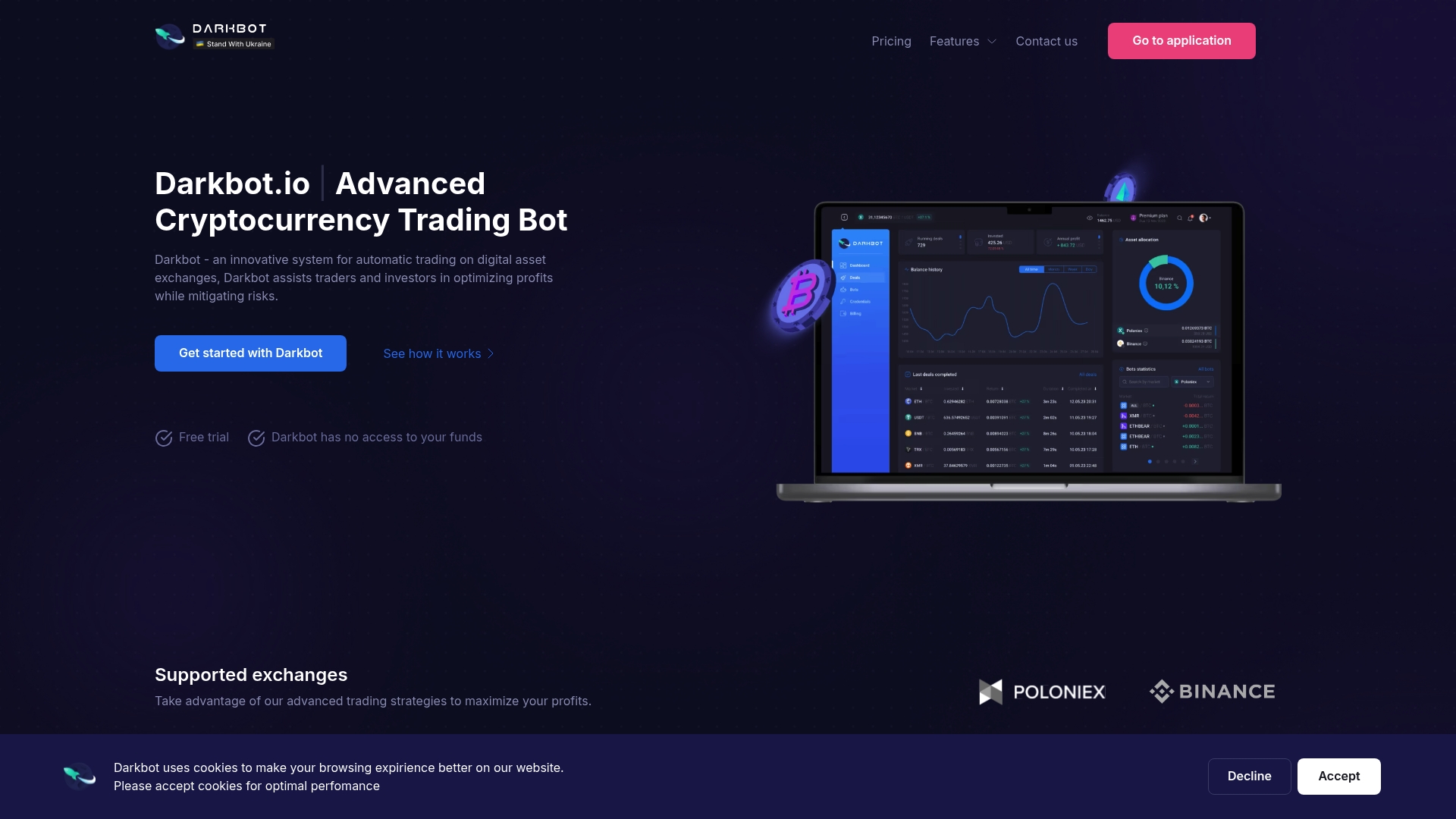
- Compare plan details on our pricing page, including Free, Standard Plan, and Premium Plan.
- Start with paper trading or the Free plan to validate a strategy before funding it.
- Enterprise teams can contact support through the appropriate channels for custom deployment questions.
FAQ
How much do trading bots cost?
Costs vary by platform and tier. Our own plans run from a Free tier with limited features up to a Standard Plan at $12.50 per month and a Premium Plan at $25.00 per month, with Enterprise pricing available on request.
Can you use OKX in the USA?
Availability depends on the state, since OKX’s US access varies by jurisdiction, with some features like derivatives trading restricted in certain states. Traders should confirm current availability directly with the exchange before building a strategy around it.
Can you use AI to trade crypto?
AI can support crypto trading as a tool for pattern evaluation, parameter tuning, and risk management, rather than as a prediction engine. It works best as part of a systematic, rule-based process that adapts within defined risk limits, not as a guarantee of outcomes.
What is the most profitable crypto trading bot?
No single bot can claim guaranteed profitability, since results depend on strategy design, market conditions, and execution quality rather than the platform alone. A more useful comparison looks at execution metrics like slippage and fill rate during backtesting, since these factors shape outcomes more reliably than any single performance claim.
Sources
- Slippage attacks explained: How MEV bots exploit price movement during transaction execution — Onchain Diary
- Agentic-BeesTrap (BeeTrap) — GitHub
Recommended

Start trading on Darkbot with ease
Come and explore our crypto trading platform by connecting your free account!
Free plan available • No credit card required