Examples of Risk Management Tools for Crypto Traders
TL;DR:
- Risk management tools identify, evaluate, and control financial exposure to prevent losses. They range from simple risk matrices and registers for retail traders to advanced simulations and enterprise platforms for institutional use. Consistent updating and linking controls to risks are essential for effective crypto trading risk management.
Risk management tools are defined as structured frameworks, software systems, and analytical methods that identify, quantify, and control financial exposure before losses occur. For cryptocurrency traders and investors, the most practical examples of risk management tools include risk matrices, risk registers, Monte Carlo simulations, and enterprise risk management platforms. Each serves a distinct function: some classify risk qualitatively, others model it probabilistically, and the best platforms connect risks directly to active controls. Choosing the right combination determines whether a trading strategy survives volatility or collapses under it.
1. What are the most effective examples of risk management tools?
Risk matrices, risk registers, Monte Carlo simulations, screening checklists, and enterprise risk management platforms form the core toolkit for serious traders. Each tool addresses a different layer of risk, from qualitative scoring to quantitative scenario modeling.
- Risk matrices assign numerical scores to threats based on likelihood and impact. The 5x5 Risk Matrix scores risks from 1 to 25, classifying scores 13–18 as High and 19–25 as Critical. That scoring range gives traders a fast, consistent way to prioritize which market or operational risks demand immediate attention.
- Risk registers are centralized documents that log every identified risk, its owner, its current status, and the controls in place. Regular updates, such as monthly reviews, are required for a register to remain accurate. A stale register is worse than no register because it creates false confidence.
- Monte Carlo simulations run thousands of price and loss scenarios to produce probability distributions of outcomes. This method surpasses simple projections by capturing fat-tail risks, the low-probability, high-damage events that destroy underprepared portfolios.
- Cyber self-assessment checklists classify exposure as High, Moderate, or Low and prompt corrective actions. For crypto traders, wallet security and exchange API exposure are the primary targets of these tools.
- Enterprise risk management platforms consolidate multiple risk domains into one system. Platforms at this level enable end-to-end governance, risk, and compliance management, though implementations take months and require significant resources.
Pro Tip: Start with a risk register and a 5x5 matrix before investing in any software platform. These two tools cost nothing and force you to articulate your actual risk exposure in writing.
2. How risk assessment tools apply in cryptocurrency trading
Cryptocurrency markets present risks that generic corporate tools were not designed for: 24/7 price swings, exchange counterparty risk, smart contract vulnerabilities, and regulatory uncertainty. The tools above adapt to these conditions in specific ways.
A risk matrix applied to crypto trading classifies threats like exchange insolvency, liquidity gaps, or protocol exploits using the same 1–25 scoring logic used in enterprise settings. The output is a ranked list of threats, not a vague sense of danger. That ranking tells you where to place controls first.
Risk registers track crypto-specific risks over time. A trader running positions across three exchanges needs a register that logs each exchange’s counterparty risk, the controls in place (such as withdrawal limits or cold storage ratios), and the date those controls were last verified. Linking risks to mitigating controls and tracking control health in real time is a professional-grade practice that most retail traders skip entirely.
Monte Carlo simulations model price path distributions for a given asset or portfolio. In crypto, where daily moves of 10–20% are common, a simulation that runs 10,000 scenarios reveals the realistic range of drawdowns, not just the expected case. Scenario analysis compares mitigation strategies before capital is allocated, which is far more useful than reviewing losses after the fact.
Screening checklists apply directly to wallet security, API key permissions, and exchange account settings. A trader who runs a structured self-assessment before connecting a new exchange integration catches misconfigured permissions before they become an attack vector.
Pro Tip: After completing any risk assessment, map each identified risk to a specific control. If a control fails, your risk score for that item should automatically increase. This is the logic that separates active risk management from passive documentation.
3. Comparing risk management tool categories for crypto investors
Not every tool fits every trader. The right choice depends on trading volume, portfolio complexity, technical skill, and available time. The table below compares the main tool categories across the factors that matter most to crypto traders.
| Tool category | Ease of use | Automation support | Quantitative modeling | Integration with trading workflows | Implementation effort |
|---|---|---|---|---|---|
| Risk matrix (5x5) | High | None | None | Manual | Minimal |
| Risk register | High | Partial | None | Manual or spreadsheet | Low |
| Monte Carlo simulation | Low | Partial | High | Requires setup | Moderate |
| Cyber self-assessment checklist | High | None | None | Manual | Minimal |
| Enterprise risk management platform | Moderate | High | High | API-based | High |
The trade-off is clear. Lightweight tools like matrices and registers are fast to deploy and require no technical infrastructure. They work well for retail traders managing a small number of positions. Enterprise platforms provide a single source of truth by breaking down data silos and giving consistent risk visibility across all positions and accounts. That level of integration matters when portfolio complexity grows beyond what a spreadsheet can track.
Monte Carlo simulations sit in the middle. They require statistical literacy and some setup time, but they deliver probability distributions that no matrix or register can produce. For traders managing significant capital in volatile assets, the modeling depth justifies the effort.
4. Choosing risk management tools based on your trader profile
The right set of tools depends on where you are in your trading practice, not on what sounds most sophisticated.
Beginner and retail traders benefit most from three things: a simple risk register in a spreadsheet, a 5x5 risk matrix for scoring new positions, and a crypto trading risk checklist that enforces position sizing rules like the 1–2% rule. These tools cost nothing and build the habit of structured thinking before every trade.
Intermediate traders managing multiple assets or exchange accounts should add a cyber self-assessment checklist and begin tracking control health alongside risks. Crypto risk management fundamentals show that derivatives are widely used as hedging controls. Knowing which controls are active and functioning changes how you score your total exposure.
Advanced and institutional traders require quantitative modeling and automation. Monte Carlo simulations belong at this level, along with platforms that connect risk scoring to execution logic. Smart automation in risk management applies rule-driven decision frameworks that remove emotional bias from high-stakes positions.
The structured risk assessment process defined by Ready.gov, which involves identifying hazards, analyzing scenarios, and prioritizing significant risks, applies directly to crypto portfolio management regardless of trader level.
Pro Tip: Add one tool at a time. Traders who try to implement a full enterprise risk framework overnight abandon it within a week. A risk register used consistently beats a Monte Carlo model used once.
Key takeaways
Effective crypto risk management requires structured tools applied consistently, not sophisticated software used occasionally.
| Point | Details |
|---|---|
| Start with a risk register | Log every risk, its owner, and its control before adding any software platform. |
| Use the 5x5 matrix for scoring | Scores 13–18 signal High risk; scores 19–25 signal Critical risk requiring immediate action. |
| Monte Carlo for fat-tail risks | Probability distributions reveal realistic drawdown ranges that simple projections miss. |
| Link risks to active controls | A control that fails should automatically raise the risk score it was suppressing. |
| Match tools to trader level | Retail traders need checklists and registers; advanced traders need quantitative modeling and automation. |
Why the tool is only half the answer
The most common mistake I see among crypto traders is treating risk management as a one-time setup. They build a risk register, run one simulation, and then leave it untouched for months. Markets change. Exchange counterparty risk shifts. New protocols introduce new attack surfaces. A risk register that was accurate in january is misleading by april if nobody updated it.
The set-and-forget mindset is the single biggest failure mode in risk management practice. The tool does not manage risk. The process does. A 5x5 matrix reviewed weekly is worth more than an enterprise platform reviewed quarterly.
I also think traders underestimate the value of control linkage. Knowing that a risk exists is useful. Knowing that the control suppressing that risk is currently active and functioning is far more useful. When a control fails, the risk score for every item it was covering should increase automatically. Most basic tools do not do this. Real-time control tracking is where professional risk management separates from amateur documentation.
AI and automation belong in this picture, but not as predictors. They belong as consistency mechanisms. A rule-based system that executes the same position sizing logic on every trade removes the emotional drift that makes manual risk management unreliable over time. That is the correct use of automation in a risk framework.
— Grisha
Darkbot and systematic risk control for crypto traders
Structured risk management requires consistent execution, and that is where automation earns its place in a trading framework.
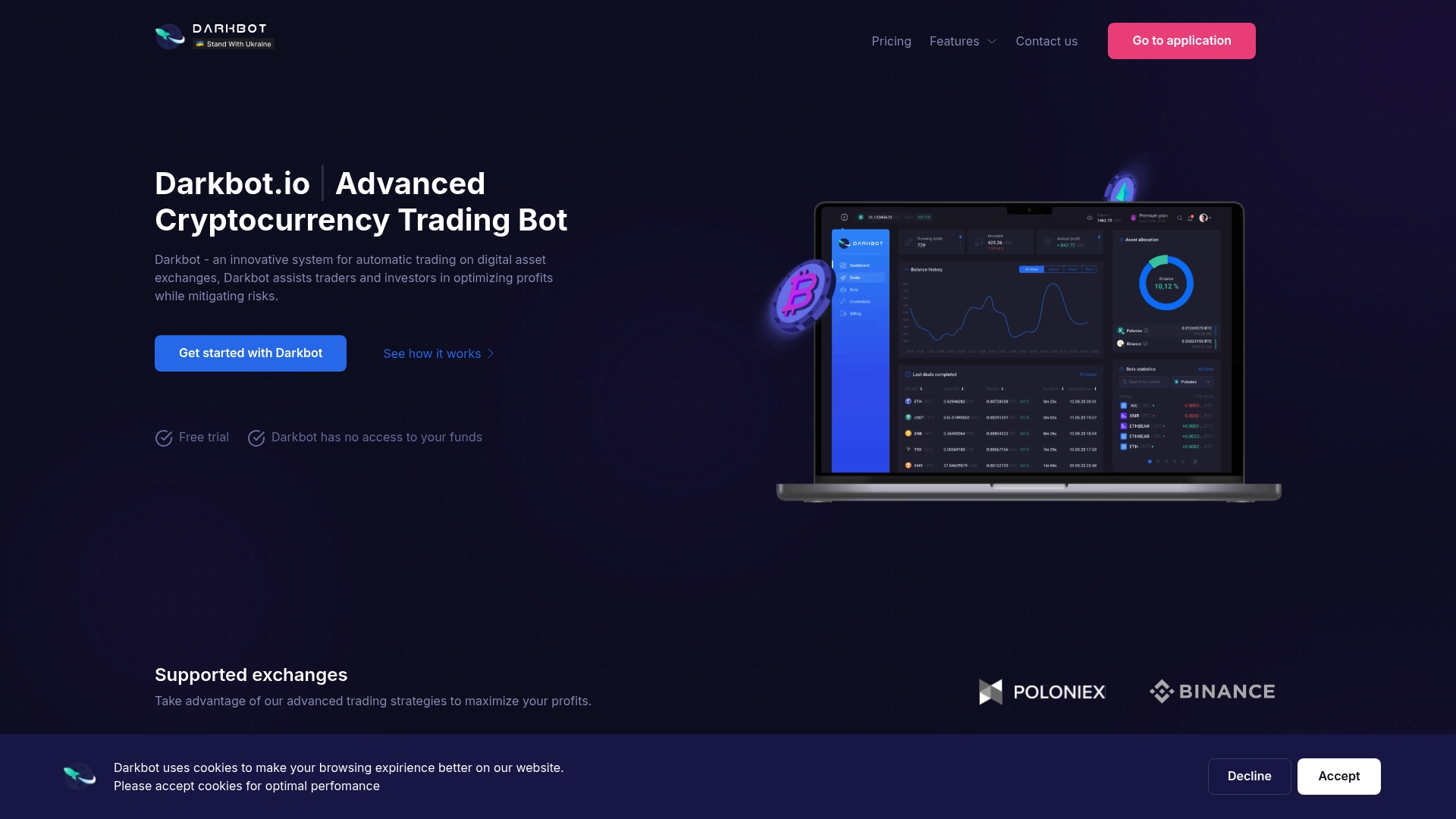
Darkbot applies rule-driven decision logic across multiple exchanges, enforcing position sizing, automated rebalancing, and portfolio-level risk controls without manual intervention on every trade. The platform connects portfolio management directly to execution, so risk parameters set in your strategy translate into actual trade behavior rather than staying as notes in a spreadsheet. For traders who have built their risk framework and want it enforced consistently, Darkbot provides the execution layer. The AI-powered trading platform is built around repeatable logic, not market prediction.
FAQ
What are the main examples of risk management tools?
The main examples include risk matrices, risk registers, Monte Carlo simulations, cyber self-assessment checklists, and enterprise risk management platforms. Each tool addresses a different layer of risk, from qualitative scoring to probabilistic scenario modeling.
How does a 5x5 risk matrix work in crypto trading?
The 5x5 matrix scores each risk from 1 to 25 based on likelihood and impact. Scores of 13–18 classify as High and 19–25 as Critical, giving traders a consistent framework for prioritizing threats across their portfolio.
Why do risk registers need regular updates?
A risk register reflects the state of your risks and controls at a specific point in time. Markets and conditions change, so monthly reviews are the minimum needed to keep the register accurate and useful for decision-making.
What is Monte Carlo simulation used for in trading?
Monte Carlo simulation runs thousands of price and loss scenarios to produce probability distributions of outcomes. It captures fat-tail risks that simple projections miss, making it the most rigorous quantitative tool available for portfolio risk analysis.
How do I choose between lightweight tools and enterprise platforms?
Retail traders with a small number of positions get the most value from risk registers and matrices, which require no technical setup. Enterprise platforms suit institutional traders who need automated control tracking, cross-domain integration, and consistent reporting across large, complex portfolios.
Recommended

Start trading on Darkbot with ease
Come and explore our crypto trading platform by connecting your free account!
Free plan available • No credit card required