Portfolio Management Tips for Crypto Investors in 2026

TL;DR:
- Effective crypto portfolio management relies on a structured approach that includes setting clear allocation targets and rebalancing rules. Limiting holdings to under 20 positions and applying a core-and-explore framework helps maintain focus and reduce over-diversification. Automating rebalancing and documenting investment rules prevent emotional decisions during volatile markets.
Effective portfolio management is defined as the disciplined process of selecting, maintaining, and adjusting a mix of investments to control risk and improve long-term returns. For cryptocurrency investors, this process carries extra weight. Crypto markets move faster and swing harder than traditional asset classes, which means the gap between a structured approach and an improvised one shows up quickly in results. The portfolio management tips in this article draw from established investment frameworks, including the core-and-explore method, Investment Policy Statements (IPS), and risk parity principles, adapted specifically for digital asset portfolios.
1. What are the best portfolio management tips for crypto investors?
The most effective portfolio management starts with structure, not stock picks. Before choosing which assets to hold, investors need a documented framework that defines allocation targets, rebalancing rules, and risk limits. Without that structure, every market swing becomes a decision point, and emotional decisions compound into poor outcomes.
The core portfolio management tips covered here are:
- Build a core-and-explore portfolio structure
- Match asset allocation to your time horizon
- Rebalance on a fixed schedule
- Limit total holdings to avoid over-diversification
- Avoid leverage in volatile markets
- Document rules in an Investment Policy Statement
- Resist overtrading and chasing short-term price moves
Each tip addresses a specific failure mode that crypto investors face. The sections below explain the reasoning and mechanics behind each one.
2. How the core-and-explore approach structures a crypto portfolio
The core-and-explore method divides a portfolio into two distinct parts: a stable core and a smaller active component. The core holds broadly diversified, long-term positions in major assets. The exploratory portion holds a limited number of high-conviction, speculative positions.

This structure solves a real problem. Crypto investors often chase every new token or trend, spreading capital across dozens of positions. Diversification benefits taper significantly after roughly 14 assets, and holding more than 20–30 positions risks diluting returns without meaningfully reducing risk. That means a portfolio of 40 tokens is not safer than one of 15. It is just harder to manage and less likely to outperform.
The core-and-explore approach suits crypto markets by keeping the active portion small and high-conviction. Limiting exploratory positions to 20 or fewer gives each position enough weight to matter when it performs well.
- Core holdings: Major crypto assets with established liquidity and long track records. These require minimal active management.
- Exploratory positions: Smaller allocations to higher-risk, higher-potential assets. Each position should have a clear thesis.
- Total position count: Keep the combined portfolio under 20 positions to maintain focus and avoid complexity.
- Review frequency: Assess exploratory positions more often than core holdings, but avoid reacting to daily price moves.
Pro Tip: Write a one-sentence thesis for every exploratory position before buying. If you cannot articulate why you own it, do not own it.
3. How to match asset allocation to your time horizon in crypto
Time horizon is the most important variable in asset allocation. Risk tolerance matters, but it is secondary. An investor who needs capital in 18 months should not hold it in volatile assets regardless of how comfortable they feel with risk in the abstract.
Long-term portfolios often hold 70–90% in growth assets, adjusted by age and near-term cash needs. The same logic applies in crypto. Capital you will not need for five or more years can tolerate significant drawdowns. Capital needed within one to three years should sit in lower-volatility positions or outside crypto entirely.
Risk parity offers a useful framework for the allocation itself. Ray Dalio’s risk parity approach balances risk contributions across asset classes so the portfolio holds up across different economic conditions. In crypto terms, this means not concentrating all risk in a single asset category, even within the digital asset space.
| Allocation approach | Best suited for | Key trade-off |
|---|---|---|
| Growth-heavy (70–90% crypto) | Long time horizons, 5+ years | High upside, high drawdown risk |
| Balanced (50–70% crypto) | Medium horizons, 3–5 years | Moderate growth, reduced volatility |
| Conservative (under 50% crypto) | Short horizons or near-term needs | Capital preservation, lower growth |
Pro Tip: Document your time horizon and allocation targets in an Investment Policy Statement before markets move. Decisions made in advance are almost always better than decisions made during a drawdown.
4. What rebalancing practices keep a crypto portfolio on track
Rebalancing is a critical but frequently neglected maintenance task. Without it, a portfolio’s actual allocation drifts away from its target as individual assets move at different rates. In crypto, where a single asset can double or halve in weeks, drift happens fast.
A systematic rebalancing process follows these steps:
- Set a target allocation. Define what percentage each asset or asset category should represent at baseline.
- Choose a rebalancing trigger. Either a fixed schedule (quarterly or annual) or a threshold rule (rebalance when any position drifts more than 5–10% from target) works. Both are valid. Pick one and document it.
- Review on schedule. Do not skip reviews because markets feel calm or chaotic. The schedule exists precisely to remove that judgment call.
- Execute without discretion. Sell what has grown overweight. Add to what has shrunk underweight. Do not let recent performance influence the decision.
- Record every rebalance. Keeping a log makes it easier to evaluate whether the process is working and to stay accountable.
Automated portfolio rebalancing tools remove the execution burden and reduce the chance of skipping a scheduled review. Automation does not replace the decision framework. It enforces it.
5. What common mistakes undermine crypto portfolio management
Investor behavior is the greatest risk to portfolio success. Market volatility does not destroy most portfolios. Emotional reactions to volatility do. The most common mistakes follow predictable patterns.
- Overtrading. Frequent trading attempts to capture short-term moves rarely improve returns. Large gains come from holding winners through volatility, not from timing every swing.
- Using leverage. Leverage magnifies losses in proportion to gains. In crypto, where 30–50% drawdowns occur within normal market cycles, margin positions can force liquidation at the worst possible moment.
- Holding too many positions. Spreading capital across 40 or 50 tokens creates the illusion of diversification while making it impossible to track each holding’s thesis or performance.
- Ignoring the IPS. An Investment Policy Statement reduces panicked decision-making by defining rules in advance. Investors who skip this step make it up as they go, which means market noise drives their decisions.
- Chasing recent performance. Buying assets after they have already run up and selling after they have dropped locks in the worst version of every trade.
Pro Tip: Before acting on any impulse trade, check whether it fits your documented IPS. If it does not, do not execute it. The IPS is the filter, not the obstacle.
6. How to track portfolio performance without overreacting to noise
Performance tracking serves one purpose: determining whether your process is working, not whether markets moved in your favor this week. These two things are not the same.
Set a benchmark before you start. For a crypto portfolio, a reasonable benchmark might be a weighted index of major assets or a simple Bitcoin-only position. Measuring against a benchmark tells you whether your allocation decisions are adding value relative to simply holding the market.
Review performance on the same schedule as your rebalancing review. Checking prices daily creates a feedback loop that encourages overtrading. Checking quarterly gives enough data to evaluate trends without generating noise-driven decisions.
Track the metrics that reflect process quality: allocation drift from target, number of rebalances executed on schedule, and whether each position still fits its original thesis. Return figures matter, but they are the output of a good process, not a substitute for one.
Key takeaways
Disciplined crypto portfolio management requires a documented structure, fixed rebalancing rules, and strict limits on position count and leverage.
| Point | Details |
|---|---|
| Use core-and-explore structure | Separate stable long-term holdings from a small number of high-conviction active positions. |
| Match allocation to time horizon | Capital needed within three years should not sit in high-volatility assets. |
| Rebalance on a fixed schedule | Quarterly or annual reviews restore target allocation and prevent drift. |
| Limit holdings to under 20 positions | Diversification benefits taper after roughly 14 assets; more positions dilute returns. |
| Document rules in an IPS | A written Investment Policy Statement removes emotional decision-making during market stress. |
What I have learned about discipline in crypto portfolio management
The biggest mistake I see crypto investors make is treating portfolio management as a performance problem when it is actually a process problem. They tweak allocations, chase new tokens, and obsess over weekly returns. The process itself never gets examined.
The core-and-explore framework changed how I think about this. Having a stable core means I do not need to react every time a new asset generates excitement. The exploratory portion handles that. Each part of the portfolio has a defined role, and that clarity reduces the number of decisions I need to make under pressure.
The Investment Policy Statement is the tool I underestimated the longest. Writing down your rules before markets move feels bureaucratic. Using those rules during a 40% drawdown feels like a lifeline. The IPS does not guarantee good outcomes. It prevents the worst self-inflicted ones.
AI-driven automation has made the execution side more consistent. Platforms like Darkbot enforce rebalancing schedules and risk parameters without the hesitation that comes from watching a position move against you in real time. The value is not in the AI making better predictions. The value is in removing the moment where emotion can override the plan.
Process quality is the only thing you fully control. Focus there first.
— Grisha
Darkbot and automated crypto portfolio management
Crypto portfolio management works best when the execution matches the plan. Darkbot is an AI-driven trading automation platform built for exactly that purpose.
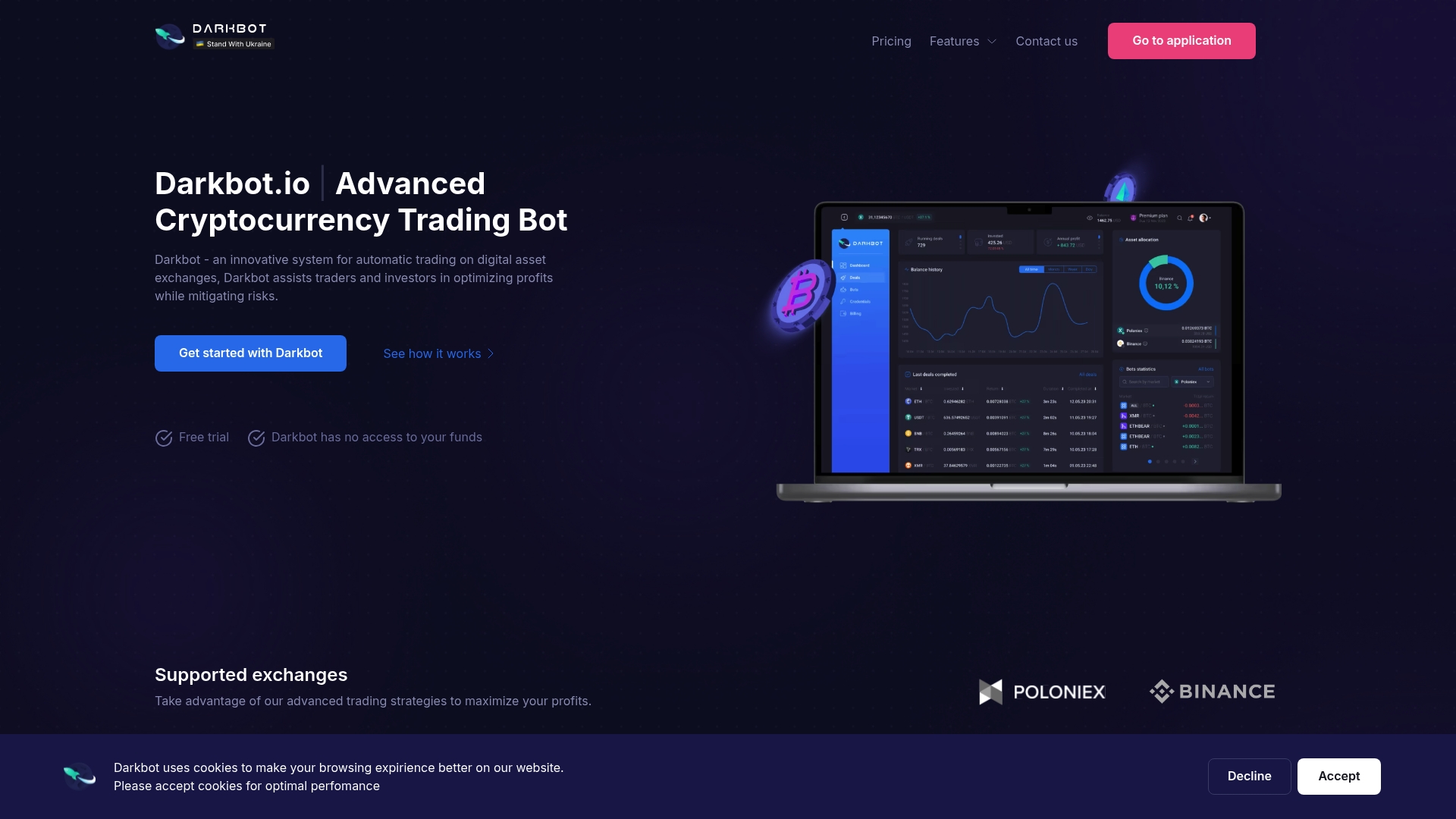
Darkbot enforces rebalancing schedules, applies rule-based risk controls, and runs multiple strategies simultaneously across exchanges without requiring manual intervention on every trade. The platform supports portfolio management and optimization for both core holdings and active positions, keeping allocation targets intact as markets move. For investors who have built a solid framework and want consistent execution behind it, Darkbot’s automation tools handle the operational side so the strategy stays intact.
FAQ
What is the core-and-explore portfolio method?
The core-and-explore method divides a portfolio into a stable long-term core and a smaller active component for high-conviction positions. Limiting total holdings to under 20 positions prevents over-diversification from diluting returns.
How often should I rebalance a crypto portfolio?
Quarterly or annual rebalancing schedules are the most common and effective approaches. The key is choosing a fixed schedule and executing it consistently, regardless of recent market performance.
Why is leverage dangerous in crypto investing?
Leverage amplifies losses in proportion to gains, and crypto’s frequent 30–50% drawdowns can trigger margin calls that force positions to close at severe losses. Avoiding leverage preserves capital through volatile periods.
What is an Investment Policy Statement and why does it matter?
An Investment Policy Statement is a written document that defines your allocation targets, rebalancing rules, and procedures for handling market downturns. It reduces emotional decision-making by establishing rules before market stress occurs.
How many assets should a crypto portfolio hold?
Diversification benefits diminish significantly after roughly 14 assets. Holding more than 20–30 positions risks diluting returns without meaningfully reducing risk, so most investors benefit from keeping total holdings under 20.
Recommended

Start trading on Darkbot with ease
Come and explore our crypto trading platform by connecting your free account!
Free plan available • No credit card required