Best Fibozachi.com Alternatives for AI Crypto Trading

For traders looking for fibozachi.com alternatives in the automated crypto trading space, Darkbot is the recommended starting point: it combines AI-driven execution with structured risk controls across multiple exchanges. Beyond Darkbot, the field breaks into three broad categories worth knowing before you commit.
- Cloud multi-exchange platforms (e.g., Darkbot): hosted execution, API integration across major exchanges, adaptive parameter tuning, portfolio management, and risk controls. Best for traders who want automation without managing infrastructure.
- Strategy-marketplace platforms: prebuilt or community-sourced strategies you subscribe to or copy. Useful for non-coders; requires careful vetting of performance claims.
- Self-hosted scripting engines: full control, no third-party custody, but demands technical skill and ongoing maintenance.
- Exchange-native bot suites: built into exchange UIs, rule-based (grid, DCA), minimal setup, limited AI features.
How these platforms compare on the features that matter
| Dimension | Darkbot | Cloud Multi-Exchange | Strategy Marketplace | Self-Hosted Engine | Exchange-Native |
|---|---|---|---|---|---|
| Best for | Automated AI-driven trading, portfolio mgmt | Cross-exchange automation | Non-coders, quick deploy | Quants, developers | Beginners, low capital |
| Pricing / free trial | Free tier + paid plans, money-back guarantee | Subscription; some free tiers | Subscription + strategy fees | One-time or open-source | Usually free |
| AI / algorithmic | AI/ML-driven, adaptive tuning | Varies; often rule-based | Rule-based or copied | Custom ML possible | Rule-based only |
| Strategy customization | Configurable parameters, multi-bot | Moderate to high | Low to moderate | Full scripting | Minimal |
| Backtesting & paper trading | Yes, both | Varies | Varies | Yes | Rarely |
| Supported exchanges | Major US-accessible exchanges | Multiple | Platform-dependent | Any via custom API | Single exchange |
| Security / API model | Encrypted key storage, 2FA, trade-only API | Varies by vendor | Varies | Self-managed | Exchange-native |
| Deployment | Cloud (SaaS) | Cloud | Cloud | Local / VPS | Exchange UI |
| Support / docs | Personalized support, documentation | Community + docs | Community | Self-serve | Exchange support |
Before subscribing to any platform, confirm it supports your specific exchange and trading pair. Exchange coverage changes; verify directly with the vendor rather than relying on marketing pages.
1. Darkbot — the recommended pick for U.S. traders
Darkbot operates as a cloud SaaS platform that connects to exchanges via API and executes strategies using AI and machine learning. The core design priority is consistency: the system applies rule-driven logic and probabilistic pattern evaluation rather than discretionary judgment, which removes the emotional bias that undermines most manual crypto trading.
Key capabilities:
- Automated rebalancing and portfolio management across positions
Pricing follows a freemium model: a free tier with limited features, standard and premium paid tiers, and a two-week money-back guarantee. The free plan is a practical entry point for testing the interface before committing capital.
The main consideration is onboarding time. Traders unfamiliar with API configuration will need to work through the setup process carefully. That said, the documentation covers API permission hygiene explicitly, and the platform’s support model is more hands-on than most category peers.
2. Cloud multi-exchange bot platforms as a category
These platforms host execution infrastructure and connect to multiple exchanges through API keys. You configure a strategy, set parameters, and the platform handles order routing. The convenience tradeoff is that your API credentials live on a third-party server.
What separates better platforms in this category from weaker ones is adaptive parameter tuning and regime detection: the ability to recalibrate strategy behavior when market conditions shift from trending to ranging. Static rule sets tend to underperform across regime changes. Platforms that retrain on rolling data windows handle this materially better.
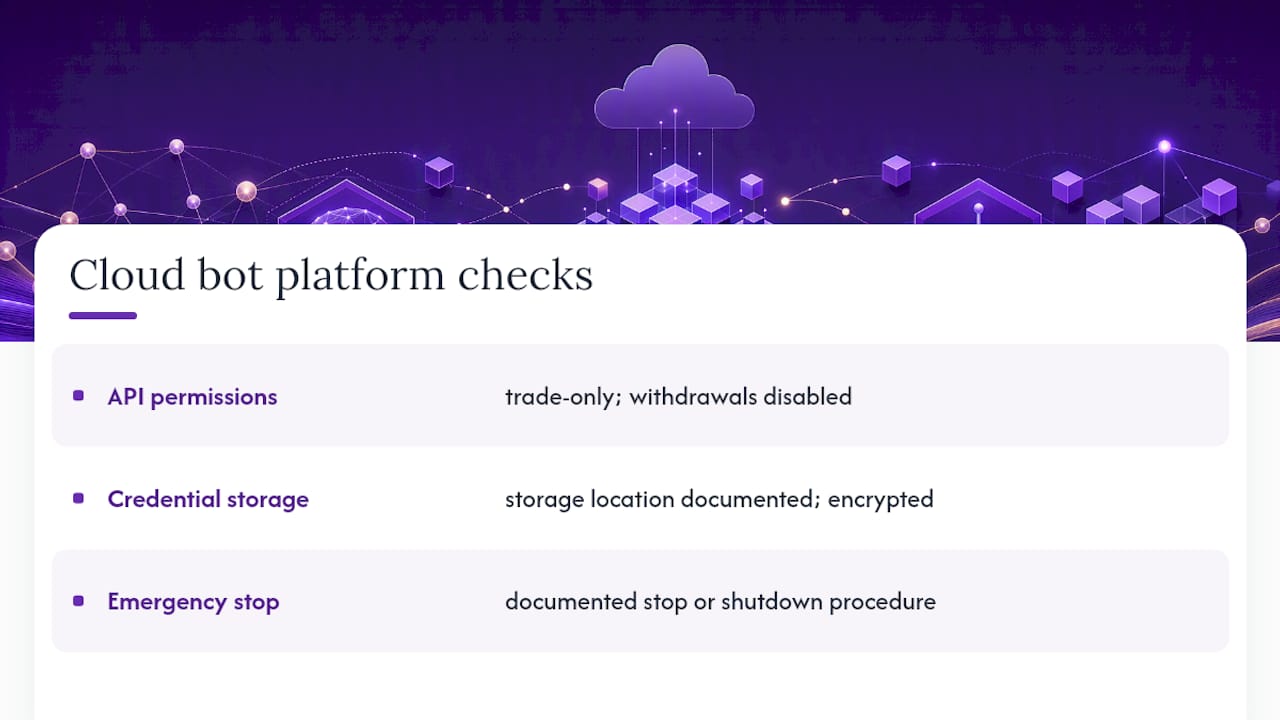
Before subscribing to any cloud platform, verify three things: the API permission model (trade-only, withdrawals explicitly disabled), where credentials are stored and how they are encrypted, and whether the platform provides documented emergency stop or shutdown procedures.
3. Strategy-marketplace platforms work best when you vet them carefully
Marketplace platforms let you subscribe to or copy prebuilt strategies from other traders or the platform’s own library. For traders without coding experience, this lowers the barrier to deployment significantly.
The risk is opaque performance data. Many marketplace listings show backtested returns without disclosing the methodology, the lookback period, or whether the strategy has ever run live. Marketing frequently overstates ML capabilities in this category; a strategy labeled “AI-powered” may be a static indicator rule set with a modern name.
What to verify before using a marketplace strategy:
- Walk-forward test results, not just in-sample backtests
- Whether paper-trading mode is available before live deployment
- The strategy’s drawdown history and maximum loss periods
- Refund or cancellation terms if performance diverges from stated metrics
This category suits traders who want quick deployment and are comfortable doing due diligence on third-party strategy claims.
4. Self-hosted scripting engines give you control at a cost
Self-hosted engines (open-source frameworks or licensed platforms you run on your own server) offer the deepest customization. You write your own execution logic, integrate alternative data sources, and maintain full custody of API keys. No third party touches your credentials.
The operational demands are real. You manage hosting, uptime monitoring, API key rotation, and software updates. A misconfigured bot running unattended on a VPS can accumulate losses faster than a hosted platform with built-in circuit breakers. This category fits experienced developers or quant teams who need custom execution logic and are prepared to treat bot operations as a software engineering responsibility.
For most individual traders, the infrastructure overhead outweighs the custody benefit unless the strategy genuinely requires custom ML integration or latency control that hosted platforms cannot provide.
How to choose the right alternative: checklist, red flags, and a testing plan
Non-negotiable features
- Backtesting with disclosed methodology (lookback period, slippage assumptions, fee inclusion)
- Paper-trading mode before any live capital is deployed
- Explicit API permission guidance: trade-only keys, withdrawals disabled
- Encrypted credential storage and 2FA on the platform account
- Documented emergency stop / shutdown procedure
Red flags
- No restriction on withdrawal API permissions
- Performance claims with no walk-forward evidence
- No paper-trade mode
- Vague or missing documentation on API handling
- Pricing or strategy fees that are not publicly listed
Testing plan
- Weeks 3–4: forward-test with minimal live capital to validate slippage, fill quality, and execution latency against backtest expectations
Pro Tip: Set a maximum drawdown threshold before you start live trading. If the bot hits that threshold in the first 30 days, pause and diagnose before adding capital.
Typical onboarding runs one to two weeks for a cloud platform. Subscription costs vary by tier; most platforms offer a free or low-cost entry point for initial testing. Budget for at least one month of subscription fees before evaluating whether a strategy is performing as expected.
US regulatory compliance and what it means for bot selection
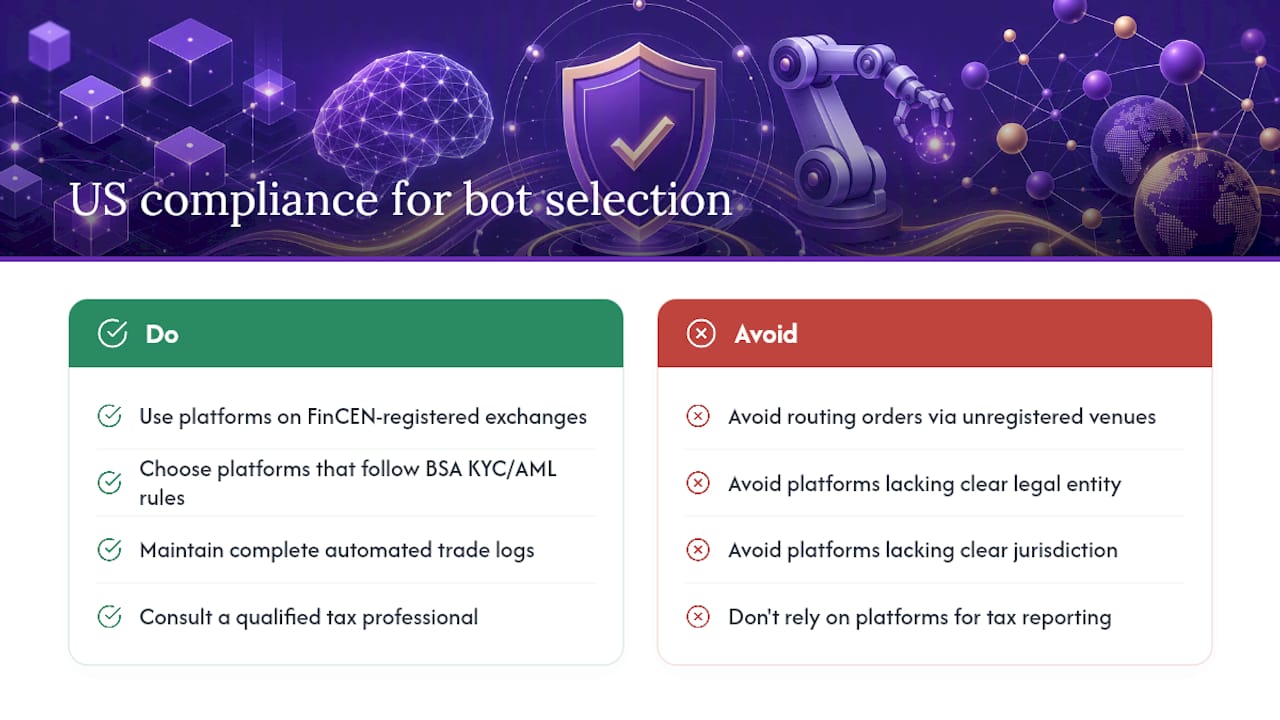
Automated crypto trading in the United States operates under a patchwork of federal and state oversight. The Commodity Futures Trading Commission (CFTC) has jurisdiction over crypto derivatives and futures; the SEC has asserted authority over tokens it classifies as securities. Neither agency certifies trading bots directly, but the platforms connecting to US-regulated exchanges must comply with applicable money transmission and exchange registration requirements.
For traders, the practical implication is straightforward: use platforms that connect to exchanges registered with FinCEN as Money Services Businesses and that comply with Bank Secrecy Act requirements (KYC/AML). Avoid platforms that route orders through unregistered venues or that cannot clearly identify their legal entity and jurisdiction.
No bot platform substitutes for your own tax reporting obligations. Automated trades are taxable events under IRS guidance; maintain complete trade logs and consult a qualified tax professional for your specific situation.
This article is general information, not legal, financial, or tax advice. Verify current regulatory requirements with a qualified professional or the relevant primary sources.
Key Takeaways
Darkbot is the recommended AI-driven alternative for U.S. traders who need multi-exchange automation, structured risk controls, and documented API security practices.
| Point | Details |
|---|---|
| Start with paper trading | Run any bot in paper-trade mode for 1–2 weeks before committing live capital. |
| Restrict API permissions | Always disable withdrawal permissions on exchange API keys before connecting any platform. |
| Verify AI claims | Most retail “AI” bots are rule-based; demand walk-forward test evidence, not just backtests. |
| Match platform to skill level | Exchange-native bots suit beginners; cloud platforms with adaptive tuning suit active traders. |
| Darkbot as starting point | Darkbot offers a free tier, a two-week money-back guarantee, backtesting, paper trading, and encrypted key storage for US traders. |
What most traders get wrong about bot selection
The conventional wisdom says to compare feature lists. In practice, the feature list is the least useful part of the evaluation. Every platform claims backtesting, AI, and multi-exchange support. What actually separates a reliable bot from a costly one is execution quality under real market conditions: slippage on fills, behavior during high-volatility periods, and how the platform handles an exchange API outage.
The second mistake is treating a strong backtest as validation. Backtests are constructed on historical data with assumptions about fill prices and fees that rarely hold in live markets. Forward testing with minimal capital is the only honest test. A bot that performs well on paper for two weeks and then degrades immediately on live capital is telling you something the backtest never could.
The third, and most avoidable, mistake is skipping API permission hygiene. Connecting a bot with full withdrawal permissions is an unnecessary risk. Every major platform supports trade-only API keys. There is no operational reason to grant withdrawal access to a third-party system.
Darkbot offers a structured path from paper trading to live automation
Traders who want a platform built around disciplined execution rather than marketing claims will find Darkbot’s approach worth examining. The free tier lets you configure the system and run paper trades before any subscription decision. Paid plans add multiple simultaneous bots, advanced risk parameters, and priority support.
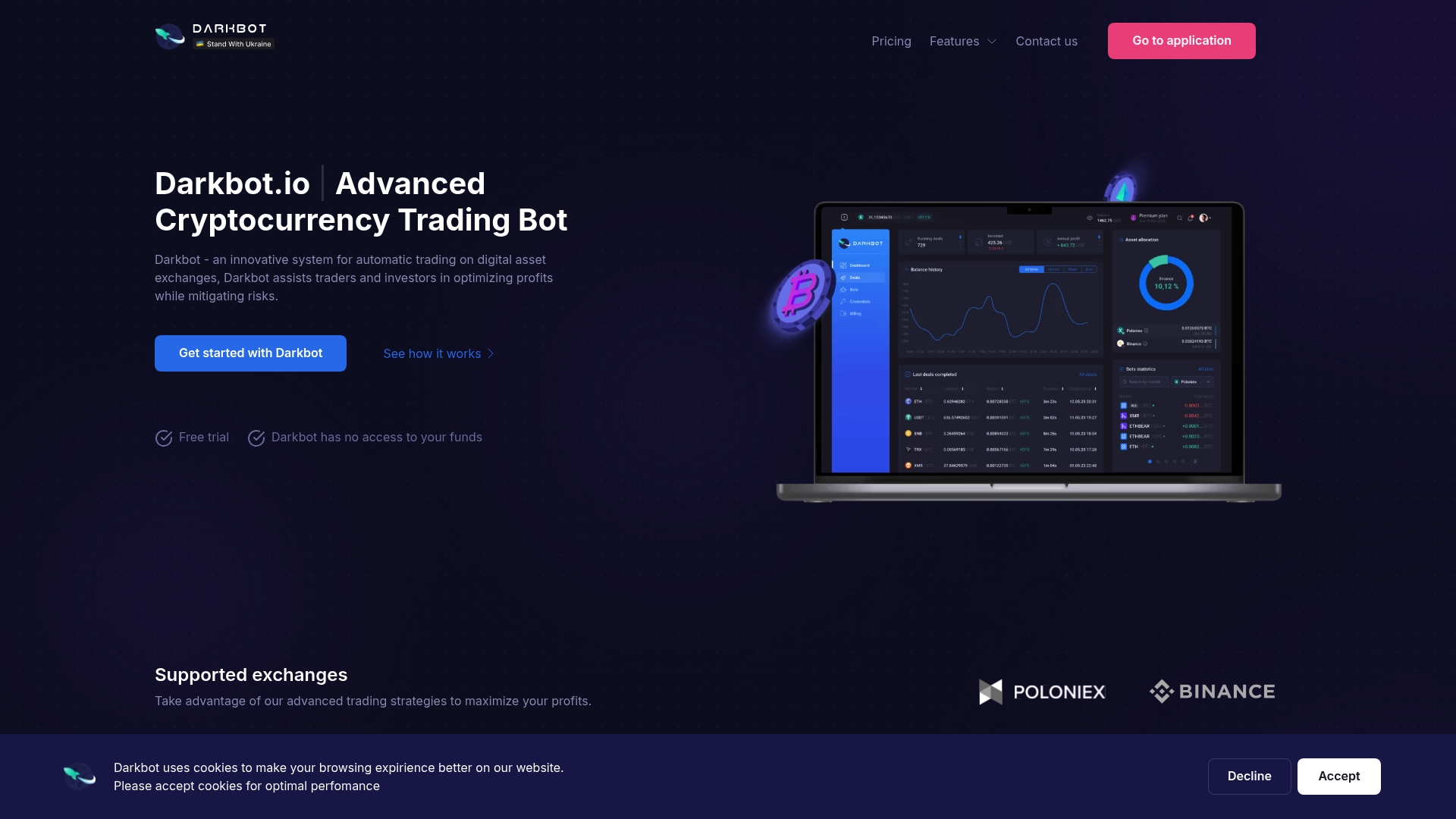
The recommended starting sequence: create trade-only API keys on your exchange (withdrawals disabled), enable 2FA on your Darkbot account, and run the automated trading setup in paper-trade mode for at least one week. Review fill quality and drawdown behavior before switching to live capital. The two-week money-back guarantee gives you a low-risk window to evaluate whether the platform fits your strategy.
Start with the Darkbot free plan and move to a paid tier only after your paper-trade results justify it.
Primary references and further reading
- Benefits of using an automated crypto trading provider — Coinbase: covers automation advantages including 24/7 monitoring, emotional bias removal, and risk-mitigation tools.
- What Is an AI Trading Bot? — Coin Bureau: explains bot taxonomy (rule-based, ML-enhanced, true ML) and vendor vetting guidance.
- How Do AI Crypto Trading Bots Work? — RonOnCrypto: practical API security guidance, including how to configure trade-only keys.
- AI Trading Explained — Dexly: clarifies what “AI” means in practice and warns about overhyped claims in retail bot marketing.
- AI Crypto Trading Bots: Complete Guide — TradeAlgo: covers adaptive parameter tuning, regime detection, and platform category tradeoffs.
- Crypto AI Trading Bots — Kraken Learn: emphasizes forward testing and live small-size deployment to validate backtests against real execution metrics.
Recommended

Start trading on Darkbot with ease
Come and explore our crypto trading platform by connecting your free account!
Free plan available • No credit card required