Best Delphictrading.com Alternatives for Crypto Traders

TL;DR:
- Darkbot is the leading AI-driven SaaS platform for multi-exchange crypto trading, emphasizing security and backtesting.
- Choosing the right platform depends on API security, strategy validation, exchange support, and user skill level.
For U.S. crypto traders searching for SaaS automated trading-bot platforms, the strongest alternatives fall into four categories: AI-driven multi-exchange SaaS (Darkbot is the recommended starting point for most users), hosted no-code SaaS suites, exchange-native automation tools, and managed open-source deployments. Darkbot stands out because it combines AI-driven strategy evaluation, backtesting, paper trading, multi-exchange API integration, and structured API key controls into a single subscription tier.
The core decision criteria are the same regardless of which platform you evaluate:
- Security posture: Does the platform enforce trade-only API keys and support IP whitelisting?
- Backtesting and paper trading: Can you validate a strategy on historical data and then run it in a simulated live environment before committing capital?
- Exchange coverage: Does it connect to the CEXs you actually use, including Coinbase Advanced, Kraken, Binance.US, and Bybit?
- AI/ML features: Does the AI enforce consistent execution and adapt probabilistically, or is it just a label on a rule-based engine?
AI-driven trading systems process large volumes of historical and real-time data and add the most value when strategies adapt within user-defined parameters — not when they claim to predict outcomes. Paper trading is the essential final validation step before any live capital is deployed.
What are the best delphictrading.com alternatives for automated crypto trading?
| Category | Best For | Starting Price / Free Tier | Major US-Friendly CEXs | Backtesting & Paper Trading | AI/ML Features | Strategy Customization | Deployment | Security & API Controls | Support & Docs |
|---|---|---|---|---|---|---|---|---|---|
| Darkbot | Traders needing AI-driven, multi-exchange SaaS with structured risk controls | Free tier available; paid plans from $X/mo | Coinbase Advanced, Kraken, Binance.US, Bybit, and others | Yes — both available | AI strategy evaluation, probabilistic adaptation | Visual + parameter-based | Cloud SaaS | Trade-only keys, IP whitelisting, key rotation | Docs, changelog, personalized support |
| Hosted no-code SaaS | Beginners and template-based strategies | Varies; free tiers common | Varies by vendor | Backtesting common; paper trading varies | Basic signal-based logic | Template-driven, limited scripting | Cloud SaaS | Varies; key permission controls not always enforced | Community forums, help centers |
| Exchange-native bots | Traders who operate on a single exchange | Often free within the exchange | Single exchange only | Limited | Minimal | Narrow, exchange-defined | Exchange-hosted | Tied to exchange security model | Exchange support only |
| Managed open-source / low-code | Developers and quant teams | Infrastructure cost only | Depends on library (CCXT supports 100+ exchanges) | Full control | Fully customizable | Code-level | Self-hosted or managed VPS | Operator-defined; highest control possible | Community, GitHub, self-serve |
Single strongest differentiator per category:
- Darkbot: AI-driven strategy evaluation with paper trading and multi-exchange coverage in a managed SaaS, no infrastructure to run.
- Hosted no-code SaaS: Fast setup with pre-built templates; trade-off is limited strategy depth and vendor lock-in.
- Exchange-native bots: Zero additional subscription cost and tight latency on one exchange; useless the moment you trade elsewhere.
- Managed open-source: Maximum flexibility and code-level control; requires meaningful DevOps time to deploy and maintain.
What does each platform category actually offer in practice?
Managed open-source or low-code hosting
Open-source frameworks serve developers who need modifiable codebases. Libraries like CCXT provide unified API access across 100+ exchanges, and native WebSocket connections handle latency-sensitive execution. For DEX sniping, TypeScript and Rust outperform Python on execution speed.
- Crypto AI trading bots: A beginner’s guide | Kraken
- Crypto Trading Bot Development: Complete Technical Guide | Lycore
- How To Create a Crypto Trading Bot (Step-by-Step) - Merehead
- How To Set Up A Crypto Trading Bot in 2026: Step-by-Step Guide for Beginners and Developers - Coin Bureau
- How Crypto Trading Bots Work in 2026 — Complete Guide | OpenLiquid
- Benefits of automated crypto trading provider | Coinbase Learn
Pro Tip: For teams constrained by development time, a managed SaaS foundation gets you to production faster than a self-hosted open-source stack — the configuration overhead alone on open-source can run several days before a single backtest runs.
How do you choose the right automated trading platform?
Evaluate in this order, since earlier criteria eliminate more options faster:
- API key security controls — Does the platform require only trade permissions? Can you whitelist IPs?
- Backtesting fidelity — Does it use tick-level or OHLCV data? Are fees and slippage modeled?
- Paper trading realism — Does paper trading simulate real order book conditions, or just fill at mid-price?
- Exchange coverage — Does it support every exchange you trade on today, plus the ones you might add?
- Latency and order execution model — Is execution via REST polling or WebSocket? How does it handle rate limits?
- Strategy customization — Can you express conditional logic, multi-leg entries, or custom indicators?
- Pricing model and fees — Is there a per-trade fee on top of the subscription? What happens at volume?
- Support SLA and documentation — Is there a changelog? How active is the community or support channel?
Questions to ask on a vendor demo:
- What API permissions does your platform request, and can I see the exact permission scope?
- Do you support IP whitelisting on API keys?
- What is your key rotation process, and do you store keys encrypted at rest?
- Do you have a SOC 2 report or equivalent security attestation?
- What does your audit log cover, and how long are logs retained?
- How does your paper trading engine model slippage and partial fills?
- What is your cancellation and data export process?
Red flags to walk away from:
- Platform requests withdrawal permissions on API keys.
- No paper trading mode at all.
- Opaque or missing audit trail.
- Fee structure that only becomes clear after connecting an exchange.
- No public documentation, changelog, or community activity.
Coinbase explicitly cautions users to vet third-party automation providers carefully and to use trade-only API keys — exchanges do not endorse third-party bot platforms.
How to set up, test, and launch safely
Realistic timeline:
- Connect exchange API keys: typically requires a short period depending on user experience.
- Configure strategy and parameters: time varies with complexity and user familiarity.
- Backtest on historical data: varies by data range and strategy.
- Paper trade: minimum 2–4 weeks to capture realistic slippage and liquidity conditions.
- Soft-launch with limited capital: first week at reduced position size before scaling.
Starter budget expectations: A cloud SaaS subscription covers hosting. Budget separately for exchange trading fees and a slippage reserve, particularly on lower-liquidity pairs.
Security checklist before going live:
- Create a dedicated API key with trade permissions only — never enable withdrawals.
- Enable IP whitelisting on every exchange that supports it.
- Store API secrets in a secrets manager or vault, not in plaintext config files.
- Enable MFA on both your exchange account and your bot platform account.
- Schedule key rotation at regular intervals and after any suspected exposure.
- Review audit logs after the first week of live trading.
Paper trading detects execution-level issues — slippage, fee modeling, queue priority — that backtests routinely miss. Treat it as the final validation gate, not an optional step.
Pro Tip: Rate limit handling is a common failure point. Before going live, confirm your platform implements exponential backoff and reconnection logic — a bot that hammers an exchange endpoint until it gets banned will cost you more than any subscription fee.
How do users rate these platform categories?
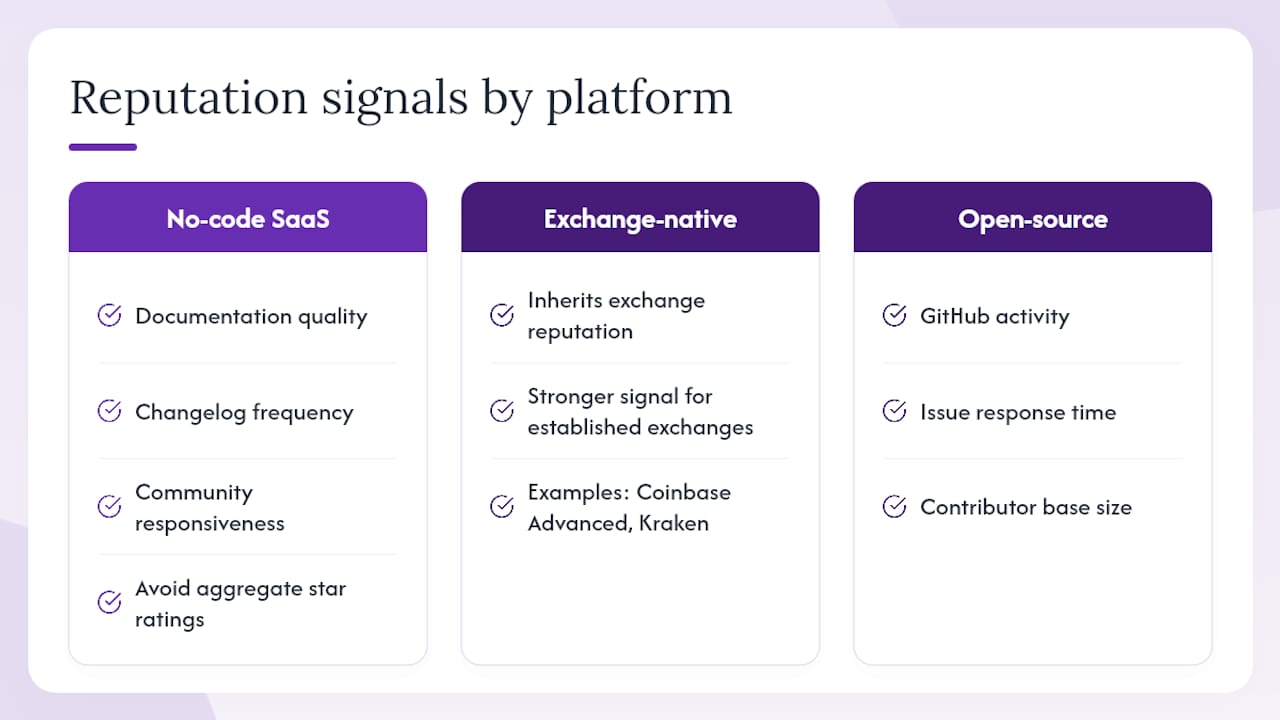
User reputation signals are worth treating as data points rather than verdicts. For any SaaS platform, the most reliable proxies are documentation quality, changelog frequency, and community responsiveness — not aggregate star ratings, which are easy to game.
Darkbot maintains a structured support model with personalized assistance and documented feature updates. For no-code SaaS platforms broadly, documentation and community activity are strong proxies for vendor quality — a vendor with sparse docs and an inactive forum is a vendor that won’t help you when something breaks at 2 AM.
Exchange-native tools inherit the reputation of the exchange itself, which is a meaningful signal for established platforms like Coinbase Advanced or Kraken. Open-source frameworks are assessed by GitHub activity, issue response time, and the size of the contributor base.
One pattern worth noting: negative reviews for bot platforms cluster around two causes. The first is unrealistic return expectations — traders who expected the bot to generate profit regardless of market conditions. The second is security incidents tied to improper API key configuration, almost always withdrawal permissions that should never have been granted.
How do mobile apps compare across platform types?
Mobile availability varies significantly by category. Cloud SaaS platforms like Darkbot are accessible via browser on mobile, with some offering dedicated apps for monitoring and alerts. The experience is generally better suited to oversight than to active strategy configuration — building a multi-parameter strategy on a phone screen is impractical regardless of platform.
Telegram-native bots and mobile-first interfaces dominate some DEX flows where speed-to-trade is the primary variable. For memecoin sniping on Solana or similar chains, a Telegram bot’s one-tap execution is genuinely faster than any desktop workflow. For quant strategies that require complex conditional logic, standalone desktop or web apps remain the practical choice.
Exchange-native bots are fully accessible within the exchange’s own mobile app, which is a real convenience advantage for traders who already live in that app. Open-source self-hosted bots have no mobile interface unless you build one.
The practical takeaway: use mobile for monitoring, alerts, and quick position checks. Reserve configuration, backtesting, and strategy review for a desktop environment where you can see the full parameter set without scrolling.
How broad is exchange compatibility beyond US-focused platforms?
Multi-exchange compatibility is a genuine differentiator. A platform locked to one or two exchanges limits your strategy options as market liquidity shifts across venues.
Darkbot supports a range of major exchanges including Coinbase Advanced, Kraken, Binance.US, and Bybit, covering the primary venues U.S. traders use. Open-source frameworks using CCXT reach the widest exchange set — the library supports over 100 exchanges — but that breadth comes with the infrastructure overhead described earlier.
Exchange-native bots are, by definition, single-exchange. No-code SaaS platforms vary: some support 10–15 exchanges, others fewer. Always verify that the specific exchange you trade on is supported before committing to a subscription, and check whether support includes the full trading API (spot, margin, futures) or only spot.
For traders who operate across both CEX and DEX environments, the architecture diverges significantly. DEX bot development favors TypeScript or Rust for latency-sensitive on-chain interactions, while Python-based frameworks handle most CEX automation adequately. A single SaaS platform rarely covers both well — know which environment is your primary focus before choosing.
Key Takeaways
For most U.S. traders who need AI-driven, multi-exchange SaaS automation with structured security controls, Darkbot is the recommended starting point — paper trade for at least two weeks, enforce trade-only API keys, and scale capital only after validating execution quality.
| Point | Details |
|---|---|
| Security is non-negotiable | Never grant withdrawal permissions to a bot API key; use trade-only keys with IP whitelisting on every exchange. |
| Paper trading before live capital | Run several weeks of paper trading to surface slippage and liquidity issues backtests miss. |
| Match category to your skill level | No-code SaaS suits beginners; open-source frameworks suit developers; exchange-native bots suit single-exchange traders. |
| Evaluate AI claims carefully | AI enforces consistent execution within user-defined parameters — it is not a return guarantee or a prediction engine. |
| Darkbot as starting point | Darkbot combines AI strategy evaluation, multi-exchange API support, backtesting, and paper trading in a single managed SaaS with a free entry tier. |
The gap between automation promises and what actually matters
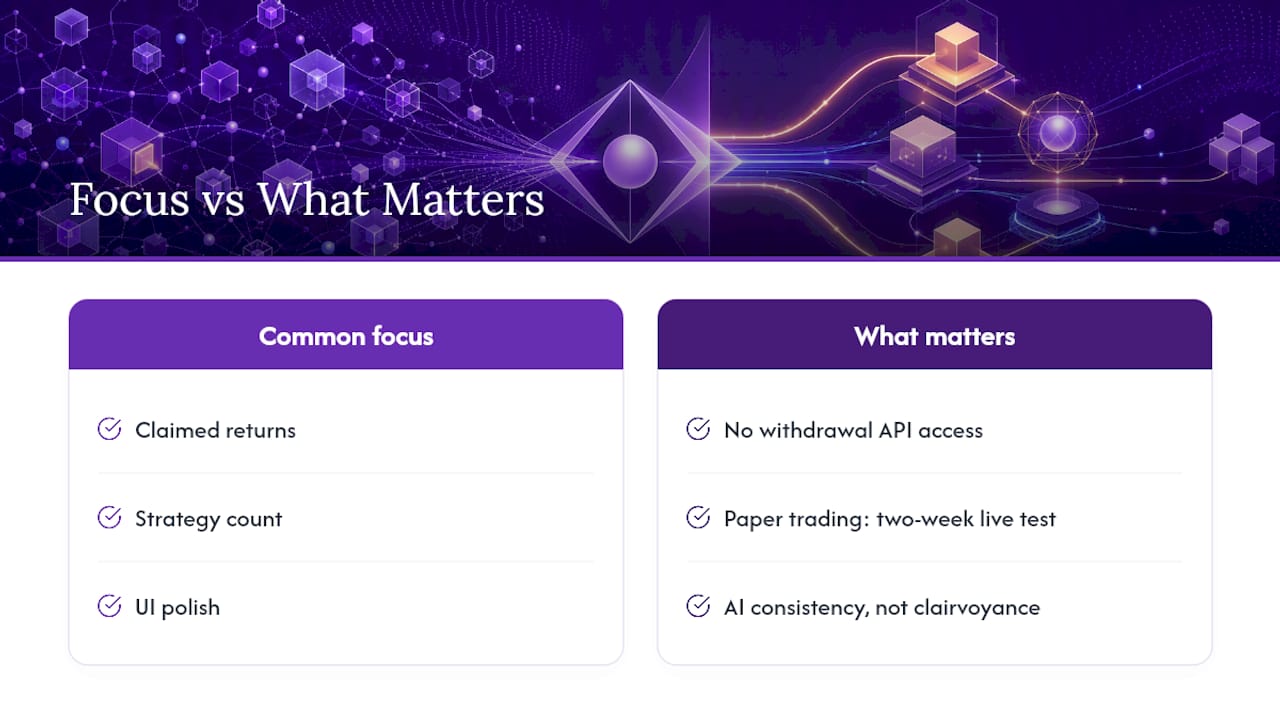
Most traders who evaluate bot platforms focus on the wrong variable first. They look at claimed returns, strategy count, or UI polish — and skip the questions that actually determine whether the platform is safe to use and whether the strategy is sound.
The security question is not a formality. A bot platform that requests withdrawal permissions on your API key is a single point of failure for your entire exchange balance. That risk is not theoretical; it has materialized repeatedly across the industry. The correct answer to “does your platform need withdrawal access?” is always no, and any vendor who hedges that answer deserves a hard pass.
The second underestimated variable is paper trading duration. Two weeks feels long when you are eager to deploy. It is not. A two-week paper trade will surface execution issues — partial fills, slippage on illiquid pairs, fee drag — that a backtest on clean OHLCV data will never show. Skipping it to save time is how traders discover those issues with real capital instead.
On AI specifically: the value is in consistency, not clairvoyance. A well-configured AI bot removes the emotional override that causes human traders to deviate from a tested strategy. That is a real, measurable advantage. It is not a mechanism for generating returns in a market moving against your strategy’s assumptions. Understanding that distinction separates traders who use automation well from those who blame the bot.
For further reading on how AI contributes to systematic execution, the AI applications in digital currencies guide covers the mechanics without overstating the case.
Darkbot: a structured way to trial automated crypto trading
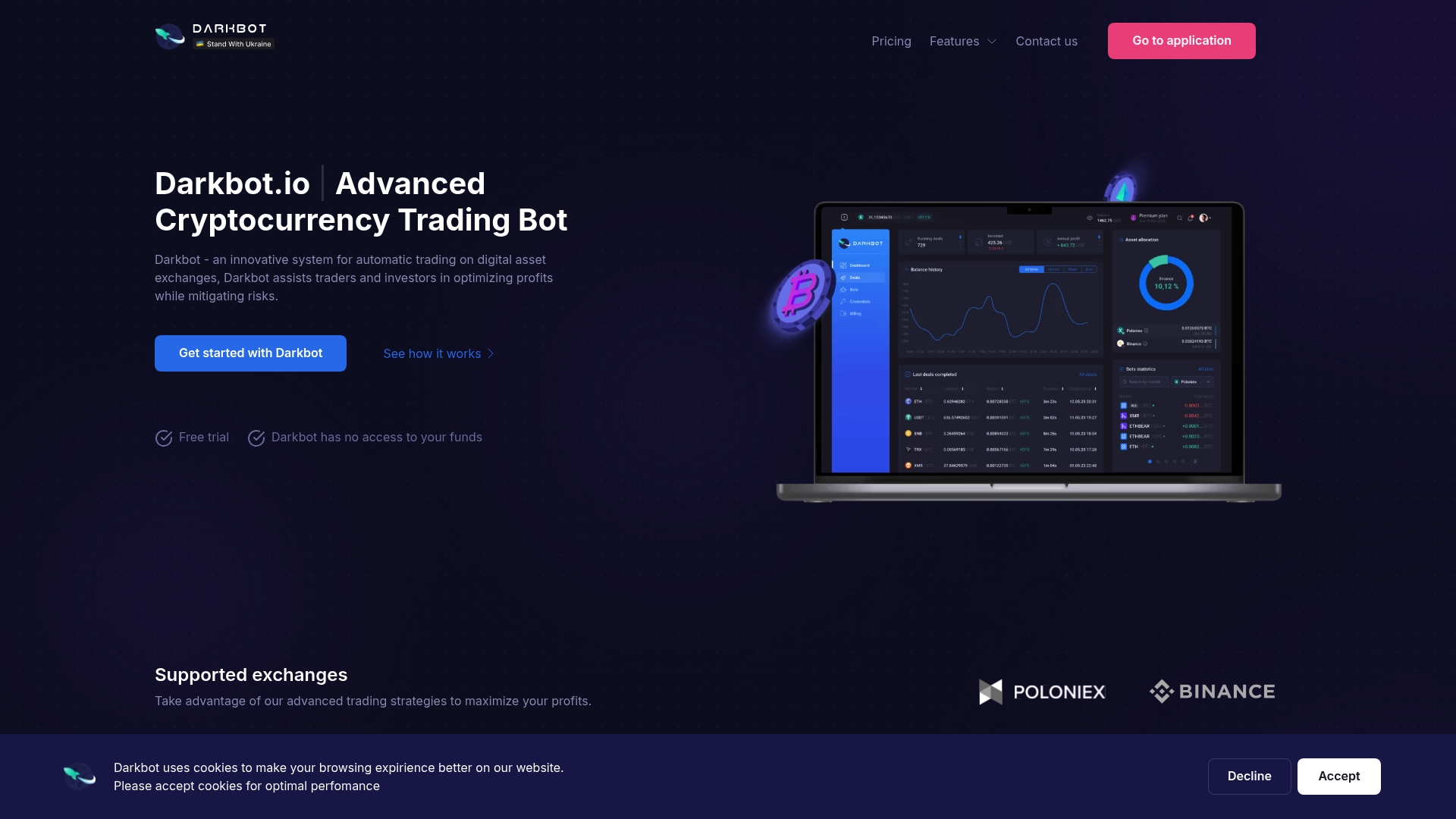
If the comparison above confirmed that you need AI-driven, multi-exchange SaaS automation with real backtesting and paper trading built in, Darkbot is the most direct path to a disciplined first deployment. The free tier lets you connect an exchange, configure a strategy, and run paper trading before any subscription decision. Paid plans add multiple simultaneous bots, deeper strategy customization, and portfolio rebalancing.
The onboarding sequence is straightforward: start on the free tier, connect your exchange with a trade-only API key (no withdrawal permissions), run paper trading for two to four weeks, review execution quality against your backtest, then scale gradually. The supported exchanges page lists every integrated venue so you can confirm your exchange is covered before you start.
Start with Darkbot’s free tier and validate your strategy in paper trading before committing capital.
This article is general information about automated trading platforms, not financial or investment advice. Confirm current platform terms, exchange rules, and regulatory requirements with the relevant providers or a qualified professional before deploying capital.
Useful sources and further reading
- Crypto AI trading bots: A beginner’s guide — Kraken: Covers how AI-driven bots process data, operate within user parameters, and why paper trading is essential before live deployment.
- Crypto Trading Bot Development: Complete Technical Guide — Lycore: Detailed technical reference on API key security, rate-limit handling, CCXT vs. native WebSocket connections, and exchange integration architecture.
- How To Create a Crypto Trading Bot — Merehead: Explains language selection (TypeScript, Rust, Python) and performance trade-offs for CEX and DEX bot development.
- How To Set Up A Crypto Trading Bot — Coin Bureau: Step-by-step comparison of no-code platforms versus open-source frameworks, with practical guidance on vetting vendors.
- How Crypto Trading Bots Work — OpenLiquid: Covers deployment models, mobile-first vs. desktop UIs, and the role of Telegram bots in DEX trading flows.
- Benefits of automated crypto trading provider — Coinbase Learn: Exchange-level guidance on vetting third-party automation providers and configuring API key permissions safely.
Recommended

Start trading on Darkbot with ease
Come and explore our crypto trading platform by connecting your free account!
Free plan available • No credit card required