Intraday Crypto Trading: A 2026 Practical Guide

TL;DR:
- Intraday crypto trading involves opening and closing positions within a single day to profit from short-term price movements. Success depends on structured strategies, strict risk management, and trading during high-liquidity windows. Automation tools can help enforce discipline and improve consistency in execution.
Intraday crypto trading is the practice of opening and closing all positions within a single 24-hour window to profit from short-term price movements without holding assets overnight. Unlike traditional stock markets, crypto markets run continuously, which means traders must define their own session boundaries and timeframes. Intraday trades typically last less than 8 hours, using 1-minute, 5-minute, or 15-minute charts to capture price action. The core appeal is straightforward: crypto’s volatility creates frequent price swings, and disciplined traders can profit from those swings without taking on overnight exposure.
What are the common intraday crypto trading strategies?
Three strategies dominate crypto day trading: Range Trading, Breakout Trading, and the Opening Range Breakout (ORB). Each suits different market conditions, and knowing when to apply each one separates consistent traders from impulsive ones.

Range Trading works when a coin oscillates between a defined support level and a resistance level. Traders buy near support and sell near resistance, repeating the cycle as long as the range holds. This strategy performs best in low-volatility sessions when no major catalyst is driving directional momentum.
Breakout Trading targets the moment price moves decisively beyond a key level. The entry signal is a candle close beyond the level, not just a wick touch. Professional traders avoid wick breakouts and require above-average volume to confirm the move, reducing the risk of fakeouts.
Opening Range Breakout (ORB) is a structured variant of breakout trading. The trader defines the high and low of the first 15–30 minutes of a chosen session, then enters when price breaks above or below that range with volume confirmation. The ORB strategy produces a 40–60% win rate when volume confirms the breakout. That win rate sounds modest, but it becomes profitable when paired with a minimum 1:1.5 risk-to-reward ratio.
Multi-timeframe analysis strengthens all three strategies. A trader uses the 15-minute chart to read the general trend, then drops to the 5-minute or 1-minute chart to time the entry. This layered approach filters out noise and improves the quality of each signal.
| Strategy | Best condition | Typical timeframe | Key confirmation |
|---|---|---|---|
| Range Trading | Sideways, low volatility | 5-min, 15-min | Price respects support/resistance |
| Breakout Trading | Trending, high volume | 5-min, 15-min | Candle close + volume spike |
| Opening Range Breakout | Session open, directional | 1-min, 5-min | Volume above average |
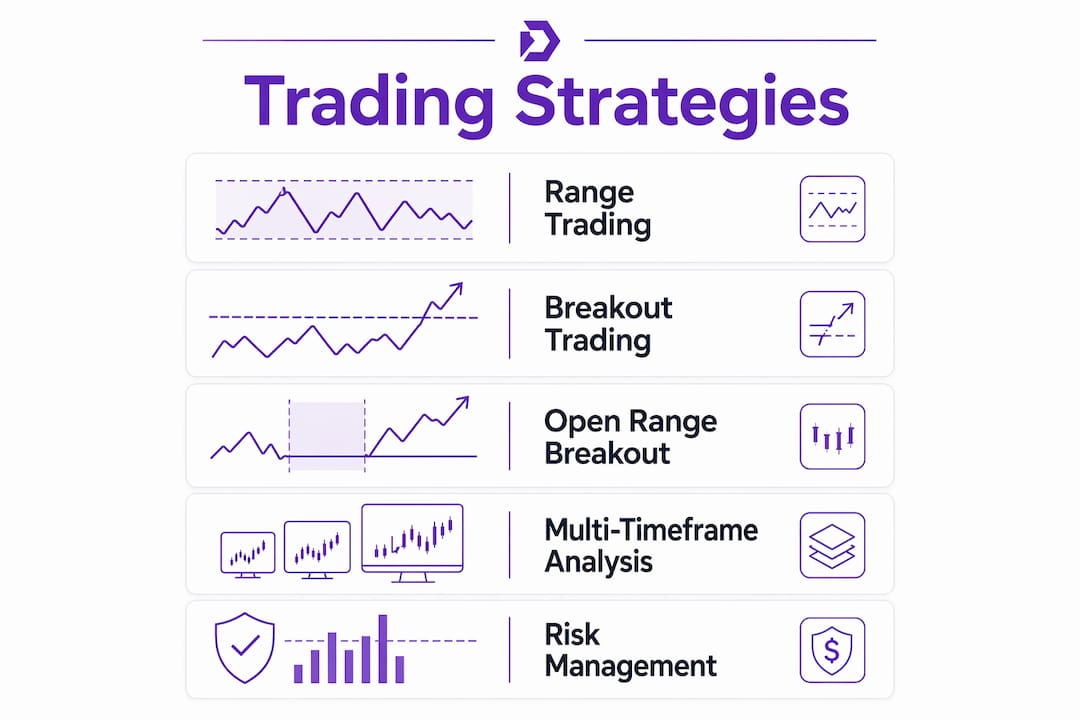
Pro Tip: Always wait for a candle close beyond the breakout level before entering. A wick touch alone is not confirmation and frequently leads to a losing trade.
How does risk management shape successful intraday crypto trading?
Risk management is the single most important variable in intraday trading. A trader with a mediocre strategy and tight risk controls will outlast a trader with a brilliant strategy and no discipline. Risking 0.5% to 2% of total account equity per trade, combined with a daily loss cap of around 3%, prevents any single session from causing serious damage.
The daily loss cap functions as a circuit breaker. Once that threshold is hit, the trading session ends. This rule removes the temptation to chase losses, which is one of the most common and destructive behaviors in day trading cryptocurrency.
A written trading plan is non-negotiable. The plan must specify entry criteria, exit rules, position sizing, and the technical signals used, such as RSI divergence or moving average crossovers. Without a written plan, decisions default to emotion rather than logic.
Key risk management practices for intraday traders:
- Cap risk per trade at 0.5%–2% of total account equity
- Set a daily loss limit of approximately 3% and stop trading when it is reached
- Use stop-loss orders on every trade, placed at a technically meaningful level
- Maintain a minimum 1:1.5 risk-to-reward ratio on every setup
- Journal every trade, recording entry reason, exit reason, and outcome
Trade journaling deserves special emphasis. Reviewing a journal weekly reveals which setups are genuinely profitable and which feel good but lose money. This feedback loop is how traders improve systematically rather than randomly. For a structured framework on applying these controls, Darkbot’s crypto risk management guide covers daily circuit breakers and position sizing in detail.
Pro Tip: Review your trade journal every Friday. Look for patterns in your losing trades. Most traders find the same two or three mistakes repeating. Fixing those is faster than finding new strategies.
What market and asset factors affect intraday crypto trading success?
Crypto markets run 24 hours a day, seven days a week, but liquidity is not evenly distributed across that time. Peak liquidity and volatility occur at 07:00–10:00 UTC and 13:30–16:00 UTC, corresponding to the London and US market opens. Trading during these windows gives traders tighter spreads, faster fills, and more reliable price action.
Weekends present a different environment. Volume thins out, spreads widen, and price movements can be erratic. Intraday strategies that depend on volume confirmation perform poorly in thin markets. Many experienced traders reduce activity or sit out entirely on Saturdays and Sundays.
Asset selection matters as much as timing. Bitcoin and Ethereum are the preferred assets for intraday trading because their deep liquidity reduces slippage and makes exits reliable. Coins with 24-hour volume below $50 million are generally too illiquid for intraday strategies. Low volume means wide spreads and the risk that a position cannot be exited at the intended price.
Leverage amplifies both gains and losses. Traders typically adhere to leverage ceilings of 1:2 despite platforms offering far higher ratios. Higher leverage dramatically increases the risk of liquidation during normal intraday volatility swings.
| Trading window | Liquidity level | Volatility | Notes |
|---|---|---|---|
| 07:00–10:00 UTC | High | High | London open; strong for breakout setups |
| 13:30–16:00 UTC | High | High | US open; highest volume of the day |
| 10:00–13:30 UTC | Medium | Medium | Overlap period; range setups viable |
| Weekends | Low | Unpredictable | Wider spreads; higher slippage risk |
Understanding trading volume and liquidity patterns in 24/7 markets is what separates traders who time entries well from those who wonder why their setups fail outside peak hours.
How to get started with intraday crypto trading
Starting on a demo account is the most important first step. Demo trading for 2–3 months before risking real capital allows traders to test entry and exit rules, build consistency, and identify weaknesses without financial consequences. Skipping this step is the most common mistake beginners make.
Once a trader moves to live markets, a structured daily routine matters. Here is a practical starting framework:
- Define your session. Choose one peak liquidity window, either 07:00–10:00 UTC or 13:30–16:00 UTC, and trade only during that window.
- Select one or two assets. Start with Bitcoin or Ethereum. Deep liquidity means your orders fill at expected prices.
- Cap your trades at five per day. Experienced traders limit activity to five trades per day to preserve edge and avoid performance decay into random decisions.
- Use the right chart timeframes. Read the 15-minute chart for trend direction. Use the 5-minute or 1-minute chart for entry timing.
- Choose order types deliberately. Limit orders provide price control but risk non-execution. Market orders guarantee execution but can suffer slippage in fast-moving conditions. Use limit orders for planned entries and market orders only when speed is critical.
- Journal every trade. Record the setup, entry price, stop level, target, and outcome. Review weekly.
The tools a trader uses must support this process. Real-time price data, customizable alerts, and a built-in journal capability are the three features that matter most. Charting platforms that display volume alongside price are necessary for confirming breakout setups. Traders who want rule-based execution without manual intervention can use Darkbot’s automated trading strategies to apply consistent entry and exit logic across sessions.
Pro Tip: Set a maximum of five alerts per session before markets open. Alerts force you to define your setups in advance rather than reacting impulsively to price movement.
One often-overlooked aspect of getting started is mindset. Day trading requires a shift from investing to speculating on price action. The goal is not to hold a position because you believe in the asset. The goal is to execute a defined setup, manage the trade, and exit at the predetermined level regardless of what you feel about the price.
Key Takeaways
Intraday crypto trading rewards process discipline and structured risk controls far more than market prediction or strategy complexity.
| Point | Details |
|---|---|
| Define your session | Trade during peak liquidity windows (07:00–10:00 UTC or 13:30–16:00 UTC) for reliable fills. |
| Cap risk per trade | Risk only 0.5%–2% of account equity per trade and stop trading after a 3% daily loss. |
| Confirm before entering | Wait for a candle close and above-average volume before entering any breakout setup. |
| Start on a demo account | Practice for 2–3 months before committing real capital to refine entry and exit rules. |
| Limit daily trades | Cap activity at five trades per day to maintain edge and avoid emotional decision-making. |
Why process beats prediction in intraday crypto trading
The traders I have watched fail consistently share one trait: they treat intraday trading as a prediction game. They look for the perfect setup, the one that “has to work,” and then increase size when it doesn’t because they are sure the market will turn. That thinking destroys accounts.
What actually works is treating each trade as one instance in a large sample. A 50% win rate with a 1:1.5 risk-to-reward ratio is profitable over 100 trades. A 70% win rate with a 1:0.5 ratio is not. The math is simple, but most beginners never run it. They focus on being right rather than being profitable.
The biggest pitfall I see in beginners is overtrading. They take 15 trades in a session because the market is “moving.” More trades do not mean more profit. They mean more exposure to random noise and more opportunities to break your own rules. Capping at five trades per day is not arbitrary. It is a structural defense against the part of your brain that confuses activity with productivity.
AI-powered automation addresses this directly. Darkbot enforces entry and exit rules without hesitation, applies the same risk parameters to every trade, and does not chase losses after a bad setup. That consistency mirrors what top discretionary traders spend years building through discipline. For traders who struggle with emotional execution, automation is not a shortcut. It is a structural solution to a structural problem. You can review common beginner investing pitfalls that apply equally to intraday trading psychology.
— Grisha
Darkbot and systematic intraday crypto trading
Intraday trading produces results when rules are applied consistently, not selectively. Darkbot is an AI-based crypto trading automation platform built around that principle.
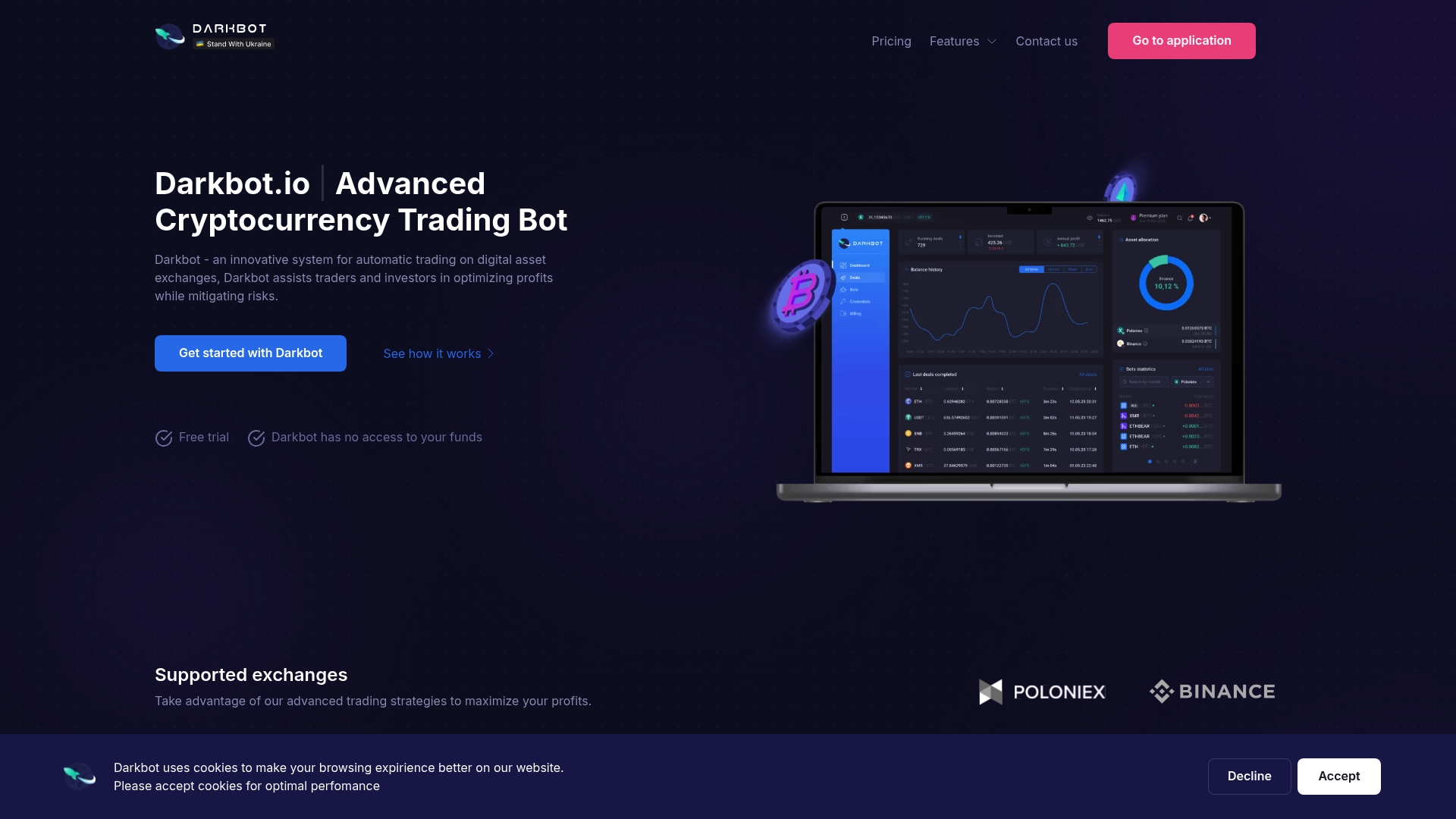
Darkbot connects to your exchange via API, applies your defined entry and exit logic, manages stop-loss levels, and caps trade frequency according to your parameters. It does not predict markets. It executes your strategy with consistency that manual trading rarely achieves. Traders who have built a tested intraday approach can use Darkbot’s automated execution to remove the execution errors that come from fatigue, emotion, or distraction. For traders managing multiple assets, portfolio management tools within Darkbot provide a structured view of exposure across all active positions.
FAQ
What is intraday crypto trading?
Intraday crypto trading is the practice of opening and closing all positions within a single 24-hour window to profit from short-term price movements. Traders use short-timeframe charts (1-minute, 5-minute, or 15-minute) and avoid holding positions overnight.
How much should I risk per trade in crypto day trading?
The standard recommendation is 0.5%–2% of total account equity per trade, with a daily loss cap of around 3%. These limits prevent any single session from causing significant account damage.
What are the best times to trade crypto intraday?
The highest liquidity and volatility occur at 07:00–10:00 UTC (London open) and 13:30–16:00 UTC (US open). Trading during these windows produces tighter spreads and more reliable price action than off-peak hours.
Which cryptocurrencies are best for intraday trading?
Bitcoin and Ethereum are the most suitable assets for intraday trading due to their deep liquidity and reliable execution. Coins with 24-hour volume below $50 million carry significant slippage risk and are generally unsuitable for intraday strategies.
How many trades should I make per day?
Experienced traders cap activity at five trades per day to preserve edge and avoid performance decay. Exceeding that limit typically introduces random, emotionally driven trades that erode profitability over time.
Recommended

Start trading on Darkbot with ease
Come and explore our crypto trading platform by connecting your free account!
Free plan available • No credit card required