Crypto Risk Management Strategies 2025: Trader's Guide
TL;DR:
- Effective risk management for 2025 relies on rapidly detecting, assessing, and responding to threats in volatile crypto markets. AI-driven tools enhance real-time anomaly detection, scenario planning, and autonomous responses, while foundational strategies include risk avoidance, reduction, transfer, and acceptance. Emerging frameworks like SSE and NRM help address systemic and unknown risks beyond traditional models, supporting continuous adaptation.
Effective risk management strategies for 2025 are defined by one core requirement: the ability to detect, assess, and respond to threats faster than markets move. Cryptocurrency markets amplify every risk category that traditional finance faces, including volatility, cyber exposure, regulatory uncertainty, and systemic contagion. A KPMG survey of 400 executives identifies AI and generative AI as the most prioritized technologies for managing risk over the next 3–5 years. That finding reflects a structural shift, not a trend. Traders and investors who build their risk frameworks around AI-assisted monitoring, scenario planning, and disciplined mitigation protocols are better positioned to survive the conditions that 2025 crypto markets consistently produce.
1. What are the top risk management strategies for 2025 in crypto?
The most effective risk management strategies for 2025 combine four foundational methods: risk avoidance, risk reduction, risk transfer, and risk acceptance. Each maps directly onto decisions crypto traders make every day. Avoidance means declining positions in assets or protocols with unquantifiable exposure. Reduction means applying controls like stop-loss orders and position sizing. Transfer means using insurance products or structured derivatives to shift financial exposure. Acceptance means formally acknowledging residual risk after controls are in place.

The critical point is that no control eliminates all risk. Residual risk always remains after mitigation, and treating it as zero is the most common failure in trader risk planning. A formal acceptance process, documented and reviewed at set intervals, keeps that exposure visible rather than ignored.
2. How AI-driven techniques are changing risk identification
AI and generative AI now lead enterprise risk technology adoption, and their application in crypto is direct. AI systems process on-chain data, order book depth, and cross-exchange price feeds simultaneously, flagging anomalies that human analysts would miss in real time. Generative AI produces scenario narratives from structured data, helping traders understand not just what is happening but what conditions could follow.
Agentic AI goes further. It executes predefined risk responses autonomously, such as reducing position size when volatility crosses a threshold, without waiting for human input. That speed matters in crypto, where a liquidity event can move prices by double digits in minutes.
- Early risk identification: AI scans multiple data streams for correlated signals before a risk event fully develops.
- Probabilistic assessment: Machine learning models assign likelihood scores to adverse outcomes based on historical pattern frequency.
- Continuous monitoring: AI systems run 24 hours a day across all trading sessions, with no attention gaps.
- Automated reporting: Generative AI summarizes risk exposure into plain-language reports for faster decision-making.
Pro Tip: AI improves data synthesis and communication in risk workflows but does not replace core mathematical risk models. Always validate AI outputs against your underlying quantitative framework before acting.
Platforms built around machine learning in fintech demonstrate how these techniques translate into executable trading logic rather than theoretical analysis.
3. How foundational mitigation strategies adapt to crypto markets
Traditional risk mitigation maps cleanly onto crypto trading once you account for the asset class’s specific characteristics. The four core strategies each require a crypto-specific interpretation to work in practice.
Risk avoidance in crypto means declining to trade assets with opaque tokenomics, unaudited smart contracts, or concentrated ownership. The risk is not just price loss. It includes protocol failure and liquidity disappearance.
Risk reduction relies on controls applied before and during a trade. Stop-loss orders are the most common reduction tool. Position sizing based on a fixed percentage of portfolio value is equally important and frequently underused. Diversification across uncorrelated assets reduces the impact of any single position’s failure.
Risk transfer in crypto is less mature than in traditional finance, but options markets and decentralized insurance protocols now offer meaningful coverage for specific exposure types. Cyber risk mitigation is a strategic priority for 43% of executives, a figure that reflects how seriously institutional participants treat non-price risks in digital asset environments.
Risk acceptance requires a formal process. Annual Loss Expectancy (ALE) provides a quantitative basis for that decision. ALE equals Single Loss Expectancy multiplied by Annual Rate of Occurrence, giving traders a dollar figure for expected annual losses from a given risk. When the cost of a control exceeds the ALE, acceptance is the rational choice.
| Strategy | Crypto application | Key control |
|---|---|---|
| Avoidance | Skip unaudited protocols | Due diligence checklist |
| Reduction | Limit position size | Stop-loss, sizing rules |
| Transfer | Use options or insurance | Derivatives, coverage products |
| Acceptance | Document residual exposure | ALE calculation, review schedule |
Pro Tip: Review your ALE calculations quarterly. Crypto market conditions shift fast enough that a risk you accepted six months ago may now justify a control.
4. What emerging governance frameworks help anticipate unknown crypto threats?
Standard risk models assume you can enumerate the threats you face. Crypto markets regularly produce threats that fall outside that assumption, including novel protocol exploits, cross-chain contagion, and regulatory actions with no historical precedent. Two emerging frameworks address this gap directly.
Scenario-Based Sociotechnical Envisioning (SSE) is a structured method for anticipating risks that do not yet exist in historical data. SSE incorporates diverse perspectives and anticipatory governance to identify systemic risks before they materialize. The key distinction from traditional scenario analysis is that SSE focuses on multiple plausible futures rather than a single predicted outcome. That approach surfaces risks that prediction-based models systematically miss.
“Scenario-based risk management should focus on multiple plausible futures rather than prediction to engage diverse thinking and surface risks that conventional models overlook. The goal is preparedness across a range of conditions, not accuracy about a single outcome.”
Nexus Risk Management (NRM) operates as an interoperable governance layer. NRM transforms risk decisions into traceable, comparable, and correctable evidence that can be applied across organizations and sectors. For crypto traders and investors, NRM’s value is in its ability to handle systemic risks that cross the boundaries of any single exchange, protocol, or regulatory jurisdiction.
- SSE helps traders build contingency plans for scenarios like a major stablecoin depeg or a coordinated exchange outage.
- NRM provides a governance structure for institutional investors managing risk across multiple custodians and trading venues.
- Both frameworks complement, rather than replace, quantitative risk models.
Traditional assumptions in risk management fail under exponential technology change. Governance approaches like NRM exist precisely because standard models cannot keep pace with the rate at which new risk categories emerge in digital asset markets.
5. Practical steps to implement effective risk controls in 2025
Applying these frameworks requires a sequenced approach. The following steps translate strategy into operational practice for individual and institutional crypto market participants.
- Audit your current exposure. Map every open position, protocol interaction, and custodial relationship. Identify which risks are currently uncontrolled.
- Integrate AI-based monitoring. Connect your trading activity to a system that tracks volatility metrics, liquidity depth, and cross-asset correlations in real time. AI applications in digital currencies now cover most major exchanges and asset classes.
- Define your risk tolerance in writing. Set maximum position sizes, drawdown limits, and concentration thresholds before you trade. Written rules remove the discretion that leads to inconsistent execution under pressure.
- Build a scenario library. Document at least five adverse scenarios relevant to your portfolio, including a liquidity crisis, a regulatory restriction, and a smart contract exploit. Assign probability estimates and planned responses to each.
- Establish key risk indicators (KRIs). Select three to five metrics that signal deteriorating conditions before losses occur. Funding rates, exchange net flows, and options implied volatility are reliable leading indicators in crypto.
- Invest in non-financial risk literacy. 90% of senior risk leaders prioritize increasing organizational literacy in non-financial risks such as AI and cyber threats. For individual traders, this means understanding wallet security, API key management, and phishing vectors, not just price risk.
- Review and update your plan on a fixed schedule. Quarterly reviews align your risk framework with current market structure and regulatory conditions.
Pro Tip: Effective risk reinvention requires three talent types: data engineers, domain specialists, and generalist risk thinkers who work across silos. If you trade alone, build relationships with people who cover the gaps in your own expertise.
Reviewing cryptocurrency trading strategies alongside your risk framework keeps both aligned as market conditions evolve.
Key takeaways
The most effective crypto risk management in 2025 combines AI-assisted monitoring, four-strategy mitigation frameworks, and anticipatory governance methods to address both known and emerging threats.
| Point | Details |
|---|---|
| AI leads risk tech adoption | KPMG data shows 400 executives rank AI as the top risk management priority for the next 3–5 years. |
| Residual risk is unavoidable | No control eliminates all exposure; formal acceptance using ALE metrics is a required step. |
| Four strategies cover all risk types | Avoidance, reduction, transfer, and acceptance each serve a distinct function in crypto portfolios. |
| Emerging frameworks fill prediction gaps | SSE and NRM address systemic and novel risks that quantitative models cannot anticipate alone. |
| Non-financial risk literacy is now mandatory | 90% of senior risk leaders prioritize education in cyber and AI risks as a core organizational capability. |
Why I think most crypto traders underestimate governance risk
Why most crypto traders underestimate governance risk
Most traders I observe focus almost entirely on price risk. They set stop-losses, size positions carefully, and diversify across assets. That discipline is real and valuable. But it leaves a wide category of exposure completely unmanaged.
Governance risk, meaning the risk that the rules governing a protocol, exchange, or regulatory environment change in ways that invalidate your strategy, is the category that produces the largest unexpected losses in crypto. A well-sized position in a structurally sound asset can still produce a total loss if the protocol governance fails or a regulator restricts access overnight. No stop-loss catches that.
The frameworks I find most useful are not the most popular ones. SSE and NRM are not discussed in most trading communities, but they address exactly the category of risk that standard models miss. The traders who survived the major crypto contagion events of recent years were not necessarily the ones with the best price risk controls. They were the ones who had thought carefully about counterparty and systemic exposure before those events occurred.
The uncomfortable reality is that risk management is not a problem you solve once. It is a process you maintain continuously, and the process has to evolve faster than the market does. AI tools help with speed and consistency. Human judgment determines whether you are asking the right questions in the first place.
— Grisha
Darkbot’s approach to systematic crypto risk control
Disciplined risk management requires consistent execution, and consistency is where automation provides the clearest advantage. Darkbot is an AI-based crypto trading automation platform built around structured risk controls, rule-driven execution, and real-time portfolio monitoring.
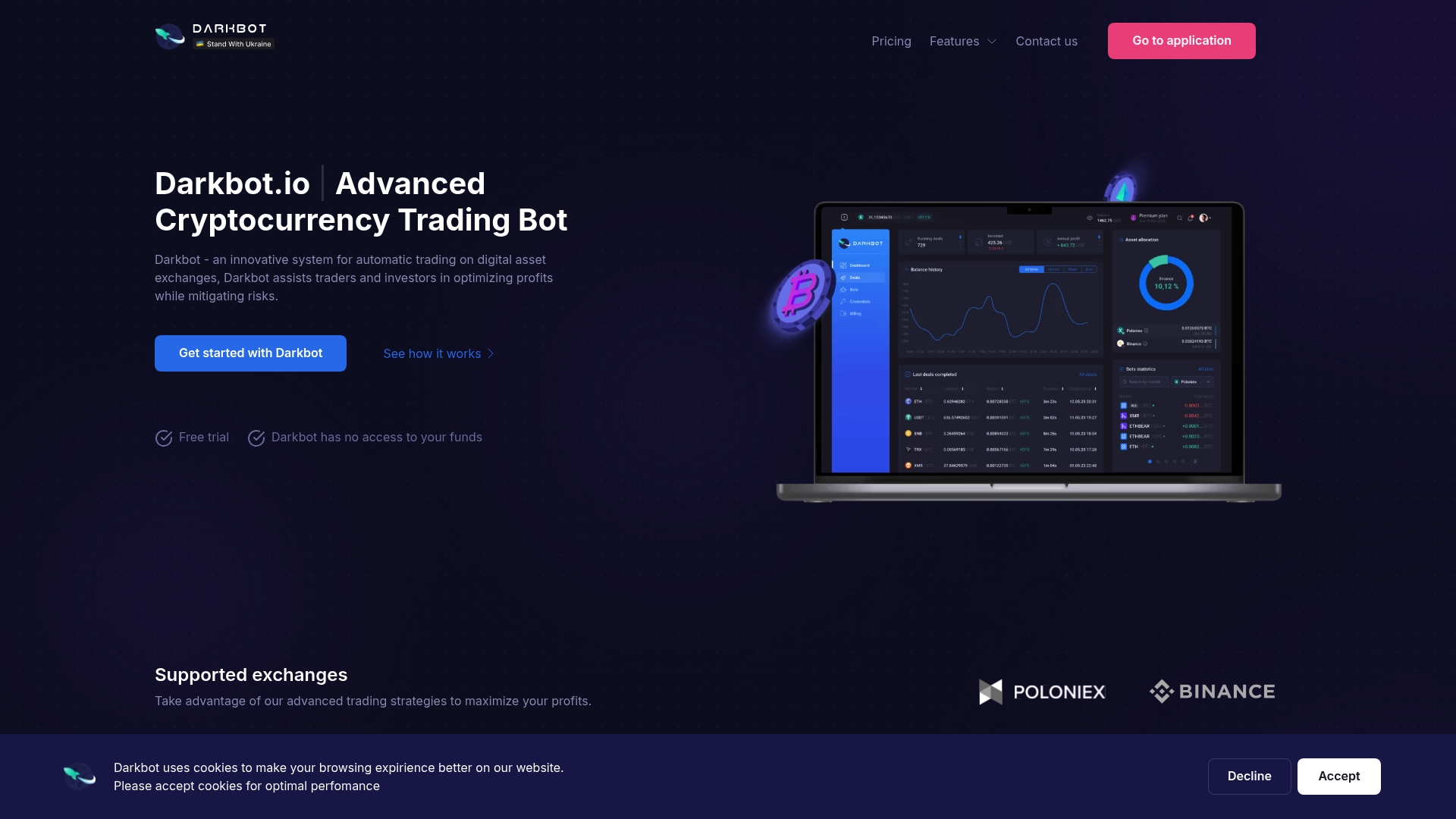
Darkbot connects to leading crypto exchanges via API and applies your defined risk parameters automatically across every trade. Position sizing, drawdown limits, and rebalancing rules run without manual intervention, which removes the execution gaps that discretionary trading creates. The platform’s portfolio management tools give traders a continuous view of exposure across assets and strategies. For traders building a systematic risk framework in 2025, Darkbot provides the execution layer that turns written risk rules into consistent market behavior.
FAQ
What are the four core risk mitigation strategies for crypto traders?
The four core strategies are avoidance, reduction, transfer, and acceptance. Each addresses a different type of exposure, from declining high-risk positions to formally documenting residual risk using metrics like Annual Loss Expectancy.
How does AI improve risk management in cryptocurrency trading?
AI processes multiple data streams simultaneously to flag anomalies, assign probability scores to adverse outcomes, and execute predefined risk responses faster than human traders can react. It supports, but does not replace, core quantitative risk models.
What is Scenario-Based Sociotechnical Envisioning (SSE)?
SSE is a structured framework that incorporates diverse perspectives to anticipate systemic risks before they appear in historical data. It focuses on multiple plausible futures rather than single-point predictions, making it well-suited for crypto’s rapidly changing risk environment.
Why is non-financial risk literacy important for crypto investors?
90% of senior risk leaders now prioritize education in non-financial risks like cybersecurity and AI threats. For crypto traders, this includes understanding wallet security, API key vulnerabilities, and protocol governance risks that price-focused models do not capture.
How often should traders review their risk management plan?
Quarterly reviews are the minimum standard for active crypto traders. Market structure, regulatory conditions, and protocol risks change fast enough that a plan built six months ago may no longer reflect current exposure accurately.
Recommended

Start trading on Darkbot with ease
Come and explore our crypto trading platform by connecting your free account!
Free plan available • No credit card required