After 200–500 Trades, Use Fractional Kelly to Size Crypto Positions

The Kelly criterion tells a crypto trader the exact percentage of capital to risk on a position to maximize long-run compound growth. In practice, that means calculating full Kelly and then trading a fraction of it, usually half or a quarter, because estimation error and crypto’s fat-tailed volatility make full Kelly sizing unmanageable for most systems. The math and worked example follow below.
TL;DR:
- Using fractional Kelly (half or quarter) typically balances growth maximization with reduced drawdown risk, especially in volatile crypto markets.
- Accurate inputs, such as win rate and payoff ratio, require at least 200 to 500 trades for reliable Kelly sizing, with frequent updates for changing market regimes.
- Implementing strict position caps and automation tools like Darkbot helps enforce Kelly-derived sizing rules and minimizes emotional or manual override risks.
- Full Kelly sizing can cause severe interim drawdowns, so conservative fractions are generally recommended until a strategy proves consistent over a large, stable sample.
What the Kelly Criterion Is and Why It Targets Geometric Growth
The Kelly criterion is a formula for maximizing expected log wealth, which is a technical way of saying it optimizes for compound growth over repeated bets rather than the profit expected from any single trade. John L. Kelly Jr. developed it in 1956 at Bell Labs while studying signal noise in long-distance phone lines, not trading. The application to gambling and markets came later, most notably through Edward Thorp.
The intuition is straightforward: size your position in proportion to your edge, then penalize that size for variance. A bigger edge justifies a bigger bet. Higher volatility around that edge demands a smaller one. This is a consequence of ergodicity: your wealth compounds sequentially, so a formula built on the average outcome of many parallel universes (arithmetic expected value) will size you wrong for the single sequential path you actually live through.
Growth-optimal does not mean drawdown-minimal. Full Kelly accepts brutal swings in exchange for the fastest compounding rate mathematics can offer. That tradeoff is exactly why most practitioners never trade full Kelly.
The Kelly Formulas and a Worked Crypto Example
Two versions of the formula matter for crypto trading.
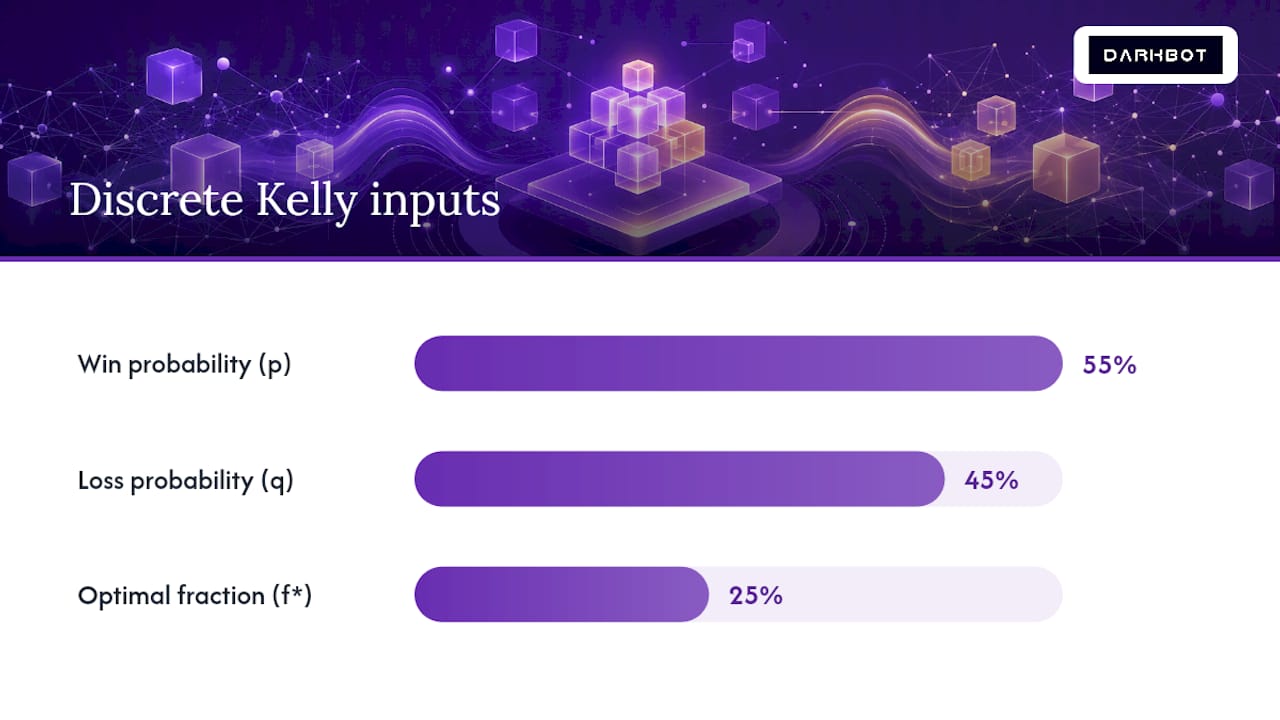
The discrete bet form, used for win/loss trades with fixed payoff ratios: f = (bp − q) / b*, where b is the ratio of win amount to loss amount, p is win probability, and q is loss probability (1 − p).
The continuous form, used for position sizing in an asset with ongoing drift and volatility: f ≈ (μ − r) / σ²*, where μ is arithmetic drift, r is the risk-free rate, and σ² is variance. This version is what applies when you’re sizing a directional crypto position rather than a discrete win/loss trade, and it’s explained well in Stanford’s walkthrough of the Kelly criterion.
A worked example using the discrete form:
- Your system wins 55% of trades (p = 0.55, q = 0.45).
- Average win is 1.5 times average loss (b = 1.5).
- f* = (1.5 × 0.55 − 0.45) / 1.5 = (0.825 − 0.45) / 1.5 = 0.25, or 25% of capital.
Small changes to either input swing that number dramatically, and using CAGR instead of arithmetic drift understates the true growth rate needed for this calculation, a distinction covered in detail in an illustrative bitcoin Kelly sizing analysis.
Estimating Inputs, Backtesting, and Automating Kelly for Crypto
Kelly’s output is only as reliable as the win rate and payoff ratio feeding it. Estimating those numbers from too few trades is where most retail applications of Kelly go wrong.
- Aim for at least 200 to 500 completed trades per strategy before trusting a Kelly output, and separate results by setup type rather than blending everything into one average. Some practical guides suggest a minimum of 50 trades as a floor, though CoinMarketCap’s guide to Kelly bet sizing treats this as a starting point, not a comfort zone.
- Recompute your inputs on a rolling basis, roughly every 6 to 12 months or every fixed block of new trades, since crypto market regimes shift and a win rate estimated in a trending market won’t hold in a chopped-up range.
- Cap position size regardless of what the formula outputs, and scale that cap down further during periods of elevated realized volatility.
- Stress test your sizing assumptions against historical drawdown periods, not just average-case backtests.
This is where automation earns its place. A platform like Darkbot’s risk management tooling enforces position-size limits mechanically, removing the temptation to override a calculated fraction after a winning streak or during a moment of conviction.
Pro Tip: Treat your Kelly fraction as a ceiling, not a target. Trading meaningfully under your calculated limit costs you little in long-run growth and buys you a lot of psychological runway.
How to Compute and Apply a Kelly Fraction to a Crypto System
- Collect and clean trade data. Pull your last N trades, strip outliers driven by exchange glitches or manual overrides, and segment results by strategy or setup type.
- Compute full Kelly. Use the discrete formula for win/loss systems or the continuous μ/σ² form for directional positions, converting any compound return figures to arithmetic drift first.
- Apply a fractional multiplier. Cut the result to a half or quarter, then layer on a hard cap independent of the formula’s output.
- Backtest with Monte Carlo and walk-forward simulation. Test the fraction across resampled historical sequences, not just one linear backtest, to see the range of plausible drawdowns.
- Deploy with enforcement built in. Connect exchange API keys, set the position-size limit as a hard rule in your automation layer, and schedule a fixed cadence for reestimating inputs.
Common Pitfalls, Drawdown Math, and Risk Controls
Full Kelly sizing carries a mathematically guaranteed cost: deep interim drawdowns are common on the way to long-run growth, even when every input estimate is correct. When those inputs are wrong, which they usually are to some degree, the risk compounds.

Small-sample estimation error is the dominant failure mode. A win rate estimated from 40 trades can look meaningfully different from the true long-run rate, and Thorp’s own writing on the criterion notes that overestimating your edge inflates the Kelly output and raises ruin risk well beyond what the formula assumes.
Four controls address this directly:
- Trade fractional Kelly, never full Kelly, as a default.
- Set a hard maximum per-position cap that holds even when the formula says otherwise.
- Diversify across uncorrelated strategies or assets rather than concentrating size in one edge.
- Scale position size down as realized volatility rises, independent of the base calculation.
Simulation research on Kelly-style portfolio applications consistently points to rolling re-estimation and conservative fractions as the practical difference between a system that survives and one that doesn’t.
Fractional Kelly and Reasonable Sizing Rules of Thumb
Half Kelly retains roughly three-quarters of full Kelly’s theoretical growth rate while cutting drawdown severity substantially, a tradeoff documented across practitioner analyses of the criterion. Quarter Kelly cuts further into growth but reduces drawdown risk even more, and eighth Kelly starts to resemble the sizing many disciplined discretionary traders already use instinctively.
- Half Kelly: strong growth, meaningful but survivable swings.
- Quarter Kelly: the common default for traders running live capital on unproven or newer strategies.
- Eighth Kelly: closer to a conservative retail heuristic like the 1-2% per-trade rule.
- Scale up only after accumulating a larger, stable trade sample with consistent performance across market regimes, not after a short hot streak.
Kelly Sizing in Practice: A Candid Take
Full Kelly is a math exercise. Fractional Kelly, paired with automation, is a tradeable system. The gap between those two matters more than any formula detail.
Start conservative, quarter Kelly or lower, and only scale up as your trade sample and stability justify it. The value of automation isn’t sophistication, it’s removing the human impulse to override the number after a good week.
— Grisha
Putting Fractional Kelly Sizing Into an Automated System
Calculating a Kelly fraction by hand is one thing. Enforcing it consistently across every trade, every day, without an emotional override after a losing streak, is the harder problem. Darkbot is built around that exact gap: it applies rule-driven position sizing, automated rebalancing, and configurable risk caps as part of a systematic execution layer, not as a signal service predicting price direction.

Backtesting and paper trading let you validate a Kelly fraction against historical data before committing live capital, while API integration across major exchanges means the position-size limit you set is the one actually executed, not adjusted mid-trade. For strategies spanning multiple assets, Darkbot’s portfolio rebalancing tools help maintain sizing discipline across positions rather than letting winners drift into oversized allocations.
If you want to test a conservative, fractional-Kelly-based sizing approach without manually enforcing every cap yourself, Darkbot’s platform is a reasonable place to start building that system.
This article is general information, not a substitute for advice from a qualified financial advisor. Consult a qualified financial professional about your own circumstances before acting on anything here.
Sources
- A New Interpretation of Information Rate — J. L. Kelly (1956)
- The Kelly Criterion — Stanford (lecture/walkthrough)
- The Kelly Criterion in Blackjack, Sports Betting, and the Stock Market (Thorp)
- The Kelly Criterion — TradeOlogy Academy
FAQ
What Is a Good Kelly Criterion Percentage for Crypto?
There’s no universal “good” number since it depends on your win rate, payoff ratio, and volatility estimates, but most practitioners trade a fraction of their calculated full Kelly, commonly half or quarter, rather than the raw output.
What Happens if You Bet Over Kelly?
Betting above full Kelly increases the probability of severe drawdowns and can push expected geometric growth negative even though the underlying edge is real, since oversizing amplifies variance faster than it captures additional return.
Can I Make $100 a Day From Crypto Trading?
Daily profit targets aren’t something the Kelly criterion addresses. It optimizes position size for a given edge and volatility profile over a long series of trades, and no sizing formula can guarantee a specific daily outcome.
What Is the Kelly Criterion Used for in the Stock Market?
In equities and other markets, Kelly is used to size positions relative to an estimated edge and volatility, applying the same μ/σ² framework traders use in crypto, adjusted for the asset’s own drift and variance estimates as described in Stanford’s Kelly criterion resource.
Recommended

Start trading on Darkbot with ease
Come and explore our crypto trading platform by connecting your free account!
Free plan available • No credit card required