Darkbot: Secure Multi Account Crypto Trading With Trade Only Keys

Managing multiple exchange accounts for automated trading comes down to one operating principle: centralize execution through a single control layer, issue trade-only API keys per exchange stored in an encrypted secrets manager with IP whitelisting, and rotate every key on a regular periodic basis. The immediate next step is a permissions audit across every existing key to disable any withdraw or transfer flag still active.
TL;DR:
- Use separate API keys for each exchange and environment, restricting permissions to trade and read only, with regular IP whitelisting and logging metadata for each key.
- Implement a normalized execution layer to unify API differences across exchanges, enabling consistent risk enforcement, account views, and order tracking, while managing dependency risks.
- Rotate API keys every 60 to 90 days, generate new keys with identical permissions, and test on read-only endpoints before full deployment to reduce operational risk.
- Monitor for unusual activity such as unexpected orders, unrecognized IPs, or new keys, and revoke compromised keys immediately, following a structured incident response process.
- Rely on automated workflows and centralized secrets management to ensure operational hygiene, including permission audits, key rotation, and continuous monitoring, to prevent operational security failures.
What Does It Take to Manage Multiple Accounts Securely?
Handling multiple exchange accounts starts with treating each API key as a discrete, disposable credential rather than a shared password. A trader running bots on three or four venues typically ends up with a dozen or more active keys once you account for separate strategies and environments. Without a system, that sprawl becomes the biggest security gap in the whole operation.
The practical checklist below reflects how experienced operators structure key creation from day one.
- Create separate keys per exchange and per environment. Development, paper trading, and production should never share credentials, and each strategy should get its own key where the exchange allows it.
- Restrict permissions to Read and Trade only. Withdraw and transfer permissions have no legitimate role in a bot key, and on some exchanges those flags can bypass two-factor login protections entirely, which is exactly why API key security guidance treats permission scoping as the first line of defense.
- Configure IP whitelisting wherever the exchange supports it. Static hosting environments make this straightforward; for dynamic or cloud-elastic hosts, document the fallback (a bastion IP or VPN egress point) rather than skipping the control.
- Log metadata for every key. Owner, purpose, creation date, next rotation date, and environment should sit in one record, not scattered across spreadsheets or Slack threads.
- Run an immediate inventory. Most operators discover at least one forgotten or overprivileged key the first time they actually audit what is live.
Exchange permission models are not standardized. What Coinbase calls a trading scope, another venue might split into separate flags, so verify each exchange’s own documentation before assuming parity, per Coinbase’s authentication and security guidance.
Pro Tip: Name your keys by function, not by exchange. A key labeled “arb-strategy-prod-binance” tells you instantly what happens if you revoke it. A key labeled “key3” does not.
How Does a Unified Execution Layer Simplify Multi-Account Trading?
An execution management system, or EMS, solves the structural problem that multi-account trading creates: every exchange speaks a slightly different API dialect, and building a custom adapter for each one multiplies your maintenance burden with every new venue you add. An EMS normalizes that variation into one layer so your strategy logic never has to know which exchange it is talking to.
The normalization layer typically handles:
- Symbol mapping across venues with different ticker conventions
- A unified balance and position model that reconciles holdings across accounts
- Order-state lifecycles (submitted, partially filled, filled, canceled) tracked consistently
- Execution reports that feed a single audit trail instead of five disconnected logs
- Rate-limit handling and retry logic so a throttled request doesn’t silently fail
This is the same argument CoinAPI’s analysis of multi-exchange trading makes: a normalized execution layer removes the need to write and maintain separate integrations for every exchange you connect. Instead of six codebases handling six APIs, you get one interface with consistent risk enforcement applied everywhere.
| Consideration | Per-exchange custom build | Unified execution layer |
|---|---|---|
| Adding a new exchange | New adapter, new testing cycle | Configuration change |
| Portfolio-wide exposure view | Manual reconciliation across accounts | Single normalized view |
| Risk rule enforcement | Duplicated per integration | Applied once, centrally |
| Failure isolation | Depends on code quality per adapter | Standardized state machine |
The trade-off is dependency concentration. A single execution layer becomes a single point of failure if it goes down, and testing changes to that layer requires more rigor because a bug propagates across every connected account instead of staying contained to one exchange. Vendor lock is a real cost too. Choose a layer with clear export paths for your data before you commit to it, as unified infrastructure analysis for commerce systems notes about standardized environments generally.
How Do You Rotate Keys Without Breaking Live Bots?
Key rotation is the operational task most traders skip because it feels risky to touch a working system. Skipping it is the bigger risk. A structured rotation sequence removes the guesswork.
- Generate the new key with the exact same permission scope as the one it replaces. Never widen scope during a rotation.
- Push the new key to your encrypted secrets manager immediately. Never let it sit in a chat message, email, or plaintext config file, even temporarily.
- Test the new key on read-only endpoints first. Confirm balance and position queries return correctly before it touches order placement.
- Deploy the new key to the live strategy during a low-activity window if your strategy allows scheduling flexibility.
- Revoke the old key only after confirming the new one has executed at least one full order cycle successfully.
- Audit and log the rotation with timestamp, reason, and operator name.
Running the old and new key in parallel for a short verification window, with the new key restricted to read-only calls until confirmed, minimizes downtime without exposing you to double-execution risk. Per-strategy keys matter here too: if one key is compromised, the blast radius stays limited to that single strategy instead of every bot you run.
Certain events should trigger emergency rotation outside the normal 60 to 90 day cycle: a suspected leak, a staff or contractor departure, or activity you cannot immediately explain. Vantixs’s rotation guidance recommends treating any access change, not just a calendar date, as a rotation trigger.
Pro Tip: Keep a “cold” replacement key generated but unused for your highest-volume strategy. In a compromise scenario, activating a pre-made key is faster than generating one under pressure.
What Should You Monitor for Signs of a Compromised Key?
Detection speed determines how much damage a compromised key can do. The signals worth instrumenting include unexpected orders that don’t match your strategy logic, API calls originating from unrecognized IPs, new key creation events you didn’t initiate, withdrawal attempts against keys that should never have that permission, and unusual rate-limit consumption that suggests a script other than yours is using your credentials.
When one of these fires, the response sequence is straightforward:
- Revoke the affected key immediately, before investigating root cause
- Halt strategy execution tied to that key across every environment it touched
- Generate a replacement key and push it through the standard rotation workflow
- Reconcile balances against your last known-good state to quantify any discrepancy
- Update the secrets store and confirm no cached copies of the old key remain
Layered security, meaning permission scoping combined with network controls, secrets management, and continuous configuration checks, closes gaps that any single control misses on its own, according to TriliCity’s API security framework. Beyond incident response, periodic audits matter on a schedule: permission inventory, IP allowlist drift checks, and key age reports catch problems before they become incidents. Document every finding and every remediation step. An audit trail with no record of what you fixed is not much better than no audit at all.
Darkbot: Operationalizing Multi-Account Security
Building a custom EMS adapter for every exchange you trade on is a significant engineering investment, one most individual traders and even many professional desks choose not to make. Darkbot approaches this differently: it provides the normalized execution layer, encrypted key management, and per-exchange account views as built-in platform capabilities rather than something you engineer yourself.
The alignment with the operational practices above is direct:
- API integrations across major exchanges use trade-only credential scopes by design
- Encrypted storage handles API key custody so keys never sit in plaintext configuration
- A centralized account view normalizes balances and positions across every connected exchange
- Automated rebalancing applies portfolio logic consistently rather than per-account manually
- Real-time analytics surface execution activity in one dashboard instead of six exchange interfaces
For traders building out a rotation workflow or a permission audit process, Darkbot’s automated trading strategies guide and API key security overview cover the implementation details in more depth. The platform does not eliminate the need for the operational discipline outlined above. It reduces how much of that infrastructure you have to build from scratch.
Secrets Management and Encrypted Storage for API Keys
An API key sitting in a plaintext environment file or a hardcoded strategy script is a liability regardless of how carefully you scoped its permissions. Encrypted secrets management is the control that prevents a code leak, a compromised laptop, or a misconfigured repository from turning into a credential leak.
The core requirement is straightforward: keys live in a dedicated secrets manager, encrypted at rest and in transit, and your trading application retrieves them at runtime rather than storing them inline. This separates the credential from the codebase entirely, so a public GitHub commit or a shared screen recording never exposes a live key.
Access control matters as much as encryption itself. Not every process or team member needs access to every key. Scope access to the secrets manager the same way you scope exchange permissions: least privilege, reviewed periodically, revoked immediately when no longer needed. Vantixs’s guidance on exchange API key hygiene is explicit that keys should never be hardcoded, and that encrypted secret managers with least-privilege access are the deployable baseline, not an advanced option reserved for large operations.
Version history is a subtle risk many traders overlook. If a key was ever committed to a repository, even briefly, and later removed, it can still exist in that repository’s git history. Rotation after any accidental exposure needs to happen regardless of whether the key was “removed” from the current codebase, because removed and revoked are not the same thing.
Centralized Account View: Balance and Position Normalization
Running bots across four exchanges without a unified account view means checking four separate dashboards to answer one question: what is my actual total exposure right now? That fragmentation is where risk miscalculation happens, usually at the worst possible moment.
A centralized account view solves this by pulling balance and position data from every connected exchange into one normalized model. The normalization piece matters more than it sounds. Each exchange reports balances, open orders, and position data in its own format, with its own field names and its own precision conventions. Without a translation layer, comparing a position on one exchange to a position on another requires manual reconciliation every time.
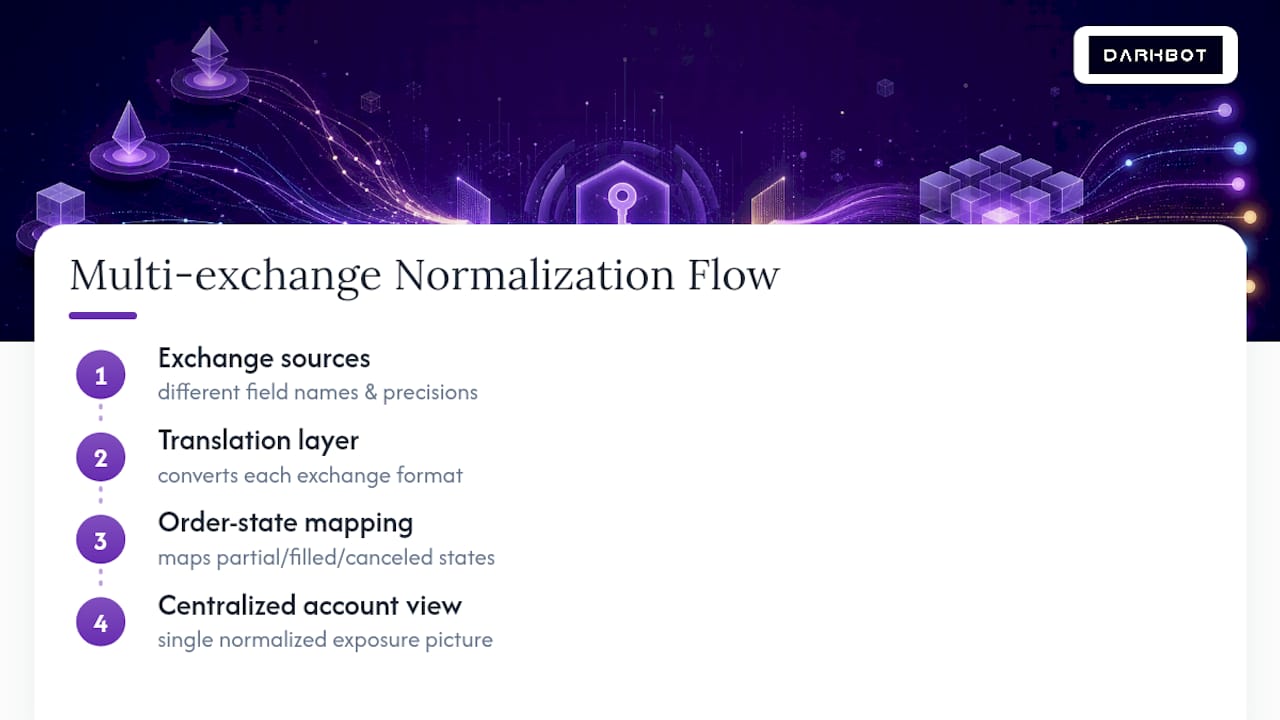
Order state adds another layer of complexity. An order can sit in submitted, partially filled, filled, or canceled states, and each exchange tracks that lifecycle slightly differently. A normalized order-state model maps every exchange’s version of “partially filled” to the same internal representation, so your risk logic and your reporting both work off one consistent picture instead of five slightly different ones.
The payoff shows up most clearly during volatile periods, when knowing your true aggregate exposure in seconds rather than minutes is the difference between a controlled adjustment and a reactive scramble. A multi-exchange integration overview covers how this normalization applies specifically to bot-driven portfolios running several strategies at once.
Synchronizing Orders and Positions Across Accounts
Coordinating orders across multiple accounts introduces a timing problem that single-account trading never has to solve. If your strategy logic decides to enter a position based on a signal, and that signal needs to execute across three exchanges simultaneously, latency differences between those exchanges can leave you with three different fill prices and three different effective position sizes.
The practical approach is to treat synchronization as a state-reconciliation problem rather than a timing problem. Instead of assuming all three orders fill at once, build the system to check confirmed state after each leg executes and adjust subsequent legs based on what actually happened, not what was expected to happen.
A few synchronization patterns show up consistently in well-run multi-account operations:
- Sequential confirmation, where each account’s order must confirm before the next is submitted, trading speed for certainty
- Parallel submission with post-trade reconciliation, which is faster but requires a reconciliation step to catch mismatches
- Position-based rebalancing on a schedule, which accepts short-term drift between accounts in exchange for lower operational complexity
Each pattern fits a different strategy profile. High-frequency approaches generally cannot tolerate sequential confirmation’s added latency, while portfolio-level rebalancing strategies rarely need order-level synchronization at all. Rate limits shape this decision too: an exchange that throttles you at 10 requests per second changes what synchronization pattern is even feasible, and building retry logic with exponential backoff into your order submission avoids a rate-limit rejection cascading into a failed trade.
Logging and Audit Trails Across Multiple Accounts
An audit trail is only useful if it answers a question you didn’t know you’d need to ask. When something goes wrong three weeks after the fact, generic logs that just say “order placed” leave you reconstructing events from memory.
Effective logging in a multi-account environment captures who or what initiated an action (a specific strategy, a manual override, a scheduled rebalance), what account and exchange it touched, the exact timestamp, the request and response payload, and the outcome. That level of detail turns a log file into a forensic record instead of a status update.
Retention matters as much as content. Regulatory and dispute-resolution needs vary by jurisdiction, but a practical baseline is retaining detailed logs for at least a full rotation cycle beyond your key rotation schedule, so you can always trace activity back through at least one full key generation. Centralizing logs from every connected account into one searchable store, rather than leaving them scattered across each exchange’s own interface, is what makes an audit actually fast to perform instead of a multi-hour reconstruction project.
Immutability is the final piece. Logs that can be edited after the fact are not an audit trail, they’re a suggestion. Write-once storage or a hash-chained log format ensures that what you’re reviewing during an incident is what actually happened, not a version that was quietly adjusted.
Security Implications of Cross-Account Access and Delegation
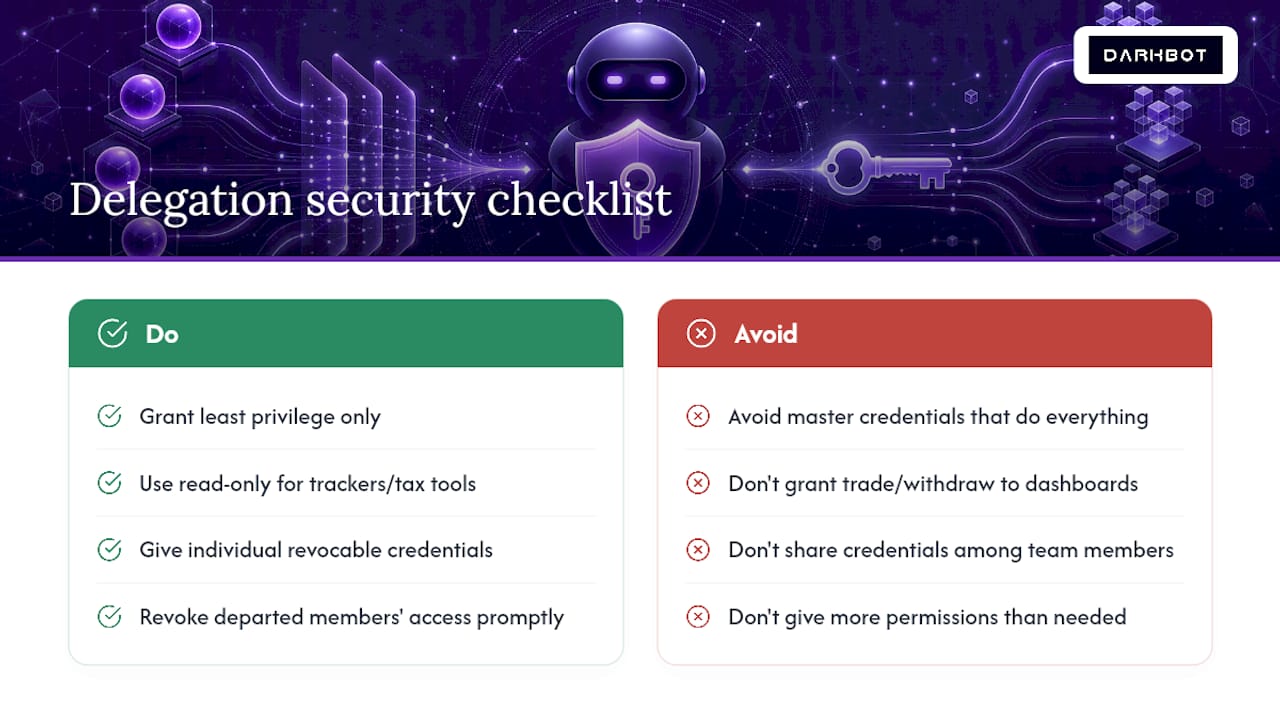
Delegation, meaning granting a tool, a team member, or a third-party service access across multiple accounts, multiplies risk in a way that is easy to underestimate. A single compromised delegated credential doesn’t just expose one account. It exposes every account that credential can touch.
This is where the principle of least privilege earns its keep most visibly. If a monitoring dashboard only needs read access to check balances, it should never receive trade permissions, let alone withdraw permissions, regardless of how convenient broader access might be during setup. The convenience of one master credential that “does everything” is exactly what turns a single point of failure into a portfolio-wide incident.
Third-party service integrations deserve particular scrutiny. Any external tool that requests API access to your exchange accounts should be evaluated on the same permission-scoping standard you apply to your own bot keys: does it need trade access, or would read-only satisfy its function? Many portfolio-tracking and tax-reporting tools only need read permissions, and granting more than that expands your attack surface for no operational benefit.
Team delegation follows the same logic. If more than one person operates your trading infrastructure, each person should have distinct, individually revocable access rather than a shared credential. When someone leaves the team, their specific access gets revoked without touching anyone else’s. Shared credentials make that kind of clean offboarding impossible, since revoking access for one person means rotating credentials for everyone.
Automation Tools and Workflows for Multi-Account Management
Manual oversight of a multi-account trading operation scales poorly. Once you pass three or four connected exchanges with several running strategies, the operational overhead of manually checking balances, verifying key status, and confirming rotation schedules becomes a job in itself, separate from actually trading.
Automating the operational layer, not just the trading logic, is what makes multi-account management sustainable at scale. That includes automated rotation reminders that flag keys approaching their 60 to 90 day threshold, automated permission-drift checks that alert you if a key’s scope changes unexpectedly, and automated reconciliation that compares expected balances against actual balances after every trading cycle.
The workflow layer matters as much as the individual tools. A rotation reminder that fires into an ignored inbox accomplishes nothing. Effective automation routes alerts to a channel someone actually monitors, and ties critical alerts, like an unexpected withdrawal attempt, to an immediate action rather than a passive notification. A risk management framework for trading bots covers how automated guardrails apply this same logic to position sizing and exposure limits, which is the trading-side equivalent of what key rotation automation does for credential security.
What Actually Separates Disciplined Multi-Account Operators From the Rest
Most operators who lose money to a compromised key didn’t get hit by a sophisticated attack. They got hit by a withdraw permission they forgot to disable, or a key that sat unrotated for over a year because nobody owned the task. Security failures in this space are usually operational, not cryptographic.
The priorities that matter most, in order, are: least-privilege permissions on every key, a centralized view of exposure across accounts, and the operational discipline to actually run rotation and monitoring on schedule rather than treating them as someday tasks. Skip any one of the three and the other two only partially compensate.
The mistakes that recur across multi-account setups are predictable: shared keys reused across strategies because creating separate ones felt tedious, rotation schedules that exist on paper but never get executed, and monitoring that only checks for problems after a trader manually looks, rather than running continuously. None of these require sophisticated fixes. They require someone treating operational hygiene as a real task with real ownership.
— Grisha
Get Started With Centralized Multi-Account Execution
Darkbot’s platform maps directly onto the operational checklist covered above: trade-only exchange integrations, encrypted key handling, a normalized account view across every connected exchange, and automated rebalancing that applies your risk parameters consistently rather than per-account. For a trader running strategies across multiple venues, that means less time spent reconciling dashboards and rotating credentials manually, and more time spent on strategy decisions.
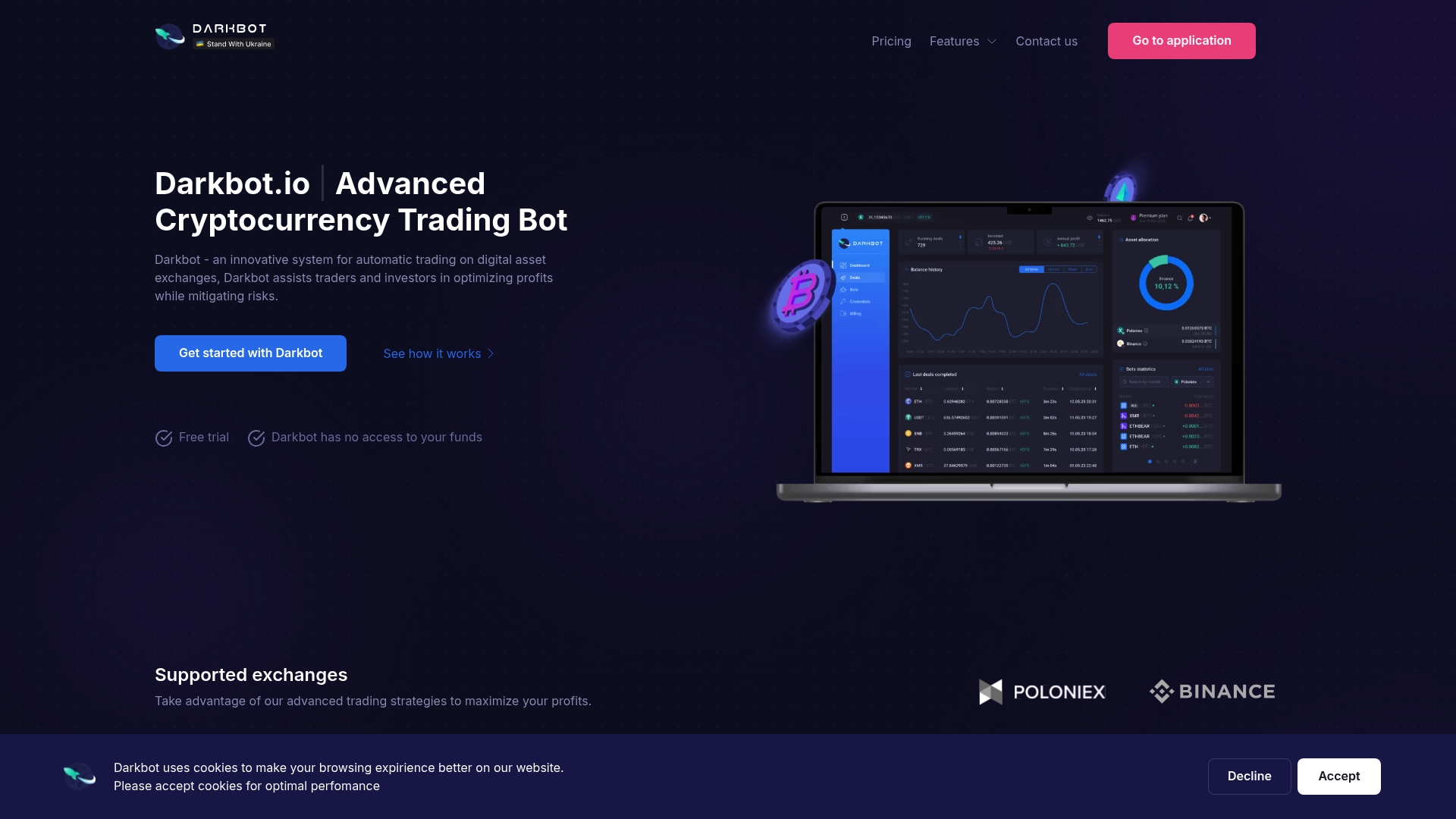
Darkbot’s platform decision-making is process-driven: rule-based execution and probabilistic pattern evaluation applied consistently across every connected account, not predictive signals or performance promises. If you’re currently managing exchange connections manually across several accounts, the Darkbot landing page is the starting point, and the trading bot setup guide walks through connecting your first exchange account under a trade-only key configuration.
Sources
- Coinbase API security guidance
- Exchange API Key Hygiene Crypto: Rotation Guide | Vantixs
- How Can You Trade on Multiple Crypto Exchanges Without Building Separate Integrations? | CoinAPI Blog
FAQ
How Often Should I Rotate Exchange API Keys?
A 60 to 90 day baseline is the standard recommendation, with immediate rotation triggered by a suspected leak, a staff change, or unexplained account activity.
Should Bot API Keys Ever Have Withdraw Permissions?
No. Bot keys should carry only Read and Trade permissions; withdraw and transfer flags serve no function in automated execution and can bypass other account protections on some exchanges.
What Is an EMS in the Context of Crypto Trading?
An execution management system is a normalized layer that centralizes order placement, balance and position data, and execution reporting across multiple exchanges, removing the need to build a separate integration for each venue.
Can One Platform Replace a Custom Multi-Exchange Setup?
A platform like Darkbot provides the normalized execution layer, encrypted key storage, and centralized account view as built-in features, reducing the engineering effort required to build and maintain a custom EMS.
What Is the Biggest Security Mistake in Multi-Account Trading?
Sharing a single API key across multiple strategies or accounts, since it removes the ability to isolate and revoke access without disrupting every strategy tied to that key.
Recommended

Start trading on Darkbot with ease
Come and explore our crypto trading platform by connecting your free account!
Free plan available • No credit card required