Machine Learning for Finance Course: 2026 Guide

TL;DR:
- Machine learning for finance courses teach professionals how to apply ML algorithms to financial problems like trading, risk assessment, and portfolio management. They focus on finance-specific validation, governance, and practical projects using real market data, preparing students for real-world applications. The right course depends on your technical background, application goals, and preferred format, emphasizing continuous learning and hands-on experience.
A machine learning for finance course is a structured program that teaches professionals and students how to apply ML algorithms to financial problems including trading strategy development, portfolio optimization, and risk assessment. Courses from institutions like the University of Chicago, Harvard, and Stanford have formalized this discipline, combining quantitative methods with finance domain knowledge. The field is no longer optional for serious practitioners. Financial firms now expect analysts and portfolio managers to understand how ML models are built, validated, and governed within real market contexts.
What does a machine learning for finance course actually cover?
The core curriculum in most ML finance programs spans five technical areas: regression, classification, clustering, dimensionality reduction, and reinforcement learning. Each method maps directly to a finance use case. Regression models forecast asset returns. Classification algorithms flag credit default risk. Reinforcement learning drives execution strategies in algorithmic trading.

Beyond the ML mechanics, finance-specific content is what separates these programs from generic data science courses. Harvard’s Applied Quantitative Finance and ML course organizes its curriculum around four pillars: data management, quantitative investment strategies, portfolio management, and risk management. That structure mirrors how a quant desk actually operates, which shortens the gap between classroom and deployment.
Coding is non-negotiable. Python and R are the standard languages across all major programs. Students work with financial time series, factor models, and real market data rather than toy datasets. Assignments typically require building and evaluating models using metrics like the Sharpe ratio and factor exposures, not just generic accuracy scores.
Pro Tip: Before enrolling, confirm that the course uses real financial datasets in assignments. Synthetic data teaches syntax. Real market data teaches judgment.
The University of Melbourne’s program takes this further by centering its curriculum on hands-on projects and case studies drawn from actual economic and financial problems. Students learn to critically evaluate model outputs in context, not just report metrics. That applied orientation is what makes graduates immediately useful in practice.
How do top courses compare in structure and prerequisites?
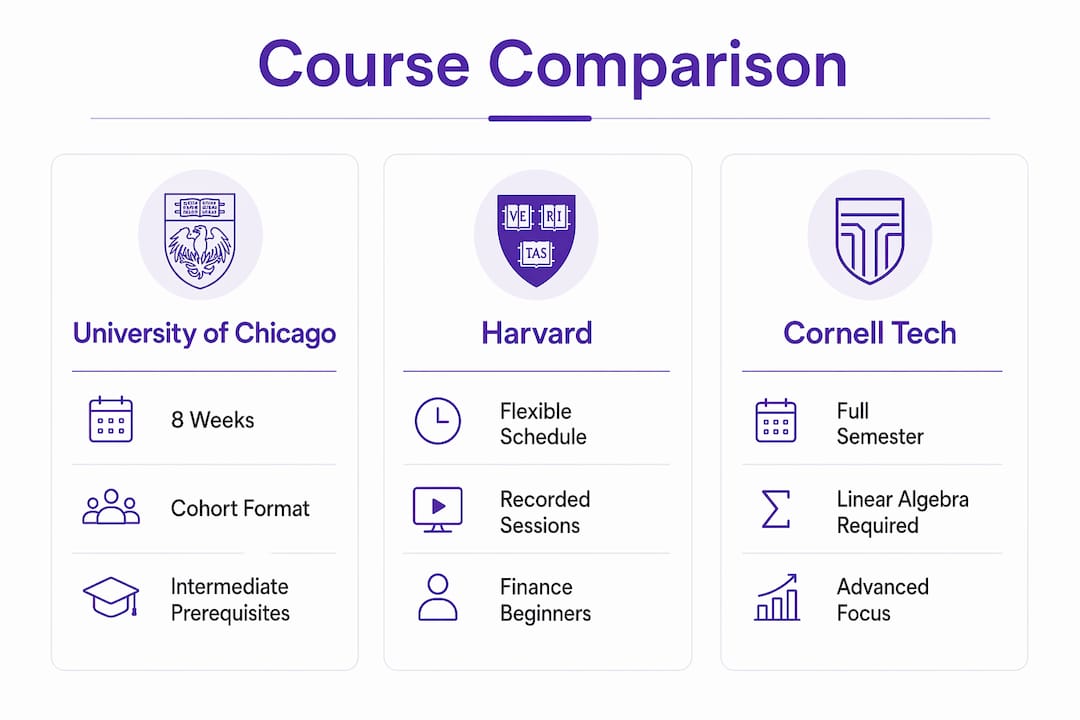
Course structure varies significantly across institutions, and the right fit depends on your background and schedule. The table below compares four flagship programs.
| Course | Duration | Format | Prerequisites | Primary Focus |
|---|---|---|---|---|
| UChicago Professional | June 29 to Aug 24, 2026 | Online, cohort-based | Intermediate math and coding | Applied ML for finance professionals |
| Harvard DCE | Multiple terms | Synchronous and asynchronous | Python or R coding experience | Quant strategies, portfolio, risk |
| Stanford Online | 6 weeks | Self-paced with structure | Basic ML and finance knowledge | Governance, financial model evaluation |
| University of Melbourne | Semester-based | In-person and online | Undergraduate finance or math | Applied projects and case studies |
The University of Chicago’s program runs as a time-bounded cohort from June 29 to August 24, 2026. That format creates accountability and peer interaction that self-paced courses rarely replicate. Cohort learning also means you work through material alongside professionals from banking, asset management, and fintech, which adds practical context to every discussion.
Harvard’s program offers more scheduling flexibility. Recorded sessions are typically available within hours of live delivery, which allows working professionals to stay current without sacrificing their day jobs. The tradeoff is that asynchronous learners must be more self-directed to extract full value.
Cornell Tech’s ORIE 5260 sits at the opposite end of the spectrum. It requires linear algebra, probability, and optimization as hard prerequisites and focuses on mathematical foundations rather than applied workflows. Skipping that foundational math undermines your ability to select, tune, and trust ML models in production. Cornell’s approach is best suited for students who want to understand why an algorithm works, not just how to run it.
Pro Tip: If you have a finance background but limited coding experience, start with Harvard’s program. If you have a math or CS background but limited finance exposure, Stanford’s six-week course on AI in Finance provides the domain context most technical learners are missing.
Why does finance-specific model validation matter?
Generic ML courses teach you to evaluate models using accuracy, precision, and recall. Finance requires a different vocabulary entirely. The Stanford AI in Finance course teaches students to interpret model performance using the Sharpe ratio and factor exposures, metrics that reflect real economic trade-offs rather than statistical fit.
This distinction matters because a model with high predictive accuracy can still destroy capital if it generates signals that are correlated with known risk factors in unintended ways. Evaluating ML models in finance requires mastery of financial performance metrics and governance practices that go well beyond standard ML loss functions.
Finance-specific validation also involves governance. Responsible AI deployment in financial contexts means models must be interpretable to risk officers, auditors, and regulators. A black-box neural network that produces alpha in backtesting is not deployable if no one can explain its decision logic to a compliance team. Stanford’s program addresses this directly by embedding governance frameworks alongside technical instruction.
Key risks of skipping domain validation include:
- Overfitting to historical regimes. A model trained on 2010–2020 data may not generalize to post-2022 volatility structures.
- Ignoring transaction costs. A strategy that looks profitable before costs often becomes marginal or negative after realistic execution assumptions.
- Misaligned metrics. Optimizing for accuracy on a classification task does not guarantee positive risk-adjusted returns.
- Regulatory exposure. Models used in credit, lending, or portfolio management face legal scrutiny that requires documented, explainable logic.
Digital assets introduce additional complexity. New risk models are required for crypto and other digital assets because traditional financial risk frameworks were not designed for 24/7 markets, thin liquidity windows, or on-chain data structures. Courses that address only equity or fixed income markets leave practitioners underprepared for this segment.
How do you choose the right course for your goals?
Selecting the right program starts with an honest assessment of two things: your current technical readiness and your intended application. These two factors narrow the field quickly.
-
Assess your math foundation. If you cannot work through matrix operations or probability distributions comfortably, a foundations-first course like Cornell Tech’s ORIE 5260 is the right starting point. Jumping into applied programs without that base produces practitioners who can run code but cannot diagnose when a model fails.
-
Define your application goal. Are you building trading strategies, managing portfolio risk, or advising on AI governance? Harvard’s four-pillar structure suits generalists who need breadth across all finance ML workflows. Stanford’s six-week program suits practitioners who need to deploy and defend models in regulated environments.
-
Match format to your schedule. A cohort program like UChicago’s demands consistent weekly commitment from late June through August. Asynchronous options like Harvard’s recorded lectures work better for professionals managing client-facing roles simultaneously.
-
Look for real data and project work. Courses that use live financial data and require end-to-end decision flows shorten the path from classroom to market-ready application. The University of Melbourne’s emphasis on applied ML projects is a model worth replicating in any program you evaluate.
-
Plan for continuous learning. No single course covers the full scope of ML in finance. Supplement formal coursework with resources on ML in crypto trading and applied quantitative strategies to stay current as methods evolve.
Pro Tip: Request a syllabus before enrolling. If the course does not include at least one module on model governance or financial metric evaluation, it is a generic ML course with a finance label, not a true finance ML program.
Key takeaways
The most effective machine learning for finance courses combine rigorous ML foundations with finance-specific validation, governance, and applied project work across trading, portfolio management, and risk.
| Point | Details |
|---|---|
| Core curriculum structure | Top programs cover regression, classification, and reinforcement learning mapped to real finance use cases. |
| Finance-specific validation | Evaluate models using Sharpe ratio and factor exposures, not just generic accuracy metrics. |
| Prerequisites matter | Skipping linear algebra and probability limits your ability to tune and trust models in production. |
| Format affects outcomes | Cohort programs build accountability; asynchronous formats suit working professionals with flexible schedules. |
| Continuous learning is required | Supplement formal courses with applied resources on crypto, options, and quantitative strategy execution. |
What i’ve learned about ML finance education that most guides skip
Most articles on this topic rank courses by prestige and stop there. That ranking misses the more important question: what kind of practitioner do you want to be in three years?
I’ve seen technically strong candidates struggle in finance roles because they optimized for ML depth and ignored financial domain fluency. They could tune a gradient boosting model but could not explain why a strategy with a Sharpe ratio below 0.5 is not worth deploying regardless of its backtest accuracy. That gap is expensive.
The courses that produce the most capable practitioners are the ones that force students to defend their model choices in financial terms. Stanford’s governance emphasis is underrated for this reason. Being able to explain a model’s behavior to a risk committee is a career skill that most ML courses never teach.
I also think the cohort format at UChicago is more valuable than it appears on paper. Working through difficult material alongside peers from asset management, banking, and fintech creates a feedback loop that recorded lectures cannot replicate. The informal discussions about how a concept applies to a specific trading desk or credit portfolio are often more instructive than the formal curriculum.
One more thing worth saying directly: a course is a starting point, not a credential that certifies competence. The practitioners who get the most out of these programs are the ones who immediately apply what they learn to real problems, whether that means building a factor model on actual market data or testing a risk framework on a live portfolio. Theory without application decays quickly in this field.
— Grisha
How Darkbot connects ML concepts to live market execution
Learning how to use machine learning in finance is most valuable when you can test those concepts against real market behavior. Darkbot is an AI-powered crypto trading automation platform that applies systematic ML-based logic to trade execution, portfolio rebalancing, and risk control across multiple digital asset exchanges.
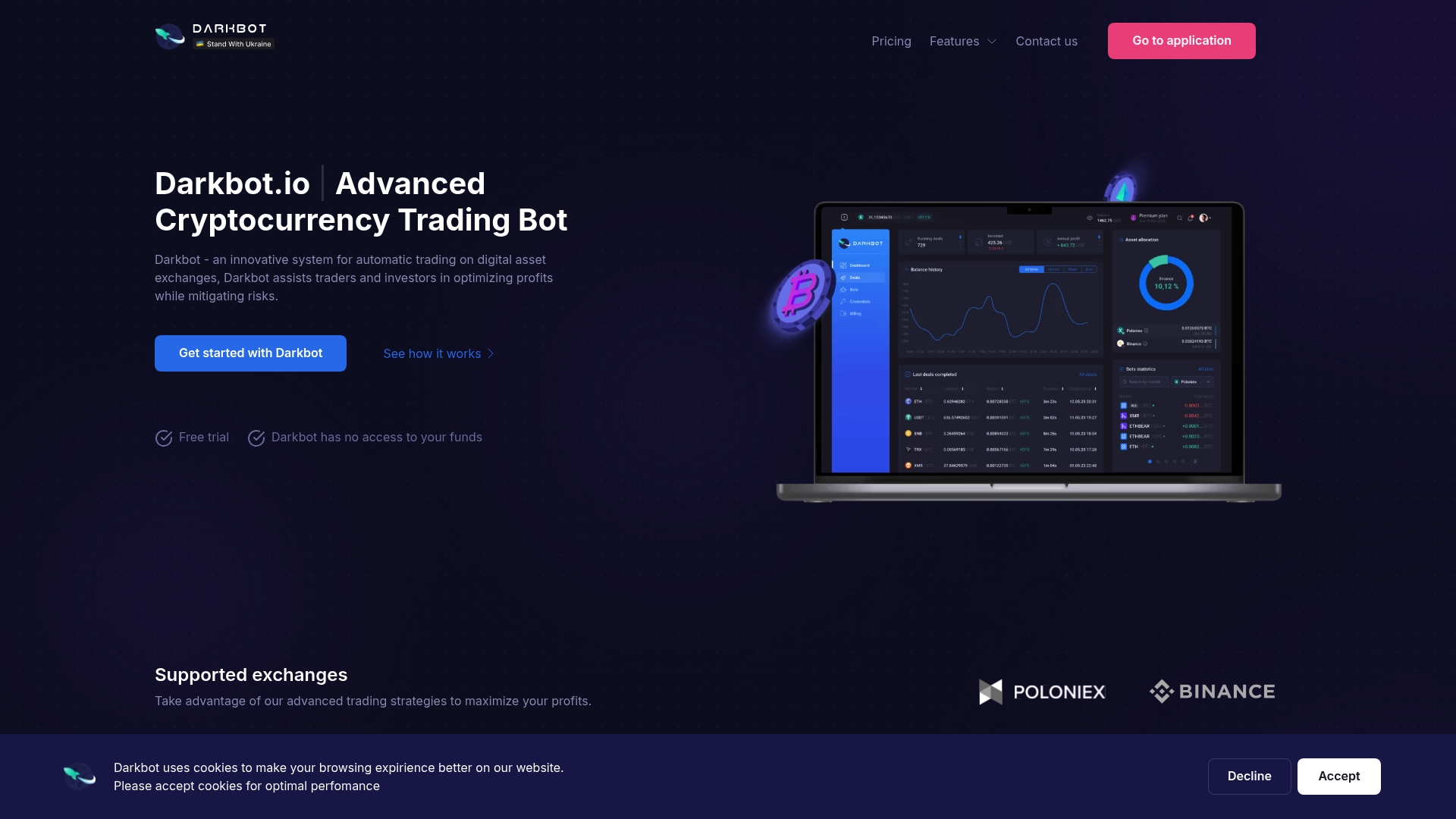
For practitioners coming out of ML finance programs, Darkbot provides a structured environment to observe how rule-driven algorithms behave under live market conditions. The platform’s automated trading and portfolio tools reflect the same principles taught in top courses: probabilistic pattern evaluation, disciplined position sizing, and repeatable execution logic. Explore Darkbot’s portfolio management capabilities to see how ML-based automation handles the risk and rebalancing decisions you study in the classroom.
FAQ
What is a machine learning for finance course?
A machine learning for finance course is a structured program teaching ML algorithms applied to financial problems like trading, risk management, and portfolio optimization. Programs from Harvard, Stanford, and the University of Chicago are among the most recognized offerings.
What prerequisites do most ML finance courses require?
Most programs require working knowledge of Python or R, along with foundational math including linear algebra, probability, and optimization. Cornell Tech’s ORIE 5260 is one of the more math-intensive options, while Harvard’s program is more accessible to practitioners with coding experience but lighter math backgrounds.
How long does it take to complete an ML finance course?
Course length ranges from six weeks for Stanford’s AI in Finance program to a full semester for university-based offerings like the University of Melbourne’s program. UChicago’s professional course runs approximately eight weeks in a cohort format.
Why is the sharpe ratio used to evaluate ML models in finance?
The Sharpe ratio measures risk-adjusted return, which is the relevant performance metric for financial strategies. Generic ML accuracy metrics do not capture whether a model generates economically meaningful signals after accounting for volatility and transaction costs.
Can i apply ML finance course skills to crypto trading?
Yes. The core methods, including time series modeling, classification, and reinforcement learning, apply directly to crypto markets. Digital assets do require adapted risk frameworks because of their 24/7 structure and liquidity characteristics, which differ from traditional equity markets.
Recommended

Start trading on Darkbot with ease
Come and explore our crypto trading platform by connecting your free account!
Free plan available • No credit card required