Crypto Strategy Optimization Process: A Trader's Guide

TL;DR:
- A systematic crypto strategy optimization process involves defining explicit rules, realistic backtesting with costs, walk-forward validation, and statistical robustness checks such as PBO and Monte Carlo simulation. It emphasizes building a pipeline that quickly rejects poor hypotheses and validates promising ones while integrating execution realism and regime-aware adjustments to ensure durability. Separate risk controls like watchdog processes enforce safety independently, ensuring reliable, repeatable trading outcomes.
The strategy optimization process in crypto is a systematic method for refining trading rules, validating them through realistic backtesting, and applying advanced algorithms and risk controls to produce consistent, repeatable outcomes. Unlike discretionary trading, this process treats each strategy as a falsifiable hypothesis: you define it, test it under realistic conditions, measure its statistical robustness, and either iterate or discard it. Tools like Bayesian optimization, walk-forward testing, and hidden Markov model regime classification have moved from academic research into practical frameworks used by systematic traders on platforms including Darkbot and open-source projects like OpenCrypto. The core discipline is not finding the perfect parameter set. It is building a pipeline that fails bad ideas quickly and validates good ones rigorously.
What are the essential steps in a systematic crypto strategy optimization process?
The systematic optimization workflow begins with a clearly defined hypothesis: explicit entry and exit rules, position sizing logic, and the market conditions under which the strategy is expected to work. Vague strategies produce vague results. Every parameter must be stated before the first backtest runs.

The second step is realistic backtesting. This means including exchange fees, estimated slippage, execution delays, and leverage costs. A backtest that ignores these factors will overstate returns and produce a strategy that fails immediately in live trading. The backtest realism gap is one of the most common causes of live underperformance among systematic crypto traders.
The third step is walk-forward optimization. Rather than optimizing parameters on the full historical dataset and calling it done, walk-forward testing splits data into sequential in-sample and out-of-sample windows. Parameters are tuned on the in-sample period and evaluated on the out-of-sample period. This process repeats across the full data history, producing a realistic picture of how the strategy would have performed on data it never saw during tuning.
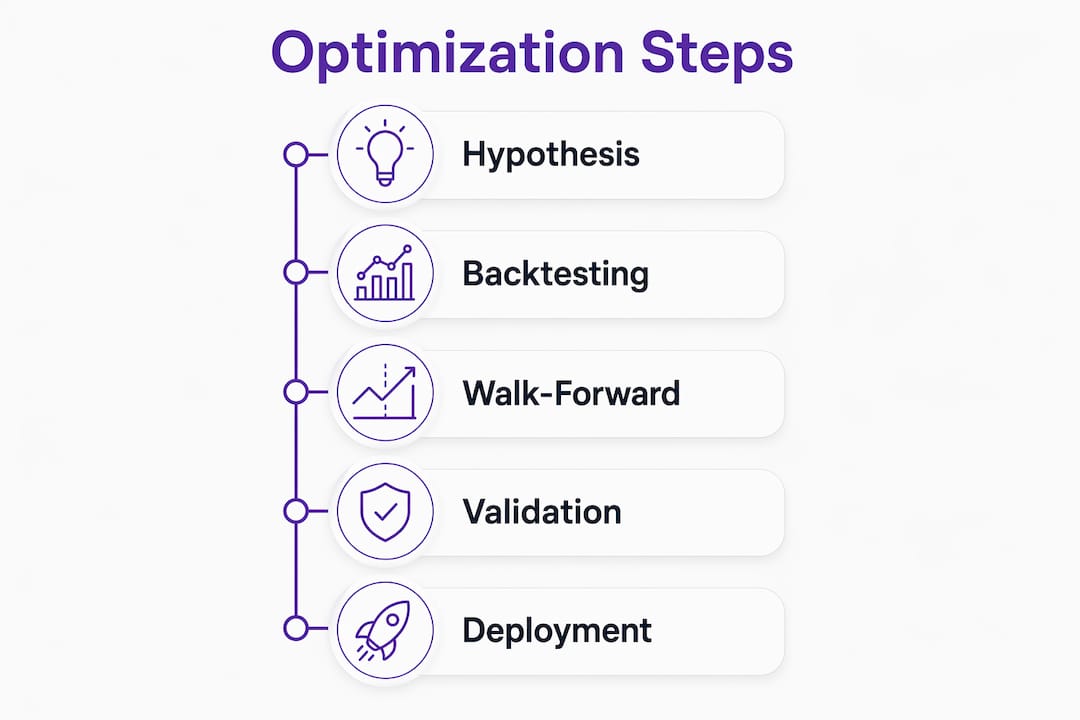
The fourth step is robustness validation. Two methods are standard here. The Probability of Backtest Overfitting (PBO) measures how likely a strategy’s performance is the result of curve-fitting rather than genuine edge. A PBO above 0.15 disqualifies the strategy outright. Monte Carlo simulation runs the strategy through thousands of randomized variations of the historical data to test whether performance holds under different sequences of trades. A 10,000-run Monte Carlo test provides meaningful confidence that results are not path-dependent.
The fifth step is iteration or discard. Most hypotheses fail. That is not a problem. It is the expected outcome of a rigorous process. The most valuable output of an optimization pipeline is throughput: the ability to test many hypotheses quickly and discard losing ones before they consume capital or time.
- Define explicit strategy rules and parameters before any testing begins.
- Run backtests with fees, slippage, and execution delays included.
- Apply walk-forward optimization across sequential data windows.
- Validate with PBO and Monte Carlo simulation.
- Iterate on passing strategies; discard failing ones immediately.
Pro Tip: Set your PBO threshold and Monte Carlo pass criteria before you run a single backtest. Defining the bar in advance removes the temptation to rationalize a marginal result after the fact.
How can Bayesian optimization and simulated annealing improve crypto strategy tuning?
Grid search tests every combination of parameters within a defined range. For a strategy with five parameters and ten values each, that is 100,000 backtests. In crypto, where backtests are computationally expensive, this approach is impractical. Bayesian optimization and simulated annealing solve this problem differently, and both are now standard tools in serious cryptocurrency strategy improvement workflows.
Bayesian optimization builds a probabilistic surrogate model of the objective function, typically a Gaussian Process, and uses an acquisition function to decide which parameter combination to evaluate next. The acquisition function is cheap to compute compared to a full backtest, so the algorithm focuses expensive evaluations on regions of the parameter space most likely to yield improvement. It balances exploration of unknown regions against exploitation of known good regions, converging on strong parameter sets in a fraction of the evaluations grid search would require.
Simulated annealing takes a different approach. It probabilistically escapes local optima by accepting worse solutions early in the search when the “temperature” is high, then becoming increasingly selective as temperature cools. This prevents the algorithm from getting trapped in a locally good but globally suboptimal parameter region. In practice, simulated annealing complements Bayesian optimization well: use Bayesian methods for structured search and simulated annealing when the parameter space is irregular or discontinuous.
Consider a moving average crossover strategy with two parameters: a fast period and a slow period. Bayesian optimization would start with a handful of random evaluations, build a surrogate model of how Sharpe ratio responds to each combination, and then direct subsequent evaluations toward the most promising regions. After 50 to 100 evaluations, it typically identifies near-optimal parameters that grid search would have found only after thousands of runs.
- Bayesian optimization is most effective when backtests are expensive and the parameter space is smooth.
- Simulated annealing handles irregular or multimodal parameter spaces where Bayesian methods may stall.
- Both methods require overfitting controls applied after tuning, not instead of them.
- Neither method replaces walk-forward validation. They reduce the search cost; they do not validate the result.
Pro Tip: When using Bayesian optimization, limit the number of tunable parameters to five or fewer. Each additional parameter exponentially increases the risk of overfitting, regardless of how efficient the search algorithm is.
Why does realistic execution modeling determine backtest credibility?
A backtest is only as credible as its execution assumptions. In crypto markets, where taker fees on major exchanges range from 2 to 10 basis points per trade and slippage on mid-cap assets can exceed that, execution costs are not a rounding error. They are a primary driver of whether a strategy is viable.
The leverage question illustrates this clearly. At a 5 basis point taker fee, a 100x leveraged round-trip costs 10% of equity in fees alone. This makes 50x leverage more optimal than 100x in many systematic strategies, even when the raw signal supports higher leverage. Traders who backtest without modeling fee drag systematically overestimate the benefit of leverage and build strategies that erode capital in live trading.
End-to-end crypto trading engines must perfectly align backtest and live execution pipelines, including the exact order of stop-loss and take-profit evaluations and execution latencies, to avoid misleading conclusions.
The paper-exchange approach addresses this by simulating order execution within the backtest engine using the same logic that will run in live trading. Stop-loss and take-profit evaluations happen in the same sequence, with the same latency assumptions, as the live system. This alignment between backtest and live execution is not optional for serious process optimization in crypto. It is the minimum standard for trusting a backtest result.
Slippage modeling deserves equal attention. A strategy that trades illiquid altcoin pairs at scale will move the market. A realistic backtest models this impact using volume-weighted estimates rather than assuming fills at the mid-price. Ignoring market impact produces backtests that look excellent on paper and fail at the first live execution.
How does regime-awareness and risk management strengthen strategy robustness?
A strategy optimized on a trending market will behave poorly in a mean-reverting one. Regime-aware optimization addresses this by classifying market states and conditioning strategy selection on the current regime. Hidden Markov models are the standard tool for this classification in systematic crypto trading. Regime labels generated by these models carry a stay-probability of approximately 0.97, meaning the market is highly likely to remain in the same regime from one period to the next. This stability makes regime labels reliable inputs for conditional strategy selection rather than noisy signals that flip constantly.
Risk management layers operate independently of regime classification and address a different problem: protecting capital when the strategy encounters conditions outside its design parameters. The OpenCrypto framework implements nine manipulation checks alongside daily drawdown limits and progressive stop-loss logic. These controls reduce false signals from wash trading and spoofing, which are common in crypto markets and can trigger strategy entries that would never occur in cleaner markets.
| Feature | Regime-aware approach | Regime-agnostic approach |
|---|---|---|
| Market state handling | Adapts strategy selection to current regime | Applies same strategy regardless of conditions |
| Drawdown behavior | Lower drawdowns during regime transitions | Higher drawdowns when market conditions shift |
| Overfitting risk | Requires regime model validation | Single strategy may overfit to dominant regime |
| Implementation complexity | Higher: requires HMM or equivalent | Lower: single optimization pass |
Operational safeguards complete the risk management architecture. A watchdog process that polls positions every 10 seconds and enforces hard stops independent of the main strategy engine prevents runaway losses when the primary system stalls or encounters an unexpected state. Separating stop-loss enforcement from core strategy logic means that a bug in the optimization layer cannot disable risk controls. This separation is a design principle, not a feature. It is the difference between a system that fails safely and one that fails catastrophically.
For a deeper look at how these risk controls integrate with automated execution, the risk management automation guide from Darkbot covers the practical implementation in detail.
Key takeaways
A rigorous strategy optimization process in crypto requires realistic execution modeling, statistical overfitting controls, and independent risk management layers working together as a single pipeline.
| Point | Details |
|---|---|
| Define before testing | State all rules and parameters explicitly before running any backtest to prevent post-hoc rationalization. |
| Model execution costs | Include fees, slippage, and leverage drag in every backtest; ignoring them produces unreliable results. |
| Use efficient search methods | Bayesian optimization and simulated annealing reduce tuning costs without replacing walk-forward validation. |
| Apply overfitting controls | PBO above 0.15 and Monte Carlo stress-testing should disqualify strategies before live deployment. |
| Separate risk from strategy logic | Watchdog processes and hard stops must operate independently of the core optimization engine. |
Why most traders optimize the wrong thing
Most traders I see focus optimization effort on finding the best parameter set. They run thousands of backtests, tune every variable, and declare the highest Sharpe ratio the winner. That is the wrong objective. The right objective is building a pipeline that processes hypotheses quickly, rejects bad ones on statistical grounds, and passes only the ones that survive realistic execution modeling and robustness checks.
Overfitting is the default outcome of optimization, not an edge case. Without PBO and Monte Carlo controls integrated into the loop continuously, not just at the end, you are measuring how well your strategy fits historical data, not how well it will perform on future data. I have seen strategies with Sharpe ratios above 3 in backtests collapse within weeks of live deployment because the optimization process had no statistical guardrails.
The regime-awareness piece is underused. Traders spend months tuning a single strategy and then wonder why it stops working when market conditions shift. A strategy optimized on 2021 trending conditions will not survive a 2022 mean-reverting environment. Building regime classification into the pipeline from the start is not additional complexity. It is the mechanism that makes the strategy durable.
Execution realism is where I see the most expensive mistakes. A trader builds a strategy on a 5-minute chart with 20x leverage, backtests it without fee drag, sees a 200% annual return, and deploys it. The live account loses 30% in the first month. The strategy was not wrong. The backtest was. Aligning your backtest pipeline with your live execution logic, including order evaluation sequence and latency, is the single highest-leverage improvement most systematic traders can make. Darkbot’s architecture enforces this alignment by design, which is one reason it produces more consistent live results than manual backtesting setups.
— Grisha
How Darkbot supports systematic crypto strategy execution
Darkbot is an AI-driven crypto trading automation platform built around disciplined strategy execution, not signal generation. Its architecture enforces the same execution logic in live trading as in the backtesting environment, closing the realism gap that undermines most manual optimization workflows. Risk management controls including drawdown limits and position management run as independent processes, separate from the core strategy engine, so that risk enforcement remains active regardless of strategy state. For traders who have completed the optimization steps for profits and want consistent application of validated strategies across multiple exchanges, Darkbot provides the infrastructure to deploy and monitor those strategies without manual intervention. Start building a more disciplined trading process at Darkbot.
FAQ
What is the strategy optimization process in crypto trading?
The strategy optimization process in crypto is a structured workflow covering hypothesis definition, realistic backtesting with fees and slippage, walk-forward validation, and robustness checks like PBO and Monte Carlo simulation. Its goal is to produce strategies with genuine statistical edge rather than curve-fitted historical performance.
How does Bayesian optimization differ from grid search for crypto strategies?
Bayesian optimization uses a surrogate model and acquisition function to direct evaluations toward the most promising parameter regions, requiring far fewer backtests than grid search to find near-optimal parameters. Grid search tests every combination exhaustively, which becomes computationally impractical for strategies with multiple parameters.
Why does leverage increase risk in crypto backtests?
At a 5 basis point taker fee, a 100x leveraged round-trip costs 10% of equity in fees alone, making lower leverage levels more optimal in practice. Backtests that ignore fee drag overstate the benefit of high leverage and produce strategies that erode capital in live trading.
What is regime-aware strategy optimization?
Regime-aware optimization classifies market states using models like hidden Markov models and selects or adjusts strategies based on the current regime. Regime labels carry a stay-probability near 0.97, making them stable enough to condition strategy selection reliably.
How do operational safeguards differ from strategy-level risk management?
Operational safeguards like watchdog processes enforce hard stops and position limits independently of the main strategy engine, ensuring risk controls remain active even if the optimization or execution logic encounters an error. Strategy-level risk management handles signal filtering and position sizing within the normal execution flow.
Recommended

Start trading on Darkbot with ease
Come and explore our crypto trading platform by connecting your free account!
Free plan available • No credit card required