ML & Algorithmic Trading: 287% Crypto Returns Explained
TL;DR:
- Reinforcement learning achieves high returns and improved risk management in crypto trading.
- Complex deep learning models often underperform simple persistent predictions in short-term crypto forecasting.
- Building robust strategies requires realistic testing, cautious tuning, and disciplined risk controls.
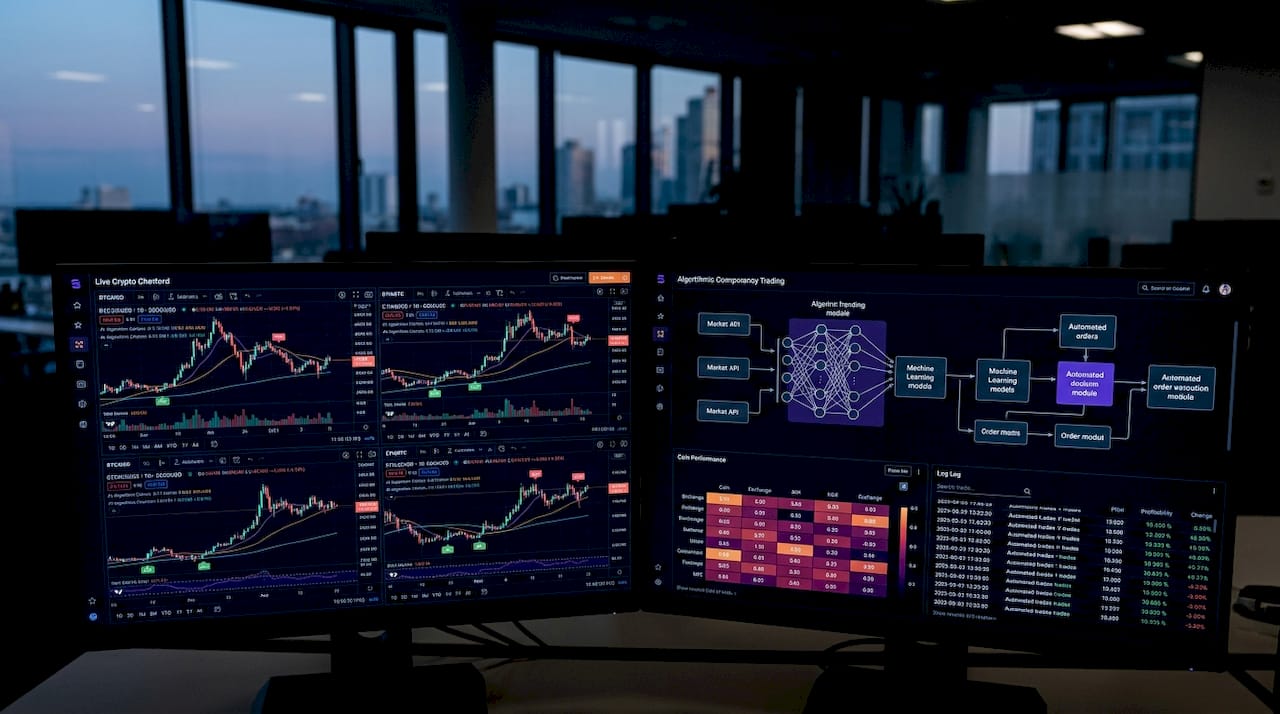
Reinforcement learning strategies have delivered 152% to 287% excess returns in crypto markets, yet 90% of machine learning models collapse the moment they meet real trading conditions. That gap between backtest glory and live performance is where most traders lose money and confidence. The promise of AI-powered crypto trading is real, but it comes with hard limits that the hype rarely mentions. This guide breaks down which ML strategies actually work, where sophisticated models fall short, and how you can build automated crypto trading approaches that survive contact with volatile, unpredictable markets.
Key Takeaways
| Point | Details |
|---|---|
| Backtesting isn’t enough | Most machine learning strategies fail to perform in real crypto markets due to hidden costs and market efficiency. |
| Reinforcement learning excels | RL-based trading outperforms by minimizing risk and maximizing returns, especially in crisis scenarios. |
| Complexity can hurt | Sophisticated deep learning models rarely beat simple strategies, proving less is often more in short-term trading. |
| Follow a disciplined framework | Build strategies using research, backtesting, stress tests, and focus on sound risk management. |
| Optimized automation is possible | With the right ML tools, crypto traders can achieve better results and manage volatility. |
How machine learning powers algorithmic trading in crypto
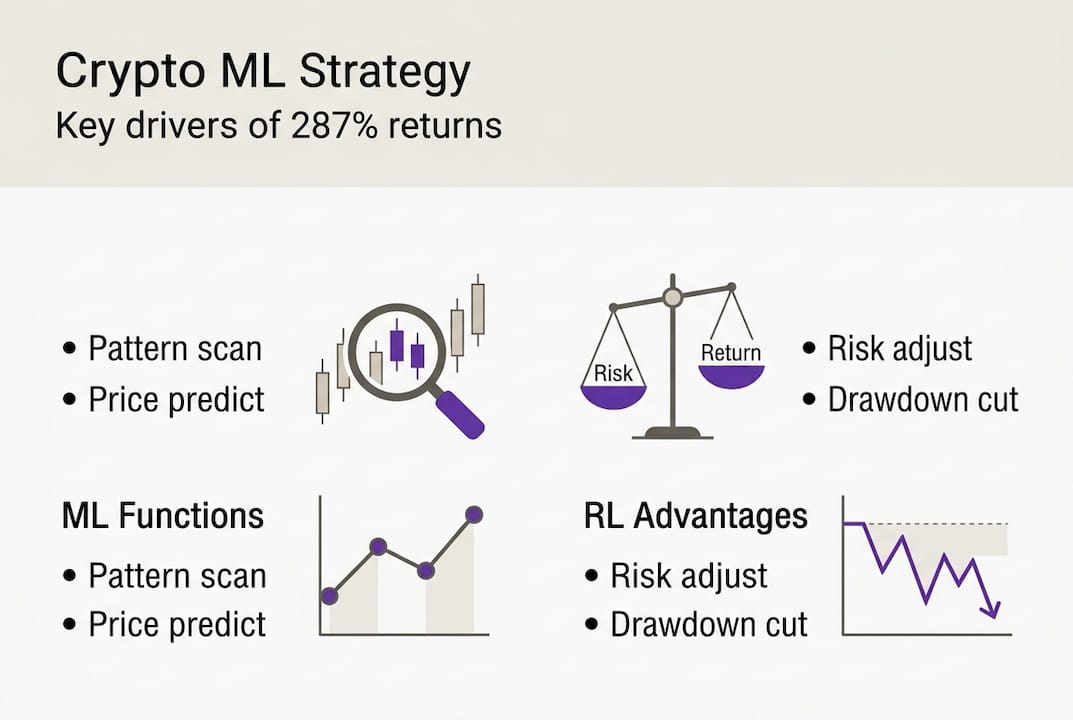
Machine learning gives algorithms the ability to scan thousands of price patterns, detect subtle market signals, and execute orders faster than any human trader. Instead of following a fixed ruleset, ML models learn from historical data and adjust their behavior as new information arrives. That adaptability is the core reason ML advantages in crypto are so compelling for traders dealing with 24/7 markets and extreme volatility.
At a basic level, crypto automation explained comes down to three functions: pattern recognition, prediction, and execution. An ML model might identify that Bitcoin tends to retrace after a specific volume spike, generate a sell signal, and route the order automatically. No emotion, no hesitation.
But the performance gap between backtests and live trading is brutal. ML strategies often outperform buy-and-hold in historical simulations, but real-world friction erodes those edges fast. Transaction fees, slippage, and regime changes all chip away at returns that looked spectacular on paper.
| Metric | Buy-and-Hold | ML Strategy (Backtested) | ML Strategy (Live) |
|---|---|---|---|
| Average ROI | Moderate | High | Often lower |
| Sharpe Ratio | ~0.8 | ~1.5-2.5 | ~0.9-1.2 |
| Max Drawdown | High | Lower | Variable |
| Transaction Cost Impact | Low | Moderate | High |
The most common pitfalls in complete ML guide literature include:
- Overfitting: The model memorizes past data instead of learning transferable patterns
- Ignoring transaction costs: Even a 0.10% fee per trade destroys thin edges over hundreds of trades
- Market regime shifts: A model trained on a bull market fails in a bear market
- Data leakage: Future information accidentally bleeds into training data, inflating backtest results
Pro Tip: Always simulate your ML strategy using realistic fees (0.10% to 0.30% per trade) and slippage estimates before you deploy a single dollar. A strategy that returns 40% in backtests might return 8% live once costs are factored in.
Why reinforcement learning changes the game for crypto trading
Reinforcement learning is a different animal compared to standard supervised ML. Instead of learning from labeled historical examples, an RL agent learns by taking actions in a simulated environment and receiving rewards or penalties based on outcomes. It figures out optimal trading behavior through trial and error, which makes it uniquely suited to sequential decision-making in volatile markets.

The real-world results back this up. RL in crypto trading research shows that Soft Actor-Critic (SAC) achieved a Sharpe ratio of 2.81 and 152% excess returns on ETH/USDT, while Rainbow DQN pushed even further with 287% excess returns. These aren’t backtest fantasies. They reflect RL’s ability to boost crypto profits by dynamically adapting position sizes and timing to shifting market conditions.
| Strategy | Sharpe Ratio | Excess Returns | Max Drawdown |
|---|---|---|---|
| Buy-and-Hold | ~0.8 | Baseline | ~42.7% |
| Rainbow DQN | ~2.1 | 287% | ~16.5% |
| SAC (RL) | 2.81 | 152% (ETH/USDT) | ~19.3% |
“During the LUNA crisis, RL-based systems reduced maximum drawdown from 42.7% to 19.3%, a 63% reduction in downside exposure compared to passive strategies.”
That drawdown reduction is where RL truly earns its place. Risk management automation becomes far more precise when an RL agent can recognize deteriorating conditions and cut exposure in real time, rather than waiting for a static stop-loss to trigger.
RL does have its own challenges. Training is computationally expensive, reward function design is tricky, and poorly tuned agents can develop strategies that game their own reward signal without actually generating profit.
Pro Tip: When designing RL reward functions, weight risk-adjusted metrics like Sharpe ratio or Calmar ratio rather than raw returns. An agent chasing maximum profit will often take reckless positions that blow up in live conditions.
The limits of sophisticated AI in short-term crypto forecasting
Here is the uncomfortable part that most AI trading content skips. Sophisticated deep learning models, including transformers, LSTMs, and attention-based architectures, frequently fail to beat a simple persistence baseline in short-term crypto forecasting. A persistence baseline just predicts that tomorrow’s price equals today’s price. That’s it. No model. No GPU cluster required.
Transformers underperform persistence baselines in short-term crypto price prediction, with directional accuracy hovering around 50% and RMSE near 3.3%. That’s essentially coin-flip territory for directional calls.
| Model | Directional Accuracy | RMSE | Net ROI (After Costs) |
|---|---|---|---|
| Persistence Baseline | ~50% | ~3.3% | Neutral |
| Transformer | ~50-52% | ~3.3% | Often Negative |
| LSTM | ~51-53% | ~3.5% | Marginally Positive |
Why does this happen? A few reasons:
- Market efficiency: Crypto markets, especially for major pairs, price in public information quickly
- Noise dominance: Short-term price moves are largely random; patterns are fleeting
- Transaction cost drag: A model with 53% accuracy still loses money if it trades frequently and pays 0.20% per round trip
- Overfitting to noise: Complex models find patterns in random data and mistake them for signal
Smarter crypto strategies often involve stepping back from minute-by-minute prediction and focusing on longer timeframes where signal-to-noise ratios improve. Fintech crypto optimization research consistently shows that simpler models with strong feature engineering outperform complex architectures that overfit to short-term noise.
The lesson here isn’t that AI is useless. It’s that complexity without edge is just expensive noise.
Building practical, profitable ML trading strategies for crypto
Knowing what doesn’t work is half the battle. Now let’s build something that does. The 90% failure rate of ML models in live production isn’t inevitable. It’s the result of skipping steps, ignoring costs, and treating backtests as proof of concept rather than a starting point.
The 5-step framework for ML strategy development:
- Research: Identify a market inefficiency or behavioral pattern with a plausible economic reason. If you can’t explain why an edge exists, it probably doesn’t.
- Backtest: Test across multiple market regimes, including bull, bear, and sideways periods. Use realistic fees (0.10% to 0.30%) and slippage estimates.
- Stress test: Simulate performance during extreme events like the 2022 LUNA collapse, the FTX crash, and COVID-era volatility. If the strategy breaks, redesign before deploying.
- Tune: Adjust parameters conservatively. Avoid over-optimization. A strategy that works across a range of parameter values is more robust than one that only works at a single setting.
- Deploy: Start with small position sizes. Monitor live performance against backtest expectations. If divergence appears early, pause and investigate before scaling.
Key stat: Tiny edges of 0.02% are completely wiped out by typical transaction costs of 0.30%, which is why most ML models fail in production despite promising backtests.
Common pitfalls that kill otherwise solid strategies include ignoring funding rates on perpetual futures, failing to account for liquidity gaps during high-volatility events, and not updating models as market conditions evolve. Option trading with ML and trading efficiency with ML both reinforce the same principle: disciplined process beats clever algorithms every time.
Pro Tip: Combine ML signals with simple, hard-coded risk rules. For example, never risk more than 2% of portfolio on a single trade regardless of what the model says. ML handles signal generation; rules handle survival.
The uncomfortable truth behind machine learning in crypto trading
Most traders come to ML with the wrong mental model. They expect an algorithm to solve the market, generate consistent profits, and require minimal oversight. That’s not how any of this works.
Markets are adversarial. Every edge you find, thousands of other quant teams are also finding. The moment a pattern becomes widely known, it gets arbitraged away. This is why risk automation perspective matters more than raw model sophistication. Protecting capital during drawdowns is often more valuable than chasing maximum returns.
The traders who actually succeed with ML aren’t the ones running the most complex neural networks. They’re the ones who treat every model as a hypothesis, not a solution. They run continuous evaluation, update their models when market regimes shift, and never let a backtest result override their risk management rules.
Humility is a genuine competitive advantage in algorithmic trading. The market will always be smarter than your model on its worst day. Build for that reality, not the best-case scenario.
Take your crypto trading to the next level with AI
Understanding the theory is one thing. Deploying it in live markets is another challenge entirely. That’s where purpose-built tools make a real difference.
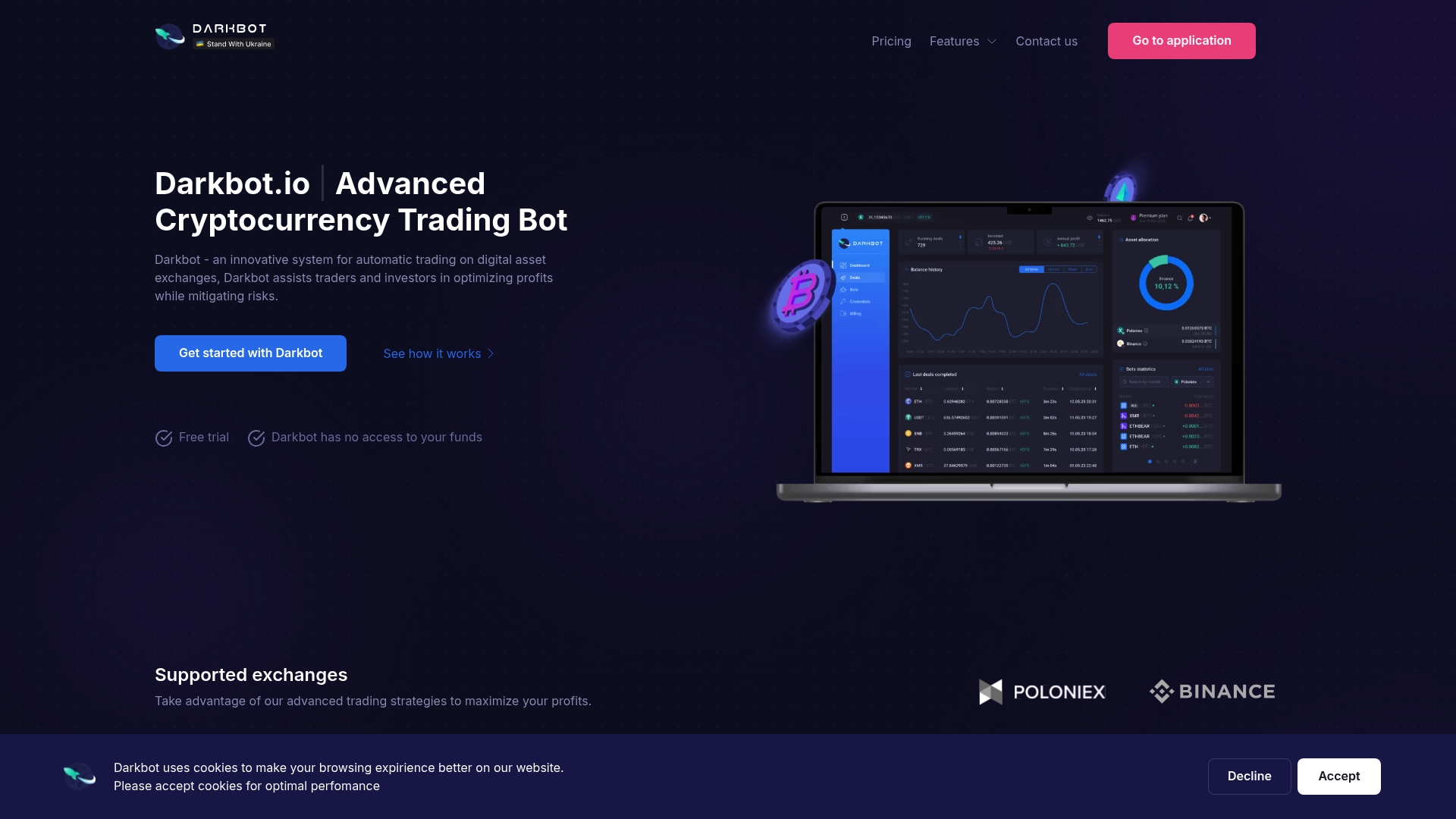
Darkbot’s AI crypto trading bot gives you access to advanced ML-powered automation across multiple exchanges, with built-in risk controls and real-time performance analytics. Whether you’re running your first automated strategy or managing a multi-asset portfolio, Darkbot’s portfolio optimization tools handle rebalancing, position sizing, and risk exposure automatically. You get the power of algorithmic trading without needing a PhD in machine learning. Explore Darkbot today and start deploying strategies that are built to survive real market conditions, not just backtests.
Frequently asked questions
Can machine learning strategies consistently beat the crypto market?
Most ML models fail to sustain consistent profits after accounting for transaction costs and market efficiency, even when backtests look strong. Consistent outperformance requires continuous model adaptation and strict cost management.
How does reinforcement learning improve crypto trading results?
RL enables dynamic, sequential decision-making that adjusts to volatility in real time, with research showing drawdown reductions of 63% compared to passive strategies during market crises. It’s particularly effective for risk control under extreme conditions.
Why do deep learning models struggle in short-term crypto trading?
Sophisticated DL models underperform simple baselines because short-term crypto price movements are dominated by noise rather than learnable patterns. High transaction costs further erode any marginal accuracy advantage these models might have.
What steps should I take to build robust machine learning trading strategies?
Follow a five-step process: research a plausible edge, backtest across multiple regimes with realistic costs, stress-test against historical crises, tune conservatively, and deploy with strict position sizing rules. 90% of ML models fail production because traders skip the stress-testing and cost-accounting steps.
Recommended
- Machine Learning in Trading 2025: Smarter Crypto Strategies
- Machine Learning in Trading Strategies: Crypto Automation Explained
- Optimize automated crypto trading: 152%+ returns safely
- Machine Learning in Crypto Trading: Impact and Advantages
- Hedging best practices: Winning strategies for FX risk in 2026

Start trading on Darkbot with ease
Come and explore our crypto trading platform by connecting your free account!
Free plan available • No credit card required