How machine learning transforms forex trading in 2026

TL;DR:
- Simpler models like Logistic Regression often outperform complex neural networks after accounting for transaction costs.
- Proper validation, out-of-sample testing, and risk management are critical for live ML forex trading success.
- Focus on disciplined processes, human oversight, and cost-aware strategies rather than overfitting complex models.
The most profitable machine learning model for forex trading isn’t always the most sophisticated one. That counterintuitive reality trips up thousands of traders who pour resources into complex neural networks, only to watch simpler models outperform them after real transaction costs hit. Machine learning has genuinely changed how algorithmic forex strategies are built, tested, and deployed, but the gap between backtested results and live trading performance remains brutally wide. This article walks you through the core methodologies, empirical model comparisons, risk frameworks, and expert best practices that separate traders who profit from ML from those who just experiment with it.
Key Takeaways
| Point | Details |
|---|---|
| Simple models win | Logistic Regression and other interpretable models deliver superior risk-adjusted performance in live forex trading. |
| Cost modeling is vital | Transaction costs can drastically reduce the effectiveness of complex ML strategies. |
| Validate with rigor | Out-of-sample testing and walk-forward optimization are essential to robust machine learning systems. |
| Human-AI synergy | Combining expert oversight with automation delivers the most reliable long-term results. |
What is machine learning in forex and why does it matter?
Machine learning in forex trading means using algorithms that learn patterns from historical price data, then generate buy or sell signals without being explicitly programmed with fixed rules. Unlike traditional rule-based bots that execute the same logic forever, ML models adapt to new data and can capture complex, nonlinear relationships between variables that no human analyst could track manually.
In practice, ML models process technical indicators like EMA (Exponential Moving Average), RSI (Relative Strength Index), MACD, Bollinger Bands, and volume metrics as input features. The model then learns which combinations of these signals historically preceded profitable moves. ML trading efficiency improves significantly when models are fed clean, well-engineered feature sets rather than raw price streams.
The range of models applied to forex is wide. Machine learning methodologies in forex integrate technical indicators with models such as LSTM, GRU, MLP, Logistic Regression, Random Forest, and XGBoost for price forecasting and prediction. Each model has a different relationship with data complexity, interpretability, and computational cost.
Here’s a quick breakdown of common ML model categories used in forex:
- LSTM and GRU (recurrent networks): Designed for sequential time-series data; capture long-range dependencies in price history
- MLP (Multi-Layer Perceptron): A feedforward neural network that excels at learning nonlinear patterns across many input features
- Logistic Regression: A simple, interpretable classifier that predicts directional price movement (up or down)
- Random Forest and XGBoost: Ensemble tree methods that handle noisy, high-dimensional data well and resist overfitting better than deep networks
Forex-specific challenges make this harder than it looks. The market is non-stationary, meaning statistical properties shift over time as economic regimes change. Data noise is extreme at short timeframes. Overfitting, where a model memorizes past data instead of generalizing, is the single biggest reason ML forex bots fail in live trading.
“The blend of technical indicators with diverse ML architectures is not a shortcut to profit. It’s a framework that demands rigorous validation before any capital is committed.”
Pro Tip: Use at least three years of tick or minute-level data across multiple currency pairs when training. Validate on a completely held-out time window, not just a random split, to properly simulate forward performance.
Most effective machine learning models for forex trading
Knowing which model to use is one of the most practical decisions you’ll make when building an ML forex system. Empirical research now gives us real performance benchmarks to work from, not just theoretical comparisons.
Empirical performance of ML models shows that Multi-Layer Perceptron achieved an ROI of 334% on INR currency pairs, while Logistic Regression with a profit-aware loss function yielded the best Risk-Adjusted Performance Index (RAPI) across tested models. That distinction matters enormously: raw ROI and risk-adjusted return are not the same thing.

| Model | Strengths | Weaknesses | Interpretability |
|---|---|---|---|
| MLP | High raw ROI, captures nonlinear patterns | Prone to overfitting, slow to retrain | Low |
| Logistic Regression | Best RAPI, fast, cost-aware | Limited to linear decision boundaries | High |
| Random Forest | Handles noise well, robust | Computationally heavy, less adaptive | Medium |
| XGBoost | Strong on tabular data, regularization built in | Requires careful hyperparameter tuning | Medium |
| LSTM/GRU | Captures temporal dependencies | Needs large data, very slow to train | Very Low |
When evaluating smarter ML trading strategies, the trade-offs between complexity and real-world performance are critical. Here are the key trade-offs to consider:
- Overfitting risk increases with model complexity. Deep networks memorize noise in training data, producing impressive backtests that collapse in live conditions.
- Cost sensitivity varies dramatically. Simpler models like Logistic Regression degrade more gracefully when transaction costs rise, while neural networks can turn profitable backtests into net losses.
- Interpretability affects adaptability. When a Logistic Regression model starts failing, you can diagnose why. When an LSTM fails, you often can’t.
- Retraining frequency matters. Complex models require more data and compute to retrain as market conditions shift, creating operational overhead that retail traders underestimate.
For AI strategy optimization, the evidence points toward a pragmatic conclusion: use the simplest model that meets your performance threshold. MLP is worth the complexity only when transaction costs are very low and you have robust overfitting controls in place.
Pro Tip: Before committing to a deep learning model, benchmark it against Logistic Regression on your specific currency pair and cost structure. If the simpler model comes within 20% of the complex one’s RAPI, choose the simpler model every time.
Risk management and transaction costs: The critical factors
Model selection is only half the equation. The other half is understanding exactly how transaction costs and risk frameworks interact with your chosen model’s real-world performance.
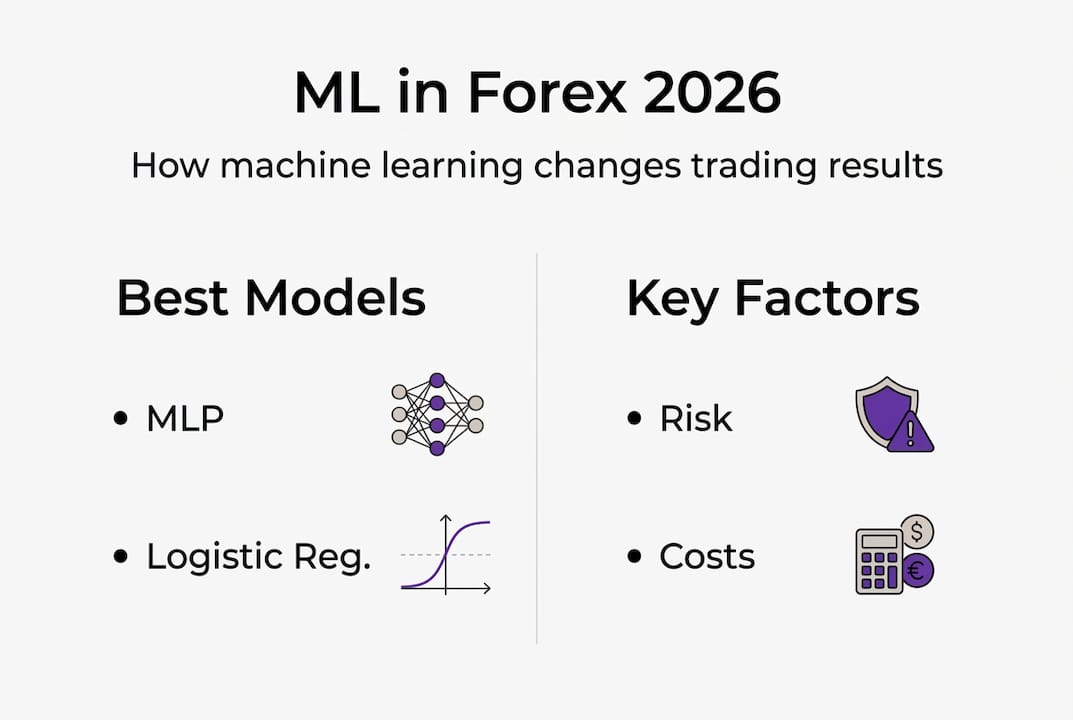
Transaction costs in forex include the bid-ask spread, broker commissions, and slippage on execution. These costs compound across hundreds or thousands of trades per month. Risk-adjusted returns and cost impact show that simpler interpretable models like Logistic Regression outperform neural networks in risk-adjusted returns after transaction costs, and that performance sharply degrades when costs exceed 1%.
| Cost Level | MLP Performance | Logistic Regression Performance |
|---|---|---|
| 0.0% (no cost) | Very High ROI | High ROI |
| 0.5% per trade | Moderate ROI | Moderate ROI |
| 1.0% per trade | Near breakeven | Slight positive |
| >1.0% per trade | Net negative | Near breakeven |
This is why so many retail forex robots fail. They are backtested in zero-cost or low-cost simulations, then deployed into real broker environments where spreads and slippage erode every edge the model found.
Two key risk metrics every ML forex trader should track:
- VaR (Value at Risk): Estimates the maximum expected loss over a given time period at a specific confidence level. Use it to size positions and set drawdown limits before live deployment.
- RAPI (Risk-Adjusted Performance Index): Combines return with volatility and drawdown into a single score. A model with a lower ROI but higher RAPI is often the better live trading choice.
Best practices for risk management in ML forex systems include:
- Use profit-aware loss functions during model training so the algorithm penalizes losing trades more heavily
- Always test on out-of-sample data that the model has never seen before deployment
- Apply walk-forward optimization: retrain the model on a rolling window and test it on the next period, simulating real-world adaptation
- Model your actual broker’s spread and slippage into every backtest, not idealized zero-cost conditions
- Set hard drawdown limits that trigger automatic position reduction or shutdown
Best practices: Building robust ML forex systems
Knowing what can go wrong is useful. Knowing exactly how to prevent it is what separates profitable ML traders from expensive experimenters.
Research on expert best practices in ML forex consistently points to walk-forward optimization, out-of-sample testing, profit-aware losses, simple models for noisy data, and hybrid human-AI oversight as the framework that survives real market conditions. These aren’t theoretical ideals. They’re the difference between a system that holds up for six months and one that blows up in week three.
Here’s what a robust implementation looks like in practice:
- Walk-forward optimization: Divide your data into sequential windows. Train on window one, test on window two, then roll forward. This simulates how the model will behave as new data arrives.
- Out-of-sample testing: Reserve at least 20% of your dataset as a final validation set that is never touched during training or parameter tuning.
- Profit-aware loss functions: Standard loss functions minimize prediction error. Profit-aware functions minimize financial loss, which is what actually matters in trading.
- Regime detection: Build a secondary classifier that identifies whether the market is trending, ranging, or in a high-volatility state. Switch model parameters or pause trading accordingly.
- Human oversight layer: Automated systems need human review of performance metrics weekly. Regime shifts, geopolitical events, and liquidity crises can invalidate a model’s assumptions overnight.
For practical crypto automation frameworks, these same principles apply directly. The ML impact in crypto mirrors forex: models that survive regime shifts are the ones built with validation discipline, not just sophisticated architecture.
Key stat: Studies show that live trading failure rates for ML forex systems exceed 70% when out-of-sample testing and cost modeling are skipped during development.
Pro Tip: Set a “paper trading” phase of at least 30 days before going live with any new ML model. If it can’t perform on forward data in simulation, it won’t perform with real capital.
Why simplicity and human oversight outperform hype in ML forex
Here’s something most articles on ML trading won’t tell you: the traders consistently making money with algorithmic forex systems are not the ones running the most sophisticated models. They’re the ones running the most disciplined processes.
The industry narrative pushes complexity. More layers, more features, more data. But after transaction costs, regime shifts, and execution friction hit a live account, that complexity becomes a liability. Simpler models fail more transparently. They’re easier to diagnose, faster to retrain, and more likely to survive a market environment they’ve never seen before.
Failed ML forex bots share a common story: impressive backtest, zero out-of-sample discipline, no cost modeling, no human review. The model learned the past perfectly and predicted the future not at all.
“In live trading, the model that explains its decisions is worth more than the model that maximizes its backtest.”
The practical edge comes from treating ML as a tool within a risk framework, not as a replacement for one. ML optimizing crypto trading works best when human judgment sets the guardrails and the algorithm executes within them. Adaptive thinking, regular model audits, and a willingness to pause a system when conditions shift are what keep accounts intact long enough to compound.
Automate smarter: Next steps with AI-powered forex tools
You now have a clear picture of which ML models work, why costs and risk frameworks matter, and what separates live trading success from expensive backtesting exercises. The next step is putting these principles into a real system.
Darkbot’s trading platform operationalizes exactly these best practices: strategy automation with built-in risk controls, real-time analytics, and portfolio rebalancing designed for volatile markets. Whether you’re running a single strategy or managing multiple bots across exchanges, Darkbot gives you the infrastructure to apply ML insights without building everything from scratch. Explore crypto portfolio optimization tools that let you test, deploy, and monitor automated strategies with the kind of risk discipline this article has outlined.
Frequently asked questions
Which machine learning model is the most profitable for forex trading?
MLP achieved ROI of 334% on INR pairs in empirical studies, making it the highest raw return model. However, Logistic Regression delivers the best Risk-Adjusted Performance Index, making it the smarter choice for most real-world conditions.
How important are transaction costs in ML forex strategies?
Transaction costs are critical. Performance degrades sharply when costs exceed 1% per trade, often turning profitable backtests into net losses in live trading.
What’s the biggest risk when using AI for forex trading?
Overfitting is the primary threat, where a model memorizes historical patterns that don’t repeat. Hybrid oversight and out-of-sample testing are the most reliable safeguards against live trading failure.
Should I use complex neural nets or simpler models for forex?
Logistic Regression outperforms neural networks in risk-adjusted returns after transaction costs in most tested scenarios. Choose complexity only when costs are minimal and overfitting controls are rigorous.
Recommended

Start trading on Darkbot with ease
Come and explore our crypto trading platform by connecting your free account!
Free plan available • No credit card required