Position Sizing for Crypto Traders: Formula, Calculator & Checklist
That single calculation converts an acceptable loss into a concrete order size before you touch the order form.
The standard guardrail across educational frameworks is to risk no more than 1%–2% of total capital on any single trade. That survivability math is the entire argument for the rule.
Key Takeaways
Correct position sizing converts a pre-set dollar risk into a specific order size, and applying that calculation consistently across every trade is the primary mechanism for long-term capital preservation in crypto.
| Point | Details |
|---|---|
| Core formula | Position size (USD) = (Account balance × Risk %) ÷ Stop-loss distance as a decimal of entry. |
| Risk-per-trade guideline | Risk 1%–2% of account per trade as the standard guardrail to preserve capital over many trades. |
| Adjust for execution costs | Subtract estimated fees and slippage from the risk budget before sizing; reduce further for illiquid altcoins. |
| Cap portfolio heat | Keep total open risk at 5%–8% of account; add daily and weekly loss stopouts to prevent compounding drawdowns. |
| Darkbot enforces the rules | Darkbot automates USD-risk sizing, stop placement, and portfolio-heat checks across exchanges without emotional overrides. |
Why position sizing in crypto is different from other markets
Position sizing is the process of deciding how many dollars to commit to a trade so that if the stop-loss triggers, the loss equals a pre-defined dollar amount and nothing more. It controls the size of each loss, not the frequency of losses or the direction of the market.
What it does not control: whether your analysis is correct, whether the exchange fills your stop at the expected price, or whether a correlated position amplifies the damage. Those are separate problems. Sizing handles the one variable you can set before the trade opens.
Crypto-specific factors make this discipline more consequential than in traditional markets:
- Volatility: Major tokens can move 10%–20% in hours; altcoins can move multiples of that. A position sized for equities-level volatility will breach its intended loss limit on the first sharp candle.
- Correlation: During broad market selloffs, BTC, ETH, and most altcoins fall together. Holding five positions feels like diversification until it isn’t.
- Liquidity: Thin order books on smaller tokens mean your stop executes at a worse price than set, inflating the realized loss.
- Leverage: Derivatives amplify both gains and losses, and a liquidation event can bypass a stop entirely.
Risk management built around loss limits rather than return targets increases survival probability over time.
How to calculate your crypto trading position size
The formula has four inputs: account balance, risk percentage, entry price, and stop price. The order of operations matters.

Step 1 — Set your dollar risk. Multiply account balance by risk percentage.
Step 2 — Place your stop-loss level first. The stop should come from your analysis (support level, ATR multiple, chart structure), not from the position size. Placing the stop after sizing inverts the logic and produces stops that are too tight or arbitrary.
Step 3 — Compute stop distance as a decimal. Stop distance = (Entry price − Stop price) ÷ Entry price. For a long at $40,000 with a stop at $38,000: ($40,000 − $38,000) ÷ $40,000 = 0.05.
Step 4 — Divide dollar risk by stop distance. $100 ÷ 0.05 = $2,000 position size.
Step 5 — Convert to token quantity. $2,000 ÷ $40,000 entry = 0.05 BTC.
Spot trade worked example
Derivatives and leverage worked example
With 5× leverage on the same trade, the notional position is still $2,000. Margin posted = $2,000 ÷ 5 = $400. The dollar risk at the stop remains $100. Leverage changes how much capital you post, not how much you lose if the stop triggers. The distinction between notional exposure and margin posted is where most leveraged traders make their first serious error.
For a short position, the stop sits above entry. Entry at $40,000, stop at $41,000: stop distance = ($41,000 − $40,000) ÷ $40,000 = 0.025. Dollar risk $100 ÷ 0.025 = $4,000 notional short. The arithmetic is identical; only the direction of the stop changes.
Adjusting for fees, slippage, and thin order books
The raw formula gives you a clean theoretical number. Real execution is messier, and the gap between planned loss and realized loss can be significant.
Costs that inflate your actual loss beyond the stop price:
- Taker fees: Market orders on most major exchanges carry fees in the 0.04%–0.10% range per side, paid on the full notional position.
- Funding rates: On perpetual futures, funding payments accumulate over time and can erode a position held overnight.
- Bid-ask spread: On liquid pairs this is negligible; on low-cap altcoins it can be 0.5%–2% of notional.
- Slippage: Stop-market orders in thin books execute below (for longs) or above (for shorts) the stop price, especially during fast moves.
If your planned risk is $100 and you estimate $8 in round-trip fees, size the position on $92 of risk.
Thin books punish market orders disproportionately when volume dries up after hours.
When order-book depth is visibly thin (you can see the bid stack in the exchange UI), prefer limit orders that sit inside the spread. You may not always get filled, but when you do, you avoid the worst slippage.
How leverage changes position sizing and liquidation risk
Leverage does not change the dollar loss implied by your stop; it changes how much margin you post and can affect liquidation risk.
The correct approach: compute position size as if you were trading spot, then determine margin required by dividing notional by leverage. After that, check whether the exchange’s estimated liquidation price sits comfortably beyond your stop.
Your stop at $38,000 sits well above that, so the buffer is adequate. If you pushed to 10× leverage, liquidation might sit near $36,000, uncomfortably close to a $38,000 stop. A sudden wick could trigger liquidation before the stop executes.
Cross margin vs. isolated margin has direct portfolio implications. Cross margin draws from your entire account balance to prevent liquidation, which means one bad position can drain capital earmarked for other trades. Isolated margin caps the loss at the margin posted for that position. For portfolio heat management, isolated margin is the more predictable choice.
Common position-sizing mistakes and how to fix them
Most account blowups trace back to a short list of repeatable errors. Each has a mechanical fix.
- Sizing by gut or round numbers. Entering “0.1 BTC” because it feels right ignores stop distance entirely. Fix: always run the formula before touching the order form.
- Sizing in tokens instead of USD risk. “I’ll buy $500 worth” is not position sizing; it’s spending. Fix: start with dollar risk, derive token quantity from that.
- Setting the stop after the position size. This produces stops placed wherever the math demands, not where the market structure suggests. Fix: set the stop first, then compute size.
- Ignoring fees and slippage. A 1% risk budget consumed 0.15% by fees is actually 1.15% risk. Fix: subtract estimated costs from the risk budget before sizing.
- Ignoring correlation. Three long positions in BTC, ETH, and SOL during a broad selloff behave like one large position. Fix: treat correlated assets as a single exposure unit and cap combined size accordingly. A layered risk system addresses this at the portfolio level.
- Revenge sizing after a loss. Doubling size to recover a loss violates every rule simultaneously. Fix: pre-commit to a fixed risk percentage and make it non-negotiable regardless of recent P&L.
- Overconfidence after a winning streak. Gradually increasing size without a documented rule is size creep. Fix: tie any size increase to a written rule (e.g., increase only after a 20% account growth milestone).
The psychological traps are harder to fix than the mechanical ones. Pre-committing rules in writing, and ideally encoding them in an automated system, removes the decision from the moment of emotional pressure.
Portfolio-level controls: heat, drawdown caps, and scaling rules
Single-trade sizing is necessary but not sufficient. Multiple open positions interact, and without portfolio-level limits, a correlated market move can breach your account’s total risk tolerance even when each individual trade is sized correctly.
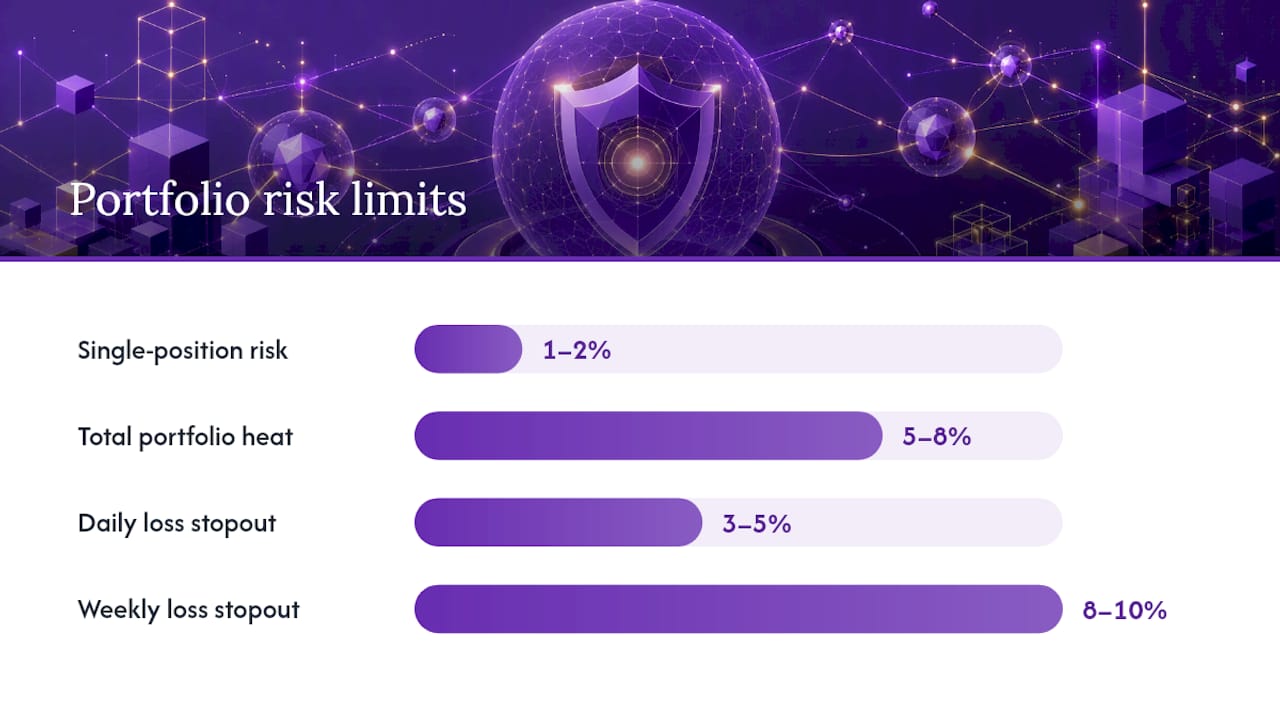
Portfolio heat is the sum of all open dollar risks expressed as a percentage of account balance. Professional frameworks generally recommend capping total open risk at 5%–8% of account balance, with tighter caps for higher-volatility strategies.
| Control | Suggested Limit |
|---|---|
| Single-position risk | 1%–2% of account |
| Total portfolio heat | 5%–8% of account |
| Single sector/token concentration | A substantial but limited portion of portfolio |
| Maximum leverage (derivatives) | 5× or lower for most retail strategies |
| Daily loss stopout | 3%–5% of account |
| Weekly loss stopout | 8%–10% of account |
Sizing on the current balance automatically enforces this, but many traders forget to update their base figure.
Scaling after wins: resist increasing size purely because recent trades were profitable. Size creep during winning streaks is one of the most common ways traders give back gains. Any increase should follow a written rule tied to account growth, not recent mood.
Pre-trade portfolio check: before placing a new order, confirm that adding it does not push total heat above your cap, that the new position is not correlated with existing open trades in a way that concentrates risk, and that you are not in a daily or weekly loss stopout period. A risk management checklist makes this a 30-second habit rather than a judgment call.
How to use a position-size calculator effectively
A calculator, whether a dedicated tool or a spreadsheet, translates the formula into a repeatable workflow. The inputs are fixed; the discipline is in using it every time.
Required inputs:
- Account balance (current, not peak)
- Risk percentage (1%–2% for most retail strategies)
- Entry price (your planned fill, not the current market price)
- Stop price (from chart analysis, not from the formula)
- Fee estimate (round-trip, as a percentage of notional)
- Expected slippage (conservative estimate based on liquidity)
- Leverage setting (1× for spot; enter actual leverage for derivatives)
Expected outputs: USD position size, token quantity, margin posted (if leveraged), estimated capital at risk after fees, and portfolio-heat contribution as a percentage of account.
Workflow: enter inputs → compute USD position → convert to token quantity → confirm portfolio heat stays within cap → confirm execution plan (limit vs. market, order type, exchange).
Pre-trade checklist
- Is the stop-loss level set from chart analysis, not from the formula?
- Have fees and slippage been subtracted from the risk budget?
- Does the position size match the formula output, not a round number?
- Does adding this position keep total portfolio heat below 8%?
- Are there correlated open positions that effectively multiply this exposure?
- For leveraged trades: does the stop sit well above (long) or below (short) the liquidation price?
- Is the entry price realistic given current bid-ask spread and order-book depth?
ATR-based stops can replace fixed-percentage stops in the calculator: set stop distance = ATR × multiplier (typically 1.5×–3× depending on strategy), then feed that distance into the formula. This adapts the stop to current market volatility rather than locking in a percentage that may be too tight in a trending market or too wide in a quiet one.
How automation enforces sizing rules without emotional overrides
Automation enforces pre-defined sizing and stop rules on every trade, every time, without the hesitation, recalculation errors, or emotional overrides that affect manual execution. That consistency is the primary operational argument for using a bot for systematic strategies.
Removing emotional overrides and common human errors like sizing by gut or moving stops mid-trade is where automation adds the most structural value. The rules are set once; execution follows them regardless of market conditions or recent P&L.
Automation features that matter for position sizing:
- Rule-driven size computation: the bot calculates position size from account balance, risk %, entry, and stop on every trade without manual input.
- Stop-loss enforcement: stops are placed automatically at the computed level and are not moved unless a rule explicitly permits it.
- Portfolio-heat caps: the system checks total open risk before opening a new position and blocks orders that would breach the cap.
- Execution-mode options: limit vs. market order selection based on liquidity conditions reduces slippage on entries and exits.
- Circuit breakers: daily and weekly loss stopouts halt trading automatically when the account hits a pre-set drawdown threshold.
Validating an automated sizing rule before live deployment:
- Backtest across at least two distinct volatility regimes (a trending period and a ranging or high-volatility period) to confirm the sizing rule performs as expected under different conditions.
- Forward paper-trade for a minimum of two to four weeks with realistic fee and slippage models applied to every fill.
- Adjust slippage assumptions based on paper-trade results before going live.
Pro Tip: Start with the smallest available position size when deploying a new automated strategy live. Confirm that fills, stop placements, and portfolio-heat calculations match the backtest assumptions before scaling up. Live execution almost always surfaces at least one discrepancy the backtest did not.
Automation checklist for safe deployment:
- Set maximum position size and portfolio-heat caps as hard limits in the bot configuration.
- Enable fill notifications so you can monitor live execution against expected fills.
- Review slippage on the first 10–20 live trades and compare against paper-trade assumptions.
- Confirm isolated margin is selected on leveraged positions to contain liquidation risk.
- Schedule a weekly review of open positions, heat, and drawdown against pre-set limits.
For practical examples of risk management tools that integrate with automated workflows, the Darkbot resource library covers exchange API integration and execution-mode configuration in detail.
The case for fixed rules over return targets
A return target tells you nothing about how to size a trade; a loss limit does. Setting a maximum dollar risk per trade and a portfolio heat cap gives you a complete decision framework before any trade opens. The return, if the strategy has edge, follows from consistent execution of that framework.
The part most guides understate: sizing discipline matters more during winning streaks than losing ones. Losses naturally prompt caution. Wins prompt confidence, and confidence prompts size creep. The traders who compound steadily over years are not the ones with the best entries; they are the ones who kept their sizing rules intact when they felt invincible.
Automation helps here, but it is not a substitute for understanding the rules you are automating. The framework has to be internalized before it can be delegated.
Darkbot applies these sizing rules automatically across every trade
Sizing a position correctly once is a calculation. Sizing every position correctly, across multiple exchanges, under time pressure, without emotional interference, is a systems problem. Darkbot addresses that gap directly.
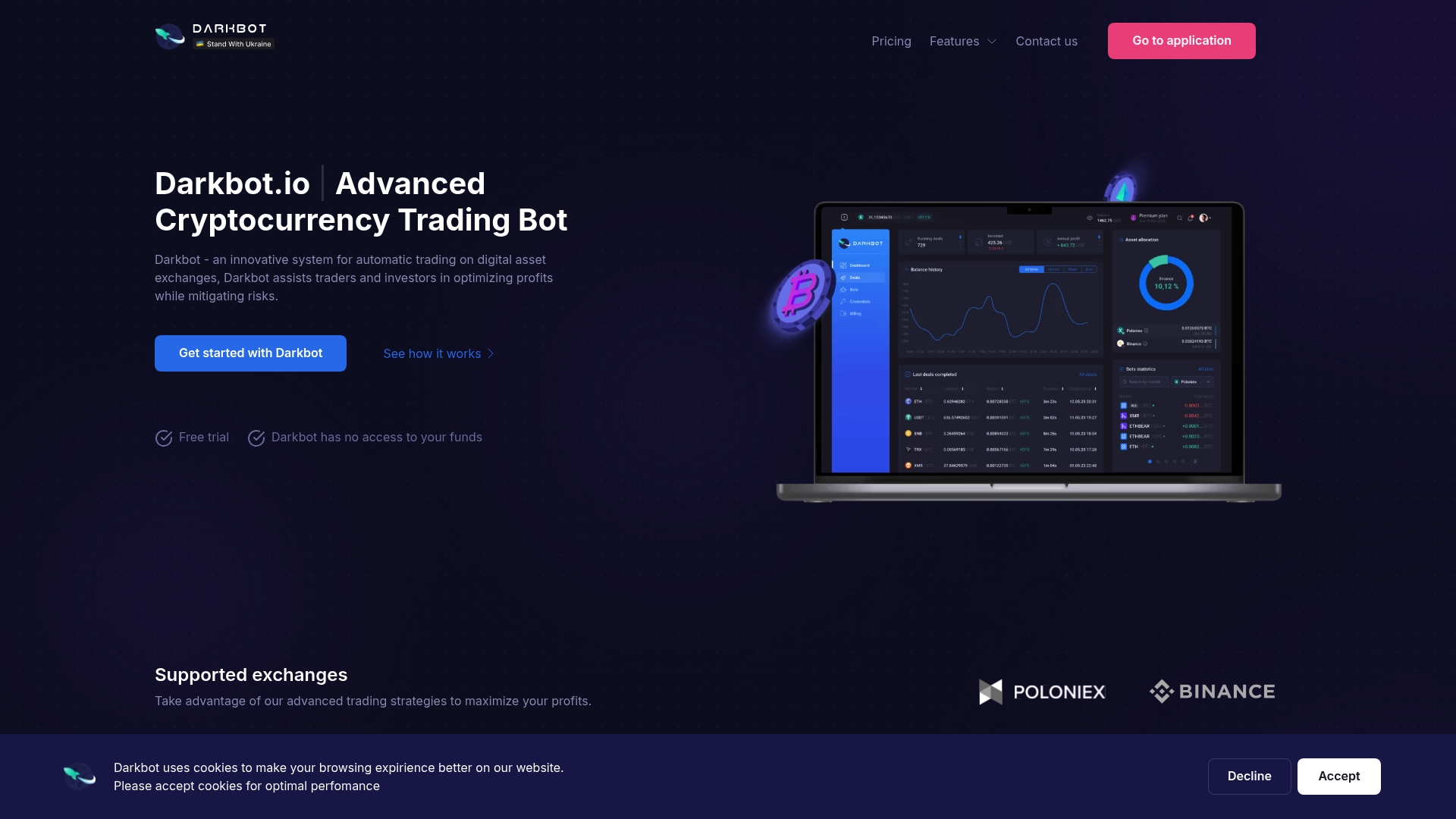
The platform computes position size from your defined risk percentage, entry, and stop on every trade, enforces stop-loss placement, and checks portfolio heat before opening a new position. Exchange integration via API connects Darkbot to your live account balance so the risk calculation always reflects current capital, not a stale figure. Backtesting and paper trading let you validate your sizing rules across historical data before committing real capital, and the execution-mode settings give you control over limit vs. market order behavior to manage slippage on entries and exits.
Darkbot’s AI operates as a rule-enforcement and consistency mechanism, not a return predictor. The platform does not promise performance; it executes the framework you define with the discipline that manual trading rarely sustains. Traders who want to confirm exchange compatibility or review platform capabilities can start with a free-tier account at Darkbot.
Sources
The following sources informed the formulas, risk rules, and portfolio controls in this guide. Links are provided for educational reference and do not constitute financial advice.
- Crypto Risk Management: Position Sizing, Stop Losses | Coin Bureau
- Position Sizing — The Formula That Keeps You In The Game | CryptoSignalApp
- Crypto Risk Management: Position Sizing, Stop Losses | TradeAlgo
- Risk Management Crypto Trading: 11 Strategies That Protect 94% of Capital – LedgerMind
This guide is for educational purposes only and does not constitute financial advice. Confirm current exchange rules, fees, and margin requirements directly with your exchange or a qualified financial professional before trading.
Recommended

Start trading on Darkbot with ease
Come and explore our crypto trading platform by connecting your free account!
Free plan available • No credit card required