Crypto trading risk checklist: 1-2% rule for safer trades
TL;DR:
- Proper risk management prioritizes position sizing, stop-losses, and risk-reward ratios for sustainability.
- Automated bots require precise coding of risk controls like backtesting, volatility adjustment, and circuit breakers.
- Diversification in crypto is limited by high correlations; sector mixing and stablecoins offer better protection.
Automated crypto trading can multiply your returns fast. It can also wipe out your account just as quickly if you skip the fundamentals. Risk is already amplified in crypto by 24/7 markets, thin liquidity windows, and extreme volatility. Add a bot to the mix and you have a system that can execute hundreds of trades while you sleep, for better or worse. Most traders obsess over entry signals and profit targets, but the traders who stay in the game long-term are the ones who protect their capital first. A structured risk checklist gives you a repeatable framework that works even when markets stop making sense.
Key Takeaways
| Point | Details |
|---|---|
| Risk per trade cap | Never risk more than 1-2% of your crypto portfolio on any single trade. |
| Automated safeguards | Backtest, use automatic stops, and set daily loss limits for all trading bots. |
| Portfolio exposure limits | Keep total open portfolio risk under 5-6% to avoid devastating drawdowns. |
| Edge cases matter | Account for slippage, outages, and emotional stress to safeguard your strategy. |
| Risk over strategy | Consistent risk management is more important for long-term survival than any trading strategy. |
Core components of a crypto trading risk checklist
Every solid risk framework starts with a few non-negotiable rules. These are not suggestions. They are the floor beneath everything else you build.
The first rule is position sizing. Never risk more than 1-2% of your total portfolio on a single trade. This sounds conservative, but it is the rule that keeps a losing streak from becoming a catastrophe. If you risk 10% per trade and lose five in a row, you have lost half your account. At 1-2%, you can survive 20 consecutive losses and still have capital to recover.
Stop-loss and take-profit orders are not optional. Every trade you place should have both. A stop-loss defines the maximum pain you will accept. A take-profit locks in gains before the market reverses. Without them, you are gambling, not trading.
Your risk management basics should also include a minimum risk-reward ratio of 1:2. This means for every dollar you risk, you target at least two dollars in return. Over time, even a 40% win rate becomes profitable with this ratio.
Diversification matters, but it has limits. Spread exposure across different market caps, sectors like DeFi, Layer 1, and infrastructure, and keep a portion in stablecoins as a buffer. That said, owning 50 coins is not diversification. It is noise. Stick to assets you understand and can monitor.

Leverage deserves its own warning. 75% of retail traders lose money when using leverage according to industry benchmarks. If you use it at all, keep it minimal and always pair it with tighter stops.
Plan every trade before you place it. Know your entry, your exit, your stop, and your target. Changing these mid-trade based on price action is how discipline breaks down.
Pro Tip: Build a written response plan for tail events. What happens if your exchange goes offline mid-trade? What if a stablecoin depegs? Having preset answers to these questions before they happen removes panic from the equation.
Continuous review closes the loop. Track your trades, review your results weekly, and adjust your rules based on what the data tells you, not what your gut says.
Automated trading: Adapting your risk controls for bots
Bots remove emotion from execution, which is genuinely valuable. But they also remove human judgment, which means your risk rules must be coded with precision. A bot will follow its instructions exactly, including the bad ones.
Here is a practical checklist for deploying bots with proper risk controls:
- Backtest on multi-year data. Include crash periods like 2018, 2020, and 2022. A strategy that only works in bull markets is not a strategy, it is luck.
- Hard-code stop-loss and take-profit into every strategy. No exceptions. These must fire automatically without human intervention.
- Use volatility-adjusted position sizing. When volatility spikes, reduce your position size. A bot should trade smaller during chaos, not the same size as in calm conditions.
- Set portfolio exposure caps. Keep total open risk below 6% of your portfolio, with no single trade exceeding 1%. These automation essentials are the foundation of sustainable bot deployment.
- Add daily drawdown circuit breakers. If your bot loses 3% in a single day, it stops trading. This prevents a bad day from becoming a bad month.
- Secure your API keys. Enable two-factor authentication, use IP allowlisting, and create separate API keys for each bot. Review your bot-specific risk controls to understand why key hygiene is as important as strategy.
- Monitor logs in real time. Bots can malfunction, over-trade, or get stuck in loops. Regular log reviews catch problems before they compound.
Pro Tip: Simulate an exchange outage or a flash crash during backtesting. Most traders test for normal conditions. The ones who survive test for the abnormal ones. Reviewing automation best practices and studying bot risk pitfalls before going live is time well spent.
Automation introduces new failure modes. The checklist above is not a one-time setup. It requires ongoing review as market conditions change.
Portfolio-level controls: Limiting exposure and managing correlation
Single-trade risk rules are necessary but not enough. You also need to manage risk at the portfolio level, where the real damage often happens.
Here is a fact that surprises most traders: crypto correlations reach 60-90% during market downturns. When Bitcoin drops 30%, most altcoins drop harder. Owning ten different coins does not protect you if they all move together.
The table below shows how correlation affects real diversification:
| Asset pair | Typical correlation | Downside behavior |
|---|---|---|
| BTC and ETH | 0.80-0.90 | Move together in crashes |
| BTC and large-cap alts | 0.70-0.85 | High correlation under stress |
| BTC and DeFi tokens | 0.65-0.80 | Moderate, but still elevated |
| BTC and stablecoins | Near 0 | True hedge, no upside capture |
| BTC and gold/commodities | 0.10-0.30 | Low correlation, real diversifier |
True diversification means mixing sectors, market caps, and off-risk assets like stablecoins. It does not mean owning more coins in the same category.
“Portfolio heat” is the sum of all your open risk positions. Keep it below 5-6% of your total portfolio at any time. If every open trade hits its stop simultaneously, you want the total damage to be survivable.
Rebalancing is not just about optimization. It is a risk control. As winning positions grow, they increase your concentration risk. Regular rebalancing corrects this drift and keeps your exposure aligned with your plan. Your bot security guide and awareness of automation risks both feed directly into how you structure rebalancing logic.
Over-diversification is a real trap. Spreading across 30 assets does not reduce risk in a correlated crash. It just makes your portfolio harder to manage and dilutes your returns in good conditions.
Edge cases and stress tests: Preparing for the unexpected
The scenarios that destroy accounts are the ones traders do not plan for. A robust checklist covers the obvious risks and the outliers.
Slippage is one of the most underestimated risks in crypto. On liquid pairs like BTC/USDT, slippage might be 0.1%. On low-cap altcoins with thin order books, slippage can spike to 15% or higher during fast moves. Your bot might execute at a price far worse than expected, turning a calculated risk into an unplanned loss.
Here are the edge cases every checklist must address:
- Exchange outages. Your stop-loss orders must operate server-side or independently of your connection. If your bot goes offline, your risk controls cannot go offline with it. Reviewing API key security is essential here.
- Volatility spikes. Use ATR (Average True Range) to adjust position size when volatility surges. Smaller size in chaotic conditions is not weakness, it is discipline.
- Losing streaks. Run a survival simulation: can your system handle 20 consecutive losses? If the answer is no, your position sizes are too large.
- FOMO and FUD events. Emotional reactions to news events are one of the top reasons risk discipline breaks down. Bots help here, but only if your rules are already coded correctly.
- Strategy failure. No strategy works forever. Build in a review trigger: if your bot underperforms by X% over 30 days, pause and reassess.
“No checklist is complete without planning for the unexpected. Your survival depends on it.”
Stress testing is not pessimism. It is the most realistic form of preparation available to you. Traders who skip this step discover their gaps at the worst possible time.
Why risk management, not strategies, determines long-term crypto success
Here is something the trading community rarely admits: most traders spend 90% of their time refining entry signals and almost no time on the rules that actually keep them solvent.
The data is uncomfortable. BTC buy-and-hold returned 251% versus 169% for complex multi-asset portfolios, but at significantly higher volatility. The implication is not that complex strategies are useless. It is that without rigorous risk management, even a simple approach outperforms a sophisticated one that is poorly controlled.
Hedging and diversification help at the margins. But they cannot compensate for poor position sizing, missing stop-losses, or ignoring drawdown limits. These real reasons traders fail are almost always rooted in skipped fundamentals, not bad strategies.
The traders who last in crypto are not the ones with the best indicators. They are the ones who apply their risk management framework consistently, especially when it is uncomfortable. Automation makes this consistency achievable at scale.
“No strategy beats rigorous risk management in the long run.”
The checklist is not a constraint on your trading. It is what makes trading sustainable.
Advance your risk controls with automated solutions
A checklist on paper is a starting point. Executing it perfectly, every trade, every day, is where most traders fall short. Automation closes that gap.
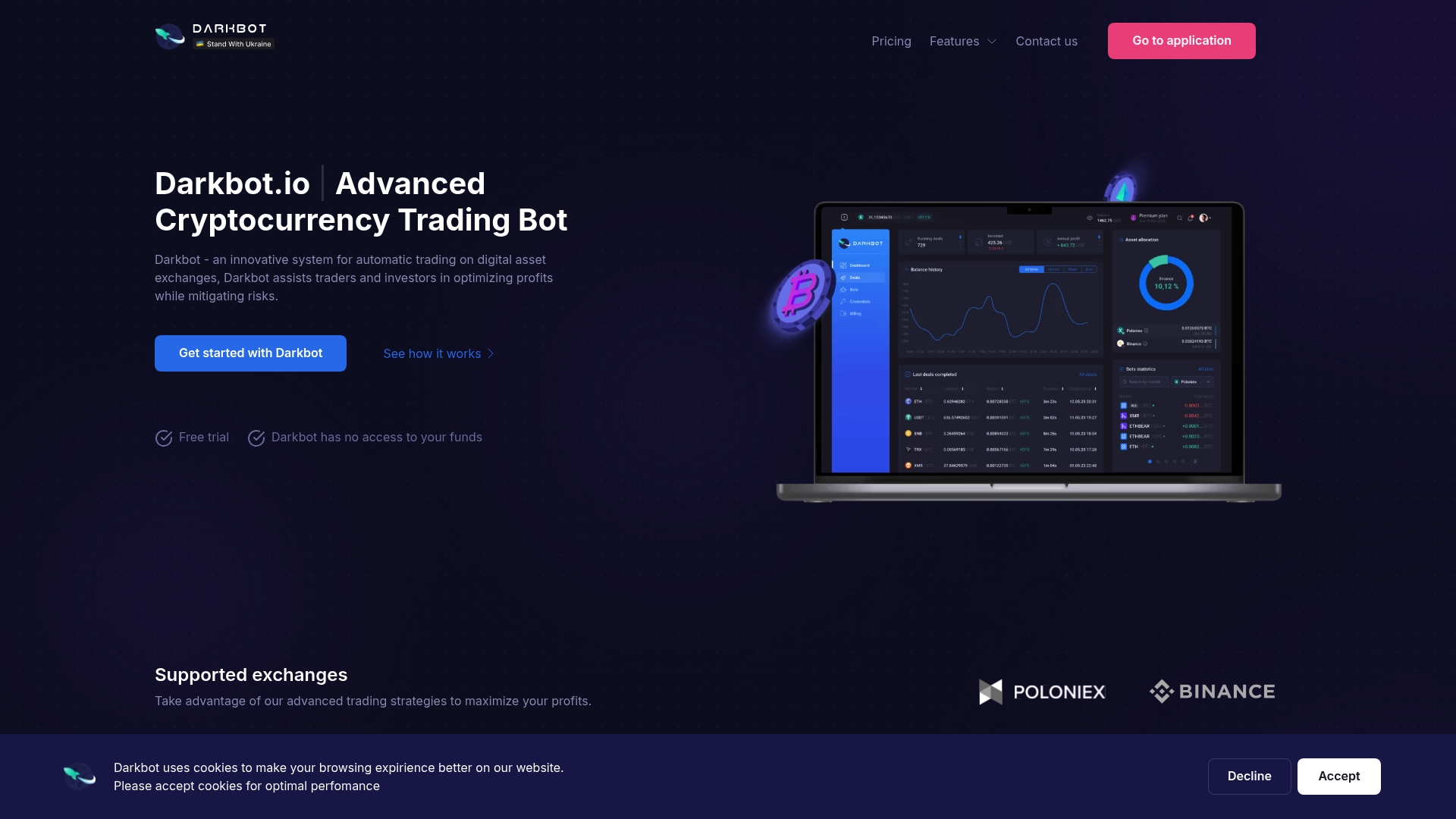
Darkbot.io integrates stop-loss rules, portfolio exposure caps, volatility-adjusted sizing, and automated rebalancing directly into your trading workflow. Our crypto portfolio management tools let you set your risk parameters once and enforce them across every bot, every exchange, and every position simultaneously. If you are serious about turning your checklist into daily discipline, crypto risk automation is the most reliable path forward. The rules you build today become the guardrails that protect your capital tomorrow.
Frequently asked questions
What is the most important rule on a crypto trading risk checklist?
Never risk more than 1-2% per trade of your total portfolio, and always pair every position with a stop-loss order. This single rule prevents a losing streak from ending your trading account.
How do automated bots manage risk differently?
Bots require coded risk limits including backtesting, stop-loss automation, volatility-based position sizing, daily drawdown circuit breakers, and API security measures that manual traders can apply more flexibly.
Why is diversification limited in crypto?
Most crypto assets show 60-90% correlation during downturns, which means spreading across many coins offers less protection than mixing sectors and including stablecoins as true hedges.
What edge cases should be on my risk checklist?
Plan specifically for slippage on illiquid pairs, exchange outages, extended losing streaks up to 15% slippage events, and emotional triggers like FOMO that can override your rules at the worst moments.
Recommended

Start trading on Darkbot with ease
Come and explore our crypto trading platform by connecting your free account!
Free plan available • No credit card required