Risk Management Strategies Checklist for Crypto Traders
TL;DR:
- A crypto risk management checklist guides traders through five lifecycle stages: identification, assessment, prioritization, mitigation, and monitoring. It emphasizes assigning ownership, setting measurable thresholds, and updating risks immediately after trigger events to ensure effective control. Continuous monitoring with real-time alerts and clear accountability helps traders respond swiftly to market shocks and protect their portfolios.
A risk management strategies checklist is a structured process tool that guides cryptocurrency traders through five core lifecycle stages: identification, assessment, prioritization, mitigation, and continuous monitoring. Each stage requires documented response strategies covering avoidance, reduction, transfer, and acceptance, with clear ownership assigned to every risk. The five-stage risk lifecycle is the recognized industry standard for 2026, not an optional framework. Crypto traders who skip any stage expose their portfolios to uncontrolled drawdowns, especially during high-volatility events.
1. What are the essential components of a risk management strategies checklist?
Every effective checklist starts with a structured risk identification method. For crypto traders, this means cataloging market risks, liquidity risks, counterparty risks, smart contract vulnerabilities, and exchange security exposures before a single trade executes.

Risk scoring follows identification. Standardized scoring uses a 1–5 scale for both likelihood and severity, with quantitative definitions that remove subjective bias. For example, “likely” is defined as an event occurring more than once per year, not a vague gut feeling. This precision matters in crypto markets, where volatility can compress a month’s worth of traditional market movement into a single trading session.
A living risk register documents every identified risk with its category, source, estimated impact, and named owner. Static spreadsheets fail here. The register must update after trigger events, not on a fixed annual schedule.
- Risk identification: Map market, liquidity, counterparty, and operational exposures specific to your asset mix
- Risk scoring: Apply a 1–5 likelihood and severity matrix with numerical definitions for each level
- Risk register: Maintain a living document with category, source, impact, owner, and current status
- Risk appetite: Set measurable thresholds, such as maximum portfolio drawdown limits, not abstract tolerance statements
- Risk ownership: Assign a named individual to every risk entry, not a team or department
Pro Tip: Define your maximum acceptable drawdown as a specific percentage before entering any position. A formal risk appetite threshold, such as no more than 15% portfolio drawdown in any 30-day period, removes emotion from exit decisions.
2. How to develop an effective risk mitigation plan for crypto
Risk treatment plans must include defined actions, named owners, timelines, and target residual risk levels. A plan without these four elements is a wish list, not a control.
The four standard treatment options each serve a distinct purpose:
- Avoidance: Exit or decline exposure entirely. Use this when the risk exceeds your appetite and no control reduces it sufficiently. Example: refusing to hold assets on exchanges with poor security audit records.
- Reduction: Apply controls that lower likelihood or impact. Stop-loss orders, position size limits, and portfolio diversification across uncorrelated assets all fall here.
- Transfer: Shift the financial consequence to a third party. Crypto insurance products and hedging with derivatives transfer specific exposures without eliminating the underlying position.
- Acceptance: Acknowledge the risk and hold the position. Use this only when the risk falls within your documented appetite and the expected return justifies the exposure.
Monitoring mitigation effectiveness requires Key Risk Indicators, or KRIs. A KRI is a measurable signal that a risk is approaching its threshold before a loss event occurs. For a crypto trader, a KRI might be a 7-day realized volatility reading crossing a predefined level, triggering a position review.
Integrating mitigation into trading workflows means encoding controls as rules, not reminders. Automated stop-loss triggers, rebalancing rules, and exposure caps enforced by a trading platform remove the execution gap between a plan and its application.
Pro Tip: Map each mitigation control directly to the risk driver it addresses. If a control cannot be traced to a specific risk, it adds process cost without reducing exposure.
3. What is the role of continuous monitoring in a crypto risk checklist?
Risk review frequency should match risk severity: quarterly for high-severity risks, semi-annual for medium, and annual for low, with immediate reassessment after any trigger event. A trigger event in crypto includes exchange hacks, regulatory announcements, major protocol failures, or a market drawdown exceeding a predefined threshold.
Real-time dashboards and automated alerts allow traders to track exposures dynamically rather than waiting for scheduled reviews. AI-driven monitoring systems evaluate probabilistic patterns across multiple data streams simultaneously, flagging anomalies that a manual review would miss between scheduled check-ins.
Scenario planning and stress testing belong inside the checklist, not outside it. A stress test asks: “What happens to my portfolio if Bitcoin drops 40% in 72 hours?” The answer should be pre-calculated, not improvised during the event.
| Review type | Frequency | Trigger condition |
|---|---|---|
| High-severity risk review | Quarterly | Any breach of KRI threshold |
| Medium-severity risk review | Semi-annual | Significant market structure change |
| Low-severity risk review | Annual | Scheduled governance cycle |
| Trigger-based reassessment | Immediate | Exchange hack, regulatory shift, major drawdown |
Maintaining audit trails for every risk decision supports governance and, where applicable, regulatory compliance. Documentation of what was known, when it was known, and what action was taken protects traders from both financial and legal exposure.
4. How to integrate strategic risk management into your trading checklist
Integrating risk management into strategic planning improves resilience and allows risks to be identified before they materialize. A survey of 210 organizations confirmed that proactive frameworks outperform reactive ones, particularly when managing cascading market shocks. Crypto markets, with their 24/7 operation and cross-asset contagion patterns, represent exactly the environment where reactive frameworks break down.
SWOT analysis identifies internal strengths and weaknesses in your trading setup. PESTEL analysis maps external political, economic, social, technological, environmental, and legal factors that affect crypto markets, including regulatory shifts across jurisdictions. Scenario analysis then stress-tests your portfolio against specific combinations of these factors.
Governance structures connect risk data to strategic decisions. For individual traders, this means a documented escalation protocol: at what drawdown level do you reduce position size, pause trading, or exit the market entirely? These thresholds must be written down before a crisis, not decided during one.
- Strategic alignment: Link every risk control to a specific portfolio objective or performance target
- SWOT and PESTEL: Use structured analysis to identify external threats before they appear in price action
- Escalation protocols: Document the exact conditions that trigger a position reduction or full exit
- Risk appetite statements: Write formal, plain-language statements with measurable thresholds for each risk category
- Automated rule encoding: Translate governance decisions into automated trading rules to close the execution gap
Risk appetite must be documented as formal statements with measurable thresholds, such as maximum drawdowns, rather than abstract descriptions. This is the difference between a governance document and a decorative policy.
5. Best practices and common pitfalls in crypto risk checklists
False ownership is the most common cause of control failure during stress events. A risk assigned to “the team” or “operations” has no owner. Every risk entry needs a single named individual who is accountable for monitoring and response.
Risk frameworks must operate as living models, not static documents. After any trigger event, the register requires immediate reassessment. Waiting for the next scheduled review after a major market shock is a governance failure, not a process discipline.
Residual risk, the exposure remaining after mitigation controls are applied, needs continuous reassessment. In crypto markets, a control that reduced a risk to acceptable levels in a low-volatility period may be insufficient after a structural market shift. Reassessing residual risk after major shocks is a non-negotiable checklist item.
Modern risk management balances loss prevention with opportunity capture. An overly conservative checklist that blocks all high-volatility positions also blocks the return profile that crypto markets offer. The goal is informed exposure, not zero exposure.
- Name every owner: Assign a single individual, not a group, to each risk entry
- Update after trigger events: Reassess immediately, not at the next scheduled review
- Score residual risk: Measure what remains after controls, not just the gross risk
- Balance control with opportunity: Align risk appetite to favorable exposure, not just loss avoidance
- Coordinate at the ecosystem level: Include exchange security, wallet infrastructure, and API access controls in the checklist scope
Pro Tip: Review your crypto portfolio checklist after every significant market event, not just on a fixed schedule. The market will create trigger events on its own timeline.
Key takeaways
An effective crypto risk management checklist requires five lifecycle stages, named ownership for every risk, measurable appetite thresholds, and immediate reassessment after trigger events.
| Point | Details |
|---|---|
| Five-stage lifecycle | Identification, assessment, prioritization, mitigation, and monitoring must all be documented. |
| Named risk ownership | Every risk entry needs one named individual accountable for monitoring and response. |
| Measurable risk appetite | Set specific thresholds like maximum drawdown limits, not abstract tolerance descriptions. |
| Living risk register | Update the register immediately after trigger events, not on a fixed annual schedule. |
| Residual risk reassessment | Measure exposure remaining after controls and reassess after every major market shock. |
Why static checklists fail crypto traders
The shift from static checklists to living, integrated risk frameworks is the defining change in risk management practice right now. I’ve seen traders build thorough risk registers, assign ownership, document appetite statements, and then treat the whole thing as a completed task. Six months later, the register reflects a market environment that no longer exists.
AI-driven real-time monitoring changes the execution discipline equation. When a system tracks KRIs continuously and flags threshold breaches automatically, the gap between a risk event and a response narrows from days to minutes. That gap is where most portfolio damage happens in crypto markets. The value is not in prediction. It is in consistency of response when conditions change.
The ecosystem dimension is the most overlooked element. Individual traders focus on their own position sizing and stop-loss rules, which is correct, but exchange security, wallet infrastructure, and API access controls carry risks that sit outside the trading strategy itself. A comprehensive checklist covers the full chain, not just the trade execution layer.
Risk management is evolving from a warning-focused discipline to a strategic resilience function that supports opportunity exploitation, not just loss prevention. Traders who internalize that shift will build frameworks that protect capital and position them to act decisively when dislocations create favorable entries. That is the real return on a well-built risk process.
— Grisha
How Darkbot supports systematic risk control
Executing a risk management framework manually across multiple exchanges and asset classes creates execution gaps. Darkbot addresses this by encoding risk controls directly into automated trading logic, enforcing position limits, stop-loss rules, and rebalancing thresholds without requiring manual intervention at each decision point.
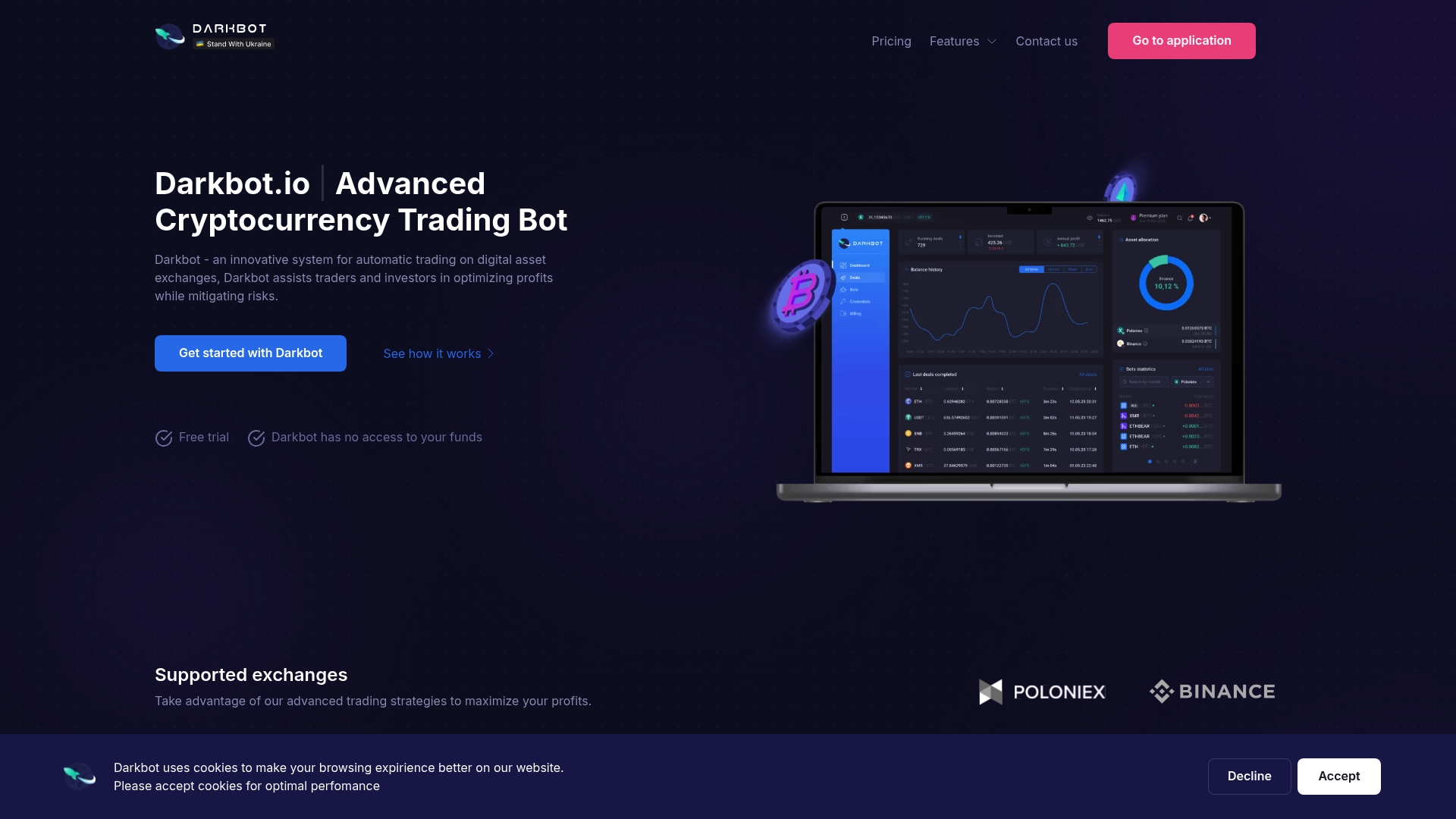
Darkbot’s portfolio management tools support strategic risk alignment by tracking exposures across assets in real time and applying rule-based rebalancing when allocations drift outside defined parameters. The AI layer evaluates probabilistic patterns to maintain consistency of execution, not to forecast outcomes. Traders who want to move from a paper checklist to an enforced, automated risk framework can explore Darkbot’s platform to see how automated controls translate governance decisions into repeatable trading discipline.
FAQ
What is a risk management strategies checklist?
A risk management strategies checklist is a structured tool that guides traders through risk identification, scoring, mitigation planning, and continuous monitoring. It documents ownership, response strategies, and measurable thresholds for every identified risk.
How often should crypto traders review their risk checklist?
High-severity risks require quarterly review, medium-severity risks semi-annual, and low-severity risks annual. Any trigger event, such as an exchange hack or major market drawdown, requires immediate reassessment regardless of schedule.
What are the four risk treatment options?
The four standard options are avoidance, reduction, transfer, and acceptance. Each applies to a different risk profile: avoidance exits the exposure entirely, reduction applies controls, transfer shifts consequences to a third party, and acceptance holds the position within documented appetite limits.
What is residual risk and why does it matter in crypto?
Residual risk is the exposure that remains after mitigation controls are applied. In crypto markets, high volatility means controls that were sufficient in calm conditions may be inadequate after a major market shock, requiring continuous reassessment.
How does false ownership cause risk management failures?
False ownership occurs when a risk is assigned to a group rather than a named individual, leaving no single person accountable for monitoring or response. During stress events, this gap causes control failures because no one acts with clear authority.
Recommended

Start trading on Darkbot with ease
Come and explore our crypto trading platform by connecting your free account!
Free plan available • No credit card required