RSI Crypto Bots Need 5 Layers Before Walk Forward Tests
An RSI crypto bot can be a practical automation tool when it is embedded in a cost-aware, regularly revalidated systematic framework. Used as a standalone static rule, RSI tends to degrade quickly in crypto markets because of regime shifts and transaction costs. The sections below cover the architecture, strategy variants, backtesting discipline, and execution controls that separate a durable RSI bot from one that looks good in a backtest and fails in production.
TL;DR:
- Test RSI periods of 7, 14, and 21 on 1 hour and 4 hour timeframes, comparing 20/80 and 30/70 thresholds separately for each asset.
- A longer moving average can filter RSI entries toward the prevailing trend, while thresholds adjusted for volatility can prevent ordinary pullbacks from triggering trades.
- Refit parameters on rolling historical windows and test each set on the next unseen period; also check neighboring settings for fragile results.
- Include exchange fees, slippage, and perpetual funding in backtests, and block trades unless their expected edge exceeds estimated costs for that asset and timeframe.
- Paper trade on live market data for several weeks before committing capital, while monitoring trade counts, latency, and fill prices against expected levels.
How RSI works and why crypto markets change its behavior
The Relative Strength Index measures the speed and magnitude of recent price changes on a 0 to 100 scale, typically calculated over a 14-period lookback. Readings above 70 are conventionally labeled overbought, and readings below 30 oversold, though many practitioners adjust these thresholds for specific assets or timeframes.
Crypto markets complicate this picture. Momentum can persist longer than in traditional equities, volatility clusters into distinct regimes, and returns are asymmetric during liquidation cascades. A fixed RSI threshold calibrated on calm conditions can misfire badly once volatility expands. An academic review of RSI applications in crypto found that naive RSI-only strategies are often ineffective, while enriched or hybrid RSI approaches can offer an advantage in some assets.
Practical implications for parameter selection:
- A 14-period RSI remains a reasonable default, but shorter periods (7 to 9) react faster in high-volatility regimes.
- Smoothed RSI variants reduce false signals generated by single-candle noise.
- Thresholds should be tested per asset rather than assumed to transfer from Bitcoin to lower-liquidity altcoins.
Essential architecture any RSI crypto bot needs
A production RSI bot is a pipeline, not a single script. Each component has a distinct job, and weaknesses in one stage propagate downstream.
- Data layer: Pull OHLCV data from exchange APIs at the chosen timeframe, store it with timestamps and versioning so backtests can be reproduced exactly.
- Signal layer: Compute RSI and any secondary filters, and keep parameter sets in a versioned configuration file rather than hardcoded values.
- Execution layer: Translate signals into orders through exchange API connectors, handling order types, retries, and rate limits.
- Risk control layer: Enforce position sizing, maximum exposure, and stop conditions independently of the signal logic.
- Monitoring layer: Track trade counts, latency, and slippage against expected values, with alerts for anomalies.
Separating these layers matters because a signal change should never require touching execution code, and a risk limit should never depend on the strategy module behaving correctly. Data versioning also protects against silent lookahead bias, where a backtest uses information that would not have been available at the time of the trade.
Pro Tip: Log every signal, filter decision, and order outcome separately, so a live discrepancy can be traced to the exact stage where behavior diverged from the backtest.
Practical RSI strategy templates and variants to test
A few concrete templates give a starting point for backtesting before any customization:
- Classic oversold/overbought: Enter long when RSI(14) crosses above 30 from below, exit or go short when it crosses below 70 from above; adding a volume or trend confirmation filter reduces false entries in choppy markets.
- Stochastic RSI: Applies a stochastic calculation to RSI itself, producing a more sensitive oscillator useful in sideways or noisy crypto regimes, though it generates more signals that need filtering.
- Divergence-based entries: Compares price highs and lows against RSI highs and lows to flag weakening momentum, typically used as a confirmation layer rather than a standalone trigger.
- Hybrid RSI plus trend filter: Only takes RSI signals in the direction of a longer moving average, which cuts down on counter-trend trades during strong momentum phases.
- Volatility-adjusted thresholds: Widens or narrows the 30/70 bands based on recent realized volatility, so the bot does not treat every minor pullback in a trending market as oversold.
For initial backtests, reasonable starting ranges are RSI periods of 7, 14, and 21, on 1-hour and 4-hour timeframes, with threshold pairs of 20/80 and 30/70 tested separately. None of these variants should be assumed profitable until validated through the process described in the next sections.
Implementation notes and a starter skeleton for practitioners
A minimal RSI bot pipeline runs on Python with an exchange connector library such as CCXT, or a framework like Freqtrade, which bundles exchange connectivity, backtesting, and strategy templates in one open-source project.
- Fetch data: Pull OHLCV candles for the target pair and timeframe, and store them locally for reproducible testing.
- Compute signal: Calculate RSI and any secondary filter (trend, volume) on each new candle close.
- Apply cost-aware filter: Compare the expected signal strength against an estimated transaction cost threshold before allowing a trade.
- Route to execution or simulation: Send the order to a paper-trading engine first, then to the live exchange API once validated.
Simulating realistic costs means modeling maker and taker fees, estimated slippage, and, for perpetual contracts, funding rates, rather than assuming frictionless fills. Paper trading on live market data for several weeks before committing capital helps surface execution issues, such as order rejections or latency, that a backtest cannot capture.
Backtesting, walk-forward optimization, and robustness checks
A backtest that optimizes parameters once over the full historical sample and reports the result is close to meaningless in crypto, where volatility regimes shift repeatedly. Walk-forward optimization, in which parameters are refit on a rolling window and tested on the following unseen period, produces a more honest estimate of future performance. Research on systematic trend-following strategies shows that walk-forward optimization and monthly reoptimization help maintain robustness as market conditions change, with intermediate-frequency signals balancing turnover against signal fidelity.
Validation checks worth running before any live deployment:
- Include transaction costs, slippage, and funding rates directly in the simulation rather than adding them as an afterthought.
- Run a break-even fee analysis to find the minimum edge per trade needed to cover costs at the expected turnover rate.
- Use at least one single-time out-of-sample test on data the optimization never touched.
- Run sensitivity analysis across neighboring parameter values to check that performance is not a fragile artifact of one specific setting.
A cost-aware execution filter that ties trade frequency to estimated transaction costs can restore net performance in strategies that otherwise lose money after fees, according to research on machine-learning-based Bitcoin trading under realistic transaction costs. For more on how execution risk undermines strategies that look strong on paper, see our guide to key risks in automated trading.
Execution realities: fees, slippage, funding, and cost-aware filters
Every RSI signal that triggers a trade carries a cost: maker and taker fees, slippage from moving through the order book, and, on perpetual futures, funding payments that accrue while a position is held. Ignoring these costs in a backtest is the single most common reason a strategy fails once deployed live.
A cost-aware execution filter addresses this directly by requiring a trade’s expected edge to exceed its estimated cost before the order is placed. Empirical work on transaction-cost-aware filters shows they can reduce trade frequency by orders of magnitude while preserving or improving net returns in selected configurations.
Practical ways to reduce execution drag:
- Use limit or post-only orders where exchange conditions allow, rather than market orders that pay the full spread.
- Batch smaller signal adjustments rather than executing every minor RSI fluctuation.
- Set a minimum expected-edge threshold calibrated per asset and timeframe, slightly above the computed break-even point.
Pro Tip: Recalculate your break-even cost threshold whenever exchange fee tiers or typical spread widths change, since a filter calibrated months ago can quietly stop matching current market conditions.
Deploying RSI strategies on Darkbot.io: practical workflow
Moving from a tested RSI strategy to live operation follows a consistent sequence on Darkbot: connect an exchange through API keys scoped to trading permissions only, never withdrawal access, keeping credentials isolated from other systems. From there, we let traders select an RSI-based strategy template, adjust parameters such as period length and threshold bands, and version those settings so changes remain traceable.
Before committing capital, the configured strategy is run through backtesting against historical data, then into paper trading to confirm behavior under live market conditions without financial risk. Portfolio tools and risk controls, including position sizing and exposure limits, operate independently of the strategy logic itself, consistent with the layered architecture described earlier. For additional detail on managing risk at the account level, see our risk management guide for crypto trading bots.
Common pitfalls and troubleshooting techniques for RSI-based bots
Several recurring issues account for most RSI bot underperformance. The first is parameter overfitting: tuning the RSI period and thresholds until a backtest looks ideal, without checking that the result holds on unseen data. The fix is the walk-forward and sensitivity testing described earlier, applied before every deployment, not just the first one.
The second is ignoring regime context. An RSI setting tuned during a trending market often generates excessive false signals once volatility compresses into a range, and vice versa. Pairing RSI with a trend or volatility filter, as outlined in the strategy variants section, reduces this failure mode without eliminating the underlying signal.
The third is execution drift: a bot that performed well in backtest and paper trading but underperforms live, usually because real slippage or fee tiers differ from the simulation’s assumptions. Comparing live fill prices against expected prices on a regular basis catches this early.
The fourth is silent failure: an API disconnect, a stalled data feed, or an exchange rate limit that halts trading without an alert. Monitoring trade counts and latency against expected baselines, as described in the architecture section, is the primary defense. Our guide to risks in crypto bot automation covers additional failure modes that surface specifically during the transition from paper to live trading.
Finally, traders using leveraged or margin accounts should review account-level risk controls before automating; a partner guide on risk rules for funded trading accounts outlines core drawdown and consistency considerations relevant to disciplined account management.

Author perspective: realistic expectations for RSI bots
RSI is a component, not a verdict. It can help identify momentum extremes, but its reliability shifts with market regime, which means a parameter set validated six months ago deserves a fresh look now, not blind trust. Automation enforces consistency that manual trading rarely achieves, but that consistency is only as good as the risk controls wrapped around it. Treat RSI, transaction costs, and execution quality as three checks that all need to pass, continually, rather than one decision made once.
— Grisha
Darkbot.io: deploy, backtest, and run RSI bots
Building and maintaining the pipeline described above, data storage, signal versioning, cost-aware execution, and monitoring, takes real engineering time. We built Darkbot to handle that infrastructure directly, so traders can focus on strategy decisions rather than connector code.
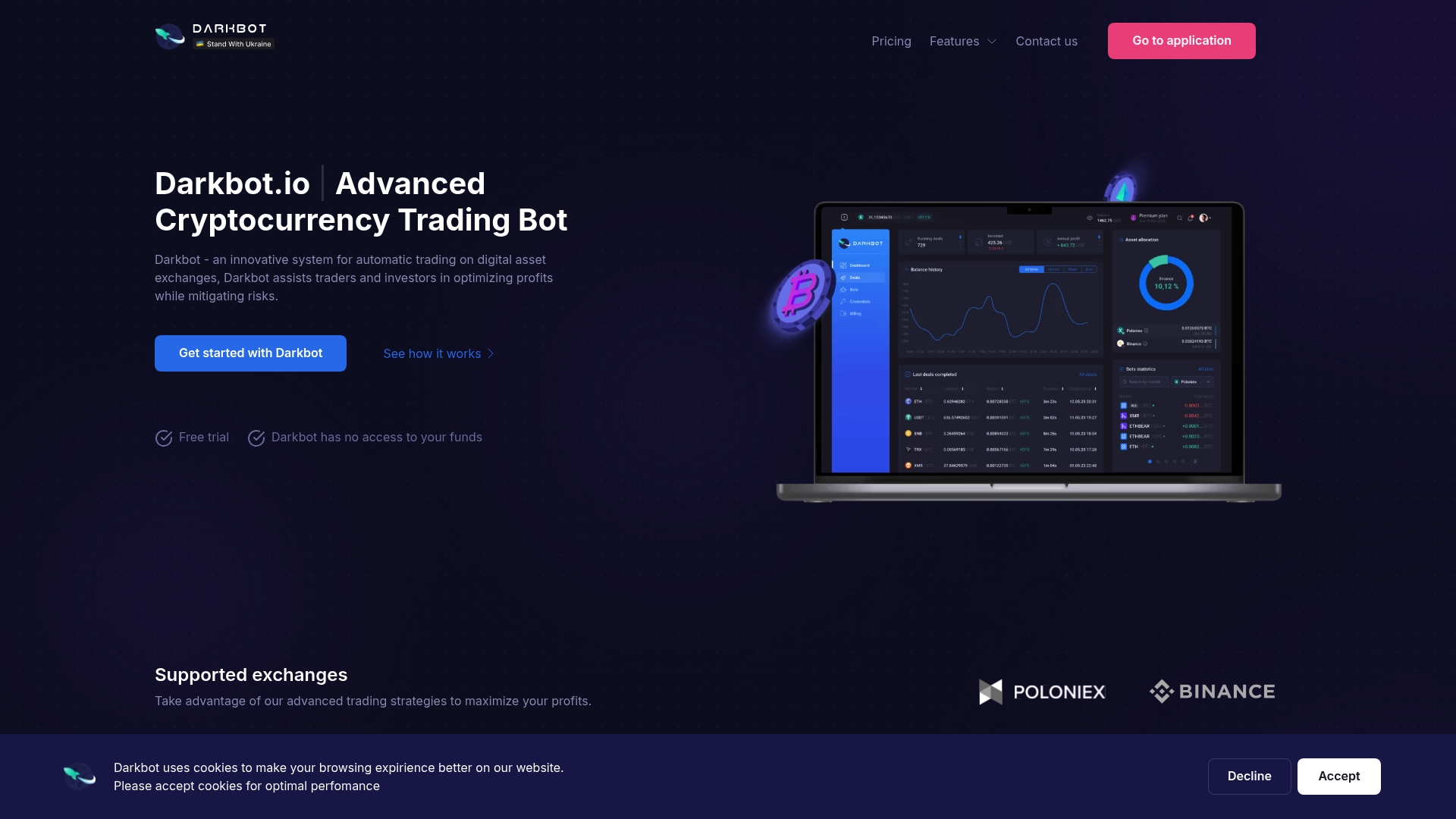
What we provide:
- Exchange API integration with scoped, trading-only key permissions
- Backtesting and paper trading before any live capital is committed
- Configurable RSI and other strategy templates with parameter versioning
- Portfolio-level risk tools and real-time monitoring
Plans range from a free tier to the Standard Plan at $12.50 per month and the Premium Plan at $25.00 per month, with Enterprise options available on request. Review the plans and start with the free tier to test a configuration before committing to a paid plan.
This article is general information, not a substitute for advice from a qualified financial advisor. Consult a qualified financial professional about your own circumstances before acting on anything here.
FAQ
Is RSI a good strategy for crypto trading?
RSI can be a useful component within a broader systematic approach, but academic review of RSI applications in crypto found that naive RSI-only strategies are often ineffective, with regime-dependent reliability. Hybrid approaches that combine RSI with trend or volatility filters, and that account for transaction costs, tend to perform more consistently than RSI used in isolation.
How do I build a trading bot for crypto?
A basic pipeline needs a data layer for market prices, a signal layer that computes indicators like RSI, an execution layer connected to an exchange API, and independent risk controls. Open-source frameworks such as Freqtrade provide prebuilt connectors and backtesting tools, while platforms like Darkbot.io handle the infrastructure so you can focus on strategy configuration.
What is the current RSI value for Bitcoin?
RSI values change continuously with price movement and depend on the timeframe and period length used, so there is no fixed current figure to report here. Checking a live charting platform or exchange interface for the specific timeframe and RSI period you use is the reliable way to get an up-to-date reading.
Can ChatGPT code a trading bot?
A language model can help draft boilerplate code for signal calculations, API connections, or backtesting scripts, which can speed up initial development. It cannot validate whether a strategy is profitable or robust, so any generated code still requires the walk-forward testing, cost modeling, and paper trading steps described above before live use.
Sources
- Machine Learning-Based Bitcoin Trading Under Transaction Costs: Evidence From Walk-Forward Forecasting
- Effectiveness of RSI in cryptocurrency markets (PMC article)
- Systematic Trend-Following with Adaptive Portfolio Construction
Recommended

Start trading on Darkbot with ease
Come and explore our crypto trading platform by connecting your free account!
Free plan available • No credit card required