Scalping Bot Crypto Picks That Survive Fees in 2026
The right scalping bot for most active traders in 2026 is an AI-assisted, risk-managed automation platform rather than a bare-bones grid script or a manual alert system. Darkbot fits that category: it combines strategy orchestration with built-in risk controls and multi-exchange execution, which matters more than raw speed once you account for fees and slippage.
Scalping lives or dies on execution quality and cost, not on signal cleverness. A strategy that nets 0.15% per trade before costs is worthless if the exchange taker fee and spread eat 0.18%. That’s the entire game: your edge has to outrun exchange fees, slippage, and any platform subscription cost, trade after trade, hundreds of times a day.
Here’s the one-line read for five common trader profiles:
- Low-touch beginners: Start with a cloud-hosted platform offering built-in risk templates (Darkbot or similar) instead of building your own bot.
- Momentum scalpers: Prioritize WebSocket-fed execution and post-only order support over raw feature count.
- Range and grid scalpers: A cloud bot with automated rebalancing beats a manual grid you have to babysit.
- Professional market-makers: Self-hosted engines with co-located infrastructure make sense once trade volume justifies the engineering overhead.
- Portfolio-first traders: Look for platforms combining scalping bots with portfolio rebalancing, not standalone scalp-only tools.
Two numbers frame everything that follows. Human visual reaction time averages 200 to 250 milliseconds, while a co-located exchange connection can execute in roughly 5 milliseconds. That gap is why manual scalping is structurally disadvantaged compared with automated systems, and why the platform category you choose matters as much as the strategy you run.
| Trader profile | Recommended category |
|---|---|
| Beginner, low technical skill | Cloud-hosted AI platform (Darkbot) |
| Momentum/breakout scalper | Cloud platform with WebSocket execution |
| Range/grid trader | Cloud platform with auto-rebalancing |
| High-frequency professional | Self-hosted, co-located engine |
Key Takeaways
Profitable crypto scalping depends less on strategy sophistication than on execution quality, fee awareness, and disciplined risk controls applied consistently across every trade.
| Point | Details |
|---|---|
| Edge must beat total cost | Per-trade edge needs to exceed exchange fees, slippage, spread, and platform fees combined. |
| Latency drives automation’s case | Human reaction time (~200-250ms) versus single-digit millisecond execution favors automated systems. |
| Custody and security come first | Scope API keys to trading only, enable 2FA, and use IP allowlisting before deploying live capital. |
| Test in sequence | Backtest, then walk-forward validate, then paper-trade, then deploy small live capital. |
| Darkbot fits the AI-assisted category | Combines strategy orchestration, risk controls, backtesting, and multi-exchange support in one platform. |
This article is general information, not a substitute for advice from a qualified financial advisor. Consult a qualified financial professional about your own circumstances before acting on anything here.
Which Scalping Bot Crypto Approach Actually Wins on Fees?
No single platform category wins every category on the decision grid, but the field narrows fast once you weight for fees, custody, and execution quality over feature lists. Below is a ranked view of the practical categories a scalper actually chooses among, not a list of every product name on the market.
1. AI-assisted cloud platforms (Darkbot). These platforms manage exchange API connections, strategy templates, and risk parameters from a hosted dashboard. Darkbot fits here, combining strategy customization with automated rebalancing and real-time analytics without requiring server maintenance. Best for traders who want systematic execution without writing code.

2. Cloud automation suites with broad marketplace strategies. Platforms like 3Commas and Cryptohopper offer marketplace-style strategy sharing and multi-exchange support, aimed at traders who want variety over depth in any single strategy type.
3. Unified spot/futures terminals with built-in bots. Bitsgap and Pionex bundle exchange access with pre-built grid and arbitrage bots, useful for traders who want to trade and automate from one interface without separate API management.
4. Self-hosted, code-driven engines. Gunbot and open-source frameworks such as Freqtrade give full control over strategy logic and execution, at the cost of needing your own server, monitoring, and technical maintenance.
5. Arbitrage-focused and alert-driven tools. ArbitrageScanner, CryptoRobotics, and Coinrule specialize narrowly, either scanning for cross-exchange spreads or triggering rule-based alerts rather than running continuous scalp cycles.
Tradeoffs worth naming plainly:
- AI-assisted cloud platforms trade some raw customization for lower operational burden and built-in risk logic.
- Marketplace suites give you strategy variety but push due diligence onto you when evaluating shared strategies.
- Unified terminals simplify onboarding but often support fewer advanced order types.
- Self-hosted engines offer maximum control but demand server uptime management and your own security hardening.
- Arbitrage and alert tools work best as a complement to a scalping bot, not a replacement for one.
If you’re choosing based on capital and oversight capacity: under $2,000 in trading capital, a cloud platform with a free or standard tier keeps fixed costs from eating your edge. Between $2,000 and $20,000, a subscription-based AI platform with automated rebalancing gives you room to run multiple bots without managing infrastructure. Above that, self-hosted becomes worth the engineering cost, mainly because maker-fee rebates start to matter at volume.
How Does a Crypto Scalping Bot Actually Execute Trades?
A scalping bot runs the same five-step loop every time: pull market data, generate a signal, place an order, monitor execution, then manage the resulting position. Understanding this loop tells you exactly where latency and failure can creep in.
- Data feed: Most scalping bots use WebSocket connections for real-time tick and order-book data rather than REST polling, which introduces request-interval lag. Common inputs include 1-minute and 5-minute candles, order-book depth, and volume-weighted price.
- Signal generation: Momentum bots watch for short-term price acceleration; grid bots watch for price crossing preset levels; market-making bots watch the bid-ask spread itself.
- Order placement: Scalping bots favor limit maker or post-only orders to earn maker fees and avoid slippage, switching to IOC (immediate-or-cancel) or market orders only when speed matters more than fee savings.
- Execution monitoring: The bot confirms fill status, partial fills, and order-book changes in near real time, since a stale order in a fast market becomes a losing position quietly.
- Position management: Stop-loss, take-profit, and trailing logic execute automatically, closing the loop before the next signal cycle begins.
Data flows in one direction, but failure can appear anywhere in that chain, from a dropped WebSocket connection to a rejected order during high volatility.
Pro Tip: Post-only orders protect you from accidentally paying taker fees during fast moves, but they can also go unfilled entirely in a fast market. Test both order types on the same pair before committing capital.
What Features Determine Whether a Scalping Bot Is Profitable?
Execution quality, fee structure, custody model, and monitoring capability determine profitability far more than the marketing feature list on a platform’s homepage. A bot with fifty indicators and a slow order pipeline loses to a simpler bot with fast, reliable fills.
The functional checklist worth running through before you commit capital:
- Latency posture: Does the platform use WebSocket feeds, and does it offer any co-located or low-latency execution path for high-frequency strategies?
- Order types and routing: Can the bot place post-only, IOC, and standard limit orders, and does it route intelligently based on order-book depth?
- Multi-exchange support: Does it connect to the exchanges where your target pairs actually have liquidity?
- Fee awareness: Does the platform account for maker/taker fee differences in its strategy logic, or does it treat all fills as equal cost?
- Built-in risk controls: Are stop-loss, position sizing, and max-drawdown limits configurable at the bot level?
- Backtesting with realistic slippage: Does the backtest model account for spread and partial fills, or does it assume perfect execution?
- Restart and failover behavior: What happens to open positions if the bot process crashes or loses connectivity?
Security deserves equal weight, since a scalping bot needs continuous API access to your exchange account:
- API keys should be scoped to trading only, never withdrawal permissions.
- Look for encryption at rest and in transit for stored credentials.
- Session limits and automatic logout reduce exposure from an idle dashboard.
- Two-factor authentication and IP allowlisting should be non-negotiable, not optional add-ons.
A bot’s live performance means nothing if a single misconfigured API permission lets a compromised account drain your exchange balance. Custody hygiene is not a footnote to strategy design; it’s a precondition for running one at all.
Pro Tip: When deploying any new bot, start with your smallest viable position size, restrict trading to one liquid pair, and run it only during hours you can actively watch. Expand scope only after you’ve confirmed order fills match what the backtest predicted.
Darkbot’s approach to risk management builds several of these controls into the platform layer rather than leaving them to manual configuration, which reduces the setup burden for traders without a systems background.
What Does Scalping Actually Cost After Fees and Slippage?
Scalping is profitable only when your per-trade edge exceeds the combined cost of exchange fees, slippage, spread, and any platform subscription fee, expressed as: edge > (exchange fee + slippage + spread + platform fee). Miss that inequality and volume just accelerates your losses.
Run the math across three realistic setups:
These figures use Binance’s published fee schedule and Bybit’s fee structure as reference points; your actual tier depends on 30-day volume and any native token discounts. The platform subscription cost matters less as trade frequency rises, but it dominates the math for low-volume accounts.
Automation earns its cost here because human reaction time averages 200 to 250 milliseconds, while co-located execution runs in single-digit milliseconds. A scalper trying to manually catch a 0.1% move against that latency gap is fighting a structural disadvantage before the trade even begins.
Pro Tip: Three levers cut implied trading cost without changing your strategy: use post-only orders to capture maker rebates instead of paying taker fees, trade only pairs with tight, consistent spreads, and avoid the first and last five minutes of major volatility windows where slippage spikes.
What Risk Controls Should Every Live Scalping Bot Have?
Risk controls, not signal quality, separate scalping bots that survive a volatile month from those that wipe an account in an afternoon. A strategy with a positive average edge can still fail if a single bad sequence of trades isn’t stopped early.
Build these operational safeguards before going live:
- Position sizing capped as a fixed percentage of account equity, never a fixed dollar amount that grows disconnected from drawdown.
- A maximum consecutive-loss stop that pauses the bot after a defined number of losing trades in a row.
- A global circuit breaker that halts all bots if account equity drops past a set daily threshold.
- Exchange-level failover logic that cancels open orders and flattens positions if the API connection drops unexpectedly.
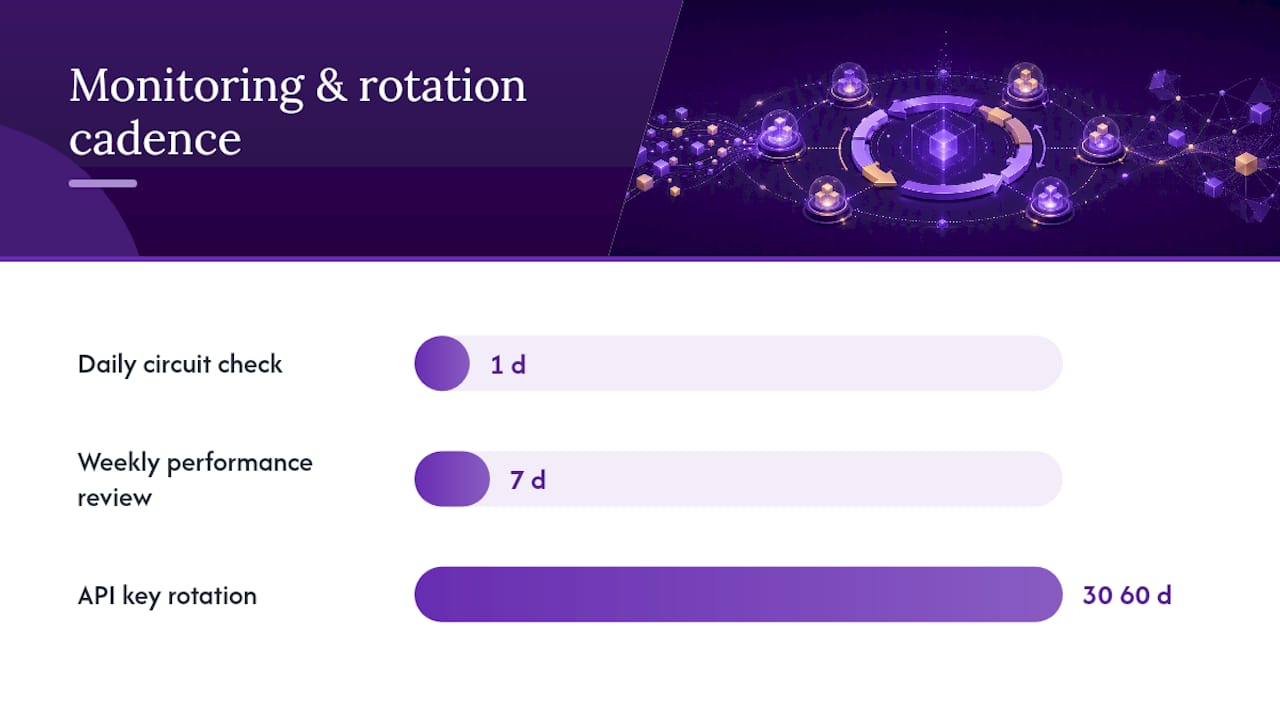
- Scheduled API key rotation, ideally every 30 to 90 days, to limit exposure from a leaked credential.
- A defined monitoring and alerting cadence, not just a dashboard you check when you remember to.
To put this into a workflow:
- Set position size and max drawdown limits before the first live trade.
- Configure a kill switch tied to both consecutive losses and total daily loss percentage.
- Set alert thresholds for unusual latency, rejected orders, or unfilled positions.
- Review strategy performance weekly against backtest expectations, not just profit and loss.
- Rotate API keys and re-verify permission scopes on a fixed schedule.
Watching liquidation data during volatile sessions gives useful context on how quickly leveraged positions can cascade, which is a good reminder that scalping bots trading on margin need tighter circuit breakers than spot-only setups. Understanding liquidity risk also helps explain why thin order books amplify slippage exactly when your stop-loss logic needs to fire cleanly.
Pro Tip: Exchanges rate-limit API requests, and aggressive polling or order resubmission can trigger a temporary ban mid-session. Space out requests and use exponential backoff on retries rather than hammering the endpoint after a rejected order.
Darkbot’s documentation on automated trading risks covers several failure modes traders overlook when they assume a bot running is a bot working correctly.
Can You Build a Scalping Workflow From TradingView Alerts?
Yes, webhooks paired with a guarded execution layer make a practical, low-friction way to turn TradingView signals into monitored scalping orders, provided you never expose exchange API keys in the webhook body itself.
The setup follows a fixed sequence:
- Build and backtest the TradingView alert condition on the timeframe your scalping strategy actually trades.
- Format the webhook payload with the minimum data needed: symbol, direction, and order type.
- Route the payload to an execution gateway that validates the signal before touching your exchange account.
- Implement authentication on the gateway itself, using a signed payload or shared secret, not raw API credentials in the alert.
- Add rate limiting so a flood of duplicate alerts can’t trigger repeated orders.
- Run the full pipeline in dry-run mode before connecting it to live capital.
A few operational notes matter here:
- Never place your exchange API key inside a public-facing webhook URL or payload; TradingView’s outbound webhook isn’t a secure credential channel.
- Use an intermediary execution gateway that holds your keys server-side and only accepts pre-authenticated, validated requests.
- Log every webhook received, matched, and executed so you can audit signal-to-fill latency after the fact.
If integration breaks, check these first: the alert message format doesn’t match what your gateway expects, the webhook URL has a typo or expired token, the gateway is rejecting requests due to a clock-sync issue with signed payloads, or the exchange API key scope doesn’t permit the order type being sent.
How Do You Backtest a Scalping Strategy Without Fooling Yourself?
High-frequency scalping strategies need walk-forward backtesting, event-driven tick simulation, and slippage-aware paper-trading, because a naive backtest with perfect fills will always look more profitable than reality allows.
Track these metrics, not just total return:
- Per-trade edge after modeled fees and slippage
- Win rate alongside average win size versus average loss size
- Maximum consecutive losses, which stress-tests your position-sizing rules
- A Sharpe or Sortino ratio adapted for high-frequency return distributions
- Execution success rate: how often orders actually fill at the intended price
- Latency-induced slippage rate, isolating losses caused by delay rather than bad signals
Realistic simulation means modeling order-book depth, not just close prices, along with maker/taker fee differences and partial fills, since a scalping strategy that assumes instant full fills at the quoted price will overstate performance every time. Frameworks like Freqtrade demonstrate this pipeline with dry-run and hyperopt tools built specifically for this kind of walk-forward validation.
As a rough guide, paper-trade for at least two to four weeks covering different volatility regimes before moving to live capital, and start live testing with a fraction of your intended position size.
Pro Tip: If your backtest edge and your paper-trading edge diverge by more than a small margin, the gap is almost always slippage or fill assumptions, not a flaw in the signal itself.
How We Evaluated These Scalping Platforms and Approaches
Evaluation combined backtesting against historical tick data, exchange fee modeling across multiple fee tiers, and short live stress tests under monitored, small-capital conditions rather than relying on advertised performance claims.
The criteria applied across every category:
- Execution latency posture, including WebSocket support and any co-location or low-latency options
- Fee model transparency, covering both platform subscription cost and how the tool accounts for exchange maker/taker fees
- Custody and security architecture, including API key scoping and encryption practices
- Backtesting fidelity, specifically whether slippage and partial fills are modeled realistically
- Monitoring and failover behavior during simulated connectivity loss
- Documentation quality and the availability of official support channels
Testing included running sample backtests across multiple pairs and timeframes, simulating slippage scenarios under varying volatility, and deploying small live positions to observe real order behavior against backtest predictions. This approach mirrors the testing pipeline documented by open-source engines: backtest, then walk-forward validate, then paper-trade, then a controlled live pilot with minimal capital.
Author perspective: when a scalping bot makes sense
Scalping automation makes sense when three things line up: your capital is large enough that fee tiers work in your favor, your target pairs have consistent liquidity, and you have the bandwidth to actually monitor the system rather than deploy it and walk away. Trade frequency scales against capital fast, and most retail accounts under a few thousand dollars will do better with a slower strategy where fees consume a smaller share of each trade’s return. The maintenance burden is the part people underestimate most. Strategy performance drifts as market regimes shift, which means scheduled reviews and parameter adjustments aren’t optional, they’re the actual job once the bot is live. Automation removes reaction-time disadvantage; it doesn’t remove the need for judgment.
Try an AI-Assisted Scalping Platform With Built-In Risk Controls
Darkbot brings together the pieces this guide has walked through: AI-assisted strategy orchestration, configurable risk controls, backtesting and paper-trading, and multi-exchange API integration under a single dashboard, so you’re not stitching together a data feed, an execution gateway, and a risk-monitoring layer separately.
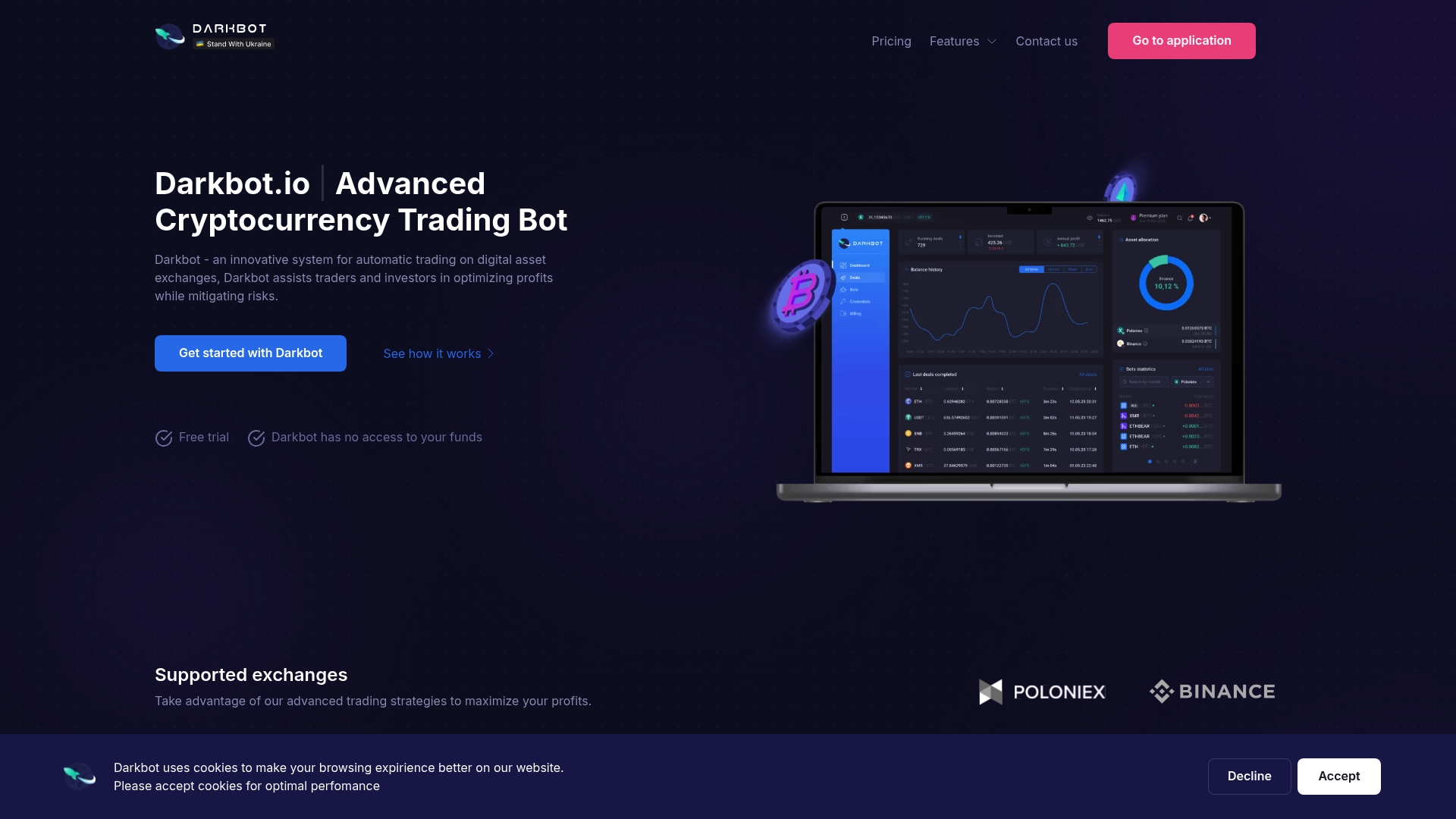
The platform supports secure API key custody with scoped permissions, along with real-time analytics and alerting so you can monitor bot behavior instead of guessing at it after the fact. For traders evaluating whether a systematic approach fits their capital and pair selection, a controlled pilot is the reasonable next step, not a full account rollout.
If you’re testing Darkbot for the first time, start with one bot on a single liquid pair, use a small position size, and watch execution latency and fill quality against what the backtest predicted before scaling up. Strategy tuning from there follows the same optimization principles covered earlier: adjust based on live execution data, not backtest assumptions alone. You can start with Darkbot and review the available plans, including the free tier, before committing to a subscription.
Sources
- Human Benchmark — Reaction Time statistics
- WhiteBIT documentation — colocation
- Binance — Fee schedule
- freqtrade/freqtrade — Free, open source crypto trading bot
Recommended

Start trading on Darkbot with ease
Come and explore our crypto trading platform by connecting your free account!
Free plan available • No credit card required