Smart Order Routing in Crypto: A Technical Guide
Smart order routing (SOR) for crypto is an execution layer that consolidates venue liquidity and splits orders to minimize all-in execution cost, meaning price plus fees, while enforcing hard safety bounds. It solves a structural problem: no single exchange or pool holds enough depth to fill a meaningful order without moving the price against you.
Three things matter immediately if you are building or evaluating one. First, fee-awareness is not optional. The ORDER research paper and production tools like sory both treat negotiated fees, not published retail tiers, as the routing input. Second, crypto SOR requires pre-funded capital across venues, unlike equities where a broker settles centrally. Third, every router needs reconciliation. If requested quantity does not equal filled plus unfilled with a stated reason, you have a silent failure, not a working system.
- Fee-aware routing changes the winning venue more often than price-only routing does.
- Pre-funding constraints mean routing decisions are capital allocation decisions, not just price comparisons.
- Observability (fills, reasons, venue health) is what separates a production router from a demo.
Key Takeaways
Smart order routing reduces all-in execution cost in crypto by consolidating fragmented venue liquidity into one fee-adjusted book and enforcing explicit safety bounds on every fill.
| Point | Details |
|---|---|
| Route on fee-adjusted price | Compare venues on all-in cost including negotiated fees, not on quoted price alone. |
| Build in reconciliation | Confirm requested quantity equals filled plus unfilled with a stated reason for every gap. |
| Plan for pre-funded capital | Crypto routing requires balances on each venue in advance, unlike centrally cleared equity markets. |
| Use graph-based routing for scale | Path-indexing methods like ORDER cut route search time significantly on large venue networks. |
| Validate before live capital | Run dry-run and paper trading through platforms like Darkbot before deploying any routing change live. |
What Is Smart Order Routing in Crypto and How Does It Work?

An SOR system is a pipeline, not a single function. Five components pass data to each other in sequence, and a failure in any one of them degrades execution quality without necessarily throwing an error.
The market-data layer consolidates order books from every connected venue, whether that is a centralized exchange (CEX) order book or an automated market maker (AMM) pool, and adjusts each for its actual fee schedule. A quote that looks best before fees can easily be the worst after them. Layered on top of that is venue health monitoring, which tracks feed staleness, API error rates, and latency so the router can exclude a venue before it causes a bad fill rather than after.
The scoring layer applies an effective cost function to every candidate route, ranking them on all-in price rather than headline price. The optimizer then decides whether to send the whole order to one venue or split it across several, and on what schedule. The execution engine sends the actual orders and enforces hard bounds like maximum slippage in basis points. Finally, reconciliation closes the loop.
- Market-data consolidation: build one fee-adjusted book from many raw books.
- Scoring: rank routes by effective cost, not quoted price.
- Optimization: decide split size and timing across venues.
- Execution: send orders and enforce slippage and price bounds.
- Reconciliation: confirm requested equals filled plus unfilled, with a reason logged for every gap.
Every production router should support a dry-run mode that runs this entire pipeline without sending live orders, which is how you validate logic changes before they touch capital. Reconciliation itself needs a clear invariant: requested quantity = filled quantity + unfilled quantity, and every unit of unfilled quantity carries an explicit reason (insufficient depth, venue exclusion, slippage bound breached). Without that trade tape and per-venue fill log, you cannot audit why a route underperformed, and you cannot fix it.
Why Do Crypto Markets Need Smart Order Routing?
Crypto liquidity is fragmented across a large number of active centralized exchanges and decentralized venues, with no equivalent to the National Best Bid and Offer that consolidates equity markets into one reference price. That fragmentation is not a temporary inefficiency, it is the market’s default state, and it means the “best price” question has no single authoritative answer at any given moment, according to an institutional guide to crypto SOR.
A few structural features make this worse for anyone routing manually:
- AMMs and central limit order books (CLOBs) behave differently under size. An AMM’s price moves continuously with trade size (slippage curves), while a CLOB has discrete levels of depth.
- Fee models vary by venue, by volume tier, and often by whether a trader has negotiated a custom rate, so two venues quoting the same price can have very different all-in costs.
- Markets run 24/7, so volatility and liquidity gaps can appear at any hour with no closing auction to reset the book.
Consider a moderately large order routed to a single venue with genuinely thin depth. Without a router splitting that order across two or three additional venues, the trader eats slippage as the order walks the book, a cost that shows up nowhere in the quoted price but directly in the fill report. Crypto also demands pre-funded balances on every venue you might route to, since there is no central clearing broker extending credit across exchanges the way there is in equities. That constraint alone reshapes routing design: capital sitting idle on an underused venue is capital not earning its keep elsewhere.
What Routing Strategies and Algorithms Do SOR Systems Use?
Four strategy families cover most production use cases, and picking the wrong one for the order size and urgency is a common design mistake; for detailed methods, see this crypto arbitrage strategies list.
- Sweep: hits multiple venues simultaneously for immediate fills, appropriate for smaller orders where speed matters more than minimizing footprint.
- TWAP/VWAP/POV: slices a large order across time using time-weighted average price or volume-weighted schedules, reducing market impact at the cost of execution speed.
- Chase algorithms: adjust order placement as the market moves, useful when a passive order risks never filling in a trending market.
- Split-optimization: for large fills, mathematically allocates size across venues to minimize the combined cost of price impact and fees.
Underneath these strategies sit distinct algorithmic approaches. Greedy heuristics rank venues and fill in order until the parent order is exhausted, which is fast but not always optimal. Convex and constrained optimizers solve for the allocation that minimizes total cost subject to per-venue limits, which is more accurate but computationally heavier. Graph and path-indexing approaches, the method behind the ORDER system, treat exchanges as nodes and convertible assets as edges, then index paths ahead of time so a routing decision becomes a fast lookup rather than a fresh search.
ORDER’s hierarchical path index reports up to 114 times the speedup over prior routing methods on real-world DeFi datasets, while preserving execution quality, by combining a bucket-based index with lazy computation and an adaptive controller for update costs.
That speedup matters because route search complexity grows fast as more venues and assets get added. The trade-off is real, though: pre-computed indexes need updates when pool states change, and a stale index is arguably worse than a slower but current search.
What Should a Production SOR Architecture Include?
Getting the algorithm right solves half the problem. The other half is operational engineering, and this is where most homegrown routers fail quietly rather than loudly.
Build a checklist around these areas before deploying anything with real capital:
- Feed aggregation: normalize order books, trades, and fee schedules from every connected venue into one internal format.
- Fee tables: store negotiated fees separately from published tiers, since routing on quoted price alone routes on the wrong number.
- VWAP depth calculation: estimate the realistic fill price for your specific order size, not just the top-of-book quote.
- Venue health states: track latency, error rates, and feed staleness, and automatically exclude a degraded venue from routing candidates.
- API rate limits and failover: respect exchange-imposed limits and have a fallback path when a primary venue connection drops.
- Pre-funding handling: monitor balances per venue and factor available capital into the routing decision itself.
Safety controls need to be non-negotiable at the code level, not configurable defaults someone can accidentally disable. Set a hard maximum slippage in basis points, cap per-venue exposure, run every strategy change through dry-run first, and enforce reconciliation before marking any parent order as complete.
On observability, log the per-order routing plan (which venues were considered, which were excluded and why), the actual allocations sent, the fills reconciled against those allocations, and latency at each pipeline stage. Anomaly alerts should fire on reconciliation mismatches, not just on outright errors.
Pro Tip: Track idle balance ratios per venue over a rolling week. A venue holding pre-funded capital that rarely gets routed to is a capital efficiency leak, and rebalancing that allocation toward venues with consistently better fill rates often improves net execution more than tuning the routing algorithm itself.
How Do Existing Crypto Routers Approach Smart Order Routing?
Studying live implementations shows how the same core problem gets solved differently depending on whether the router runs on-chain or off-chain.
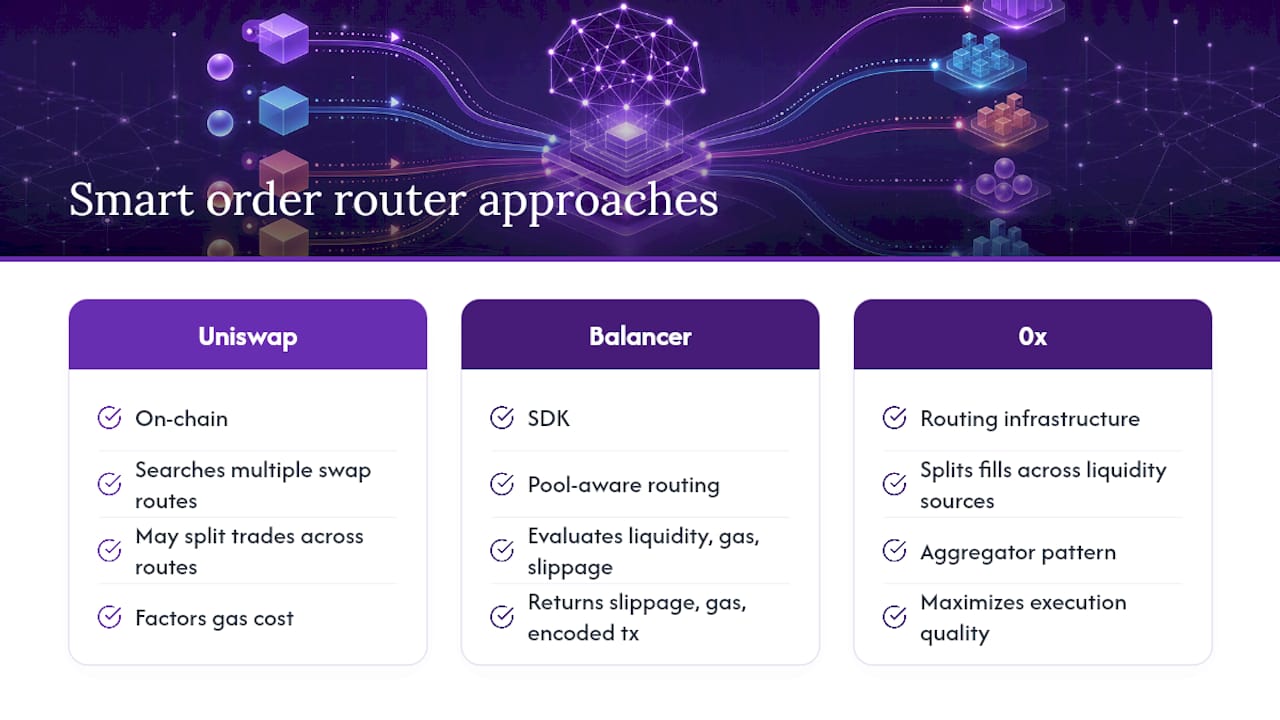
Uniswap’s smart order router searches multiple potential swap routes across pools, weighing whether splitting a trade across routes improves the outcome once gas cost is factored in. Because it executes on-chain, it works within hard multicall and gas-limit constraints that cap how many routes it can realistically evaluate per transaction, a limitation documented in Uniswap’s own auto-router posts.
The Balancer Smart Order Router SDK takes a pool-aware approach, evaluating liquidity, gas costs, and slippage together, then returning a swapInfo object with expected slippage, gas cost, and an encoded transaction payload ready to submit. It is a useful reference for anyone building a router that needs to hand off a fully-formed execution package to a downstream system.
0x’s routing infrastructure splits fills across multiple liquidity sources to maximize overall execution quality, an aggregator pattern distinct from single-protocol routers like Uniswap’s or Balancer’s.
The common thread: on-chain routers optimize within gas constraints, while off-chain routers like sory optimize on a fee-adjusted consolidated book without that ceiling. Reading the source repositories directly is worth the time if you plan to integrate any of them.
What Are the Common Failure Modes in Crypto Order Routing?
Routers fail in specific, recurring ways, and most of them are preventable with the right guardrails rather than a smarter algorithm.
- Stale or spoofed feeds: a venue reporting outdated or manipulated depth leads the optimizer to route into liquidity that isn’t there.
- Venue outages: an exchange going offline mid-execution leaves a parent order partially filled with no clean recovery path unless the reconciliation layer catches it.
- Fee changes and hidden tiers: an unannounced fee shift can flip the ranking of venues the router has been trusting.
- Insufficient pre-funded capital: a venue with the best price is useless if the account balance there can’t cover the order.
- MEV and front-running risk: on-chain routes are visible in the mempool before confirmation, exposing large orders to sandwich attacks.
- Settlement delays: on-chain confirmation times can leave a router’s view of “filled” out of sync with actual settled balance.
Mitigation is mostly procedural: exclude unhealthy venues automatically, run dry-run before every strategy change, keep slippage bounds conservative for illiquid pairs, and build a short incident checklist so a degraded venue gets isolated within minutes, not discovered the next day in a reconciliation report.
What Does a Fee-Aware SOR Call Look Like in Practice?
A fee-aware router needs to expose a simple contract: take an order and constraints in, return an execution plan and result out. Conceptually, a call looks like this:
book = router.build_consolidated_book(pair="BTC/USDT", fee_table=negotiated_fees)
result = router.place_order(
    side="buy",
    quantity=12.5,
    max_slippage_bps=15,
    dry_run=True
)
The router should return, at minimum: allocations (how much was routed to each venue), achieved_price (the actual all-in price across the fill), filled quantity, an unfilled remainder, with a stated reason, if the order wasn’t fully completed, and a venue health snapshot at the time of routing.
A router that cannot tell you why a portion of an order went unfilled is not reporting execution quality, it is reporting a number with no context behind it.
Before running this against live capital, confirm four settings: the negotiated fee table is current, max_slippage_bps reflects the pair’s actual liquidity rather than a copied default, dry-run mode is on for any new strategy, and VWAP depth requests are sized to the order, not just the top-of-book quote.
Pro Tip: Log the venue health snapshot with every trade, even successful ones. When a failure does happen weeks later, that historical snapshot data is often the only way to tell whether the cause was a genuine liquidity gap or a feed problem that had been degrading quietly.
A Practitioner’s Note on Adopting SOR
Start narrow. Instrument two or three venue feeds properly, with real health monitoring and reconciliation, before adding a tenth venue that just adds noise. Institutional-grade routing is less about a clever optimizer and more about capital efficiency and monitoring discipline sustained over months, not a one-time build. Validate every change through paper trading and dry-run reconciliation before it touches live capital. That sequencing, unglamorous as it is, is what separates routers that survive contact with real markets from ones that only worked in a backtest.
How Darkbot Handles Fee-Aware Execution
Darkbot approaches order execution as a systematic, rule-driven process rather than a signal service. The platform connects to major exchanges through API integration, and its execution logic accounts for exchange-specific fee structures when evaluating trade decisions rather than treating quoted price as the whole picture.
For traders comparing execution across multiple exchanges, Darkbot’s multi-exchange integration supports running automated strategies against several venues without manually managing separate API sessions for each one. The platform includes paper trading and backtesting so strategy logic, including how orders get sized and where they get sent, can be validated against historical data before any capital is committed. Risk controls like position sizing and rebalancing rules operate continuously in the background, with real-time analytics reporting on execution outcomes rather than price predictions.
If you want to see how automated, rule-based execution works across your connected exchanges, you can review the platform and start with Darkbot’s free plan to test strategy configuration before committing to a paid tier.
Sources
FAQ
What Is Smart Order Routing in Crypto?
Smart order routing (SOR) is an execution layer that consolidates liquidity from multiple exchanges and pools, then splits or directs orders to minimize all-in cost while enforcing hard slippage and price bounds.
Why Does Crypto Need SOR More Than Traditional Markets?
Crypto lacks a consolidated tape like equities’ National Best Bid and Offer, and liquidity is fragmented across a large number of centralized exchanges and decentralized venues with varying fee models, making manual venue selection unreliable.
How Does Fee-Aware Routing Differ From Price-Only Routing?
Fee-aware routing ranks venues by the all-in cost after applying negotiated or actual fee tiers, while price-only routing compares quoted prices that can hide meaningfully different final costs.
What Should a Router Report Back After Execution?
A well-built router should return per-venue allocations, the achieved all-in price, filled quantity, any unfilled remainder with a stated reason, and a venue health snapshot at execution time.
Can Automated Trading Platforms Like Darkbot Support SOR Concepts?
Darkbot supports multi-exchange execution with fee awareness, dry-run validation through paper trading, and continuous risk controls, applying the same systematic principles that underlie smart order routing design.
Recommended

Start trading on Darkbot with ease
Come and explore our crypto trading platform by connecting your free account!
Free plan available • No credit card required