Top swing trading strategies to optimize crypto profits
TL;DR:
- Effective crypto swing trading relies on risk management, win rate, drawdown, and automation compatibility.
- Strategies like order book imbalance, EMA crossover, and Bollinger Band breakout have proven performance metrics.
- Automation through precise rule definition, backtesting, and platform tools enhances consistency and reduces emotional trading.
Crypto swing trading is one of the few approaches where the right strategy can genuinely separate profitable traders from the rest of the crowd. With thousands of coins, 24/7 markets, and volatility that can erase gains in hours, picking the wrong approach doesn’t just cost you a trade. It costs you compounding opportunities, capital, and confidence. This article breaks down the most effective swing trading strategies for crypto, backed by real performance data, compares their strengths and weaknesses side by side, and shows you exactly how to automate them for consistent execution without the emotional noise.
Key Takeaways
| Point | Details |
|---|---|
| Define clear criteria | Evaluating swing trading strategies requires clear risk and performance criteria tailored to crypto. |
| Rely on evidence | Choose strategies with strong backtesting results and real-world win rates. |
| Automate for consistency | Trading bots and OCO orders help execute strategies efficiently and reliably. |
| Stay flexible | Adapt strategies to changing market conditions and avoid relying solely on technical patterns. |
How to evaluate swing trading strategies for crypto
Before you choose among popular swing trading strategies, it’s vital to know what makes a strategy suitable for crypto markets. Not every method that works in stocks or forex will hold up against the volatility and liquidity dynamics of Bitcoin, Ethereum, or Solana. You need a framework to evaluate any strategy before you risk real capital on it.
The four primary criteria for evaluating any crypto swing strategy:
- Risk management: This is non-negotiable. A solid strategy should always define how much you’re willing to lose per trade before you enter. The 1-2% risk rule is a standard benchmark, where you risk only 1-2% of your total capital on any single trade, with a stop-loss placed logically below the swing low or support level. A minimum 1:2 risk-reward ratio is also critical, meaning for every dollar you risk, you should target at least two dollars in profit.
- Win rate and profit factor: Win rate alone doesn’t tell the full story. A strategy with a 40% win rate but a profit factor above 2.0 can be far more profitable than one with a 70% win rate and a 1.0 profit factor. Always look at both together.
- Drawdown tolerance: Maximum drawdown tells you the worst losing streak a strategy has historically produced. Strategies with drawdowns above 15-20% are harder to sustain psychologically and financially, especially in crypto where losses can cascade quickly.
- Automation compatibility: Can the strategy be defined by clear, repeatable rules? Strategies with objective entry and exit conditions are the ones you can hand off to a bot, which removes emotion and increases consistency.
Beyond these four pillars, diversification matters more than most traders admit. Running a single strategy on a single asset is a fragile setup. Pairing uncorrelated strategies across different assets spreads risk and smooths your equity curve over time. Position sizing is the mechanic that makes diversification work in practice. If you’re putting 20% of your account into one swing trade, diversification becomes meaningless.
“A strategy that can’t define its rules precisely can’t be backtested, and a strategy that can’t be backtested can’t be trusted with real capital.”
Pro Tip: Before committing to any swing strategy, backtest it on at least 100 trades across different market conditions, including trending and ranging environments. A strategy that only works in bull markets will destroy accounts when sentiment shifts.
Backtesting in crypto requires using actual OHLCV (open, high, low, close, volume) data from exchanges, not simulated or synthetic data. Tools like TradingView’s Pine Script or dedicated platforms allow you to run these tests with realistic spread and slippage assumptions.
List of proven swing trading strategies for crypto
Once you know the criteria, here are the strategies that meet those standards and have demonstrated measurable results.
1. Order book imbalance strategy
This strategy reads the real-time balance between buy and sell orders in the order book to identify high-probability entry points. When buy orders significantly outweigh sell orders at a specific price level, a bullish swing entry is triggered, and vice versa. The magic number? An order book imbalance ratio of 1.8:1 has produced a 57.3% win rate with an average reward of 1.6R across 1,847 trades on BTC, ETH, and SOL. That’s not theoretical. That’s live market performance across three of the most liquid crypto markets.
2. EMA crossover strategy (21/50)
The exponential moving average crossover using the 21-period and 50-period EMAs on the daily (D1) chart is a classic, but when optimized for crypto it produces consistent results. When the 21 EMA crosses above the 50 EMA, it signals a bullish trend entry. When it crosses below, it signals a bearish or exit setup. On BTC’s daily chart, the EMA 21/50 swing strategy delivers a profit factor of 2.14, a win rate of 41.7%, and a maximum drawdown of just 5.8%. That low drawdown is what makes it sustainable for long-term use.
3. Bollinger Band breakout strategy
When price breaks above the upper Bollinger Band with volume confirmation, it signals an explosive move that swing traders can ride for several days. This setup works particularly well on BTC during high-volatility periods. The Bollinger breakout has produced an 81.82% win rate with a profit factor of 6.345 on BTC. That profit factor is exceptional. It means for every $1 lost, the strategy generates $6.35 in profit.
Why 3 to 7 day holding periods outperform in crypto:
Swing trading works best when the holding period is long enough to capture the full price swing but short enough to avoid overnight funding risks and macro reversals. For most essential crypto trading strategies, a 3 to 7 day window captures the bulk of the directional move while keeping drawdown exposure manageable.
Key features at a glance:
- Order book strategy: needs real-time data feed and level 2 order book access
- EMA crossover: works on daily charts, easy to automate, lower win rate but strong profit factor
- Bollinger breakout: high win rate, best during trending and volatile conditions
- All three benefit from trading strategies for beginners as foundational context before scaling up
Pro Tip: Never rely on a single signal for entry. The highest probability setups combine order book imbalance confirmation with a technical trigger like an EMA crossover or Bollinger Band breakout. Confluence dramatically improves win rates and reduces false entries.
Comparing swing trading strategies: performance and nuance
After seeing each strategy in detail, it’s important to compare them side by side and understand their trading context.

| Strategy | Win rate | Profit factor | Max drawdown | Ideal market | Automation difficulty |
|---|---|---|---|---|---|
| Order book imbalance | 57.3% | ~1.9 | Moderate | Trending + volatile | Medium (requires L2 data) |
| EMA crossover (21/50) | 41.7% | 2.14 | 5.8% | Trending | Low (simple rules) |
| Bollinger Band breakout | 81.82% | 6.345 | Low to moderate | Volatile, trending | Low to medium |
The EMA crossover stands out for its minimal drawdown, making it the most psychologically sustainable of the three. It requires you to accept a sub-50% win rate, which most traders struggle with emotionally. If you can tolerate losing six out of ten trades while knowing the math works in your favor over hundreds of trades, this strategy is highly automatable and scalable.
The Bollinger Band breakout strategy looks like the obvious winner based on win rate and profit factor alone. But it comes with important nuances. False breakouts are extremely common in crypto, especially during low volume periods or when macro events are distorting price action. Reducing your position size by 50% ahead of major economic announcements or Fed decisions can protect you from whipsaw losses that wipe out multiple winning trades in a single session.
“Indicator confluence is not optional in crypto swing trading. A breakout confirmed by order book imbalance and a rising EMA is worth three times the signal of any single indicator alone.”
The order book imbalance strategy requires the most infrastructure. You need access to real-time Level 2 order book data, which not all retail platforms provide cleanly. It’s the most nuanced of the three but arguably the most forward-looking since it reflects actual market participant behavior rather than lagged price history.
A critical and often overlooked nuance: avoid using charts below the 4-hour (4H) timeframe for swing trading. Shorter timeframes produce far more noise, false signals, and emotional reactions without improving actual performance. The data supports maximizing profits safely by staying on higher timeframes and resisting the urge to micromanage entries.
Pro Tip: Before scaling any strategy, run it through strategy optimization steps to identify parameter sensitivity. A strategy that falls apart with slight adjustments to its parameters is fragile. Robust strategies hold up across a range of settings.
Dynamic exits also matter more than most traders realize. Trailing your stop-loss below recent swing lows rather than holding to a fixed profit target lets winners run while protecting gains when momentum shifts. Fixed targets cap upside in fast-moving crypto markets.
How to automate swing trading strategies for crypto
Understanding which strategy to use is only half the battle. The next is making it work automatically for you.
Step-by-step guide to automating your swing trading strategy:
- Define your rules precisely. Every entry, exit, position size, and stop-loss must be expressed as a specific, testable rule. “Buy when the 21 EMA crosses above the 50 EMA on the daily chart with a close above the crossover candle” is a rule. “Buy when it looks bullish” is not.
- Backtest on TradingView. Use Pine Script to test your exact rules on historical data before touching live markets. Backtesting with TradingView lets you simulate hundreds of trades in minutes, surfacing weaknesses in your logic without risking capital.
- Set up OCO (One Cancels the Other) orders. For manual or semi-automated setups, OCO orders on exchanges like Binance or Phemex execute your take-profit and stop-loss simultaneously. When one fills, the other cancels automatically. This is the minimum viable form of automation for swing traders.
- Deploy a grid bot for ranging markets. When assets are consolidating between clear support and resistance, grid bots automatically buy low and sell high within the range. Using trading bots for swing trading removes the need to monitor screens constantly and improves execution speed.
- Monitor and adjust weekly, not hourly. Automated systems need oversight but not micromanagement. Review performance weekly, check for parameter drift, and adjust position sizing as your account grows.
| Automation tool | Best for | Complexity | Key exchanges |
|---|---|---|---|
| OCO orders | Fixed take-profit and stop-loss | Low | Binance, Phemex, Bybit |
| Grid bots | Ranging market strategies | Medium | Binance, KuCoin |
| Full strategy bots | Multi-condition automated entries | High | Most major exchanges via API |
| TradingView alerts | Notification-based semi-automation | Low | Works with any exchange |
Choosing automated platforms for swing traders that support API connectivity ensures your bot can execute trades directly on the exchange without manual intervention.
Pro Tip: Never go live with a strategy that hasn’t been forward-tested in a paper trading environment for at least two to four weeks. Backtesting shows you historical performance. Forward testing shows you how the strategy handles real-time price action, slippage, and data gaps.
Balancing automation with manual oversight is a skill in itself. Bots don’t understand breaking news, regulatory announcements, or sudden liquidity crises. Keep a simple macro checklist: check for scheduled events before enabling your bot each week, and pause automated systems during extreme uncertainty. The best traders treat their bots as tools with boundaries, not autonomous systems with unlimited authority.
Perspective: What most crypto swing traders get wrong — and how to outsmart the crowd
Most traders who struggle with swing trading crypto share a common blind spot. They study chart patterns obsessively but ignore the liquidity environment where those patterns are forming. A textbook bullish flag means nothing if there’s a massive sell wall sitting just above the breakout level in the order book. Prioritizing liquidity and order flow at the point of entry over pure pattern recognition is the single biggest behavioral shift that separates consistently profitable swing traders from the rest.
The second mistake is rigid exit management. Traders set a fixed profit target and exit the moment price touches it, even when momentum is accelerating and order flow still favors the move. Trailing stops on swing lows let you stay in winning trades longer and capture the full range of the move. Exiting on imbalance reversal in the order book is a far more intelligent signal than a round-number price target.
Here’s the uncomfortable truth about automation and backtesting failures: most traders abandon strategies after short losing streaks that fall entirely within the strategy’s expected statistical range. They optimize for the past and call it done, then quit when the real world doesn’t match the backtest. Learning to automate strategies with discipline means trusting your system’s edge while staying alert to structural market changes that legitimately require recalibration. That balance is where the real edge lives.
Next steps: Automate and optimize your swing trading
You now have the strategies, the performance data, and the automation roadmap. The question is whether you’ll execute manually and inconsistently or build a system that works for you around the clock.
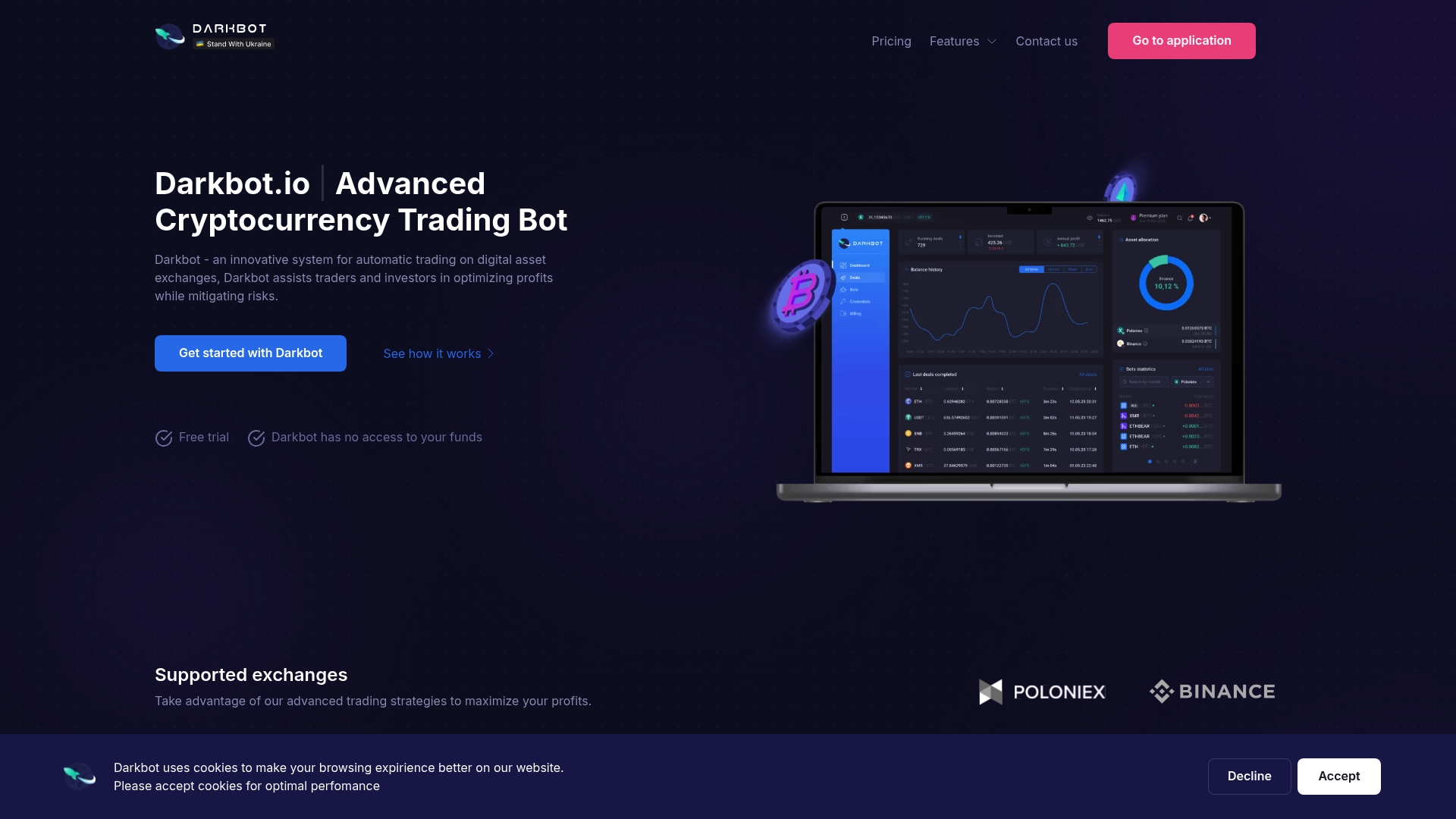
Darkbot.io’s AI-powered crypto trading bot is built specifically for traders who want to move from manual execution to automated, optimized performance. Connect your exchange via API, configure your strategy rules, and let the bot handle entries, exits, and risk management automatically. For traders focused on growing their holdings over time, the crypto portfolio optimization tools handle rebalancing and risk allocation so your overall strategy stays on track even when individual trades fluctuate. Whether you’re starting with a free plan or scaling into premium, the infrastructure is ready when you are.
Frequently asked questions
What is the safest way to manage risk in swing trading crypto?
Limit your position risk to 1-2% per trade, place stop-losses logically below swing lows or support levels, and spread exposure across uncorrelated assets to avoid concentrated losses.
How long should I hold positions for swing trading crypto?
Holds of 3 to 7 days are typically optimal, giving you enough time to capture the full price swing while avoiding prolonged exposure to macro risks and overnight funding costs.
Which swing trading strategy has the highest win rate in crypto?
The Bollinger Band breakout strategy has shown an 81.82% win rate with a profit factor of 6.345 on BTC, making it the highest performer in recent data among commonly tested strategies.
How do you automate a swing trading strategy?
Set up predefined OCO orders on exchanges like Binance or Phemex for basic automation, use grid bots for ranging markets, and always backtest your strategy on TradingView before deploying with live funds.
Recommended

Start trading on Darkbot with ease
Come and explore our crypto trading platform by connecting your free account!
Free plan available • No credit card required