A Practical Guide to Setting Up Automated Crypto Trades
Setting up automated crypto trades comes down to one principle: automation is a disciplined execution layer that enforces rules and probability-based decisions. It does not predict prices or guarantee profit, and any platform that implies otherwise misunderstands what AI-driven bots actually do.
Three steps get you from idea to a running bot. First, pick a strategy that matches your time horizon and risk tolerance. Second, connect your exchange with trade-only API keys and no withdrawal rights. Third, run a paper test before committing real capital.
- Choose a strategy type (grid, DCA, TWAP, or trailing stop).
- Secure your API connection with restricted permissions.
- Paper trade for at least two weeks, then scale gradually.
Key Takeaways
Automated crypto trading succeeds when strategy selection, API security, and validated testing happen in that order, with risk controls active before any live capital is committed.
| Point | Details |
|---|---|
| Verdict on automation | Bots enforce rules and probability-based decisions; they do not guarantee profit outcomes. |
| API security first | Use trade-only keys, disable withdrawals, and apply IP whitelisting before connecting any exchange. |
| Validate before scaling | Paper trade for a period adequate to compare fills and slippage against backtest expectations. |
| Risk limits are mandatory | Set position sizing caps, daily loss limits, and a global emergency stop before going live. |
| Darkbot’s role | Provides API integration, backtesting, paper trading, and risk controls across a tiered subscription model, including a free plan. |
Setting Up Automated Crypto Trades: A Step-by-Step Walkthrough
Before touching a strategy, get your account infrastructure in order. Verify your identity with the exchange, fund the account, and enable two-factor authentication. Skipping this step is the single most common reason first-time automation attempts stall out before they start.
- Create trade-only API keys. Disable withdrawal permissions entirely and, where the exchange supports it, whitelist the IP address of your bot or server.
- Configure the bot. Select a strategy type, set your base capital, choose the trading pair and timeframe, define order types (limit or market), and set a realistic tolerance for fees and slippage.
- Deploy in paper mode first. Run a forward test for a period sufficient to observe fills and slippage using simulated or minimal capital, watching how these compare to expectations.
- Log everything. Every trade, every rejection, every deviation from plan.
Exchange-side tools like Crypto show a similar sequence for setting up basket orders and DCA schedules, which is a useful reference if you want to see the mechanics before committing to a dedicated platform.
The goal isn’t returns yet. It’s confirming the bot behaves exactly as configured.
What Automated Strategy Types Should You Consider?
Not every strategy fits every market condition. Matching the tool to the environment is more important than which tool you pick.
- Dollar-cost averaging (DCA): Buys fixed amounts on a schedule regardless of price. Works well in long-term accumulation phases; fails to capitalize on sharp reversals.
- Grid trading: Places buy and sell orders at set intervals within a price range. Effective in sideways, range-bound markets; loses money in strong trending moves that break the grid boundaries.
- TWAP (time-weighted average price): Splits a large order into smaller slices executed over a defined window. Useful for reducing market impact on bigger trades; less relevant for small retail positions.
- Trailing stop strategies: Follow price movement and lock in gains as trends develop. Strong in trending markets; prone to premature exits during choppy volatility.
Each strategy has its own configuration checklist. Grid bots need a defined price range, grid count, and capital allocated per grid line. DCA needs a cadence (daily, weekly) and tranche size. TWAP needs an execution window and slice size.
| Market Condition | Better-Suited Strategy | Management Style |
|---|---|---|
| Low volatility, range-bound | Grid trading | Active monitoring of range boundaries |
| High volatility, trending | Trailing stop | Semi-passive, trend-following |
| Long-term accumulation | DCA | Passive, scheduled |
| Large order execution | TWAP | Passive, time-based |

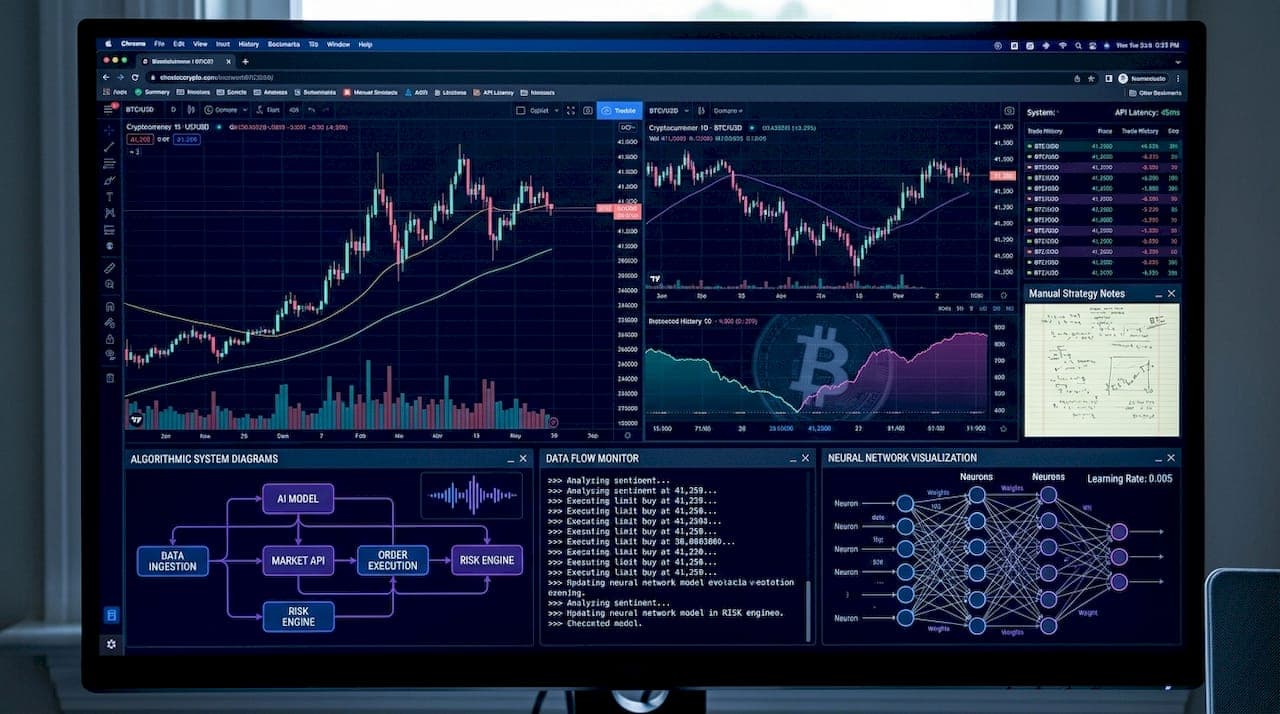
A modular architecture that separates data ingestion, strategy logic, execution, and risk management makes it easier to swap strategies without rebuilding the whole system.
Pro Tip: Never run a grid strategy through an earnings-style catalyst or a major protocol upgrade. Grids assume range-bound behavior, and a breakout event defeats the entire premise.
How Do You Connect an Exchange Safely?
Connecting an exchange is where most operational risk gets introduced, or eliminated, depending on how carefully you set permissions.
- Generate a new API key pair specifically for the bot. Never reuse keys across services.
- Set permissions to trade-only. Withdrawal rights should always stay disabled.
- Apply IP whitelisting if the exchange supports it, restricting API access to your server’s address.
- Store keys in an encrypted secret manager or a dedicated VPS environment rather than a local file.
- Rotate keys periodically, especially after any suspected exposure.
Security guidance from Bitpanda is direct on this point: automation platforms are execution layers, not custodians. Your funds remain on the exchange, and the platform only acts within the permission scope you define.
Automation does not remove custody risk. It shifts responsibility to whoever configures the API scope. A bot with withdrawal rights is a liability, not a convenience.
Pro Tip: Keep a documented “kill switch” procedure: know exactly which button revokes API access before you ever need to press it under pressure.
How Should You Backtest and Paper Trade Before Going Live?
A backtest that assumes perfect fills is not a strategy, it’s a fantasy with a chart attached. Real execution involves slippage, partial fills, and latency, none of which a naive backtest captures.
- Pull clean historical data and check for lookahead bias, where the model “sees” information it wouldn’t have had in real time.
- Apply realistic fee and slippage assumptions to every simulated trade.
- Move to paper trading with live market data for a minimum of 14 days, comparing actual fills against backtest expectations, a practice Kraken’s guide treats as essential rather than optional.
Track performance metrics such as win rate, expectancy, drawdown, risk-adjusted return measures, fill rate, and average slippage. Divergence between backtest and paper-trade numbers is your earliest warning sign.
Pro Tip: Schedule periodic re-backtesting at regular intervals to detect strategy degradation. A strategy tuned for one volatility regime degrades quietly as market conditions shift, and you won’t notice until the drawdown shows up.
What Risk Controls Belong in an Automated Trading Bot?
Position sizing and hard limits are what separate a disciplined system from an expensive experiment.
- Cap any single position at a small fixed percentage of total portfolio value to prevent any single trade from causing material damage.
- Set limits on the number of concurrent open positions across running bots.
- Define a daily loss cap that triggers automatic trading halt once reached.
- Build in a per-bot drawdown kill switch and a global emergency stop that can shut down every bot at once.
- Set position size and exposure limits before your first live trade.
- Configure alerting for latency spikes, unexpected order rejections, or exchange downtime.
- Route alerts through email, SMS, or Slack, and write down a response plan in advance so you’re not improvising during an outage.
What Does Automation Actually Cost?
Subscription fees are only part of the budget. Exchange trading fees, network costs, and slippage often matter more to net returns than the platform price tag.
- Platform subscription: free, standard, and premium tiers depending on features and number of concurrent bots.
- Exchange fees: maker and taker rates vary by exchange and volume tier.
- Infrastructure: a VPS or cloud server for continuous uptime, plus any market data subscriptions.
- Slippage: the gap between expected and actual execution price, which grows with order size and thin liquidity.
High-frequency grid strategies are especially fee-sensitive since they generate many small trades, so tight spreads and low fees matter more there than for a slow DCA schedule.
Pro Tip: Run a fee-sensitivity check during backtesting. If your expectancy turns negative once realistic fees and slippage are applied, the strategy isn’t ready to scale.
How Darkbot Applies These Principles in Practice
Darkbot’s platform structures each of the steps above into a guided workflow rather than leaving traders to assemble the pieces manually.
- API integration across major exchanges, with setup guidance defaulting to trade-only permissions.
- Backtesting and paper-trading tools to validate a strategy before any live capital is committed.
- Multiple simultaneous bots with portfolio-level rebalancing and real-time analytics.
- Risk controls including stop-loss parameters and equity-curve kill switches configurable per bot.
New accounts move through the same sequence: create an account, connect an exchange with restricted API keys, select a strategy template, run it in paper mode, then deploy with monitored, small-scale capital. Darkbot’s AI and machine-learning approach applies pattern recognition and probability assessment to execution decisions. It does not forecast prices or promise outcomes, and treating it as anything beyond a disciplined execution tool misreads what the technology does.
| Point | Details |
|---|---|
| Platform coverage | Supports major exchange integrations, tiered pricing from free to premium, and multiple concurrent bots. |
Legal and Tax Implications of Automated Crypto Trading
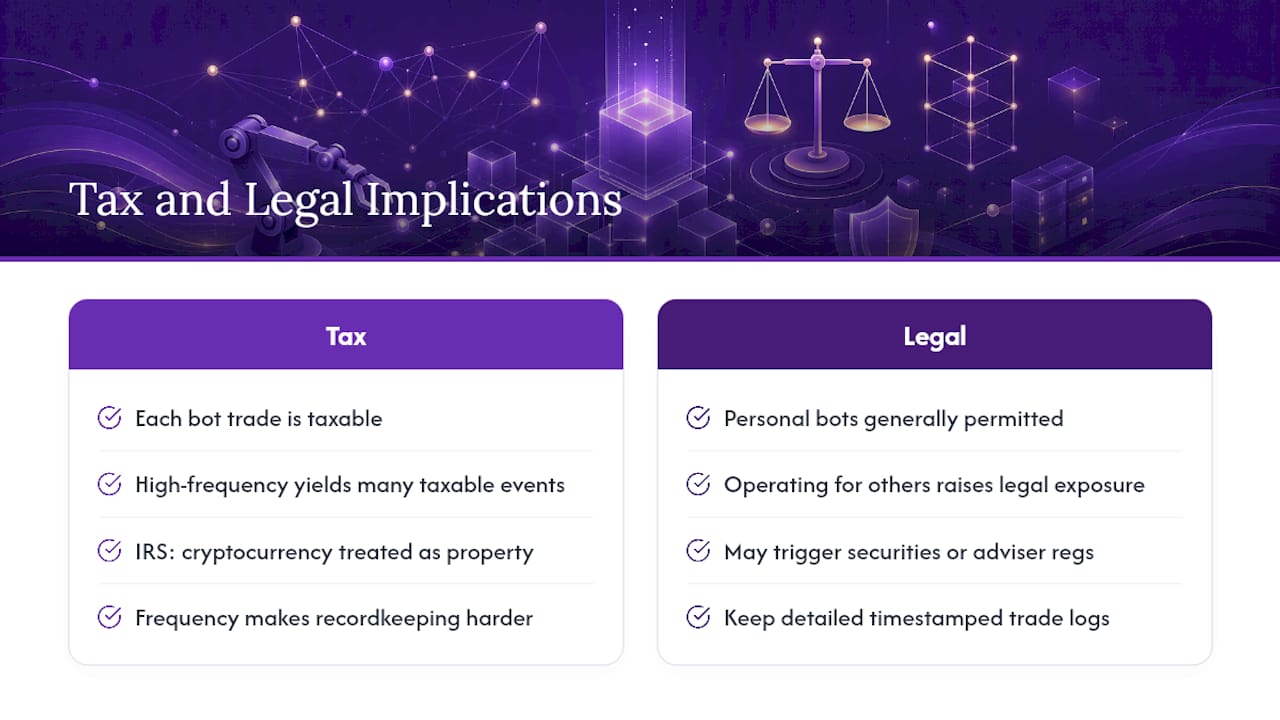
Automated trading does not change your tax obligations. Every trade a bot executes is still a taxable event in most jurisdictions, and the frequency of automated trading, sometimes dozens of transactions a day, can make recordkeeping substantially harder than manual trading.
In the United States, the IRS treats cryptocurrency as property, meaning each sale or swap triggers a capital gain or loss calculation based on the holding period and cost basis. High-frequency bot activity generates high-frequency taxable events, so traders running grid or TWAP strategies should expect a much larger volume of transactions to reconcile at filing time compared to a buy-and-hold approach.
Regulatory status of automated trading itself varies less than tax treatment does. Running a bot on a personal account is generally permitted, but operating one on behalf of others, or offering signals as an investment service, can trigger securities or investment-adviser regulations depending on structure and jurisdiction. That distinction, personal use versus offering a service to others, is where legal exposure actually increases.
Keep detailed transaction logs from day one. A platform that exports trade history in a clean, timestamped format saves significant reconciliation work later. None of this constitutes tax or legal advice specific to your situation. Consult a qualified tax professional or attorney familiar with digital asset regulations in your jurisdiction before scaling any automated strategy that generates meaningful trading volume.
Troubleshooting Common Setup and Live Trading Issues
Most setup failures trace back to a handful of predictable causes, and knowing them in advance saves hours of debugging.
API connection failures usually stem from incorrect permission scopes or an IP whitelist mismatch. If your bot can’t place orders, check that trade permissions are actually enabled and that your server’s current IP matches what’s whitelisted on the exchange side.
Order rejections often come from insufficient balance, minimum order size violations, or price precision errors where the bot sends a price with more decimal places than the exchange accepts. Review the exchange’s specific trading rules for each pair you’re running.
Unexpected slippage during live trading, compared to paper results, usually points to thin liquidity on the pair you selected or a strategy sized too large for the available order book depth. Reducing position size or switching to limit orders instead of market orders often resolves this.
Bot downtime or missed trades typically trace back to server issues rather than strategy logic. Running on a stable VPS with monitored uptime, rather than a home computer, eliminates most of these failures.
Stale data or duplicate orders can occur when a connection drops and reconnects without properly clearing the order queue. Building in sanity checks that flag stale price feeds, a practice detailed in this Python bot-building guide, catches this before it causes duplicate fills.
A Note on Discipline and Expectations
Automation enforces rules, but it doesn’t govern itself. Monitoring, periodic re-evaluation, and conservative position sizing remain the trader’s responsibility, not the bot’s.
Start Paper Trading With Darkbot
Darkbot gives you a structured path from strategy selection to monitored deployment, without requiring you to build the infrastructure, API handling, and risk controls yourself. 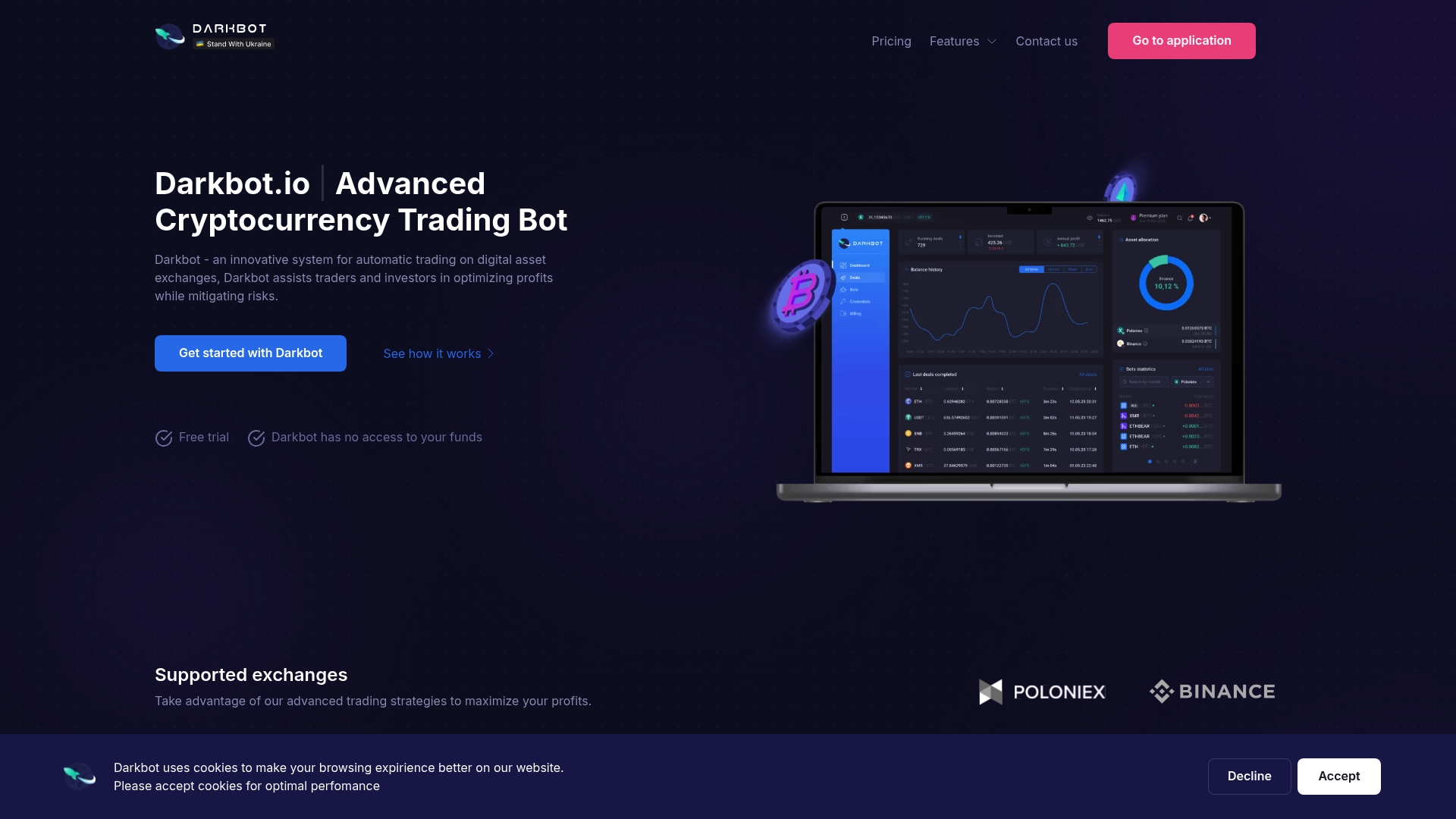
The free tier includes paper trading, strategy templates, and configurable risk parameters, so you can validate a strategy exactly the way this guide recommends before any capital is at risk. Darkbot’s AI components support pattern recognition and rule-based execution. They are not a forecasting tool, and no subscription tier changes that fact. If you’re ready to move from checklist to practice, create a Darkbot account and start with a paper-traded strategy before scaling to live capital.
Frequently Asked Questions
Do I need coding experience to set up automated crypto trades? No. Platforms like Darkbot use pre-built strategy templates and configuration interfaces, so you never need to write execution code yourself. Custom-built bots using frameworks like ccxt do require Python knowledge.
How much money do I need to start automated trading?
Can automated trading bots lose money? Yes. Automation removes emotional decision-making and enforces consistency, but it cannot eliminate market risk, and a poorly configured or under-tested strategy can lose money as easily as manual trading.
How often should I re-evaluate my trading strategy? Re-backtest and review performance at least quarterly, or immediately after a major shift in market volatility, since a strategy tuned for one regime can degrade quietly under different conditions.
Should I ever give a trading bot withdrawal permissions? No. Trade-only API permissions with withdrawals disabled is the standard security practice across every reputable exchange and automation platform.
Sources
- Crypto AI trading bots: A beginner’s guide | Kraken
- Start with a Prompt: Connect AI to Your Bitpanda Portfolio | Bitpanda blog
- Crypto
- How to Build a Crypto Trading Bot in Python: A Step-by-Step Guide (2026)
Recommended

Start trading on Darkbot with ease
Come and explore our crypto trading platform by connecting your free account!
Free plan available • No credit card required