Udacity Machine Learning for Trading: A Practical Guide

TL;DR:
- Udacity’s machine learning for trading offers a comprehensive curriculum covering supervised, unsupervised, and reinforcement learning techniques applied to real financial data, emphasizing data preparation and evaluation rigor. Integrating multiple ML paradigms creates resilient strategies that utilize signals, market filtering, and decision-making under risk constraints. Rigorous backtesting with walk-forward validation and early transaction cost modeling is essential to translating models into real-world trading success.
Udacity machine learning for trading is defined as a structured, end-to-end curriculum that teaches aspiring traders to build complete algorithmic trading pipelines using supervised, unsupervised, and reinforcement learning on real financial data. The program, offered through Udacity’s Building a Workflow for AI course, covers every stage from raw data ingestion to backtested strategy evaluation. Unlike courses that teach ML theory in isolation, this program treats trading as a systems problem where data quality, model selection, and evaluation rigor are equally weighted. For traders who want to move beyond intuition-based decisions, understanding this workflow is the prerequisite.
What machine learning techniques does Udacity teach for trading?
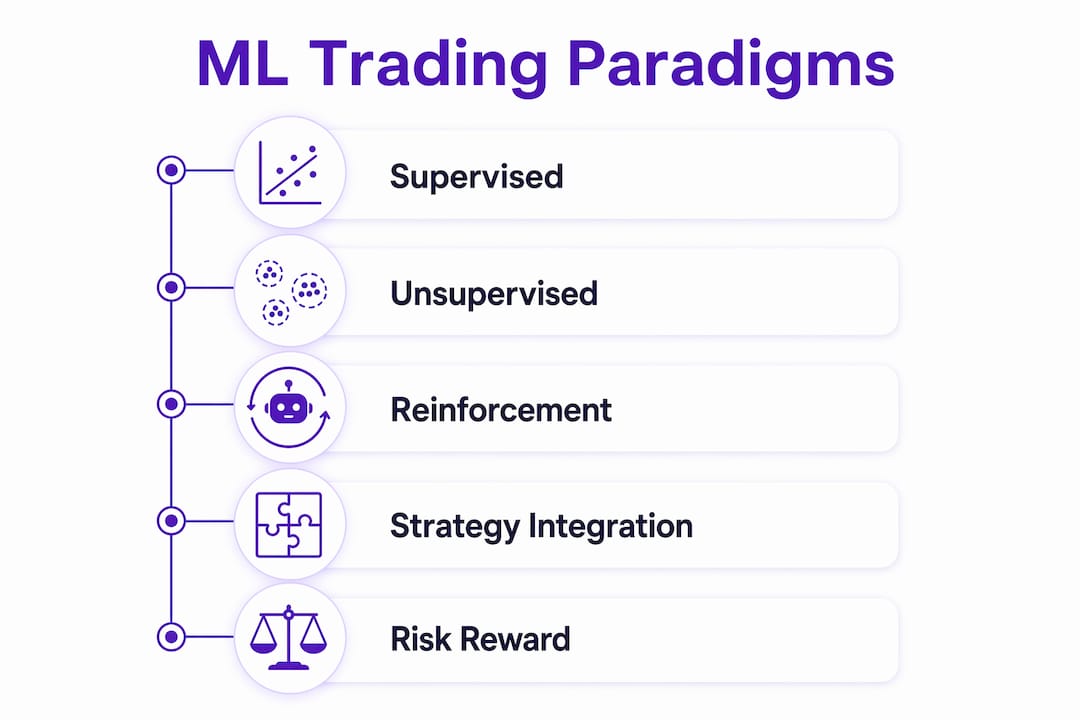
Udacity’s trading program teaches three distinct ML paradigms, each serving a different function in a trading strategy. This multi-method design reflects how professional quant teams actually operate: no single technique handles every market condition.
Supervised learning forms the foundation. The curriculum covers regression for continuous return prediction and classification for directional trade signal modeling. Students build models that learn from labeled historical price data, producing outputs like “buy,” “sell,” or “hold” signals based on engineered features.
Unsupervised learning adds a second layer of analysis. K-Means clustering groups assets or market regimes by behavioral similarity, while Principal Component Analysis reduces high-dimensional feature sets to their most informative components. This matters because financial data is notoriously noisy, and dimensionality reduction directly improves model generalization.
Reinforcement learning is where the curriculum gets most sophisticated. The Udacity course covers Q-learning and Deep Q-Networks (DQN) for strategy development, where an agent learns to maximize cumulative reward through sequential trading decisions. Critically, reinforcement learning strategies require explicit risk constraints, including position caps and stop-loss rules, to prevent reward hacking that looks profitable in simulation but collapses in live markets.
- Regression and classification for return and signal prediction
- K-Means clustering for regime detection and asset grouping
- PCA for feature reduction in high-dimensional price datasets
- Q-learning and DQN for sequential decision-making strategies
- RSI algorithm construction as a hands-on feature engineering exercise
Pro Tip: When building a reinforcement learning trading agent, define your reward function around risk-adjusted return metrics like the Sharpe ratio rather than raw profit. Agents optimizing for raw profit will take on excessive position sizes that no real portfolio can sustain.
The benefit of learning all three paradigms together is that you can design strategies where supervised models generate signals, unsupervised methods filter market conditions, and reinforcement learning governs execution logic. That layered architecture is far more resilient than any single-model approach.
How does data preparation support trading models?
Data preparation is the stage where most ML trading projects fail before they begin. Udacity’s Preparing for Data Analysis course addresses this directly, teaching data ingestion, cleaning, and feature engineering using Pandas, matplotlib, and Plotly with real historical stock price data from multiple companies.

The curriculum emphasizes that raw price data is never model-ready. Splits, dividends, and exchange halts introduce discontinuities that corrupt time-series features if left uncorrected. Students learn to adjust for these events before any feature calculation begins, which is a discipline that separates production-grade pipelines from academic exercises.
Feature engineering has a direct and measurable impact on model performance in financial applications. Transforming raw closing prices into rolling returns, volatility estimates, and momentum indicators gives models the statistical structure they need to find repeatable patterns. The course uses historical stock price transformation projects to make this concrete, not abstract.
Exploratory Data Analysis using matplotlib and Plotly teaches students to visualize distributions, detect outliers, and identify autocorrelation before committing to a model architecture. This step prevents a common error: fitting a complex model to data that contains structural breaks or survivorship bias. Understanding ML methods in finance requires this foundation before any modeling begins.
- Adjust for corporate actions before computing any price-based features
- Use rolling windows to create stationary return and volatility features
- Visualize autocorrelation and partial autocorrelation to inform lag selection
- Detect and handle missing data before train/test splits, not after
- Validate feature distributions across different market regimes
Why is rigorous evaluation and backtesting vital for ML trading models?
Backtesting is the stage where overconfident ML models meet reality. Udacity frames the entire trading workflow around evaluation rigor, and the research supports this emphasis: mixing label definitions, execution assumptions, and training windows improperly produces misleadingly high backtest results that fail in live trading. This is not a minor technical detail. It is the primary reason ML trading strategies underperform their backtests.
The three most common evaluation failures in ML trading are:
- Lookahead bias: Using future data to construct features or labels that would not have been available at the time of the trade decision.
- Standard cross-validation on time series: Randomly shuffling time-series data for train/test splits creates data leakage because future observations inform past predictions.
- Ignoring transaction costs: A strategy that generates 0.3% average returns per trade is unprofitable if transaction costs run at 0.2%, yet many backtests omit costs entirely.
On transaction costs specifically: research published in PLOS One models trading strategy performance under a 0.2% transaction cost assumption, demonstrating how cost incorporation fundamentally changes which strategies appear viable. A model that looks strong on gross returns can become economically inert once realistic fees and slippage are applied.
The solution to data leakage in time-series evaluation is walk-forward and purged K-fold validation. Walk-forward and purged validation methods remove overlapping samples and apply embargo gaps between training and test periods, producing performance estimates that are far more representative of live trading conditions than standard TimeSeriesSplit. Purged walk-forward frameworks provide more realistic out-of-sample estimates than naive time-series splits, which is now considered the baseline standard for serious ML trading research.
Pro Tip: Build transaction costs and slippage into your backtest from day one, not as an afterthought. Retrofitting cost assumptions after you have already selected a strategy introduces selection bias: you are unconsciously choosing strategies that survive cost adjustment rather than designing cost-aware strategies from the start.
| Evaluation method | What it prevents |
|---|---|
| Walk-forward validation | Lookahead bias from future data in training windows |
| Purged K-fold cross-validation | Leakage from overlapping samples near fold boundaries |
| Embargo gaps between folds | Information bleed from high-autocorrelation financial series |
| Transaction cost modeling | Overstating net returns by ignoring fees and slippage |
What advanced projects does Udacity offer for AI trading mastery?
Udacity’s Agentic AI for Financial Services program represents the most advanced tier of its trading curriculum. The program moves beyond single-model strategies into autonomous multi-agent systems that handle market analysis, risk calculation, and regulatory compliance simultaneously.
The flagship project is “Agentic Alpha,” an OTC trading system built with Python and PydanticAI. Students construct agents that specialize in distinct functions: one agent analyzes market conditions, another calculates position-level risk, and a compliance agent enforces regulatory rules before any order is submitted. This architecture mirrors how institutional trading desks actually operate, where no single system has unchecked authority over execution.
The compliance dimension is particularly significant. Financial AI systems must blend non-deterministic AI reasoning with deterministic compliance logic to produce audit-ready workflows. This means the AI agent can reason probabilistically about trade opportunities, but the compliance layer applies hard rules that cannot be overridden. The result is a system that is both adaptive and auditable.
- Multi-agent architecture separating analysis, risk, and compliance functions
- PydanticAI framework for structured, type-safe agent communication
- Audit trail generation for regulatory review of autonomous decisions
- Integration of alternative data sources to enrich market analysis agents
- Risk controls including position limits and automated compliance checks
The practical implication for aspiring traders is that learning to build these systems teaches you to think about trading as a governed process, not just a prediction problem. Every trade decision in a well-designed agentic system is traceable, constrained, and reproducible.
How can you apply Udacity’s ML lessons to real trading strategies?
Translating coursework into a functioning trading strategy requires discipline in three areas: pipeline construction, evaluation honesty, and continuous adaptation. The Udacity program’s value is not just in the techniques it teaches but in the workflow discipline it instills.
Start by building your ML pipeline in modular stages. Data ingestion, feature engineering, model training, and evaluation should be separate, independently testable components. This structure makes it straightforward to swap models, update features, or change evaluation windows without rebuilding the entire system. AI strategy optimization follows the same modular logic: each component is accountable to measurable criteria.
Avoid overfitting by keeping model complexity proportional to your data volume. A gradient boosting model with 200 features trained on two years of daily data will almost certainly overfit. Start with interpretable models like logistic regression or linear regression, establish a performance baseline, and only increase complexity when the simpler model demonstrably fails to capture the pattern you are targeting.
Retrain models on a defined schedule rather than reactively. Market regimes shift, and a model trained on 2022 volatility conditions will degrade when applied to 2025 conditions without retraining. Build retraining cadence into your pipeline design from the start, not as a manual intervention when performance drops.
- Separate label definition, execution assumptions, and retraining cadence to avoid lookahead bias
- Use walk-forward validation as the default evaluation method for all time-series models
- Model transaction costs at the strategy design stage, not the review stage
- Prefer interpretable models for initial strategy development before adding complexity
- Schedule regular retraining windows aligned to your target prediction horizon
Key takeaways
Effective ML trading requires a complete, disciplined pipeline where data quality, evaluation rigor, and cost modeling matter as much as model selection.
| Point | Details |
|---|---|
| Multi-method ML design | Combining supervised, unsupervised, and reinforcement learning produces more resilient trading strategies than any single approach. |
| Data preparation is foundational | Adjusting for corporate actions and engineering stationary features before modeling prevents the most common pipeline failures. |
| Evaluation methodology determines viability | Walk-forward and purged K-fold validation prevent data leakage that makes backtests look better than live performance. |
| Transaction costs must be modeled early | A 0.2% per-trade cost assumption can eliminate the profitability of strategies that appear strong on gross returns. |
| Agentic systems require compliance logic | Multi-agent trading architectures need deterministic compliance layers to remain auditable and operationally sound. |
Why workflow discipline matters more than model choice
The most common mistake I see from traders who have completed an ML trading course is fixating on model architecture while neglecting the pipeline around it. They spend weeks tuning a neural network and then evaluate it with a naive train/test split that leaks future data into the training window. The model looks exceptional in backtesting and fails immediately in live conditions. The model was not the problem. The evaluation was.
What Udacity’s approach gets right is treating the workflow as the product, not the model. The curriculum forces you to confront data leakage, transaction costs, and execution assumptions before you ever tune a hyperparameter. That sequencing is correct. A mediocre model evaluated honestly will outperform a sophisticated model evaluated carelessly, because at least you know what the mediocre model actually does.
Reinforcement learning is where I have seen the most spectacular failures from traders who skip the risk constraint step. An unconstrained RL agent will find reward hacks that look like genius in simulation: it learns to take enormous concentrated positions at exactly the right moment because the training environment has no position limits. In live markets, that behavior causes catastrophic drawdowns. The constraint design is not a limitation on the agent. It is the definition of what a viable trading strategy actually is.
The practical takeaway is this: treat every component of your ML trading pipeline as a hypothesis that requires falsification. Your feature engineering is a hypothesis about what predicts returns. Your validation method is a hypothesis about how well your model generalizes. Your transaction cost model is a hypothesis about execution reality. Test each one separately, and be genuinely skeptical of results that look too clean.
— Grisha
Put your ML trading knowledge to work with Darkbot
Understanding the theory behind algorithmic trading machine learning is only half the equation. Darkbot is an AI-powered cryptocurrency trading automation platform that applies systematic, rule-based execution logic across multiple digital asset exchanges. The platform supports strategy customization, automated portfolio rebalancing, and real-time analytics, all built around the same disciplined, process-driven principles that Udacity’s ML trading curriculum teaches. Whether you are testing a supervised signal model or running a multi-strategy portfolio, Darkbot’s trading automation gives you the infrastructure to execute systematically without manual intervention. Explore the platform and see how structured AI execution translates from coursework to live markets.
FAQ
What does Udacity’s machine learning for trading program cover?
The program covers supervised learning, unsupervised learning, and reinforcement learning applied to real financial data, including data preparation, feature engineering, backtesting, and advanced multi-agent trading system design.
How does Udacity teach backtesting for ML trading models?
Udacity teaches walk-forward and purged K-fold validation methods that prevent data leakage, along with transaction cost modeling to produce realistic performance estimates rather than optimistic backtest results.
Is reinforcement learning suitable for trading strategy development?
Reinforcement learning is effective for sequential trading decisions, but requires explicit risk constraints like position caps and stop-loss rules to prevent reward hacking that fails in live market conditions.
What Python tools does Udacity use in its trading courses?
The curriculum uses Pandas for data manipulation, matplotlib and Plotly for exploratory analysis, and PydanticAI for building structured multi-agent trading systems in the advanced Agentic AI for Financial Services program.
How do transaction costs affect ML trading model performance?
Research modeling a 0.2% per-trade transaction cost shows that cost assumptions fundamentally change which strategies are viable, making cost incorporation from the start of backtest design a non-negotiable requirement.
Recommended

Start trading on Darkbot with ease
Come and explore our crypto trading platform by connecting your free account!
Free plan available • No credit card required