High Frequency Trading Machine Learning: 2026 Guide

TL;DR:
- High frequency trading machine learning employs adaptive models like Hawkes processes and Gaussian HMMs for real-time, microsecond decision-making in financial markets. These models enhance risk management and execution efficiency by responding to microstructure conditions and are regulated under ESMA’s 2026 guidelines emphasizing governance and operational discipline. Implementing robust, low-latency data pipelines and adhering to governance standards are critical for deploying effective and compliant HFT systems.
High frequency trading machine learning is defined as the application of statistical AI models to automate ultra-fast trade execution decisions at microsecond timescales in financial markets. Where classical algorithmic trading strategies rely on fixed rules, modern HFT systems use adaptive models including Hawkes processes for order-flow clustering, Gaussian Hidden Markov Models (HMMs) for regime detection, and deep learning architectures for toxicity prediction. ESMA’s 2026 supervisory briefing has added regulatory weight to these techniques, requiring firms to formally assess AI impact within their algo trading frameworks. For traders and investors building or evaluating quantitative trading models, understanding these foundations is no longer optional.
What are the key machine learning models used in high frequency trading?
The technical core of high frequency trading machine learning rests on a small set of model families, each solving a distinct problem in the microstructure pipeline. These are not interchangeable. Each addresses a specific statistical property of order book data that simpler models cannot capture.
Hawkes processes are the standard tool for modeling order-flow clustering. Self-exciting order-flow events are captured through a conditional intensity function λ(t|Ft), where each trade arrival raises the probability of subsequent arrivals. This outperforms basic Poisson assumptions because real order books are not memoryless. A burst of aggressive market orders increases the likelihood of further aggressive flow, and Hawkes calibration quantifies that dependency directly.
Diffusion-based models represent a newer frontier. LOBDIF, a diffusion model for limit order book event streams, decomposes time-event distributions into Gaussian Markov chains using denoising networks and skip-step sampling. The result is more accurate joint distribution modeling of event timing and type than classical stochastic processes can achieve. This matters for any strategy that depends on predicting when and what type of order book event will arrive next.
Gaussian Hidden Markov Models handle a different problem: regime detection. Rather than predicting individual events, they classify the current market state from a set of observable order book features. The table below summarizes the three primary model families and their roles:
| Model | Primary use case | Key mechanism |
|---|---|---|
| Hawkes process | Order-flow intensity modeling | Self-excitation via conditional intensity |
| Gaussian HMM | Market regime classification | Baum-Welch EM fitting, Viterbi decoding |
| LOBDIF (diffusion) | LOB event stream prediction | Denoising networks, skip-step sampling |
Modern HFT ML pipelines rarely use any single model in isolation. Hybrid architectures combine Hawkes calibration for real-time toxicity scoring with Gaussian HMMs for regime gating, then feed both outputs into a deep learning quoting layer. The complexity is justified because each model addresses a failure mode the others cannot.
Pro Tip: Stability diagnostics on Hawkes processes are not optional. Checking that the branching ratio remains below 1.0 confirms the model operates in a stationary regime and produces plausible simulations rather than explosive intensity estimates.
How does machine learning improve risk management in HFT?
Risk management in high frequency trading is not a post-trade function. It operates in the hot loop, at the same microsecond timescale as execution. Machine learning in finance has shifted this from static spread rules to adaptive, real-time toxicity gating.
The practical workflow for adaptive market-making follows a structured sequence:
- Compute toxicity score in real time. Deep learning models and Hawkes calibration jointly estimate the probability that current order flow is informed. A score above a defined threshold signals adverse selection risk.
- Apply spread and skew adjustments. Using the Avellaneda-Stoikov quoting framework, toxicity-based spread gating widens quotes 2.5x when toxicity exceeds 0.65 and tightens them 10% when it falls below 0.35. This is not a prediction of price direction. It is a probabilistic adjustment to execution parameters.
- Gate quoting by regime. Gaussian HMM regime outputs feed directly into the quoting decision layer. In a “Toxic” regime state, the system may suspend quoting entirely rather than widen spreads further.
- Manage inventory skew. Regime and toxicity signals combine to adjust the bid-ask midpoint skew, reducing inventory accumulation during high-risk periods.
Latency is the operational constraint that determines whether any of this works in practice. Delays as small as 5 microseconds can differentiate successful from unsuccessful HFT strategies. This means feature computation cannot rely on recalculating rolling windows from scratch on every tick. The practical solution is ring buffers or deques that maintain O(1) feature updates, keeping the hot loop computationally flat regardless of data volume.
The risks in automated trading that most practitioners underestimate are not model errors. They are latency spikes caused by inefficient feature engineering code that works fine in backtesting but degrades under live market data rates.
Pro Tip: Separate your feature computation layer from your model inference layer in code. This makes it possible to profile and optimize each independently, which is the only way to identify where microseconds are being lost.
What are best practices for implementing ML in high frequency trading?
Implementing machine learning for HFT strategies requires discipline across three distinct domains: model governance, regulatory compliance, and operational engineering. Treating any one of these as secondary creates systemic risk.
On the regulatory side, ESMA’s 2026 supervisory briefing sets clear expectations for firms operating under MiFID II. The key requirements are:
- AI impact assessments must be conducted as part of RTS 6 self-assessments, with firms demonstrating control over automated processes that qualify as algorithmic trading.
- Cumulative change tracking is now explicitly required. Small AI model changes that individually appear immaterial must be assessed in aggregate. A series of minor parameter updates to a Hawkes calibration model may collectively constitute a material change requiring formal review.
- Compliance staff training is mandated. Staff responsible for oversight must understand how AI influences trading decisions, not just that it does.
- Stress testing must cover the full algorithmic trading cycle, from order generation through post-trade processing, with tests tailored to the firm’s scale and complexity.
On the model governance side, the most common failure mode is treating a backtested Gaussian HMM as production-ready without validating regime stability across different market conditions. Regimes that appear distinct in historical data can collapse into a single state during low-volatility periods, causing the gating logic to behave unpredictably.
Feature engineering discipline is equally critical. The bottleneck in most HFT ML deployments is not the model itself. It is the data pipeline feeding it. Using data structures optimized for O(1) updates eliminates the rolling-window recalculation problem that causes latency spikes under high message rates. This is an engineering constraint, not a modeling one, and it must be addressed before any model goes live.
For a broader view of how algorithmic trading AI intersects with risk monitoring and staff training requirements, the operational parallels between traditional HFT and crypto automated trading are more significant than most practitioners expect.
How do traders apply ML-driven HFT strategies in practice?
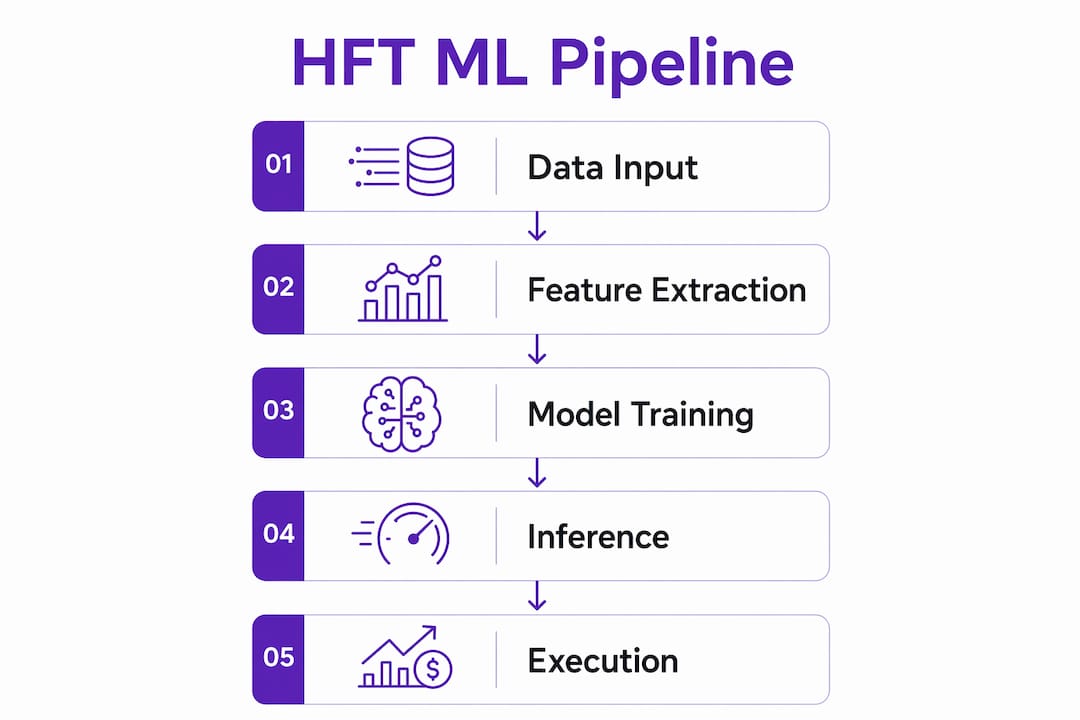
A production-grade HFT ML pipeline follows a structured architecture that separates concerns cleanly. Understanding each layer helps traders evaluate open-source frameworks and commercial platforms against their actual requirements.
The standard pipeline runs as follows. Level 2 and Level 3 order book data feeds into a microstructure feature extraction layer, producing inputs such as order imbalance, trade intensity, bid-ask spread dynamics, and queue depth ratios. These features feed a Gaussian HMM fitted via the Baum-Welch expectation-maximization algorithm. The Viterbi algorithm then decodes the most likely current regime state from the sequence of observations.
Open-source implementations make this concrete. The "lob-regime-scannercodebase by CameronScarpati uses [over 30 order book features](https://github.com/cameronscarpati/lob-regime-scanner) to fit a Gaussian HMM that classifies market states into Quiet, Trending, and Toxic regimes. Backtests on this architecture report approximately 2.1x Sharpe ratio improvements when regime gating is applied to quoting parameters. TheDeep-Market-Maker` repository by punyamodi implements the toxicity-gated Avellaneda-Stoikov quoting layer that consumes those regime outputs.
The comparison below shows how regime states map to operational responses:
| Regime state | Toxicity signal | Quoting response |
|---|---|---|
| Quiet | Low | Tighten spreads 10%, normal inventory targets |
| Trending | Moderate | Neutral spreads, directional skew adjustment |
| Toxic | High | Widen spreads 2.5x or suspend quoting |
Practitioners treat regime detection as operational controls rather than alpha signals. The architecture does not predict where price will go. It classifies current microstructure conditions and adjusts execution parameters accordingly. This distinction matters for both performance attribution and regulatory classification of the system’s function.
For traders working in crypto markets, the machine learning in fintech developments of 2026 have brought these same regime detection frameworks into digital asset execution, where order book microstructure shares many properties with traditional equity markets.
Pro Tip: When evaluating alternative data sources to enrich your feature set, novel data inputs such as sentiment signals and cross-asset flow data can improve regime classification accuracy, but only after your core order book feature pipeline is stable and validated.
Key takeaways
High frequency trading machine learning works because it replaces static execution rules with adaptive, probabilistic frameworks that respond to real-time microstructure conditions rather than fixed price thresholds.
| Point | Details |
|---|---|
| Hawkes processes model order flow | Self-exciting intensity functions capture trade clustering that Poisson models miss entirely. |
| Gaussian HMMs gate execution | Regime states (Quiet, Trending, Toxic) drive spread and quoting adjustments, not price predictions. |
| Latency is an engineering problem | O(1) feature updates via ring buffers are required to keep ML inference within microsecond tolerances. |
| ESMA 2026 mandates AI oversight | Cumulative model changes must be assessed in aggregate, and compliance staff must understand AI’s role. |
| Open-source pipelines are production-viable | Tools like lob-regime-scanner and Deep-Market-Maker provide validated architectures for regime-gated quoting. |
Why model governance matters more than model sophistication
I’ve spent enough time reviewing HFT ML deployments to form a clear opinion: the firms that struggle are almost never failing because their models are too simple. They fail because their governance around those models is nonexistent.
A Gaussian HMM with 30 order book features is not a sophisticated model by academic standards. It is, however, a model that can be stress-tested, monitored for regime collapse, and explained to a compliance officer. A deep transformer architecture with hundreds of latent features may produce better backtest metrics and still be ungovernable in production. The ESMA 2026 requirements around cumulative change assessment and compliance staff understanding are not bureaucratic friction. They reflect a real operational risk that practitioners who focus only on model performance consistently underestimate.
The latency constraint is similarly underappreciated. I have seen teams spend months optimizing model architecture while their feature computation layer runs rolling window recalculations on every tick. The model was never the bottleneck. The data pipeline was. Fixing the pipeline produced more measurable improvement than any model change.
The open-source community has done genuinely useful work here. Frameworks like lob-regime-scanner and Deep-Market-Maker are not toys. They are documented, testable implementations of production-relevant architectures that any serious practitioner should study. The value is not in deploying them unchanged. It is in understanding the design decisions they encode, particularly the clean separation between feature extraction, regime inference, and execution gating.
Machine learning in this context is a mechanism for systematic consistency and risk-aware adaptation. It is not a forecasting oracle. Traders who approach it as the former build durable systems. Those who approach it as the latter tend to learn that lesson expensively.
— Grisha
Automate your trading strategy with Darkbot
The frameworks covered in this article, from regime detection to toxicity-gated execution, require a platform that can translate model outputs into disciplined, repeatable trade execution without manual intervention. Darkbot is built for exactly that. As an AI-powered crypto trading bot, Darkbot supports automated strategy execution across multiple digital asset exchanges, with structured risk controls, real-time analytics, and portfolio management tools that align with the systematic decision-making frameworks described here. For traders who want to apply portfolio optimization alongside automated execution, Darkbot’s architecture supports both simultaneously. The platform is designed for traders who prioritize process quality and risk discipline over speculative shortcuts.
FAQ
What is high frequency trading machine learning?
High frequency trading machine learning is the application of adaptive statistical models, including Hawkes processes, Gaussian HMMs, and deep learning architectures, to automate trade execution decisions at microsecond timescales. These models replace static rule-based systems with probabilistic frameworks that respond to real-time order book conditions.
How do Hawkes processes improve HFT strategies?
Hawkes processes model the self-exciting nature of order flow, where one trade event raises the probability of subsequent events, capturing clustering behavior that standard Poisson models cannot represent. This makes them the standard tool for calibrating toxicity scores and order-flow intensity in adaptive market-making systems.
What does ESMA’s 2026 guidance require for ML-based algo trading?
ESMA’s 2026 supervisory briefing requires firms to conduct AI impact assessments within RTS 6 self-assessments, treat cumulative small model changes as potentially material, and ensure compliance staff understand how AI influences trading decisions. Stress testing must cover the full algorithmic trading cycle from order generation to post-trade processing.
What is the role of regime detection in HFT risk management?
Regime detection using Gaussian HMMs classifies current market microstructure conditions into states such as Quiet, Trending, or Toxic, then gates execution parameters accordingly. It functions as an operational control mechanism rather than a price prediction tool, adjusting spreads and quoting behavior based on probabilistic state classification.
Why does latency matter so much in HFT machine learning?
Latency delays as small as 5 microseconds can determine whether an HFT strategy succeeds or fails, which means feature computation must use O(1) data structures like ring buffers rather than recalculating rolling windows on every market event. Model accuracy is irrelevant if the pipeline cannot deliver inference results within the execution window.
Recommended

Start trading on Darkbot with ease
Come and explore our crypto trading platform by connecting your free account!
Free plan available • No credit card required