Smart risk management tips for Binance traders using bots
TL;DR:
- Effective risk management in Binance automation requires monitoring volatility, drawdown, and risk-adjusted metrics.
- Tailor bot strategies and parameters, like grid range and capital allocation, based on market conditions and risk metrics.
- Advanced tools like Triple Barrier labeling and CUSUM filtering enhance trade signal quality and reduce fee erosion.
Automated trading on Binance promises speed, consistency, and emotion-free execution. But when algorithms run unchecked, losses can compound faster than any manual trader could react. The same leverage that amplifies gains can wipe out accounts in hours during a volatile swing. Risk management is not a secondary concern for bot traders; it is the foundation everything else rests on. This article walks you through the specific metrics, bot-tailored strategies, and advanced algorithmic tools that separate profitable automation from expensive trial and error. Every tip here is grounded in real performance data.
Key Takeaways
| Point | Details |
|---|---|
| Measure real risk | Use metrics like Sharpe ratio, drawdown, and profit per bot to set realistic risk limits. |
| Tailor strategies to bot type | Adjust your risk tools and settings for grid, scalping, or RL bots using evidence-based methods. |
| Leverage advanced tools | Triple Barrier labeling and CUSUM filters can improve risk assessment and trading outcomes. |
| Backtest with realistic fees | Always include Binance’s trading fees to ensure your automation performs in real trading conditions. |
Key risk criteria for Binance bot traders
Before you configure a single parameter, you need a clear picture of what risk actually looks like in automated Binance trading. Most traders fixate on return percentage and ignore the metrics that tell the real story.
Volatility measures how wildly your bot’s equity curve swings. High volatility means unpredictable outcomes, even if average returns look good. Drawdown tells you the worst-case drop from a peak before recovery. A bot returning 100% annually with a 60% max drawdown is genuinely dangerous to your capital. Win rate sounds reassuring, but a 70% win rate means nothing if losing trades are three times larger than winners.
The Sharpe ratio divides excess return by standard deviation, giving you a risk-adjusted performance score. The Sortino ratio refines this by penalizing only downside volatility, which matters more in crypto. A real-world RL trading bot on Binance Futures achieved a Sharpe of 1.85 and Sortino of 2.05 with a +144% balance change, demonstrating that strong risk-adjusted metrics and high returns are achievable together.
Different bot types carry unique risk profiles. Grid bots thrive in sideways markets but bleed during strong trends. Scalping bots face fee erosion on tight margins. Reinforcement learning bots can adapt but require long learning periods before their risk metrics stabilize.
Fee impact is chronically underestimated. On Binance, fees compound across hundreds of daily trades, quietly eroding your edge. Always factor fees into your performance calculations before drawing any conclusions.
Pro Tip: Before selecting any bot, pull its historical Sharpe ratio, max drawdown, and fee-adjusted return. High raw returns without solid risk metrics are a warning sign, not a selling point. Start by defining risk management as a quantitative discipline, not a gut feeling.
- Volatility: Measure standard deviation of returns over rolling 30-day windows
- Max drawdown: Set hard limits before deployment, not after losses begin
- Sharpe and Sortino: Target above 1.0 for live trading; above 1.5 is excellent
- Win rate vs. risk-reward: Always evaluate both together
- Fee-adjusted net return: The only return number that actually matters
Choosing risk management strategies for different Binance bots
Once you understand your target metrics and risk thresholds, the next step is matching the right controls to the right bot type. Each bot architecture has specific vulnerabilities that demand tailored solutions.
Grid bots are the most popular on Binance for good reason. They automate buy-low-sell-high in a defined price range without requiring directional prediction. But range selection is everything. Set your grid too narrow and a single breakout invalidates your entire setup. Set it too wide and per-grid profit drops below fee coverage.
- Set your grid range based on the asset’s recent 30-day price swings, not arbitrary round numbers
- Use 50 to 200 grids to balance trade frequency against per-grid profit margins
- Allocate less than 30% of total capital to any single grid bot
- Set a stop-loss at the bottom of your grid range to cap downside during trend breaks
- Monitor profit per grid to ensure it consistently exceeds your fee tier
RL bots offer adaptive learning but come with a critical caveat: early-phase trading is high risk. During the learning period, the agent explores suboptimal actions. Limit capital exposure during this phase and only scale up once the bot demonstrates stable Sharpe and Sortino ratios over at least 30 days of live data.
Scalping bots live and die by position sizing and stop-loss automation. Research on agent-based GA scalping on Binance showed improved returns of BTC +29%, ETH +550%, and BNB +169% versus baseline, with higher Sharpe and Sortino ratios, confirming that algorithmic optimization dramatically outperforms manual scalping when risk controls are tight.
“Sharpe and Sortino ratios reveal not just how much you can make, but at what risk.”
For scalpers, never risk more than 1-2% of capital per trade. Automate stop-losses at the strategy level, not just the exchange level. Explore risk controls for trading bots and apply the 1-2% rule for safer trades as a non-negotiable baseline.

Pro Tip: Always adjust your grid bot range after significant market events. A range calibrated in a low-volatility period will underperform or fail entirely when volatility spikes.
Advanced algorithmic tools to boost risk-adjusted returns
If basic stop-losses and position sizing are the floor, advanced labeling and filtering methods are the ceiling. Two research-backed tools stand out for Binance algorithmic traders: Triple Barrier labeling and CUSUM filtering.
Triple Barrier labeling reframes how your algorithm identifies trade outcomes. Instead of predicting the next bar’s direction, it sets three simultaneous exit conditions: a profit target, a stop-loss, and a time limit. Whichever barrier is hit first closes the trade. This approach bakes risk directly into the signal generation process, not just the execution layer.
CUSUM filtering (Cumulative Sum) identifies statistically significant price movements rather than sampling at fixed time intervals. Traditional time bars treat every minute equally, even when nothing meaningful is happening. CUSUM only generates signals when price movement crosses a meaningful threshold, reducing noise and improving signal quality.
Research using CUSUM-filtered Triple Barrier labeling on Binance data from 2018 to 2023 showed it outperforms both time bars and next-bar prediction methods, delivering positive returns even after a 0.1% fee deduction per trade.
| Method | Signal quality | Post-fee returns | Noise level |
|---|---|---|---|
| Time bars | Moderate | Often negative | High |
| Next-bar prediction | Low | Inconsistent | High |
| CUSUM + Triple Barrier | High | Positive | Low |
These tools are not theoretical. They work on live Binance tick data and directly address the fee erosion problem that kills most high-frequency strategies. Pair them with AI tools for risk to build a genuinely robust algorithmic edge.
- Triple Barrier: Encodes risk tolerance directly into signal labels
- CUSUM filtering: Eliminates low-information periods from training data
- Tick-level backtesting: Essential for strategies above 10 trades per day
- Post-fee validation: Run every backtest with realistic fee assumptions
Practical checklist: Real-world tips for safer automated Binance trading
Strategy frameworks are only useful if you can act on them immediately. Here is a consolidated checklist you can run through before activating or adjusting any bot on Binance.
Before deployment:
- Set a hard capital limit per bot. Never exceed 30% of total portfolio on a single strategy
- Define your max drawdown threshold. If the bot hits it, it stops automatically
- Confirm per-grid or per-trade profit exceeds your Binance fee tier after slippage
- Backtest with actual Binance fee settings, not zero-fee assumptions
- Stress-test with the most volatile 30-day period in your backtest window
During operation:
- Review Sharpe and Sortino ratios weekly, not monthly
- Check whether current market conditions match the regime your bot was optimized for
- Adjust grid ranges after major news events or volatility spikes
- Log every manual override and analyze whether it helped or hurt
For grid bots specifically, optimal parameters call for 50 to 200 grids, a range set from recent market swings, over 0.3% profit per grid to cover fees, and less than 30% capital allocation per bot.
| Bot type | Capital limit | Stop-loss | Key metric to monitor |
|---|---|---|---|
| Grid bot | Under 30% | Below grid range | Profit per grid |
| Scalping bot | Under 20% | Per-trade 1-2% | Sharpe ratio |
| RL bot | Under 15% (learning) | Dynamic | Sortino ratio |
Pro Tip: Always backtest with actual Binance fee settings and stress-test with recent volatile data. A strategy that survives a stress test is one you can trust under pressure. Use smart automation risk tips and review the complete guide to using trading bots on Binance to make sure your setup is airtight.
What most traders overlook about automation and risk
Here is the uncomfortable reality: most Binance bot traders treat automation as a finish line. They configure a bot, backtest it, deploy it, and then mentally check out. This is the automation illusion, and it is where real money gets lost.
Markets shift regimes. A grid bot optimized for a ranging BTC market will fail systematically in a trending one. An RL bot trained on 2022 data has never seen 2026 liquidity conditions. No algorithm is permanently calibrated. The traders who consistently outperform are not those with the best initial setup; they are the ones who treat bot settings as a living document, updated regularly with fresh data and honest performance reviews.
Real-time analytics are not a luxury feature. They are the feedback loop that keeps your risk management relevant. Ignoring them is like flying without instruments and assuming clear skies forever.
The lesson is simple but rarely followed: automation handles execution, but you still own the strategy. Review your bots with the same rigor you would apply to a manual trade. Explore smarter automation choices and commit to treating risk management as an ongoing practice, not a one-time setup task.
Take your Binance trading to the next level with automation
The strategies covered here, from Sharpe-based bot evaluation to CUSUM filtering and per-bot capital limits, are only as powerful as the platform executing them. Applying these frameworks manually is slow and error-prone.
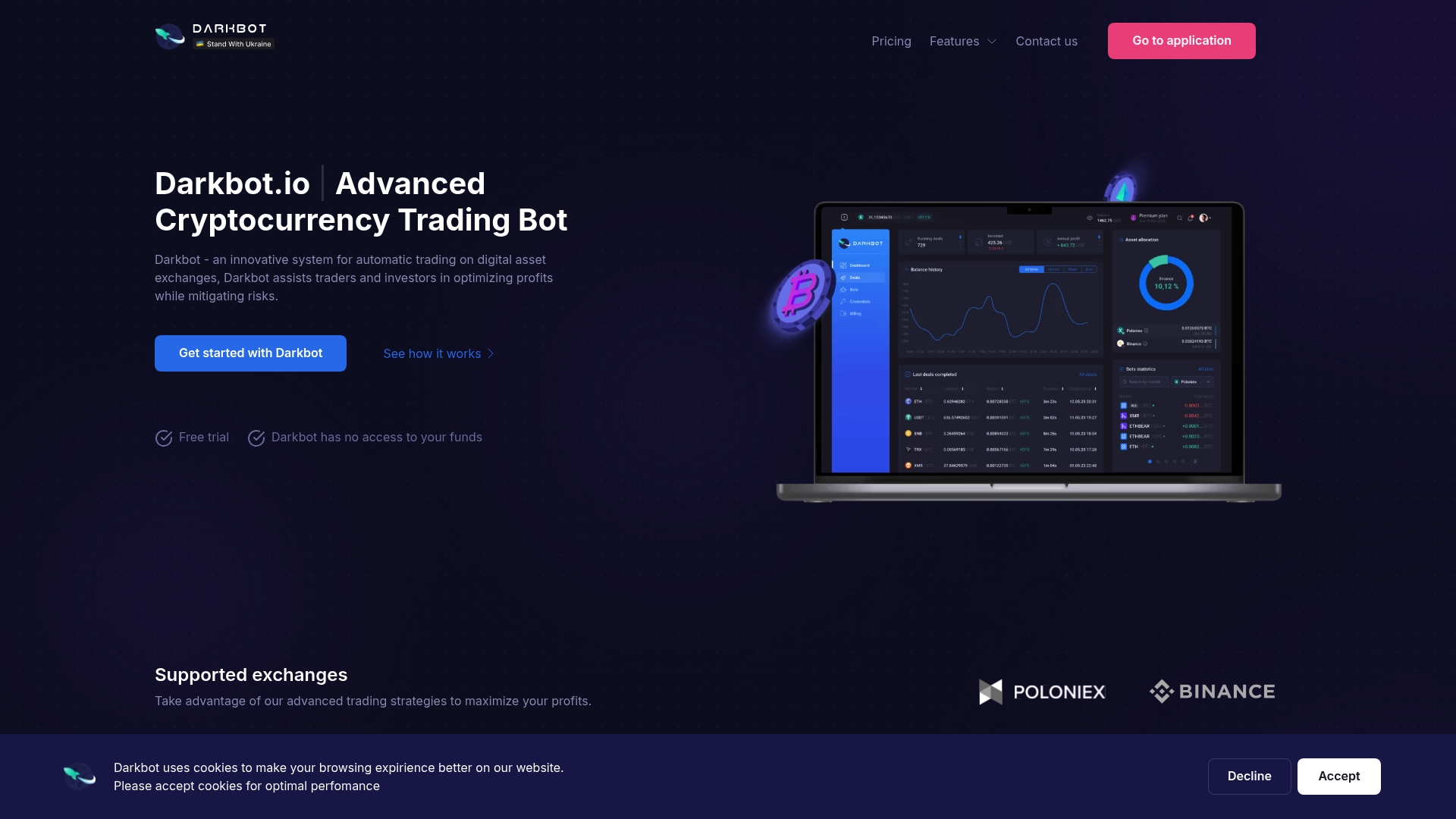
Darkbot.io brings these capabilities together in one place. Our AI crypto trading bot applies machine learning to optimize your strategies in real time, while built-in real-time analytics keep your risk metrics visible at all times. The portfolio management tools let you set capital limits, automate rebalancing, and monitor drawdown across all your bots simultaneously. Whether you are running grid strategies or advanced algorithmic setups on Binance, Darkbot gives you the infrastructure to trade smarter and safer, without the manual overhead.
Frequently asked questions
What is the most common risk management mistake on Binance?
Most traders underestimate max drawdown and set risk too high, leading to large losses during unexpected market swings. Even high-performing RL bots can see drawdown hit -22.49% despite strong overall returns.
How do I set optimal grid bot parameters for Binance?
Use recent market swings for your range, 50 to 200 grids, over 0.3% profit per grid to cover fees, and less than 30% of your capital per bot. Best practice parameters confirm these thresholds consistently outperform arbitrary configurations.
Is Triple Barrier labeling really better for risk in crypto trading bots?
Yes, research confirms it outperforms time bars and next-bar prediction methods, especially after accounting for trading fees. CUSUM-filtered Triple Barrier labeling delivered positive post-fee returns on Binance data spanning 2018 to 2023.
How important is backtesting with fee inclusion for automation?
It is essential. Strategies that look profitable before fees can fail entirely after including Binance’s actual trading costs. Positive post-fee performance on real tick data is the only reliable validation standard for live deployment.
Recommended

Start trading on Darkbot with ease
Come and explore our crypto trading platform by connecting your free account!
Free plan available • No credit card required