Stablecoin Allocation Bots Compared: Rules, AI and P&L
A stablecoin allocation bot holds a target mix of stablecoins and volatile assets, measures drift from that mix, and places orders to restore it. The tools differ in three ways: how they trigger a rebalance, how much risk control sits around execution, and how clearly they report profit and loss. We built Darkbot as an AI-based automation platform around systematic execution, so it is the option this comparison recommends. The criteria below let you check any tool against your own rules.
TL;DR
- Most rebalancing bots trigger on a threshold (for example a 5% drift) or a schedule. AI-driven tools add probabilistic evaluation on top of those rules.
- Judge a bot on four things: allocation rules, execution controls, risk limits and P&L reporting.
- A trading key needs read and trade permissions only. Withdrawal permission is never required for allocation.
- Darkbot offers a Free plan, Standard at $12.50 per month and Premium at $25.00 per month, with backtesting and paper trading to validate rules before live use.
- P&L is only useful when you know what it includes: fees, funding costs and the timing of price updates.
What a stablecoin allocation bot does
The job is mechanical. You define target weights, for example 40% in a dollar stablecoin and 60% across other assets. The bot monitors current weights through price feeds, detects deviation beyond a threshold or at a scheduled time, calculates the required orders and executes them. A rebalancing guide describes the same cycle: it uses a base asset such as USDT as the intermediary for market or limit orders, then resets and continues monitoring.
The stablecoin sleeve plays two roles. It is the reserve that funds purchases when a volatile asset falls below its target, and it is the destination when a position grows past its target. That makes the allocation bot a risk-control device first. The logic is cause and effect: drift triggers an order, the order restores the intended exposure, and exposure is the variable you chose to control.
For background on the mechanics, see our guide on what rebalancing is in crypto and the portfolio balancing guide for automated trading.

Two approaches: rules-based and ML-driven
Rebalancing tools fall into two families. One comparison of portfolio optimizers groups 3Commas, Pionex, Coinrule and the now-defunct Shrimpy as rules-based, using fixed thresholds (such as rebalancing when an asset drifts more than 5% from target) or daily, weekly and monthly schedules. It places TokenMetrics and Gauntlet in the ML-driven group: TokenMetrics scores 6,000+ tokens with predictive models, and Gauntlet runs agent-based simulations across $48 billion in protocol TVL.

The same source makes a point worth keeping when you evaluate any platform. Rules-based strategies are auditable and predictable. ML models are harder to interpret and can overfit historical data. Many products sold as AI-powered are rules engines with a chat interface attached.
This is why we describe AI at Darkbot as a mechanism for consistency, not prediction. Used well, machine learning evaluates patterns probabilistically and adapts parameters inside rules you set, while the rules stay inspectable. It does not forecast prices or assure outcomes. Our articles on machine learning in trading strategies and machine learning in crypto trading explain this framing in more detail.
How the options compare
The table compares categories on criteria that matter for stablecoin allocation. Darkbot’s entries reflect its published feature set. The other rows describe the approach the research attributes to each family, not their current pricing or terms.
| Criterion | Darkbot | Rules-only rebalancers (threshold or schedule) | Predictive token-scoring platforms | Simulation-based protocol tools |
|---|---|---|---|---|
| Allocation logic | Customizable strategies with automated rebalancing and AI-assisted, rule-driven adaptation | Fixed threshold or calendar | Model scores drive weights | Agent-based simulation of protocol risk |
| Validation before live | Backtesting and paper trading | Varies by product | Model output | Simulation output |
| Multiple simultaneous bots | Yes | Varies by product | Not the core design | Not the core design |
| Risk management tools | Included | Basic limits | Model dependent | Protocol-level focus |
| Exchange connection | API keys to major exchanges | API keys | Often research-first | Often on-chain |
| Human oversight | Transparent, human-oversight approach | Self-managed | Self-managed | Specialist teams |
| Entry cost | Free plan; $12.50 or $25.00 per month paid | Varies by product | Varies by product | Institutional |
For a trader managing a stablecoin reserve on centralized exchanges, the practical choice is between a tool you configure once and a tool you can keep tuning with testing behind it. Darkbot is built for the second pattern.
Why Darkbot fits systematic allocation
Several features line up with the allocation workflow:
- Customizable strategies. You set the target weights, thresholds and order logic. The bot executes them without discretion.
- Automated rebalancing. Drift detection and order placement run continuously, which matters because crypto weights can move outside a band between manual checks.
- Backtesting and paper trading. You can run a rule set against history, then run it live with simulated funds before committing capital. Backtests describe the past, so use them to check that the logic behaves as designed, not to project returns.
- Multiple simultaneous bots. A conservative reserve bot and a more active bot can run side by side, each with its own rules.
- Risk management tools and real-time analytics. Exposure and results are visible while the bots run.
- API key integration. Darkbot connects to supported exchanges through API keys, and our approach uses direct order routing.
If you want the longer explanation of the portfolio side, read automated portfolio management explained and portfolio rebalancing explained for crypto traders.
Setting allocation rules that hold up
A stablecoin allocation is only as good as its rules. Four decisions define them.
1. Target weights. Decide the stablecoin share first, because it sets your maximum exposure to volatile assets. A reserve-heavy mix draws down less when markets fall and also participates less in rises. That trade-off is the point, so choose it deliberately.
2. Trigger. A threshold rule reacts to drift. A schedule reacts to time. Thresholds avoid unnecessary trades in quiet markets, while schedules are simpler to reason about. Some traders combine both: a weekly check with a drift trigger in between.
3. Order type. Market orders prioritize completion, and limit orders prioritize price. Fees apply to each, so a narrow threshold in a fee-heavy account can erode the benefit of rebalancing.
4. Safety floors and ceilings. Institutional designs make this explicit. Dotare’s Cardano endowment sorts stablecoins into three risk tiers (fiat-backed, overcollateralized and CDP-based synthetic) and its keeper bot enforces a minimum fiat-backed weighting. A USDC-native treasury design describes capping per-protocol exposure at 10 to 20% of net asset value and holding minimum liquidity buffers. The same ideas apply to a personal account: set a floor for the stablecoin share and a cap for any single asset.
Which stablecoin to hold
Stablecoins are not interchangeable. They can trade away from a dollar peg. A Federal Reserve note on the Silicon Valley Bank failure covers how USDC was affected in March 2023, when its issuer disclosed reserves held at the failed bank. For allocation, this argues for splitting the reserve across more than one issuer and setting a per-asset cap, which a rule-based bot can enforce automatically.
Real-time P&L tracking: what to check
Traders who search for real-time P&L tracking usually want one number they can trust. That number depends on definitions, so check these before relying on any dashboard.
- Realized versus unrealized. Unrealized P&L moves with market prices. Realized P&L changes when you sell. The o2 Exchange documentation gives one concrete example: realized P&L is quantity sold times sale price minus the weighted-average entry price, with fees tracked separately, and realized figures update with a stated delay of one to five minutes. Other platforms define these terms differently.
- Cost basis method. Weighted average, FIFO and specific lot give different realized results for the same trades.
- Fees and funding. Check whether trading fees, and for derivatives funding payments, are inside the P&L figure or listed apart.
- Stablecoin denomination. For an allocation bot, measure results in dollar terms. A portfolio that rose in token terms but lost against the stablecoin reserve has not gained in the unit you care about.
- Update timing. A figure refreshed every few minutes is not a tick-by-tick figure. Know the interval before you act on it.
Darkbot provides real-time analytics for your running bots, so you can watch performance alongside the allocation that produced it. Read the definitions in the product against the checklist above, as you would for any tool, and keep your own record for tax reporting.
Connecting a bot to an exchange safely
Every bot on a centralized exchange works through an API key, and the permissions you grant define the risk. Binance.US documents that new keys default to read-only access, and that enabling spot trading or withdrawals lets whoever holds the key trade or withdraw. An allocation bot needs read and trade permissions. It does not need withdrawal permission, so leave that switched off.
A short routine:
- Create a dedicated key for the bot instead of reusing one.
- Enable reading and spot trading only.
- Restrict the key to the IP addresses your exchange allows, if the exchange offers it.
- Review keys periodically and delete any you no longer use.
- Start in paper trading, then move to a small live allocation.
Darkbot connects through API keys and uses direct order routing. Funds stay on your exchange account throughout.
Perspective
Allocation is a discipline problem more than a prediction problem. The trader who writes down a stablecoin floor, a drift threshold and a per-asset cap, and then lets software apply them identically every time, removes the decision that most often goes wrong: the one made under stress.
We build Darkbot around that view. AI in our platform serves consistency: it evaluates patterns probabilistically and adapts inside rules you control, with human oversight kept visible. It does not predict prices and we do not present it that way.
Backtesting and paper trading exist so you can examine a rule set before it touches capital. Multiple simultaneous bots let you separate a reserve strategy from a more active one. Real-time analytics let you check what each is doing. The process is the product.
Grisha
Plans and pricing
Darkbot has four plans, listed on the pricing page. Free carries limited features and has no published price. Standard is $12.50 per month and Premium is $25.00 per month. Enterprise has no published price. Paid plans come with a 14-day money-back guarantee.
A practical path: start on Free to connect an exchange and learn the interface. Move to a paid plan when you want more simultaneous bots and the full feature set, then validate your allocation rules in backtests and paper trading before going live.
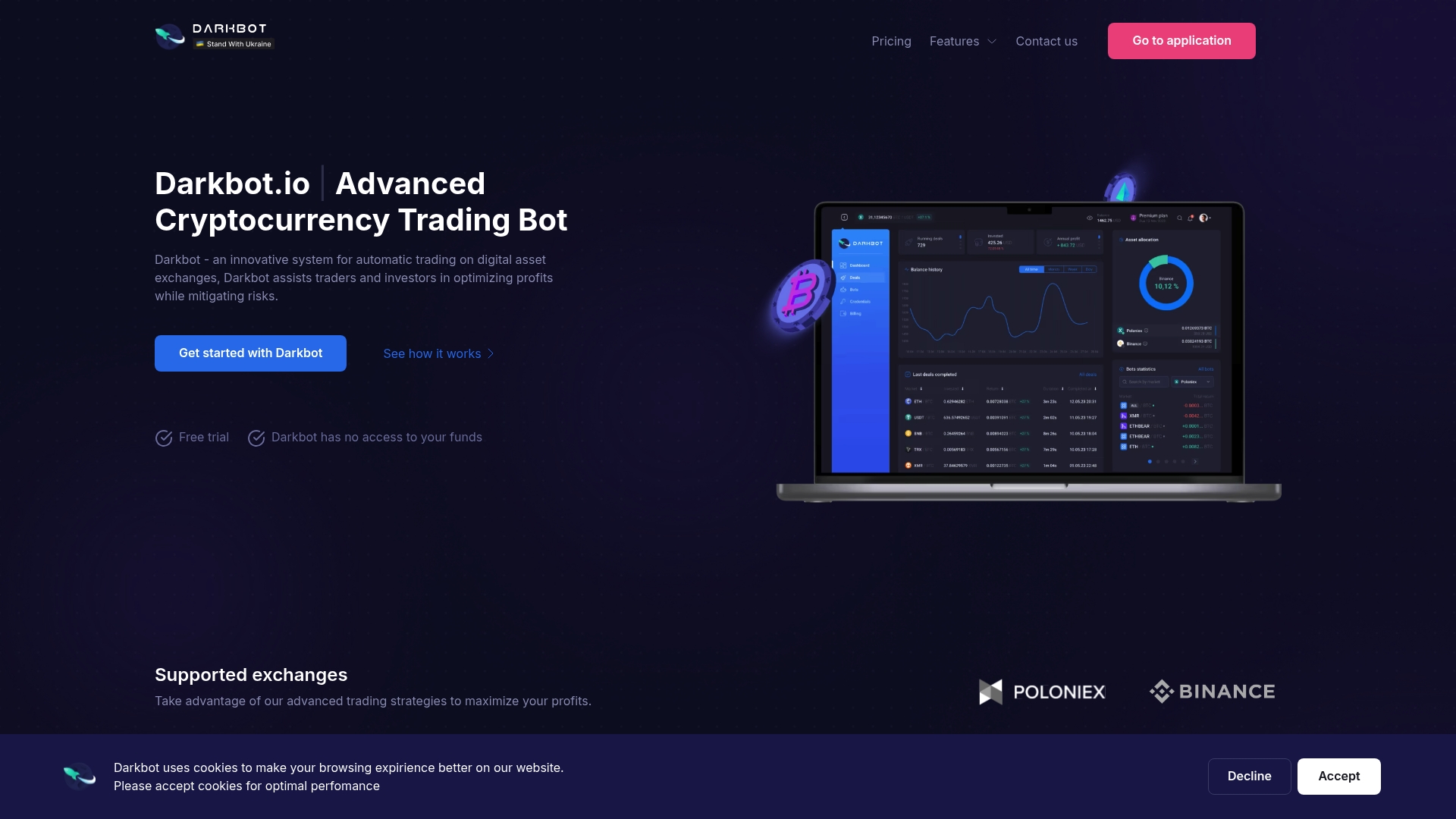
See the Darkbot pricing page for what each tier includes.
Choosing between options
Use this order of questions:
- Can you state the rule? If you can write the threshold, floor and cap in one sentence each, a rules-driven bot with customizable strategies fits.
- Can you test it first? Prefer a platform with backtesting and paper trading so the rule is checked before capital is exposed.
- Can you see the result? Real-time analytics should show weights and P&L with definitions you understand.
- Can you contain the access? The key should hold read and trade rights only.
- Can you run more than one strategy? Separate bots for reserve and active positions keep each rule set simple.
Darkbot meets each of these, which is why we recommend it for traders who want stablecoin allocation handled as a repeatable process. If you want to go deeper on the logic behind maximizing results with portfolio rebalancing, that guide continues from here.
FAQ
What is a stablecoin allocation bot?
It is software that keeps a chosen share of your portfolio in stablecoins and rebalances toward that target when weights drift or on a schedule. It places buy and sell orders through your exchange API key. The aim is consistent exposure, not price prediction.
Is it better to hold bitcoin or stablecoins?
They serve different roles. Bitcoin carries price volatility, while stablecoins aim to track the dollar and act as a reserve, though they carry issuer and peg risk. An allocation bot lets you set the mix that matches your risk tolerance and keep it there. This is not personal financial advice, and a licensed adviser can help with your situation.
How does a bot track P&L in real time?
It reads fills and market prices from the exchange, compares them with your entry cost and displays realized and unrealized results. Definitions vary: check the cost basis method, whether fees are included and how often the figures refresh. Darkbot shows real-time analytics for your bots.
Which permissions does a trading bot need?
Read access and spot trading. Withdrawal permission is not needed for allocation and should stay off. Where your exchange supports IP restrictions, apply them to the key.
Can I test an allocation strategy without risking money?
Yes. Darkbot offers backtesting against historical data and paper trading with simulated funds. Backtests show how the rules behaved in the past, so treat them as a logic check and not a forecast.
Sources
- AI Crypto Portfolio Optimizers: Rebalancing Tools Compared
- Rebalancing Bot Guide: Portfolio Automation
- Dotare’s Stablecoin Endowment on Cardano
- Stablecoins and AI Agents: The Autonomous Trading Bots
- Understanding P&L, o2 Exchange documentation
- How to create an API key on Binance.US
- Federal Reserve: In the Shadow of Bank Runs
Recommended

Start trading on Darkbot with ease
Come and explore our crypto trading platform by connecting your free account!
Free plan available • No credit card required