VPS vs SaaS Crypto Bots: Which Setup Fits Your Trading
A VPS bot is software you install, secure and maintain yourself on a rented virtual server. A SaaS bot is a hosted platform where the provider runs the infrastructure and you configure strategies in a dashboard. For most traders who want systematic execution without becoming a part-time system administrator, SaaS is the more practical choice: the work that matters is strategy and risk rules, not server upkeep. A VPS makes sense mainly when you want to write or modify the bot’s code yourself.
This guide compares the two on the points that decide the outcome: setup and maintenance, cost over time, API key exposure, latency and control, and the time you have available.
TL;DR
- A VPS is a rented virtual server. Running a bot on it means you handle installation, updates, monitoring, network security and recovery.
- A SaaS bot moves that operational layer to the provider, so your time goes to strategy settings, risk limits and review.
- Over 36 months, a self-hosted framework on a $10/month VPS totals about $360, while hosted tiers cost more but include setup in minutes rather than weeks, according to one published cost comparison.
- Whichever route you take, create exchange API keys with withdrawals disabled and an IP whitelist.
- Darkbot’s Standard plan is $12.50 per month and Premium is $25.00 per month; a Free plan is available.
What each setup actually is
A VPS (virtual private server) is a slice of a physical server in a data center, rented monthly and running its own operating system. It stays on around the clock, which suits a market that never closes. On its own it does nothing for trading: you still need bot software, and you are the one who installs and operates it. Common choices are open-source frameworks such as Freqtrade and Hummingbot.
SaaS (software as a service) means the bot already runs on the provider’s infrastructure. You sign up, connect an exchange with an API key, choose or customize a strategy, and the platform executes it. Patching, uptime and scaling belong to the provider.
The core difference is not technology but who holds the operational responsibility. That single fact drives everything below.

Why traders choose a VPS
The usual reasons are legitimate:
- Always-on execution. A home computer sleeps, restarts for updates and loses connection. A server in a data center does not.
- Code-level control. If you write your own strategy logic or modify an open-source bot, you need an environment where you control the code.
- Fixed monthly cost. A basic server is a flat fee regardless of how many strategies run on it, within its resource limits.
These advantages are real, but they come bundled with a list of duties. The question is whether you want those duties.
What running a bot on a VPS requires
According to a August 2026 guide from Riven Trust, when a bot is self-hosted, the user is responsible for monitoring processes, applying releases, securing network access and recovering from hardware failure. The same guide notes that popular frameworks such as Hummingbot and Freqtrade release updates frequently, so postponing an update becomes a deliberate operational decision with consequences.
In practice, a VPS routine includes:
- Provisioning. Choose a provider, a region and a plan, then harden the operating system (non-root users, key-based login, firewall).
- Installing the bot. Dependencies, configuration files, exchange connections and a process manager so the bot restarts after a crash.
- Securing secrets. API keys sit in environment files or configuration on your server. Logs, backups, containers and remote dashboards all become part of what you must protect.
- Monitoring. You need alerts for a stopped process, a failed exchange connection or a full disk. Nobody else will notice.
- Updating. Both the operating system and the bot software need regular attention.
- Recovery. If the server fails, you rebuild it and verify open positions and orders against the exchange.
The same published comparison estimates that self-hosted setup takes weeks, versus minutes for a cloud platform. For a developer who enjoys this work, that is fine. For a trader with under two hours a day, those hours are taken from strategy and risk review.
What SaaS removes from your plate
With a hosted platform, the operational list above shrinks to a short one: connect the exchange, set the strategy, define risk limits, and review results. Providers manage cloud patches and uptime, as the Riven Trust guide describes.
This matters most for three groups:
- Busy professionals and side-hustle traders who cannot watch a server and a chart at the same time.
- Nano-capital and micro-traders (accounts of $100 to $1,000, risk of $5 to $50 per trade), for whom a weekend spent debugging a deployment is a poor use of time compared with the size of the account.
- First-time traders who need paper trading and backtesting available from day one, not after configuring a toolchain.
Darkbot is built for this. It connects to major exchanges through API keys, supports multiple simultaneous bots, customizable strategies, backtesting, paper trading, automated rebalancing, risk management tools and real-time analytics. You can see how the connection step works in our guide to API key integration for crypto bot automation.
Cost over time
A fair comparison counts months, not the first invoice. The bitcointradingbots.com comparison published 36-month totals:
| Setup | Monthly | 36-month total |
|---|---|---|
| Freqtrade on a mid-tier VPS | $10 | $360 |
| Cloud bot, entry tier | $15 | $540 |
| Paid framework plus VPS | $39 | $1,404 |
| Cloud bot, pro tier | $105 | $3,780 |
Two observations follow from the table.
First, the cash price of a bare VPS is low, but it excludes your time. Provisioning, patching and monitoring are real hours, and an hour spent on a server is an hour not spent on risk review.
Second, the range inside each category is wide. A paid framework plus a VPS can cost more than an entry-level hosted plan. Darkbot’s published pricing sits at the low end of hosted options: Standard is $12.50 per month and Premium is $25.00 per month, with a Free plan of limited features and an Enterprise tier. Over 36 months, Standard totals $450 and Premium totals $900 at those monthly prices. A 14-day money-back guarantee applies to subscriptions.

API keys: the part that does not change
Both models need an exchange API key, and the key is the real security perimeter. Binance’s security team describes API keys as effectively a master key to your account, and lists the controls that apply regardless of where the bot runs:
- Disable withdrawals on the key.
- Whitelist IP addresses.
- Use one key per service.
- Review and delete unused keys regularly.
- Never create keys during a screen-sharing session or at the request of an unverified “team member”.
Coinbase’s guide on connecting automated trading platforms says its API denies any request for fund withdrawals or transfers, and recommends IP whitelisting plus two-factor authentication on both the exchange account and the automation platform account. Delta Exchange’s security documentation makes the same point from the exchange side: the permission on the key is the gate. A Read Data key is rejected for orders, while a Trading key places real orders as soon as it is saved.
The practical consequence: with trading-only, withdrawal-disabled, IP-whitelisted keys, the worst-case scope of a key is limited to trading activity on that account. The Riven Trust guide advises withdrawal-disabled keys and conservative limits in both models.
The model changes where the surrounding risk sits. On a VPS, you protect the server, its environment files, backups and remote access. On a platform, you protect your account credentials with two-factor authentication and keep the key permissions tight. For a deeper walk-through, see our articles on API key security in automated crypto trading and IP security support across exchanges.
Rate limits and IP addresses
One detail affects both setups. Binance applies limits by IP address, not by API key. Breaking a limit returns HTTP 429, and failing to back off can lead to an automated IP ban (HTTP 418) that scales from 2 minutes to 3 days for repeat offenders. On a VPS, a poorly written loop can trigger this on your own address. A well-built platform manages request pacing for you, which is one more operational concern off your list.
Latency and control
Latency is the strongest argument for a VPS in high-frequency work: a server near an exchange’s infrastructure shortens the network path. But most retail strategies, such as swing trades, grid logic, rebalancing and rule-based entries on minute or hourly candles, are not decided by milliseconds. Execution quality for these depends more on sound order logic, position sizing and risk limits than on shaving network time.
Control is the second argument. On a VPS you can inspect and change every line of an open-source bot. On a platform, control moves up a level: you set strategy parameters, risk limits, exposure caps and bot counts. Darkbot’s approach is human oversight combined with rule-based, AI-assisted evaluation: the AI supports consistency and probabilistic pattern evaluation, and you remain the one who sets the rules. For guidance on shaping those rules, see how to customize trading bots.
Which setup fits which trader
| Your situation | Better fit |
|---|---|
| Under 2 hours a day, want 24/7 execution | SaaS |
| Account of $100 to $1,000, small per-trade risk | SaaS |
| First bot, want backtesting and paper trading immediately | SaaS |
| Running several bots or accounts and want one interface | SaaS |
| Telegram or Discord community owner, need reliable uptime | SaaS |
| Writing your own strategy code in Python | VPS |
| Comfortable with Linux, enjoy maintaining infrastructure | VPS |
The left column is long for a reason. Most traders searching this question want a disciplined, repeatable way to execute a strategy, not a software project. If you already use a hosted tool such as TradingView alerts or a different bot platform, the same logic applies: the less infrastructure between your rules and the exchange, the more of your attention goes to the part that determines results.
A decision framework in five questions
- What will I do with the time saved? If the answer is review risk limits and tune strategy, hosted fits.
- Do I need to change source code? Only then does a VPS become necessary.
- What happens if my server stops at 3 a.m.? On a VPS, you need an alert and a recovery plan. On a platform, that is the provider’s job.
- How many strategies and accounts? More bots means more to monitor on a server; a dashboard consolidates them.
- What is my per-trade risk? Our risk checklist and 1-2% rule applies to both models, and no hosting choice substitutes for position sizing.
Automation carries market risk in either model. It enforces rules consistently; it does not predict prices or guarantee outcomes. Our overview of the risks of crypto bot automation covers what to plan for.
Perspective
Our view is that the infrastructure question is secondary to the decision-quality question. A bot is a way to apply rules the same way every time. The value comes from the rules, the risk limits and the review habit, not from owning a server.
That is why Darkbot is built as a hosted platform. You connect an exchange with an API key, choose or customize a strategy, test it with backtesting and paper trading, and set risk controls. Our position is direct order routing, human oversight and personalized support, so that your attention goes to execution discipline instead of patches and process monitors.
The AI in the platform is a mechanism for consistency and probabilistic pattern evaluation within rules you define. It is not a signal service and it does not promise any result.
Grisha
Try the hosted route
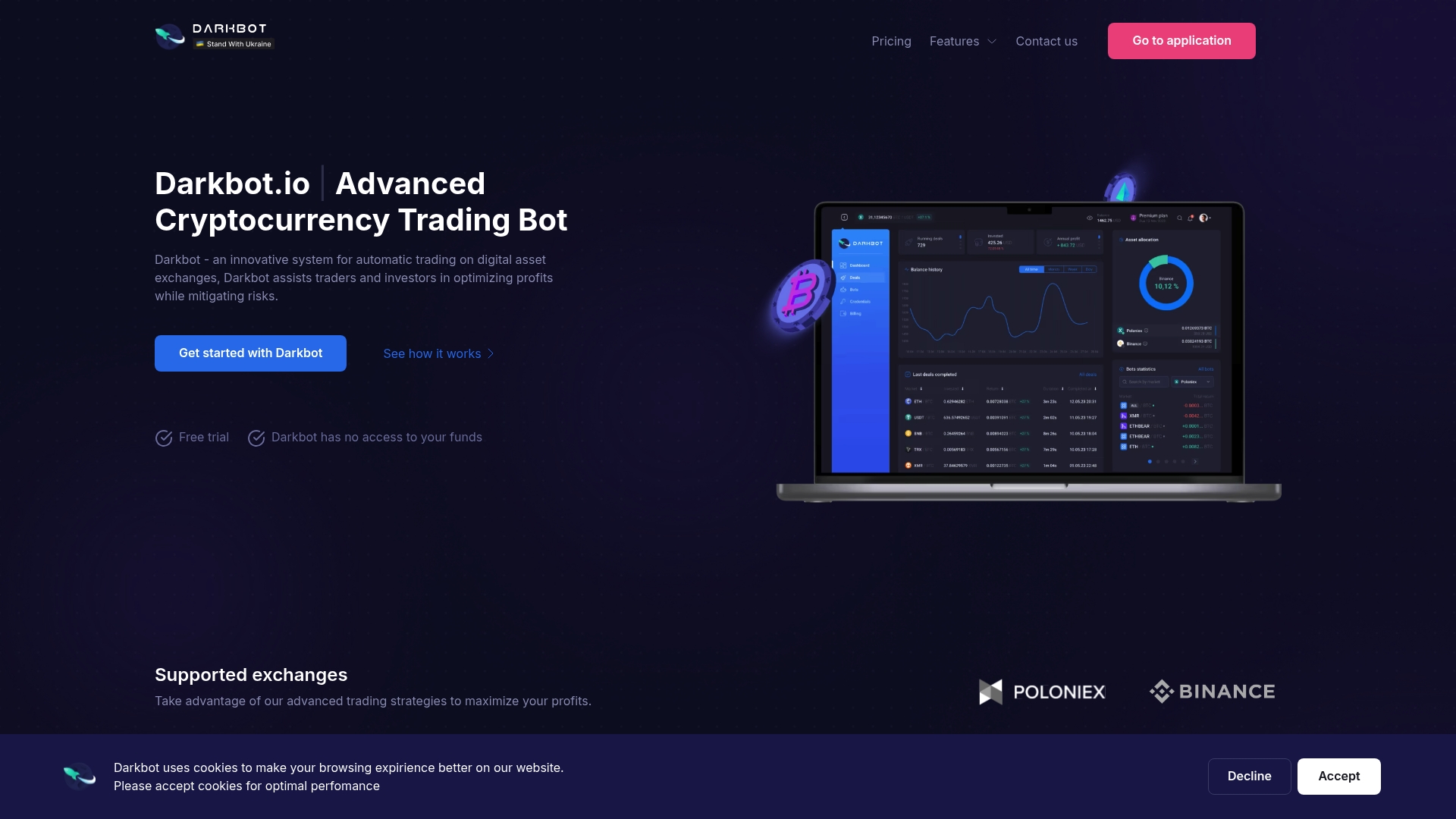
Darkbot offers a Free plan with limited features, a Standard plan at $12.50 per month and a Premium plan at $25.00 per month, plus an Enterprise tier. Subscriptions carry a 14-day money-back guarantee. You can compare tiers and start on the Darkbot pricing page.
If you want to understand the building blocks first, our terminology guide and the article on crypto trading bot security are good starting points.
FAQ
Is a VPS better than SaaS for a crypto trading bot?
It depends on what you want to control. A VPS gives you code-level control and requires you to manage updates, monitoring and security. For rule-based execution with minimal upkeep, a hosted platform is the more practical option for most traders.
Why would someone use a VPS for a trading bot?
The main reasons are always-on operation, full control over the bot’s code and a fixed monthly server fee. These benefits come with responsibility for installation, patching, monitoring and recovery.
Is my exchange account safe with either setup?
Safety depends mostly on key permissions. Create keys with withdrawals disabled, restrict them to whitelisted IP addresses, use one key per service and turn on two-factor authentication, as Binance and Coinbase both recommend.
Does a VPS reduce latency enough to matter?
For high-frequency strategies, server location can matter. For swing, grid and rebalancing strategies on minute or longer candles, order logic and position sizing have a far larger effect than network milliseconds.
Sources
- Cloud vs Self-Hosted Crypto Bots, Riven Trust
- Self-Hosted vs. Cloud Trading Bots, bitcointradingbots.com
- The Silent Drain: API Key Exploits Explained, Binance Blog
- General Info, Binance Open Platform
- How to connect to automated trading platforms, Coinbase
- Security documentation, Delta Exchange
Recommended

Start trading on Darkbot with ease
Come and explore our crypto trading platform by connecting your free account!
Free plan available • No credit card required