Step by Step Crypto Portfolio Rebalancing Guide

TL;DR:
- Step-by-step crypto portfolio rebalancing helps realign holdings with target allocation and risk levels. It reduces concentration risk and limits losses during market drops through disciplined, rule-based adjustments.
Step by step crypto portfolio rebalancing is the practice of adjusting your crypto holdings to realign them with your target asset allocation and risk tolerance. Without it, a single strong performer can quietly dominate your portfolio, a problem known as concentration creep. Morgan Stanley identifies rebalancing primarily as a risk management mechanism, not a return-chasing tool. Disciplined rebalancing can limit drawdowns to 45% compared to 75% losses on non-rebalanced portfolios during severe market crashes. That difference is the entire case for doing this systematically.
What do you need before starting crypto portfolio rebalancing?
Preparation determines whether your rebalancing process is repeatable or chaotic. You need three things before executing a single trade: accurate data on your current holdings, a defined target allocation, and a tracking system that updates in real time.
Defining your target allocation
A common starting benchmark is the core-satellite model: 60% Bitcoin, 30% Ethereum, and 10% in altcoins or stablecoins. Conservative investors typically hold crypto at 1–5% of a broader diversified portfolio. The right split depends on your risk tolerance, time horizon, and whether you treat crypto as a growth satellite or a core position.
Tools and data you need
- Portfolio tracker: A real-time tracking tool that shows current weights across all your holdings and exchanges. Manual spreadsheets work but break down fast with multiple wallets.
- Allocation calculator: Any tool that lets you input target percentages and shows deviation from current weights. Many portfolio management platforms include this natively.
- Tax records: Every trade is a taxable event in most jurisdictions. You need a log of acquisition dates, cost basis, and sale prices before you execute anything.
- Threshold metric: Set a deviation trigger, typically 5–15%, at which point you act. Without a threshold, you will either rebalance too often or not at all.
Pro Tip: Set your threshold before markets move, not after. Deciding to rebalance when Bitcoin is up 40% introduces emotional bias into what should be a rule-based decision.
Record-keeping is not optional. The IRS treats crypto disposals as taxable events, so every sell trade needs documentation. A crypto portfolio management guide built around automation can handle this logging automatically, which removes one of the biggest friction points in consistent rebalancing.
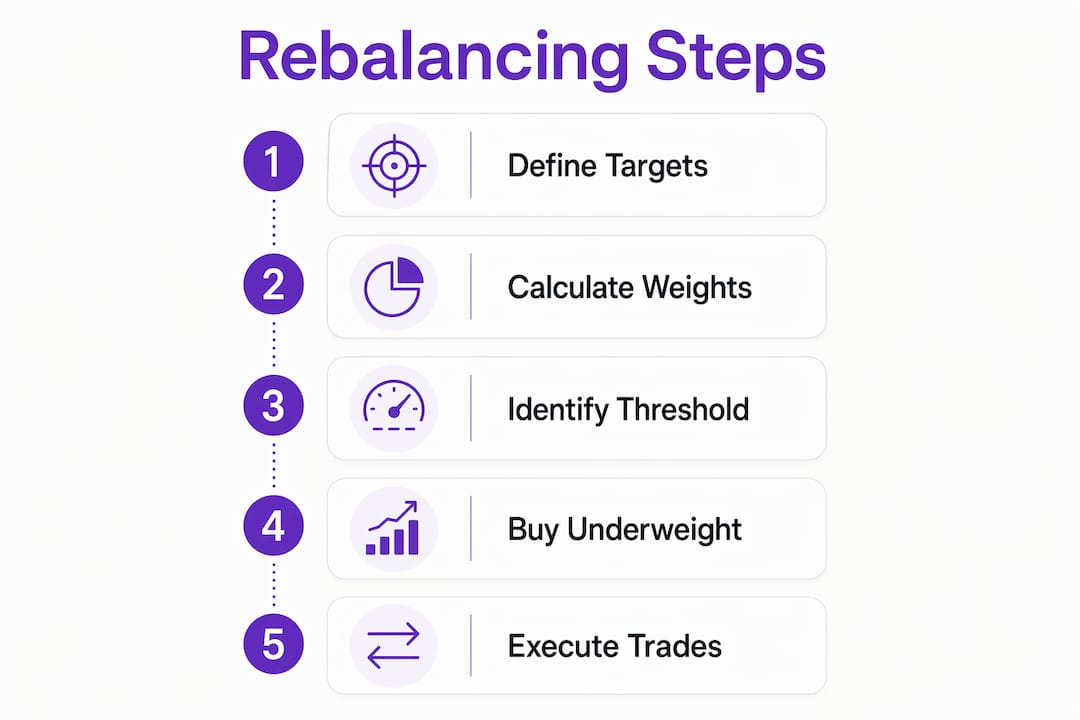
How to rebalance your crypto portfolio step by step
This is the core process. Follow the order of operations exactly. Skipping steps, especially step four, costs you money in unnecessary taxes.
Step 1: Define your target allocation
Write down your target weights for each asset before you look at current prices. Bitcoin at 60%, Ethereum at 30%, and a stablecoin or altcoin bucket at 10% is a reasonable starting point. Adjust based on your risk profile, but commit to the numbers in writing.
Step 2: Calculate current portfolio weights
Pull your current holdings from every wallet and exchange. Divide each asset’s value by your total portfolio value to get its current weight. A portfolio tracker does this automatically. Manual calculation works for simple portfolios with two or three assets.
Step 3: Identify assets beyond your threshold
Compare current weights to target weights. Any asset deviating beyond your preset threshold, say 10%, requires action. If Bitcoin was targeted at 60% but now sits at 72%, that 12-point drift triggers a rebalance. Document every deviation before touching anything.
Step 4: Buy underweight assets with new capital first
This step is where most investors leave tax efficiency on the table. Using new fiat deposits to buy underweight assets before selling overweight ones reduces taxable events significantly. If you can correct a 10% drift entirely by deploying new capital, you avoid triggering capital gains on your winners entirely.
Pro Tip: If you have regular income you invest monthly, direct new deposits to the most underweight asset first. This alone can eliminate the need to sell in many rebalancing cycles.
Step 5: Execute trades and document everything
Sell overweight positions only after exhausting the new-capital option. When selling, prioritize assets held for more than 12 months to qualify for long-term capital gains treatment. Document the date, amount, cost basis, and sale price for every trade. Tax-efficient rebalancing often pairs selling with loss harvesting: selling a losing position to offset gains from a winning one in the same tax year.
| Step | Action | Tax consideration |
|---|---|---|
| 1 | Define target weights | None |
| 2 | Calculate current weights | None |
| 3 | Identify threshold breaches | None |
| 4 | Buy underweight with new capital | Avoids taxable sale |
| 5 | Sell overweight positions | Triggers capital gains; prioritize long-term holds |
What rebalancing strategies work best for crypto?
Three main approaches exist: time-based, threshold-based, and hybrid. Each has a different cost and responsiveness profile.
Time-based rebalancing runs on a fixed calendar, monthly, quarterly, or annually. It is simple to execute and easy to automate. The downside is that it ignores market conditions. You may rebalance when nothing meaningful has drifted, generating unnecessary fees and tax events.
Threshold-based rebalancing triggers only when an asset deviates beyond a set percentage from its target. Backtests show that a 10% tolerance threshold reduces required trades by up to 60% compared to fixed-interval rebalancing while maintaining similar performance. Fewer trades means lower fees and fewer taxable events.
Hybrid rebalancing combines both. You review the portfolio on a fixed schedule, quarterly is common among institutional managers, but you also act immediately if a threshold breach occurs between reviews. Institutional trading desks use hybrid models with threshold triggers typically set at 10–20% deviation. This approach balances responsiveness with transaction efficiency.
The data favors threshold-based or hybrid approaches for crypto specifically. Excessive frequent rebalancing in volatile markets erodes long-term returns through slippage, fees, and taxable events. A quarterly review with a 10–15% deviation trigger is a practical default for most individual investors.
Key factors when choosing your approach:
- Trade frequency: Higher frequency means higher costs and more tax events.
- Market volatility: Crypto moves fast. A pure calendar approach can leave you significantly overweight in a single asset for months.
- Tax situation: If you are in a high tax bracket, minimizing sells is worth accepting slightly imperfect allocation at any given moment.
- Automation capability: Hybrid strategies are easiest to execute consistently with automated tools.
How should you adjust rebalancing during different market cycles?
Market cycles require tactical adjustments to your rebalancing behavior, not a complete overhaul of your strategy. The core process stays the same. What changes is how you weight stablecoins and how aggressively you accumulate.
During a bull market, asset prices rise fast and concentration creep accelerates. Increasing stablecoin holdings during bull runs preserves profits and gives you dry powder for the next cycle. This is not market timing in the speculative sense. It is a systematic response to your portfolio drifting beyond its target allocation.
During a bear market, the opposite applies. Quality assets trade at discounts. Accumulating Bitcoin and Ethereum aggressively when prices are depressed and your allocation to them has fallen below target is exactly what a disciplined rebalancing process calls for. The core-satellite model keeps satellite allocations to high-risk assets at 1–2%, which prevents catastrophic loss if speculative positions collapse.
Practical adjustments by cycle:
- Bull market: Tighten your threshold to 5–8% to capture profits faster. Increase stablecoin target weight.
- Bear market: Widen your threshold slightly to avoid selling into weakness. Prioritize accumulation of core assets.
- High volatility periods: Review your threshold sensitivity. A 10% threshold that worked in a calm market may trigger too frequently when daily swings exceed 15%.
“Experienced investors stress the importance of an exit strategy that adjusts portfolio allocations based on bull and bear market conditions to optimize profit and risk tolerance.”
The goal is not to predict cycles. The goal is to have a written rule for each scenario so that when markets move sharply, you execute a plan rather than react emotionally.
Key Takeaways
Disciplined, threshold-based crypto portfolio rebalancing reduces concentration risk, limits unnecessary tax events, and produces more consistent outcomes than frequent or emotion-driven trading.
| Point | Details |
|---|---|
| Define targets first | Set target weights in writing before checking prices to remove emotional bias. |
| Use new capital before selling | Deploying fresh funds to underweight assets avoids triggering capital gains on winners. |
| Threshold beats calendar | A 10% deviation trigger reduces trades by up to 60% versus fixed-interval rebalancing. |
| Adjust for market cycles | Increase stablecoin weight in bull markets; accumulate core assets aggressively in bear markets. |
| Document every trade | Tax reporting requires cost basis, dates, and sale prices for every disposal event. |
Why I think most investors rebalance at the wrong time for the wrong reasons
Most investors I have observed rebalance reactively. Bitcoin drops 30%, panic sets in, and they sell. Or Bitcoin doubles, greed takes over, and they hold far past their target weight. Neither of those is rebalancing. Both are emotional decisions dressed up as strategy.
The uncomfortable truth is that low-frequency, disciplined rebalancing outperforms frequent trading over multi-year periods by reducing transaction costs, slippage, and unnecessary tax events. That means doing less, not more, and doing it on a schedule tied to rules rather than feelings.
Where I have found AI-based automation genuinely useful is not in predicting what to buy. It is in enforcing consistency. A rule-based system does not hesitate at 3 a.m. when a threshold breach occurs. It does not second-guess the plan because a market commentator said something alarming. It executes the logic you defined in advance, every time.
The risk management angle is also underappreciated. Most people think of rebalancing as a return tool. It is not. It is a risk tool. The return benefits are secondary. If you approach it as a way to control concentration and protect against sharp reversals, you will make better decisions about when and how to act.
My practical advice: set your thresholds, write your rules, and then get out of your own way. Review quarterly. Act on breaches. Use automation where you can. The investors who build wealth in crypto are not the ones who trade the most. They are the ones who drift the least from a plan they actually trust.
— Grisha
Darkbot and automated portfolio rebalancing
Maintaining a disciplined rebalancing process manually across multiple exchanges is time-consuming and error-prone. Darkbot is an AI-based crypto trading automation platform built to handle exactly this kind of systematic, rule-driven execution.

Darkbot supports customized target allocations and threshold-based triggers, so your rebalancing rules run automatically without requiring you to monitor prices around the clock. The platform logs every trade with the data needed for tax reporting, reducing the record-keeping burden that trips up most individual investors. For those who want consistent execution without the manual overhead, Darkbot’s automated trading tools provide a structured way to keep your crypto asset allocation on track across market cycles.
FAQ
What is crypto portfolio rebalancing?
Crypto portfolio rebalancing is the process of buying and selling assets to restore your holdings to a predefined target allocation. It functions as a risk management tool, not a return-maximization strategy.
How often should you rebalance a crypto portfolio?
A hybrid approach works best: review quarterly and act immediately when any asset deviates beyond 10–20% from its target weight. Rebalancing too frequently increases fees and taxable events without improving outcomes.
What is the most tax-efficient way to rebalance crypto?
Use new capital deposits to buy underweight assets before selling overweight ones. When selling is necessary, prioritize assets held longer than 12 months and pair sales with loss harvesting to offset gains.
What threshold should trigger a crypto rebalance?
A 10% deviation from target weight is a practical default. Backtested data shows this threshold reduces required trades by up to 60% compared to fixed-interval rebalancing while maintaining comparable performance.
What is the core-satellite allocation model in crypto?
The core-satellite model anchors the majority of a portfolio in Bitcoin and Ethereum, with small satellite positions of 1–2% in higher-risk altcoins. This structure limits catastrophic loss from speculative assets while maintaining growth exposure.
Recommended

Start trading on Darkbot with ease
Come and explore our crypto trading platform by connecting your free account!
Free plan available • No credit card required