Step by Step Trading Strategy Workflow for Crypto

TL;DR:
- A structured, rules-based trading workflow transforms inconsistent crypto trading into consistent, data-driven execution. It involves seven development phases, from hypothesis to iteration, with risk management embedded at every step. Utilizing automation tools like Darkbot supports precise risk control and frees traders from emotional biases, enabling more reliable performance.
A step by step trading strategy workflow is a complete, rules-based decision framework that specifies what to trade, when to trade, how to manage risk, and how to review outcomes systematically. In crypto markets, where volatility is structural and emotional pressure is constant, the difference between consistent execution and impulsive trading often comes down to whether a trader has a documented workflow or not. This article breaks down the full workflow process across seven phases, from forming a hypothesis to iterating on live results, and covers the risk controls, tools, and common mistakes that determine whether a trading plan actually holds up under real market conditions. Tools like trade journals, risk calculators, and automation platforms such as Darkbot each play a specific role in making the workflow repeatable.
What are the essential components of a step by step trading strategy workflow?
A rules-based trading framework specifies market, timeframe, setup type, entry and exit criteria, risk parameters, and a review process. Every element answers a specific question before you sit down at a live chart. Without that structure, decisions get made in the moment, which is where most errors originate.
The core components of a functional workflow include:
- Market and timeframe selection. Crypto traders must decide which assets and which chart intervals they will monitor. Spreading attention across too many pairs without a defined filter creates noise, not opportunity.
- Setup and entry criteria. A setup is a specific, observable condition that signals a potential trade. Entry rules define the exact trigger: a candle close, a breakout level, or a volume threshold.
- Exit rules. Both profit targets and stop-loss levels must be defined before entry. Deciding exits during a trade introduces emotional bias.
- Position sizing and risk limits. The 1% maximum loss rule caps each trade’s downside at 1% of total account equity, calculated through stop-loss distance and position size.
- Review and journaling. Every trade gets logged with entry rationale, outcome, and emotional state. After roughly 30 trades per setup, the data reveals whether an edge exists.
A practical trading plan fits on one page and covers six sections: what to trade and when, setups, entry and exit rules, risk rules, post-loss protocol, and a review process. If the plan exceeds that scope, it is too complex to execute consistently under live conditions.
Pro Tip: Write your workflow as a checklist, not a narrative. Checklists are faster to consult mid-session and harder to rationalize around when a marginal trade appears.
How to operationalize each step: from hypothesis to execution
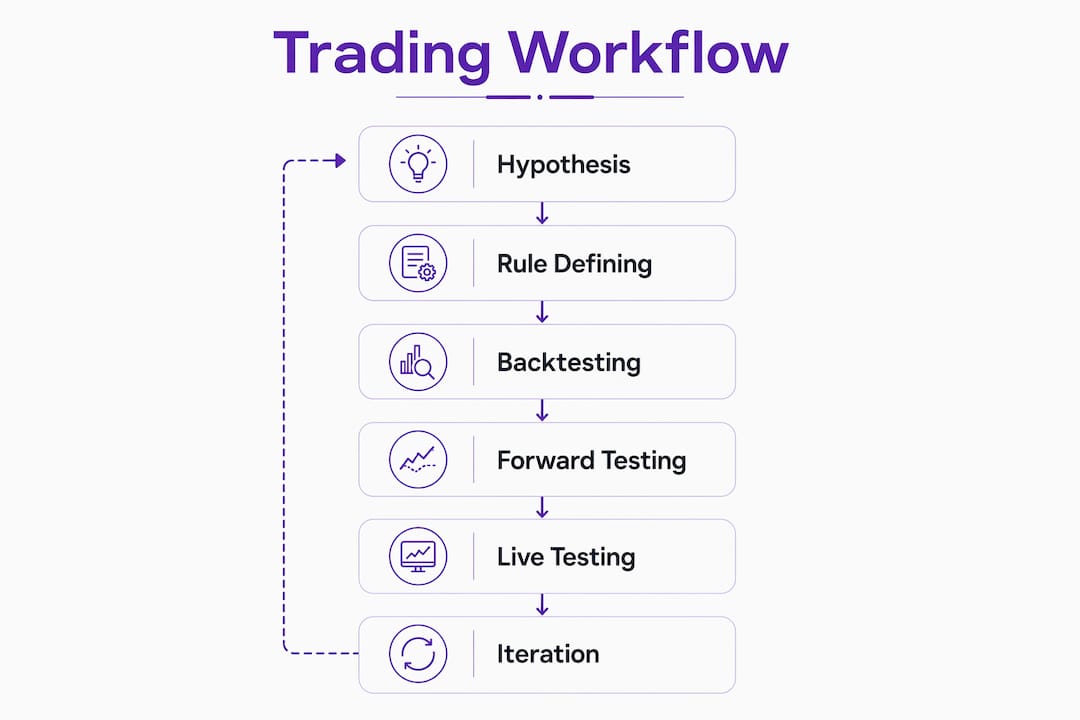
Trading system development follows seven distinct phases, and skipping any one of them creates blind spots that only appear during drawdowns.
- Hypothesis. Define the market condition you believe creates an edge. For example: “Bitcoin tends to revert to the mean after a 3% intraday deviation on low volume.”
- Rule definition. Convert the hypothesis into precise, objective rules. Vague conditions like “strong momentum” cannot be tested or replicated.
- Backtesting. Apply the rules to historical data to assess statistical viability. Backtesting is necessary but insufficient on its own. It cannot account for slippage, liquidity gaps, or the psychological pressure of real capital at risk.
- Forward testing. Run the strategy on live data without committing real capital. This phase reveals execution timing issues and data feed discrepancies that backtests miss entirely.
- Live testing. Deploy the strategy with small capital. A forward and small-capital live test exposes real-world execution challenges that no backtest can replicate.
- Evaluation. Measure win rate, average risk-to-reward ratio, maximum drawdown, and consistency across different market conditions. Evaluate the data, not the recent emotional experience of trading.
- Iteration. Adjust rules based on measured performance, not on the frustration of a losing streak. Rule changes must be data-driven and documented.
“Plans convert emotional decisions into pre-defined rule execution.” — TradeZella
The iteration phase is where most traders either improve or regress. Changing rules after three consecutive losses is not iteration. It is emotional reaction disguised as analysis. True iteration requires a sample size large enough to distinguish noise from signal, typically 30 to 50 trades per setup.
How effective risk management integrates into the trading workflow

Risk management is not a separate activity. It is embedded into every phase of the workflow, from position sizing at entry to daily loss limits that stop trading when drawdown thresholds are reached.
The core risk controls that belong in every crypto trading workflow are:
- The 1% rule. On a $10,000 account, maximum loss per trade is $100. Position size is calculated by dividing that $100 by the stop-loss distance in price terms. This single rule prevents any one trade from causing structural damage to the account.
- Daily loss limits. Setting a maximum daily loss of 2% to 3% of account equity creates a hard stop that removes the decision of whether to keep trading after a bad session.
- Maximum trade count. Limiting the number of trades per session reduces overtrading, which is one of the most common causes of account erosion in crypto markets.
- Automated stop adjustments. AI-powered risk tools adjust take-profit and stop-loss levels based on volatility indicators like ATR and Bollinger Bands, removing the need for manual recalculation during fast-moving sessions.
The discipline benefit of rule-based risk management is underrated. When risk limits are pre-defined and automated, the cognitive load during live trading drops significantly. Traders who rely on in-session judgment about position size consistently underperform those with fixed, pre-calculated rules. For a detailed breakdown of position sizing in crypto, the 1-2% risk rule guide at Darkbot covers the calculation mechanics in full.
Stat callout: Documented trading routines improve consistency by 23%. That figure reflects the measurable impact of pre-market preparation, including economic calendar checks, key level marking, and risk limit confirmation, before a single order is placed.
What tools and automation techniques support a trading workflow?
The right tools reduce friction at each phase of the workflow. The table below maps common workflow tasks to the tools best suited for each.
| Workflow phase | Recommended tools | Primary benefit |
|---|---|---|
| Trade logging and review | Edgewonk, TraderSync | Structured journaling with performance analytics |
| Pre-market preparation | Economic calendars, price alert systems | Reduces reactive decision-making during sessions |
| Risk calculation | Position size calculators, spreadsheet models | Removes in-session math errors |
| Automated execution and risk control | Darkbot, API-connected bots | Enforces TP/SL rules and position sizing without manual input |
| Strategy backtesting | TradingView Pine Script, dedicated backtest platforms | Validates rules against historical data before live deployment |
Journaling tools like Edgewonk and TraderSync do more than store trade records. They surface patterns in your behavior: which setups you execute well, which sessions produce the most errors, and whether your actual risk per trade matches your stated rules. That gap between intended and actual behavior is where most traders lose money without realizing why.
Manual traders benefit most from automating the tasks most prone to error under stress: stop-loss adjustment, position sizing, and risk gating. Full strategy automation is not required to gain the consistency benefits of automation. Partial automation preserves human judgment at the entry decision level while removing the mechanical tasks that degrade under emotional pressure.
Pro Tip: Set price alerts for your key levels before the session starts. Reacting to a live chart without pre-set alerts forces real-time analysis and execution simultaneously, which is the exact condition that produces impulsive trades.
Common pitfalls in maintaining a trading strategy workflow
The most frequent failure mode in trading workflows is mixing the analysis and execution layers. Analysis answers whether a setup exists. Execution answers how to enter and manage risk. Review happens after the session. When these three functions bleed into each other, traders find themselves re-analyzing during a live position or adjusting rules mid-session, both of which introduce errors that compound over time.
Other common pitfalls include:
- Rewriting rules after short losing streaks. A three-trade losing streak is statistically normal in any strategy with a 50% win rate. Changing rules before reaching a meaningful sample size destroys the data needed to evaluate the strategy accurately.
- Skipping the pre-trade checklist. Pre-market decisions remove emotional improvisation during live trading. A 15 to 20 minute pre-market routine that marks key levels, checks economic events, and confirms risk limits is not optional for consistent execution.
- Overtrading. Taking trades outside the defined setup criteria to recover losses or capitalize on perceived opportunities is the fastest way to invalidate a workflow. Every off-plan trade is a data point that contaminates the strategy’s performance record.
- Treating the workflow as static. After an initial sample of 30 to 50 trades, a trading plan becomes a data-driven system with measurable edges. Traders who never update their plan based on data are not following a workflow. They are following a habit.
Pro Tip: Time-box your trading day into three phases: pre-market preparation (15 to 20 minutes), active session execution, and post-session review (10 minutes). Keeping these phases separate prevents analysis from contaminating execution and execution from contaminating review.
Workflow stages should function like a state machine with strict boundaries. Hidden intra-session rule changes, even small ones, cause failures that are invisible until a losing streak makes them visible. The ForexMechanics trader workflow guide describes this as one of the most underestimated sources of strategy failure among experienced traders.
Key takeaways
A structured, rules-based trading workflow is the single most reliable mechanism for converting inconsistent crypto trading into repeatable, data-driven execution.
| Point | Details |
|---|---|
| Define before you trade | Specify market, timeframe, setup, entry, exit, and risk rules before any live session begins. |
| Follow the 7-phase development process | Move from hypothesis through backtesting, forward testing, and live testing before committing full capital. |
| Cap risk at 1% per trade | Calculate position size from stop-loss distance to limit any single trade’s loss to 1% of account equity. |
| Separate analysis, execution, and review | Mixing these three layers is the leading cause of impulsive, emotionally driven trading errors. |
| Automate the error-prone tasks | Use tools like Darkbot to handle stop-loss adjustment and position sizing, preserving judgment for entry decisions. |
Why I think most traders underestimate the workflow’s middle phases
Most traders spend the majority of their preparation time on entry signals and almost none on the phases between backtesting and full live deployment. That gap is where strategies fail. I have seen traders backtest a system for weeks, get a promising result, and then go live at full size immediately. The forward testing and small-capital live testing phases feel slow and unrewarding, so they get skipped.
The problem is that backtests cannot replicate the experience of watching a position move against you while you are trying to decide whether the setup is still valid. That psychological pressure changes behavior in ways that no historical data simulation captures. The only way to calibrate your execution under real conditions is to trade the strategy at low stakes first, observe where your actual behavior diverges from your rules, and fix those gaps before scaling.
Trade journaling is the habit that makes this visible. Traders who log not just outcomes but their emotional state and rule adherence during each trade accumulate a dataset about themselves, not just about the market. That self-knowledge is what separates traders who improve from those who repeat the same mistakes across different market cycles. I would start with a simple spreadsheet before moving to a dedicated tool like Edgewonk or TraderSync. The discipline of logging matters more than the sophistication of the software.
The step-by-step automation setup guide at Darkbot is worth reading alongside any workflow you build manually. Understanding how rules translate into automated logic forces you to make your criteria more precise than you would if you were only executing manually.
— Grisha
Put your workflow into practice with Darkbot
Building a trading workflow on paper is the first step. Executing it consistently under live market conditions is where automation earns its place.
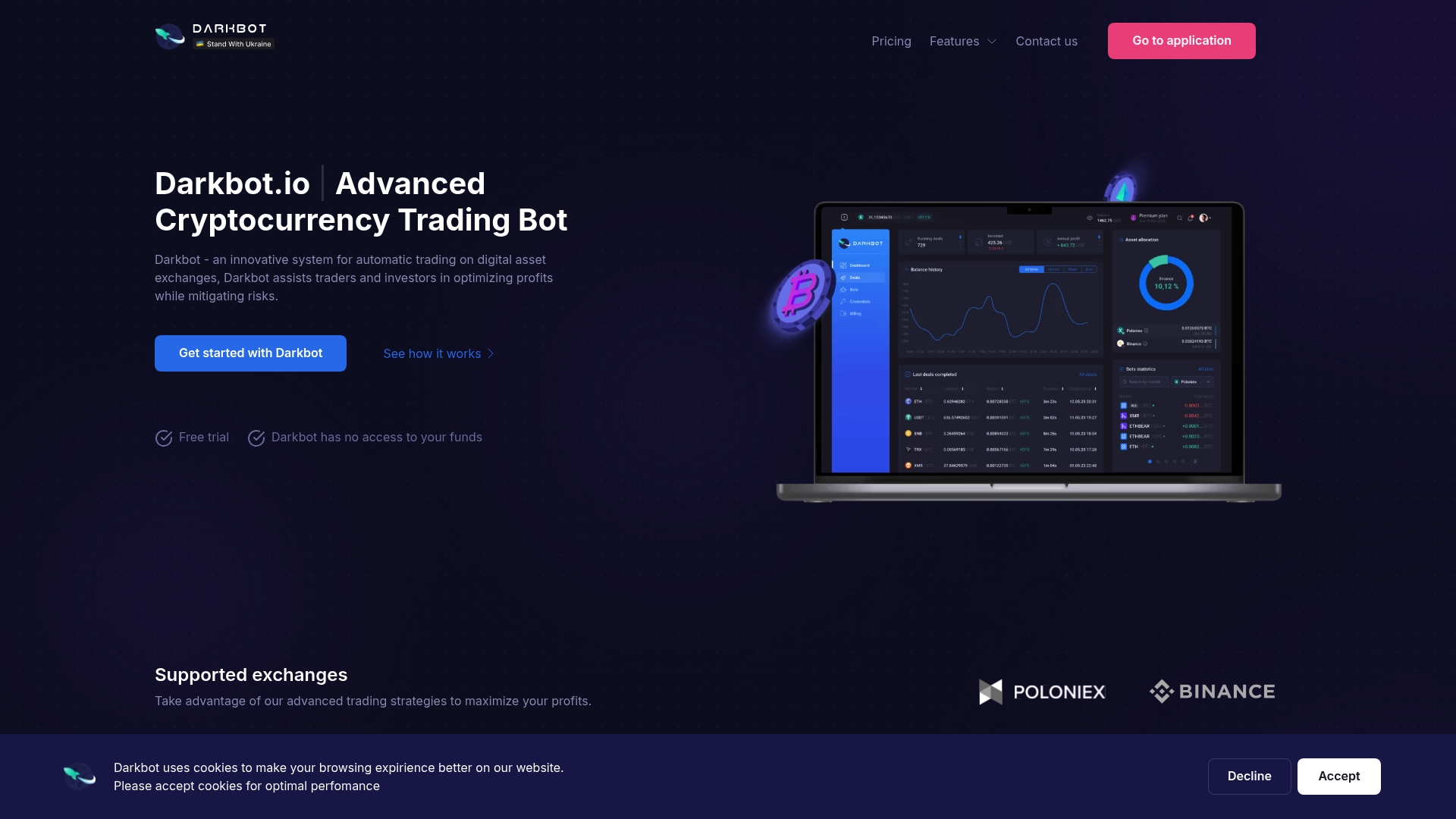
Darkbot is an AI-powered crypto trading automation platform designed to enforce the mechanical elements of your workflow: position sizing, stop-loss and take-profit management, and risk gating across multiple exchanges. Rather than replacing your strategy decisions, Darkbot handles the tasks most likely to break down under stress, so your rules execute as written. The platform supports portfolio management and optimization alongside automated trade execution, giving you a structured view of risk across your full position set. For traders at any experience level looking to move from a documented plan to consistent execution, Darkbot provides the infrastructure to make that transition without rebuilding your workflow from scratch.
FAQ
What is a trading strategy workflow?
A trading strategy workflow is a rules-based decision framework that defines what to trade, when to enter and exit, how to size positions, and how to review results. It converts discretionary decisions into pre-defined, repeatable execution steps.
How many phases does a trading system development process have?
Trading system development follows seven phases: hypothesis, rule definition, backtesting, forward testing, live testing, evaluation, and iteration. Skipping the forward and live testing phases is the most common cause of strategy failure after backtesting.
What is the 1% rule in crypto trading?
The 1% rule caps the maximum loss per trade at 1% of total account equity. On a $10,000 account, that means no single trade should lose more than $100, calculated by adjusting position size relative to stop-loss distance.
How do I avoid emotional trading within a workflow?
Separate your analysis, execution, and review phases into distinct time blocks. Pre-market preparation locks in decisions before the session starts, which removes the need for real-time judgment under emotional pressure.
Can automation replace a manual trading workflow?
Automation handles the mechanical, error-prone tasks within a workflow, such as stop-loss adjustment and position sizing, but does not replace the strategy logic itself. The most effective approach combines manual entry decisions with automated risk execution.
Recommended

Start trading on Darkbot with ease
Come and explore our crypto trading platform by connecting your free account!
Free plan available • No credit card required