Boost Crypto Strategy Efficiency: Cut Costs, Maximize Profits
TL;DR:
- Many backtested crypto strategies appear profitable but are undermined in live markets by hidden costs like slippage and trading fees. Accurately modeling execution frictions and stress-testing strategies under adverse conditions are essential for real-world performance. Using entropy-based portfolio methods and disciplined automation enhances resilience and overall trading efficiency in volatile crypto environments.
Your backtest just posted a 60% annual return with a Sharpe ratio of 2.1. Before you celebrate, consider this: execution frictions like commissions, bid-ask spread, slippage, and market impact routinely strip high-turnover crypto strategies of their profitability the moment they go live. The gap between simulated success and real-world performance is not a minor rounding error. It is the single biggest reason most automated strategies underperform. This guide breaks down exactly where efficiency breaks down, how to design strategies that survive contact with real markets, and why smarter portfolio construction and automation practices can change your bottom line.
Key Takeaways
| Point | Details |
|---|---|
| Model execution costs | Unseen trading frictions often turn profitable strategies unprofitable—always stress-test with realistic costs. |
| Refine with slippage data | Slippage is a leading cause of live performance gaps; include it in every backtest. |
| Embrace robust diversification | Entropy-based portfolios deliver better risk-adjusted returns and resilience in volatile markets. |
| Automate wisely | Automation can boost crypto strategy efficiency, but missteps like neglected slippage will sabotage results. |
| Continual strategy audits | Ongoing monitoring and adjustment are vital, as uncorrected automation or risk changes can erode performance. |
Why backtests fail: Hidden costs and real-world performance gaps
Every trader who has moved from a simulated environment to live trading knows the sinking feeling when returns fail to match the backtest. It is not bad luck. It is execution friction, and it compounds fast. Understanding the strategy optimization pitfalls that kill backtested edge is the first step toward building strategies that actually hold up.
The four most damaging frictions in live crypto trading are:
- Commissions: Exchange fees range from 0.01% to 0.30% per trade. On high-turnover strategies executing dozens of trades per day, this alone can drain several percentage points of annual return.
- Bid-ask spread: The spread between buy and sell prices is a cost paid on every round trip. In illiquid altcoin markets, spreads can exceed 0.5% per trade.
- Slippage: When your order moves the market before filling, you pay more than the quoted price. Larger orders in thinner markets suffer more.
- Market impact: Repeated execution of similar orders tips off other participants, pushing prices against you before your order completes.
Research shows that live Sharpe ratios are often 30% to 50% lower than backtested values once transaction costs are factored in. That is not a rounding problem. That is the difference between a strategy you would deploy with confidence and one you would never risk capital on.
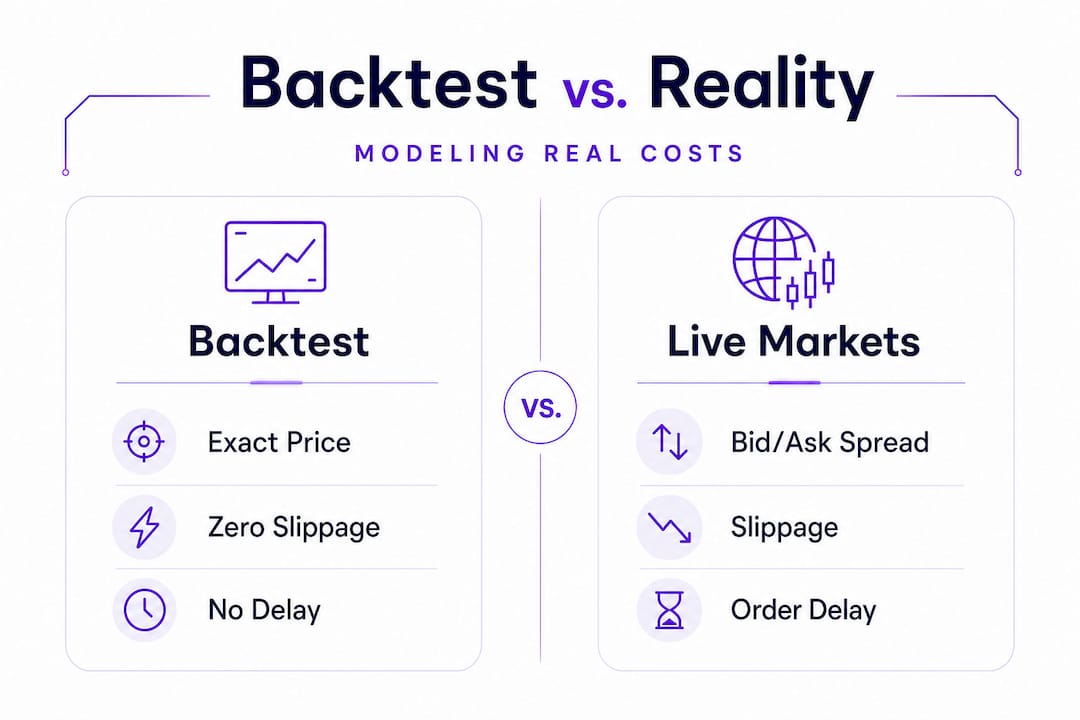
| Backtest assumption | Live market reality |
|---|---|
| Fills at exact signal price | Fills at bid/ask plus slippage |
| Zero or minimal fees | 0.05%–0.30% per trade |
| Unlimited liquidity | Order size affects fill price |
| Consistent spreads | Spreads widen in volatile conditions |
| No market impact | Large orders move prices against you |
The ROI impacts of execution costs are often invisible in backtests because most engines default to optimistic assumptions. A strategy showing 40% annual return in backtest may deliver 15% to 22% live, and that gap widens significantly for strategies with high trade frequency.
Pro Tip: Always model a “worst-case” slippage scenario before committing capital. Set your assumed slippage at two to three times your best estimate and see if the strategy remains profitable. If it does not, the edge was never real.
Understanding automation and execution risks early prevents painful live lessons. Strategies that look brilliant in simulation often fail the moment they interact with real order books, real spreads, and real human behavior on the other side of every trade.
Modeling slippage and execution: The path to realistic strategy design
Once you see how hidden costs undermine strategies, the next step is to build models that reflect real trading conditions. Slippage is the difference between the price a backtesting engine assumes and the price actually achieved in live markets. It sounds simple. The consequences of ignoring it are not.
Here is a quick reference for typical slippage ranges by exchange and market type:
| Market type | Typical slippage range | Notes |
|---|---|---|
| Major BTC/ETH pairs (top-tier CEX) | 0.01%–0.05% | High liquidity, tight spreads |
| Mid-cap altcoins (top-tier CEX) | 0.10%–0.30% | Moderate liquidity |
| Small-cap altcoins | 0.30%–1.00%+ | Thin order books, high risk |
| Decentralized exchanges (DEX) | 0.50%–3.00%+ | Gas costs add further friction |
The variance is enormous. A strategy that maximizes profits safely on Bitcoin pairs may become completely unviable when applied to a lower-liquidity asset, even if the signal logic is identical.
Here is how to incorporate slippage and liquidity modeling into your backtesting process:
- Pull real order-book data. Use historical level-2 order-book snapshots to estimate fill prices rather than relying on last-trade price alone.
- Define a slippage function by order size. Small orders experience less slippage. Model this relationship explicitly rather than applying a flat percentage.
- Layer in spread costs. Add the average bid-ask spread for your target asset as a fixed cost on every round trip, separate from slippage.
- Apply a commission schedule that matches your actual exchange. Do not use a generic 0.10% if your exchange charges 0.25% for taker orders.
- Run multiple slippage scenarios. Test at 0.5x, 1x, 2x, and 3x your baseline estimate to understand how sensitive the strategy is to execution quality.
- Compare results across market regimes. A strategy that survives 2022-style drawdown conditions with realistic slippage modeled has genuinely passed a stress test.
Strategy automation becomes dramatically more reliable when your underlying model is built on realistic execution assumptions. The automation itself does not fix a flawed model. It simply executes the model faster and more consistently, for better or worse.
Pro Tip: Stress-test your backtest with multiple slippage scenarios before you finalize any strategy. If profitability disappears at 2x slippage, treat it as a warning sign that the edge is marginal and the strategy needs refinement.
Realistic modeling is not pessimism. It is the discipline that separates traders who learn expensive lessons live from those who filter out bad strategies before capital is at risk.
Robust portfolio management: Entropy, diversification, and efficiency
With execution realities addressed, maximizing efficiency also means modernizing your approach to portfolio construction. Most traders default to mean-variance optimization. It is intuitive, well-documented, and frequently wrong in crypto markets. The reason is correlation instability. In traditional markets, asset correlations shift slowly. In crypto, correlations can spike to near 1.0 across seemingly unrelated assets during risk-off events, eliminating diversification precisely when you need it most.

Entropy-based portfolio optimization offers a more robust alternative. Rather than minimizing variance under a fixed correlation assumption, entropy methods maximize information diversity across the portfolio. In plain terms, the portfolio is structured so that no single factor or correlation regime dominates performance.
Empirical research published in MDPI shows that Weighted Shannon Entropy (WSE) outperforms both mean-variance and standard Shannon entropy approaches in Sharpe ratio and CVaR (Conditional Value at Risk). That is a meaningful result because CVaR measures tail risk, which is where crypto portfolios get hurt most.
| Portfolio approach | Sharpe ratio | CVaR performance | Entropy score |
|---|---|---|---|
| Mean-variance (MV) | Moderate | Higher tail risk | Low |
| Standard Shannon entropy | Moderate to good | Moderate | Moderate |
| Weighted Shannon Entropy (WSE) | Highest | Best tail risk control | High |
“Entropy-enhanced portfolio optimization may improve diversification and resilience, even when risk-adjusted performance is similar to conventional approaches.” This finding matters because resilience in crypto markets is not a secondary concern. It is central to risk management with diversification that survives market shocks.
Pros and cons of entropy-based vs. mean-variance optimization:
- Entropy: Pro. Better handles correlation instability across market regimes.
- Entropy: Pro. Reduces concentration risk without requiring precise correlation estimates.
- Entropy: Pro. Tends to produce more stable weights over time, reducing rebalancing friction.
- Entropy: Con. Requires more computational setup and may be less intuitive to implement.
- Mean-variance: Pro. Widely supported by existing tools, easy to communicate.
- Mean-variance: Con. Relies on stable correlations that crypto does not consistently provide.
Referring to a solid risk rule checklist alongside entropy-based construction helps ensure that your portfolio design is not just theoretically sound but operationally executable.
The takeaway is practical. You do not need to abandon every existing tool. But supplementing your portfolio construction with entropy measures, especially when managing multi-asset crypto portfolios, can materially improve resilience to the sudden correlation shocks that define crypto bear markets.
Automating strategy efficiency: Tools, processes, and common traps
Optimized portfolios and realistic models create the foundation. Now see how automation streamlines strategy execution and risk control. Done well, automation eliminates emotional interference, enforces discipline at execution speed, and handles rebalancing adjustments that manual traders perpetually delay. Done poorly, automation locks in bad logic at machine speed and creates losses faster than any human could.
The efficiency gains from automation are real. Bots execute at millisecond latency, which means fewer missed entries, tighter compliance with position sizing rules, and consistent rebalancing without the paralysis of manual decision-making. Consider following these optimization steps when you automate a validated strategy:
- Start with paper trading. Run your automated strategy against live market data without committing capital. Confirm that execution logic produces the fills your model assumes.
- Configure slippage tolerance in your bot settings. Set maximum allowable slippage per order. If the market cannot fill within your tolerance, the bot should cancel rather than chase a bad fill.
- Define hard risk limits. Program maximum drawdown thresholds that trigger pauses in trading, giving you time to assess before losses compound.
- Automate rebalancing with a frequency cap. Rebalance on a schedule or drift threshold, not every price tick. Over-rebalancing generates unnecessary friction costs.
- Build in error handling and alerting. Every automation should log failures and notify you immediately when an order fails to execute as intended.
- Review performance weekly, not daily. Daily noise triggers emotional overrides. Weekly reviews keep focus on structural performance rather than short-term variance.
The most common automation pitfalls worth watching for: timing delays between signal generation and order submission, misconfigured slippage that allows bad fills, position sizing logic that ignores current portfolio correlation, and a lack of human oversight when market conditions shift dramatically.
Research confirms that entropy-enhanced portfolio optimization improves resilience in volatile crypto markets, which is precisely why automating rebalancing toward entropy-driven targets is more robust than automating toward static mean-variance weights. The strategy stays adaptive even when market structure changes.
Smart automation is not about removing the human. It is about making the human’s judgment count at the strategic level rather than being spent on execution details.
Pro Tip: Use automation specifically for enforcing risk limits and triggering rebalancing adjustments. Reserve human judgment for periodic strategy audits and regime change assessments, where pattern recognition and context matter most.
The uncomfortable truth about crypto strategy efficiency: Why most automation fails and how to get it right
Here is what years of watching traders deploy automated strategies reveal: the biggest source of failure is not bad code or poor market conditions. It is the gap between what traders believe their backtest proved and what their backtest actually measured.
Most traders treat a high backtested Sharpe ratio as proof of a viable strategy. It is not. It is proof that, under ideal execution assumptions with the benefit of hindsight, a pattern existed in historical data. That is a fundamentally different claim. The moment you introduce real spreads, real slippage, and real-world order routing, the picture changes. The strategies that survive this transition are the ones built by traders who tested under adversarial assumptions first.
The real difference-makers in strategy efficiency are rarely the signal itself. They are the execution infrastructure around it. Stress-tested slippage models. Automated error handling that catches missed fills before they become portfolio drift. Adaptive alerting that tells you when market conditions have shifted outside the regime your strategy was built for. These are unglamorous. They are also what separate consistently profitable automation from strategies that work for two months and then quietly drain capital.
One more insight worth internalizing: intentional over-diversification via entropy-based construction often beats precisely optimized mean-variance portfolios in live crypto conditions. Why? Because precise optimization is fragile. It relies on inputs that are constantly changing. Entropy-based construction is deliberately more robust to input error, and in a market as structurally volatile as crypto, that robustness compounds into real risk-adjusted return advantages over time.
Schedule periodic audits of your automations, at minimum quarterly. Markets evolve. Correlations shift. Execution conditions change on exchanges. A strategy that was well-calibrated six months ago may be running on stale assumptions today. Treating automation as a set-and-forget tool is the most expensive mistake in systematic crypto trading. Pairing redefining risk management practices with ongoing audits is what keeps automated strategies genuinely efficient over time.
Ready to optimize your crypto strategy? Next steps with Darkbot
If the lessons in this guide resonate, the next question is practical: how do you implement them without building every piece of infrastructure from scratch?
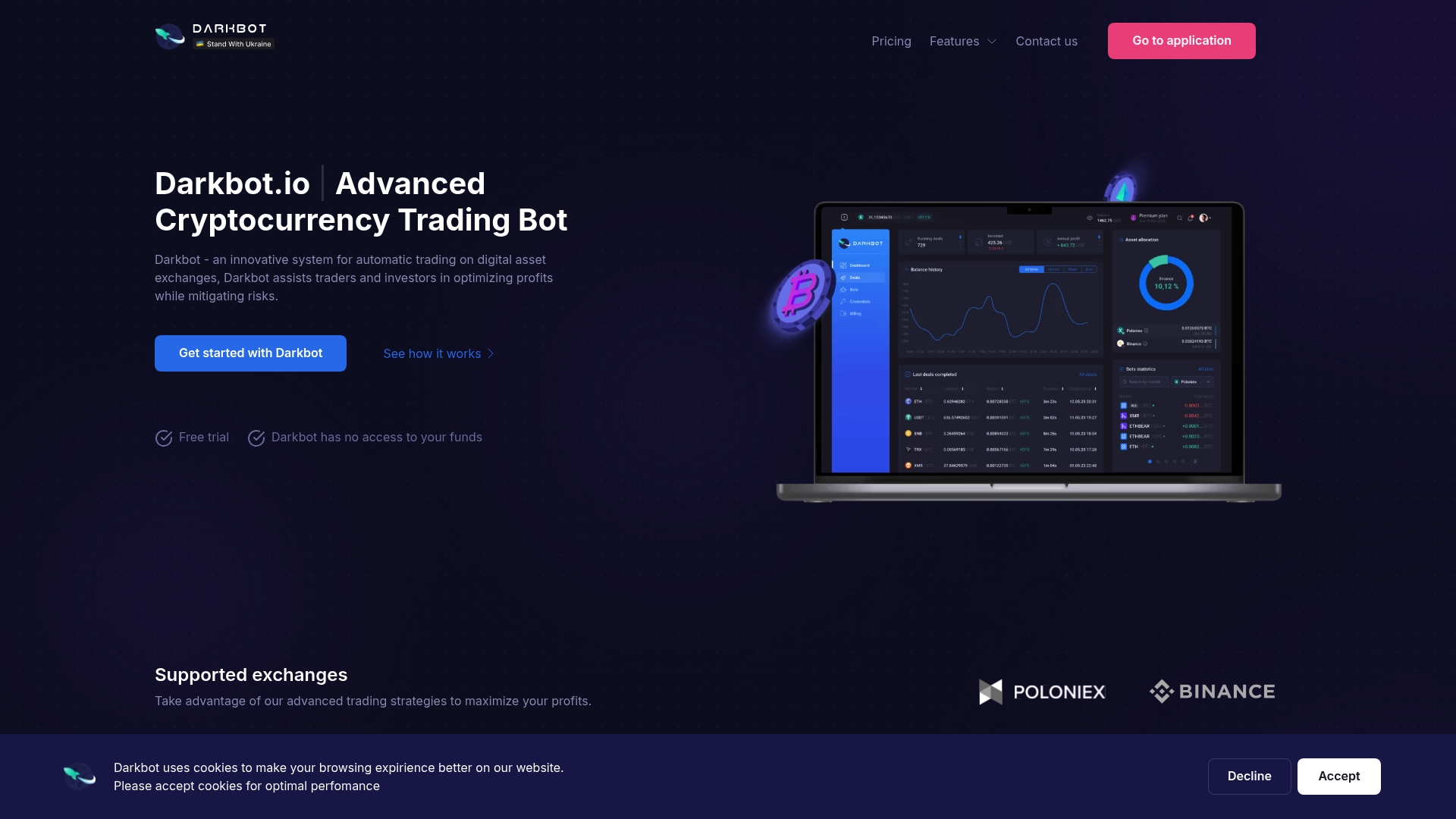
Darkbot’s AI-powered trading bots are built specifically to bridge the gap between backtested theory and live execution reality. The platform supports realistic slippage configuration, automated rebalancing with frequency controls, and hard risk limits that enforce discipline without requiring constant manual oversight. Whether you are stress-testing a new strategy or managing an existing crypto portfolio optimization workflow, Darkbot provides the tools to reduce execution friction and maintain consistency across volatile market conditions. With flexible pricing tiers including a free entry point, you can start validating real-world performance without committing full capital from day one. Explore what systematic, data-driven automation looks like in practice.
Frequently asked questions
What is strategy efficiency in crypto trading?
Strategy efficiency measures how well a crypto trading strategy delivers risk-adjusted returns after accounting for friction like slippage, commissions, and market impact. As research confirms, backtest-to-live gaps are frequently dominated by these execution frictions.
Why do backtests often overstate strategy profits?
Backtests rarely account for real-world costs such as slippage and trading commissions, which reduce actual profits by 30 to 50% or more. Studies show that Sharpe ratios drop 30% to 50% in live conditions compared to backtested values.
How can I model slippage for better strategy accuracy?
Stress-test your strategy using a range of slippage values and include order-book liquidity modeling to avoid over-optimistic results. Realistic slippage modeling can turn marginal backtested edges into negative expectancy, revealing which strategies are genuinely viable.
What is entropy-based portfolio optimization?
Entropy-based methods aim to improve diversification and portfolio resilience by spreading risk beyond mean-variance assumptions, often resulting in more stable performance. Research shows WSE approaches outperform mean-variance in both Sharpe ratio and CVaR metrics.
Is automation always better for strategy efficiency?
Automation improves consistency, but it is only efficient if execution risks like slippage and misconfiguration are actively managed. Robust automation paired with slippage modeling is what makes live trading efficiency achievable.
Recommended

Start trading on Darkbot with ease
Come and explore our crypto trading platform by connecting your free account!
Free plan available • No credit card required