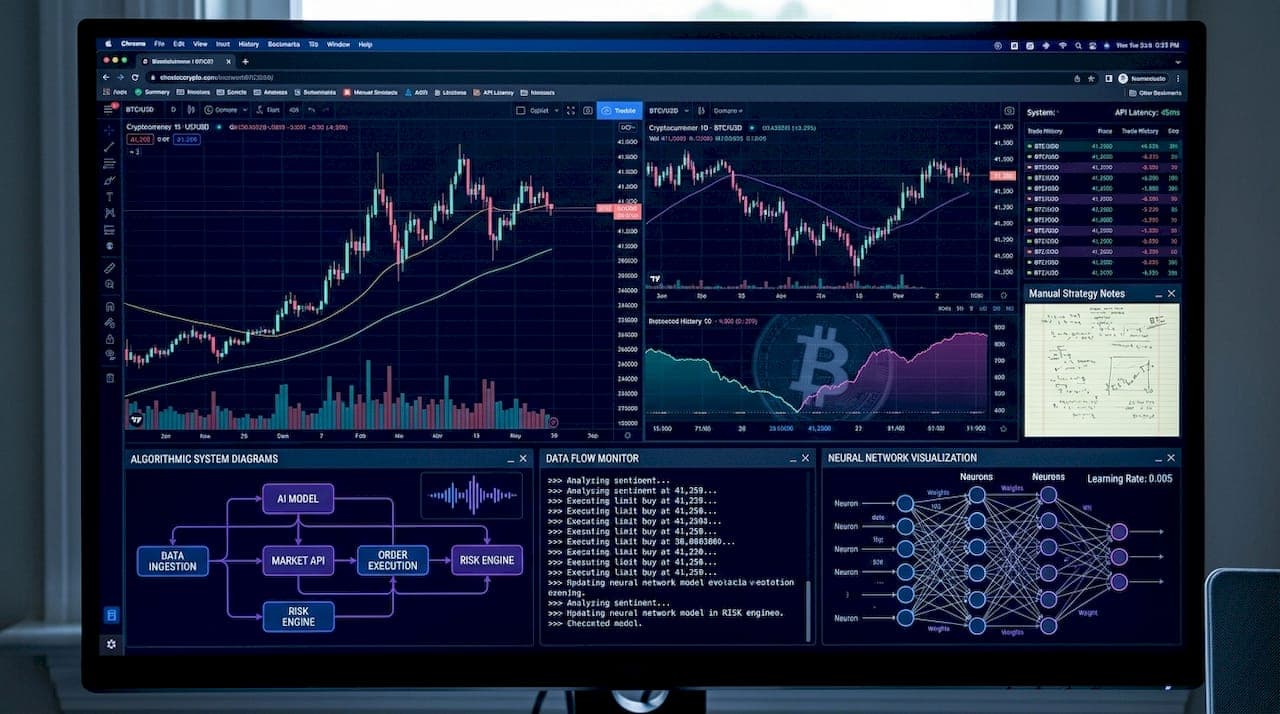
Arbitrage Strategies Checklist for Crypto Traders 2026

TL;DR:
- An arbitrage strategies checklist is a structured set of validation criteria ensuring spread sufficiency, execution readiness, and risk controls before trading. It emphasizes pre-trade analysis, capital allocation, execution checks, risk management, and cost modeling to prevent uncontrolled exposure. Utilizing appropriate tools and disciplined review processes ensures consistent, profitable arbitrage operations across markets.
An arbitrage strategies checklist is a structured set of validation criteria that crypto traders use to confirm spread sufficiency, execution readiness, and risk controls before entering any arbitrage trade. Without a formal checklist, traders routinely underestimate fees, miss latency constraints, or enter positions without defined exit rules. Platforms like Binance, tools like Hummingbot, and strategies like funding rate arbitrage each carry distinct operational requirements that a generic approach cannot address. The difference between consistent arbitrage profits and repeated losses almost always traces back to process discipline, not market access. This guide covers every component of a working checklist, organized by strategy type and execution phase.
1. Core components of the arbitrage strategies checklist
Every arbitrage strategies checklist starts with the same foundational categories regardless of strategy type. Skipping any one of them converts a low-risk trade into an uncontrolled exposure.
Pre-trade analysis is the first gate. The minimum profitable spread for CEX-to-CEX arbitrage in 2026 is 0.15% to 0.25%, while DEX-CEX trades require 0.3% to 0.5% to cover Ethereum L1 gas costs. That threshold is not a guideline. It is the floor below which a trade destroys capital.
Capital allocation is the second gate. Prefunding multiple exchanges eliminates on-chain transfer delays that routinely close arbitrage windows before execution completes. Maintain a working float on every exchange you trade, sized to cover at least three simultaneous positions.

Execution readiness covers API connectivity, order book depth verification, and latency benchmarking. A checklist item here should confirm that your API keys are active, rate limits are not near their ceiling, and the order book on both legs shows sufficient depth to absorb your order without moving the price.
Risk controls require written exit rules with numerical thresholds. Predefined exit rules with specific basis drift limits and funding failure triggers materially reduce emotional decision-making during volatile conditions. Write the number down before you open the position.
Profitability modeling must account for trading fees, withdrawal fees, gas costs, slippage, and transfer time. Fees and transfer delays can exceed the spread entirely, turning a visible opportunity into a realized loss. Model every cost before execution, not after.
Trade logging closes the loop. Every trade should be recorded with entry price, exit price, fees paid, net profit, and execution time. This data feeds both tax compliance and checklist refinement.
Pro Tip: Set a minimum net-profit threshold in dollar terms, not just percentage terms. A 0.2% spread on a $500 position yields $1.00 before fees. That math often fails after costs are applied.
2. Checklist for CEX-to-CEX arbitrage
CEX-to-CEX is the most common starting point for crypto arbitrage techniques for beginners. The strategy involves buying an asset on one centralized exchange and simultaneously selling it on another where the price is higher.
The checklist for this type requires simultaneous order execution on both legs. Any delay between the buy and the sell introduces leg risk, where one side fills and the other does not. Confirm that both exchanges support the same trading pair, that withdrawal limits are not active, and that your API connections are live on both sides before placing either order.
Spread verification is non-negotiable. The 0.15% to 0.25% minimum must be confirmed in real time, not from a price alert that fired 30 seconds ago. Prices on liquid pairs move faster than manual execution allows, which is why automation is nearly mandatory for capturing CEX-to-CEX windows in competitive markets.
3. Checklist for triangular arbitrage
Triangular arbitrage exploits pricing inconsistencies across three currency pairs on a single exchange, cycling through assets to return to the starting currency at a profit. Net returns average 0.05% to 0.15% per cycle, which requires fast execution and precise sequencing to be worthwhile.
The checklist here centers on trade sequence validation. All three legs must execute in the correct order, and the spread must survive the full cycle including fees on each leg. Market-making bots dominate triangular arbitrage on major pairs. Retail traders find realistic edges only in newly listed tokens and low-liquidity altcoin pairs where institutional bots have not yet saturated the opportunity.
Confirm correlation between the three pairs before entry. If one leg is illiquid, the cycle breaks and you are left holding an unintended position.
4. Checklist for DEX-CEX arbitrage
DEX-CEX arbitrage captures price differences between decentralized exchanges like Uniswap or Curve and centralized venues. The spread threshold is higher because gas costs on Ethereum L1 are a fixed cost per transaction regardless of trade size.
The checklist for this type must include a real-time gas estimate before every trade. A profitable spread at 30 gwei becomes a loss at 80 gwei. Use a gas tracker like ETH Gas Station or the gas estimation built into your execution bot to confirm net profitability at current network conditions.
MEV protection is a required checklist item for DEX trades. Without a private RPC or a service like Flashbots Protect, your transaction is visible in the public mempool and subject to front-running. This is not a theoretical risk. It is a routine cost for unprotected DEX transactions.
5. Checklist for statistical arbitrage
Statistical arbitrage, sometimes called stat arb, identifies pairs of correlated assets and trades the spread when it deviates beyond a historical threshold. This is a more advanced approach within the investment arbitrage guide category and requires quantitative modeling.
The checklist here starts with correlation verification. Confirm that the pair’s correlation coefficient remains above your threshold, typically 0.85 or higher, using recent data rather than historical averages. Markets shift, and a correlation that held for six months can break in a week.
Position sizing is the second critical item. Statistical arbitrage carries convergence risk: the spread can widen further before it closes. Size positions so that a 2x spread expansion does not breach your risk management thresholds. The 1% to 2% per-trade rule from standard crypto risk frameworks applies here with equal force.
6. Checklist for funding rate arbitrage
Funding rate arbitrage is the most accessible strategy for retail traders. It involves holding a delta-neutral position: long spot on one side and short a perpetual futures contract on the other, collecting the funding payment when rates are positive.
The checklist for this strategy requires confirming the funding rate before entry, not just the current rate but the trend. A rate that is positive now but declining toward zero closes your income window faster than expected. Verify the funding interval (typically every 8 hours on Binance) and calculate annualized yield against your capital cost.
Exit rules must be written with specific numerical triggers. Define the minimum funding rate at which the trade remains worth holding, and define the basis drift level at which you close both legs regardless of funding. These numbers prevent the common mistake of holding a position through a rate reversal because it “might recover.”
Pro Tip: Funding rate arbitrage works best when rates are elevated due to market-wide leverage. Check open interest and long/short ratios on Coinglass before entry to assess whether the rate environment is structurally favorable or a temporary spike.
7. Common risks and pitfalls checklist
Every arbitrage opportunity checklist must include a dedicated risk review. The following items represent the most common failure points across all strategy types.
- Leg risk: One side of the trade fills and the other does not, leaving a directional exposure. Mitigate by using bots that execute both legs simultaneously or by setting contingent orders.
- Exchange and withdrawal halts: APIs, exchange downtime, and withdrawal halts create operational risk that no spread calculation can account for. Check exchange status pages before deploying capital.
- Slippage and liquidity: Confirm order book depth covers your full position size at the target price. Thin books move against you on entry and exit.
- Regulatory and tax compliance: Arbitrage trades generate taxable events in most jurisdictions. Tools like CoinTracker and Koinly automate cost-basis tracking across exchanges.
- API rate limits: High-frequency execution can hit rate limits and cause missed fills. Monitor API usage in real time and build retry logic into your bot configuration.
- MEV and front-running on DEX trades: Use private RPCs or Flashbots Protect for any on-chain transaction to prevent sandwich attacks.
8. Tools and automation checklist
Automated trading bots like Hummingbot, 3Commas, and Pionex are the standard infrastructure for executing arbitrage across exchanges. Each serves a different use case within the broader automation checklist.
- Hummingbot: Open-source and highly configurable. Best suited for CEX-to-CEX and DEX-CEX strategies where custom logic is required. Requires technical setup but offers the most control over execution parameters.
- 3Commas: Cloud-based with a visual interface. Better for traders who want pre-built strategy templates and do not need custom code. Supports multiple exchanges via API.
- Pionex: Built-in bots with no external setup required. Lower barrier to entry, though less flexible for complex multi-leg strategies.
- Coinglass: The standard tool for monitoring funding rates, open interest, and liquidation data across major exchanges. Required for funding rate arbitrage checklist validation.
- CryptoCompare: Price aggregation across exchanges. Useful for identifying spread opportunities before routing to execution.
- CoinTracker and Koinly: Portfolio and tax tracking tools that handle multi-exchange cost-basis calculations automatically. Both integrate with Binance, Coinbase, Kraken, and most major venues.
For a structured review of automated arbitrage tools and how they map to specific checklist requirements, the comparison between platforms matters more than any single feature. Match the tool to the strategy type, not the other way around.
Pro Tip: Before automating any strategy, run it manually for at least 20 trades. Manual execution reveals checklist gaps that simulated backtests miss, particularly around slippage and API timing.
Key takeaways
A complete arbitrage strategies checklist covers spread validation, capital prefunding, execution controls, and written exit rules before any trade is placed.
| Point | Details |
|---|---|
| Spread thresholds by type | CEX-to-CEX requires 0.15% to 0.25%; DEX-CEX requires 0.3% to 0.5% to cover gas costs. |
| Prefund all exchange accounts | Maintaining float on both exchanges eliminates on-chain transfer delays that close arbitrage windows. |
| Write exit rules numerically | Define basis drift limits and minimum funding rates before entry to remove emotional decision-making. |
| Match tools to strategy type | Hummingbot suits custom DEX-CEX logic; Coinglass is required for funding rate monitoring. |
| Model all costs before entry | Fees, slippage, gas, and transfer time must be calculated against the spread before execution begins. |
Why the checklist is a living document, not a one-time setup
I have seen traders build a solid checklist, run it for three months, and then stop updating it when market conditions shift. That is where the discipline breaks down. The checklist that worked during a high-volatility period in early 2025 will not perform the same way in a compressed-spread environment six months later.
My experience is that the checklist needs a scheduled review, not just a reactive one. Every time a trade fails in a way the checklist did not anticipate, that failure becomes a new checklist item. This is how the document evolves from a generic framework into a precision instrument calibrated to your specific exchanges, capital size, and strategy mix.
The mental discipline piece is underrated. A checklist only works if you actually stop and run through it before every trade. The temptation to skip steps when an opportunity looks obvious is exactly when the checklist matters most. The obvious opportunities are often the ones where slippage or a withdrawal halt is already in play.
My recommendation for anyone starting out: run the checklist manually for the first 20 to 30 trades before connecting any automation. You will find items that need to be added, thresholds that need to be adjusted, and failure scenarios you had not considered. Automate a refined checklist, not a draft one. Once you are scaling, diversify across at least two strategy types so that a funding rate compression or a liquidity drought on one venue does not shut down your entire operation. You can explore the fundamentals of arbitrage trading to build the conceptual foundation before committing capital to any single approach.
— Grisha
How Darkbot supports systematic arbitrage execution
Darkbot is built for traders who have defined their checklist and need consistent, rule-driven execution across multiple exchanges.
Darkbot connects to exchanges via API keys, supports multi-exchange pre-funding workflows, and applies AI-driven pattern evaluation to maintain execution consistency without manual intervention. The platform’s risk controls map directly to checklist requirements: configurable stop-loss triggers, real-time position monitoring, and automated alerts for spread and funding rate conditions. For traders managing crypto portfolio allocation across arbitrage strategies, Darkbot provides the analytics layer that keeps every position within defined parameters. Explore Darkbot’s trading automation to see how the platform operationalizes the checklist items covered in this guide.
FAQ
What is an arbitrage strategies checklist?
An arbitrage strategies checklist is a structured set of pre-trade and in-trade criteria that validates spread sufficiency, capital readiness, execution conditions, and exit rules before a trade is placed. It replaces ad hoc decision-making with a repeatable process.
What spread is needed for crypto arbitrage to be profitable?
CEX-to-CEX arbitrage requires a minimum spread of 0.15% to 0.25%, while DEX-CEX trades need 0.3% to 0.5% to cover gas costs on Ethereum L1. Trades below these thresholds typically generate losses after fees.
Is automation required for crypto arbitrage?
Automation is nearly mandatory for liquid market arbitrage where windows close in milliseconds. Manual execution remains viable for funding rate arbitrage and niche low-liquidity pairs where timing pressure is lower.
What tools do arbitrage traders use?
Hummingbot, 3Commas, and Pionex handle execution automation. Coinglass monitors funding rates and open interest. CoinTracker and Koinly manage tax compliance across exchanges. Each tool addresses a specific checklist category.
What is the biggest risk in crypto arbitrage trading?
Leg risk, where one side of a trade fills and the other does not, is the most common operational failure. Exchange downtime, API rate limits, and withdrawal halts compound this risk and must be addressed in every checklist before capital is deployed.
Recommended

Start trading on Darkbot with ease
Come and explore our crypto trading platform by connecting your free account!
Free plan available • No credit card required