Binance API Trading Explained: A Practical 2026 Guide

TL;DR:
- Binance API trading enables automated order execution and data retrieval through structured programming interfaces. Proper security, interface selection, and error handling are essential for reliable and safe live trading. Building resilient systems with disciplined error management is more challenging than developing trading strategies alone.
Binance API trading is defined as the practice of connecting external software directly to Binance’s exchange infrastructure through a set of programming interfaces, enabling automated order execution, real-time data retrieval, and portfolio management without manual input. This method, formally called algorithmic trading via exchange API, gives traders a structural speed advantage. Automated systems respond in milliseconds, a margin that manual trading cannot match. Binance supports access to Spot, Margin, Futures, and Options markets through its API layer, and authentication relies on cryptographically signed, time-stamped requests. Understanding these components is the foundation of any serious Binance API trading guide.
What is Binance API trading, and how does it work?
The Binance API functions as a structured communication channel between your software and Binance’s trading engine. Your application sends requests, Binance processes them, and responses return in a defined format. Three distinct interface types handle different use cases.
- REST API: Handles synchronous, request-response interactions. You send a request to place an order, cancel an order, or query account balances, and Binance returns a result. REST is the standard choice for order management and account data retrieval.
- WebSocket API: Delivers continuous, real-time data streams. Instead of polling for price updates, your application subscribes to a stream and receives updates as they happen. This is the correct tool for live order book data, trade feeds, and user account event monitoring.
- FIX API: Targets institutional and high-frequency trading operations. It uses the Financial Information eXchange protocol, a standard in traditional financial markets, and offers the lowest latency of the three options.
Binance offers REST, WebSocket, and FIX APIs for varied trading purposes, each suited to a different execution context. Choosing the wrong interface type is a common beginner mistake. A strategy that requires sub-second reaction to price changes belongs on WebSocket, not REST.
Authentication is non-negotiable across all three interfaces. Authenticating API requests requires timestamped, cryptographically signed payloads with percent-encoding for integrity and security. This means every request your application sends must include a signature generated from your secret key and the request parameters. Binance rejects unsigned or improperly signed requests outright.
How to generate and manage Binance API keys securely
API keys are the credentials that identify your application to Binance. Generating them incorrectly or storing them carelessly creates serious security exposure. Follow this process carefully.
- Log into your Binance account and navigate to the API Management section in your account dashboard.
- Create a new API key by selecting the key type. Binance currently offers standard API keys and Ed25519 keys. Ed25519 keys use asymmetric cryptography and are the more secure option for production systems.
- Set permissions explicitly. Binance lets you enable read access, spot trading, margin trading, and futures trading independently. Grant only the permissions your application actually requires.
- Configure IP restrictions. Whitelist specific IP addresses so the key only accepts requests from known sources. This single step eliminates a large category of unauthorized access attempts.
- Disable withdrawal permissions. Most trading bots require only trade and read permissions. Leaving withdrawal permissions active on an API key that only needs to trade is an unnecessary risk.
- Copy and store your secret key immediately. Binance displays the secret key only once at creation. If you miss it, you must generate a new key pair.
Pro Tip: Never hardcode API keys directly into your source code. Store credentials in environment variables or a dedicated secrets manager. Code repositories are a common source of credential leaks, and a leaked key with trade permissions gives an attacker direct access to your funds.
The security steps for API key setup extend beyond generation. Rotate keys periodically and revoke any key that has been exposed, even briefly. Treat API credentials with the same discipline you apply to account passwords.

Common Binance API trading strategies and practical applications
The API unlocks trading approaches that are structurally impossible to execute manually. Speed, consistency, and the ability to monitor multiple markets simultaneously are the core advantages.
- Rule-based automated bots: A bot monitors price, volume, or indicator conditions and places orders the moment defined thresholds are met. For example, a simple mean-reversion bot buys when price drops a set percentage below a moving average and sells when it recovers. The logic is fixed, and execution is immediate.
- Portfolio rebalancing: A program tracks asset allocations and places corrective trades when any position drifts beyond a defined tolerance. This removes the need to manually check and adjust holdings, which is especially useful across multiple trading pairs.
- Real-time data-driven decisions: WebSocket streams feed live order book depth, recent trades, and ticker data into your application. Strategies that depend on detecting sudden liquidity changes or large order flow shifts require this kind of continuous data, not periodic REST polling.
- Multi-market monitoring: A single application can subscribe to dozens of WebSocket streams simultaneously, watching for conditions across multiple trading pairs and acting on whichever triggers first.
“Automated trading removes emotional decision-making using objective, quantifiable rules executed by bots. Emotional biases like panic-selling can be eliminated through API trading.”
The psychological dimension matters more than most technical guides acknowledge. A bot does not hesitate, second-guess, or override its own rules during a sharp market move. That consistency is the primary behavioral advantage of automated crypto trading over discretionary execution. The strategy either works or it does not, and the data tells you which.
Pro Tip: Start with a single, well-defined strategy on a small position size. Test it in Binance’s testnet environment before deploying real capital. A strategy that looks clean in theory often reveals edge cases in live market conditions.
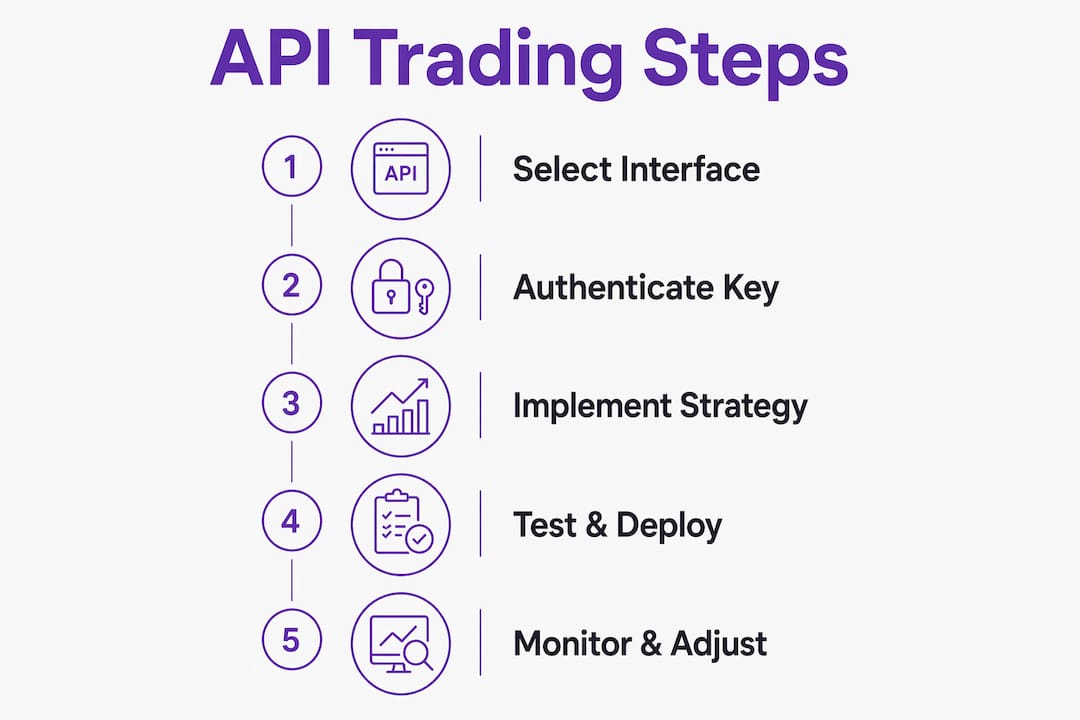
Security and reliability considerations in Binance API trading
Production API bots operate in an environment where network failures, exchange downtime, and sudden volatility are routine. A bot that cannot handle these conditions gracefully will fail at the worst possible moment.
The recvWindow parameter is a critical security control. The recvWindow parameter restricts the valid time window for signed requests to prevent replay attacks. The default is 5,000 milliseconds, but tightening it reduces the window during which an intercepted request could be reused maliciously. Set it as tight as your system’s clock synchronization allows.
Robust error handling is crucial for production bots to manage rate limits, timeouts, and partial order fills during volatile markets. Binance enforces rate limits on both request frequency and order count. Exceeding them results in temporary bans that can leave your bot unable to act during exactly the conditions it was built for.
| Risk category | Cause | Mitigation |
|---|---|---|
| Replay attacks | Intercepted signed requests reused | Tight recvWindow, clock sync |
| Credential exposure | Keys hardcoded in source code | Environment variables, secrets manager |
| Rate limit bans | Excessive request frequency | Request queuing, exponential backoff |
| Partial fills | Volatile market conditions | Order state tracking, fill confirmation logic |
| Connection timeouts | Network instability | Reconnection logic, WebSocket heartbeat monitoring |
Pro Tip: Implement exponential backoff for failed requests. If a request fails, wait a short interval before retrying, then double the interval on each subsequent failure. This prevents your bot from hammering a temporarily unavailable endpoint and triggering a rate limit ban.
The API-based exchange integration layer is only as reliable as the code surrounding it. Authentication handles identity. Error handling handles reality.
Key takeaways
Binance API trading requires correct interface selection, strict key security, and production-grade error handling to function reliably in live markets.
| Point | Details |
|---|---|
| Choose the right interface | Use REST for order management, WebSocket for real-time streams, and FIX for high-frequency execution. |
| Secure API keys from the start | Disable withdrawal permissions, whitelist IPs, and store credentials in environment variables, never in code. |
| Use recvWindow tightly | A narrow recvWindow limits the validity of signed requests and reduces replay attack risk. |
| Build error handling first | Rate limits, timeouts, and partial fills are routine. A bot without error handling will fail in live conditions. |
| Automate to remove bias | Rule-based execution eliminates emotional decisions like panic-selling that degrade manual trading performance. |
Why I think most traders underestimate the operational side of API trading
Most traders who start with Binance API trading focus almost entirely on strategy logic. They spend weeks refining entry and exit conditions, then deploy a bot with minimal error handling and no reconnection logic. The first time Binance returns a 429 rate limit error or a WebSocket connection drops mid-session, the bot either freezes or fires duplicate orders. That is not a strategy problem. It is an infrastructure problem.
The traders who build durable systems treat error handling as a first-class feature, not an afterthought. They write reconnection logic before they write strategy logic. They test failure scenarios deliberately, not by accident in live markets. This discipline separates bots that run for months from bots that break in the first week.
The other underestimated shift is the move toward AI-powered adaptive trading. Binance’s own developer infrastructure increasingly favors agent-native designs where AI systems analyze external data, evaluate performance, and adjust parameters without human intervention. This is not speculative. The API architecture already supports it. Traders who understand the underlying mechanics now are better positioned to work with these systems as they become standard. The fintech API landscape is moving toward autonomous execution, and the Binance API is part of that trajectory.
The honest lesson from working with API trading systems is this: the strategy is the easy part. The hard part is building something that keeps running when conditions are not ideal. That is where most of the real work lives.
— Grisha
Darkbot and automated Binance API trading
Traders who want to build on Binance API without writing infrastructure from scratch have a structured alternative.
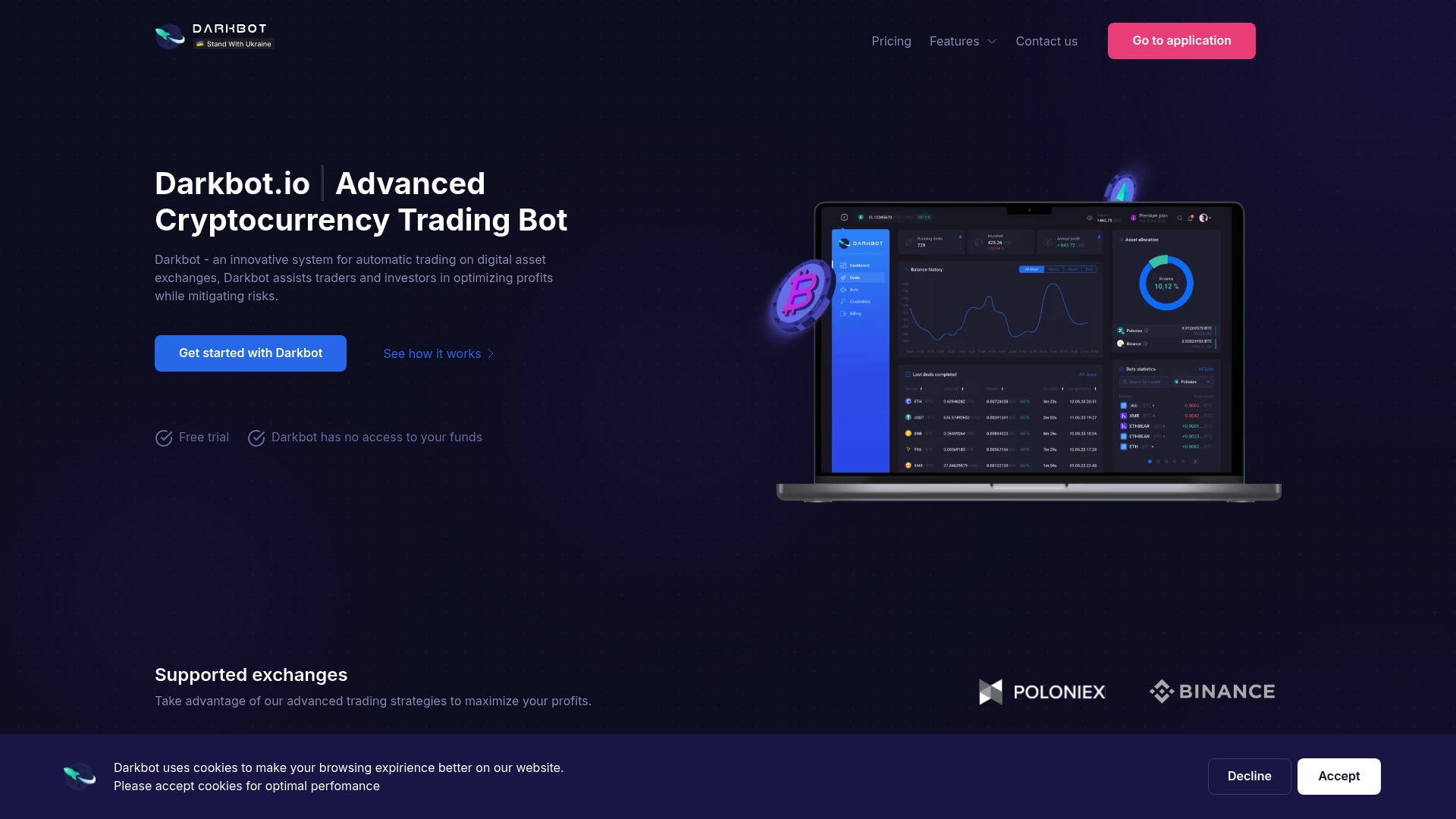
Darkbot is an AI-based crypto trading automation platform built for systematic execution across multiple exchanges, including Binance. It connects via API keys, applies rule-driven trading logic, and manages portfolios with automated rebalancing and real-time analytics. The platform handles the infrastructure layer, including error handling and exchange connectivity, so traders can focus on strategy configuration rather than code. Darkbot offers free, standard, and premium tiers, making it accessible at different levels of commitment. For traders ready to put the concepts in this guide into practice, Darkbot’s trading automation tools provide a structured starting point. Traders focused on allocation management can also review Darkbot’s portfolio management tools for systematic rebalancing across crypto positions.
FAQ
What is a Binance API key used for?
A Binance API key authenticates your application’s requests to Binance’s trading infrastructure. It grants defined permissions, such as reading account data or placing trades, without exposing your account password.
What is the difference between REST and WebSocket APIs on Binance?
REST API handles individual request-response interactions like placing or canceling orders. WebSocket API delivers continuous real-time data streams, making it the correct choice for live price feeds and order book monitoring.
How do I keep my Binance API keys secure?
Disable withdrawal permissions, restrict access to specific IP addresses, and store keys in environment variables rather than source code. Rotate keys periodically and revoke any key that may have been exposed.
Can beginners use Binance API trading?
Beginners can use the Binance API, but the learning curve is real. Starting with Binance’s testnet environment and a simple rule-based strategy reduces risk while building familiarity with authentication, error handling, and order management.
What is the recvWindow parameter in Binance API authentication?
The recvWindow parameter defines how long a signed request remains valid after its timestamp. Setting it tightly reduces the window during which an intercepted request could be replayed by an attacker.
Recommended

Start trading on Darkbot with ease
Come and explore our crypto trading platform by connecting your free account!
Free plan available • No credit card required