Maker vs Taker Fees: What Crypto Traders Need to Know
Maker fees apply when your order adds liquidity to an exchange’s order book; taker fees apply when your order removes it. The practical difference can be significant: on many U.S. exchanges, taker fees typically run higher than maker fees at the same volume tier. To get maker pricing immediately, place a limit order with a post-only flag so the exchange rejects the order rather than filling it as a taker if it would cross the spread. The maker–taker pricing structure is documented in detail by Investopedia, the Coinbase fee schedule, and is a core consideration in automated execution platforms like Darkbot.
Key Takeaways
Maker fees apply when your order rests on the book; taker fees apply when it executes immediately, and the difference in total execution cost compounds significantly across high-frequency or large-notional trading.
| Point | Details |
|---|---|
| Maker vs taker classification | Determined by whether your order adds or removes liquidity at the moment it arrives, not by order type alone. |
| Post-only flag | Use post-only on limit orders to guarantee maker classification and prevent accidental taker fills. |
| True execution cost | Model effective cost as explicit fee plus slippage plus price impact; taker fees are often the smallest component. |
| Fee tier strategy | Track 30-day USD volume across all pairs; crossing a tier boundary reduces both maker and taker rates on all subsequent trades. |
| Darkbot for execution discipline | Darkbot’s API integration, post-only support, and fee-aware backtesting help enforce consistent maker-favoring execution at scale. |
How maker vs taker fees actually work: definitions and order-type mapping
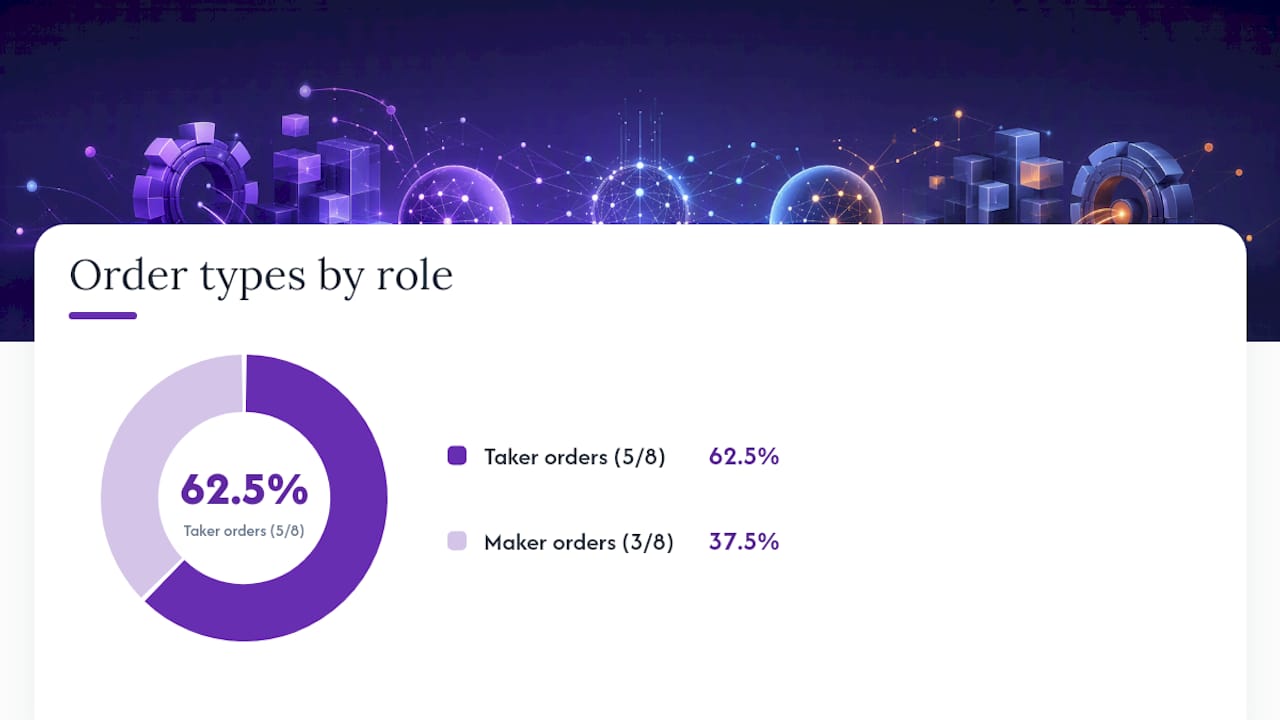
A maker is any trader whose order rests on the order book without immediately executing. By posting a bid or ask that others can trade against, the maker adds depth and improves market quality. Exchanges reward this with lower fees or, at higher volume tiers, outright rebates.
A taker executes against an existing order, removing that liquidity from the book. Because the exchange has to compensate the maker and still cover its own costs, takers pay a higher fee rate.
The classification follows the order, not the trader. The same account can be a maker on one trade and a taker on the next, depending entirely on how the order interacts with the book at the moment it arrives.
Order-type mapping:
- Market order: Always taker. It executes immediately at the best available price, removing liquidity.
- Limit order (resting): Maker. Posted at a price away from the current best bid/ask; it sits on the book until filled.
- Limit order (crossing the spread): Taker for the portion that fills immediately. If your buy limit is at or above the current ask, it executes on arrival.
- Post-only limit order: Guaranteed maker. The exchange cancels the order rather than filling it as a taker if it would cross.
- IOC (Immediate-or-Cancel): Taker for any portion that fills; the remainder is canceled.
- FOK (Fill-or-Kill): Taker. The entire order must fill immediately or it is canceled.
- Stop-market order: Taker when triggered, because it converts to a market order.
- Stop-limit order: Maker if the limit price rests on the book after triggering; taker if the limit price crosses the spread at trigger time.
| Order Type | Typical Classification | Short Example |
|---|---|---|
| Market order | Taker | Buy BTC at best ask immediately |
| Resting limit order | Maker | Buy BTC at $500 below current ask |
| Crossing limit order | Taker (filled portion) | Buy limit at or above current ask |
| Post-only limit | Maker (guaranteed) | Limit with post-only flag set |
| IOC | Taker | Fill what you can, cancel rest |
| FOK | Taker | Fill all or cancel entirely |
| Stop-market | Taker | Triggers as market order |
| Stop-limit (resting) | Maker | Limit rests after trigger |
Pro Tip: A limit order is not automatically a maker order. If your limit price crosses the current spread at the moment of submission, the exchange fills it immediately as a taker. Always check the current bid/ask before placing a limit order you intend to be maker.
How exchanges set fees: tiers, rebates, and sample calculations
U.S. exchanges including Kraken, Binance.US, and Coinbase use tiered fee schedules based on trailing 30-day USD trading volume. As your volume rises, both maker and taker rates fall. At higher tiers, maker fees can reach zero or flip to a rebate, meaning the exchange pays you a small amount per dollar traded for providing liquidity. Non-USD trading pairs are converted to USD equivalents using recent fill prices to calculate which tier you occupy.
The structure creates a clear incentive: trade more, pay less per trade, and eventually get paid to make markets.
Sample fee tier structure (illustrative, based on U.S. exchange tier logic):
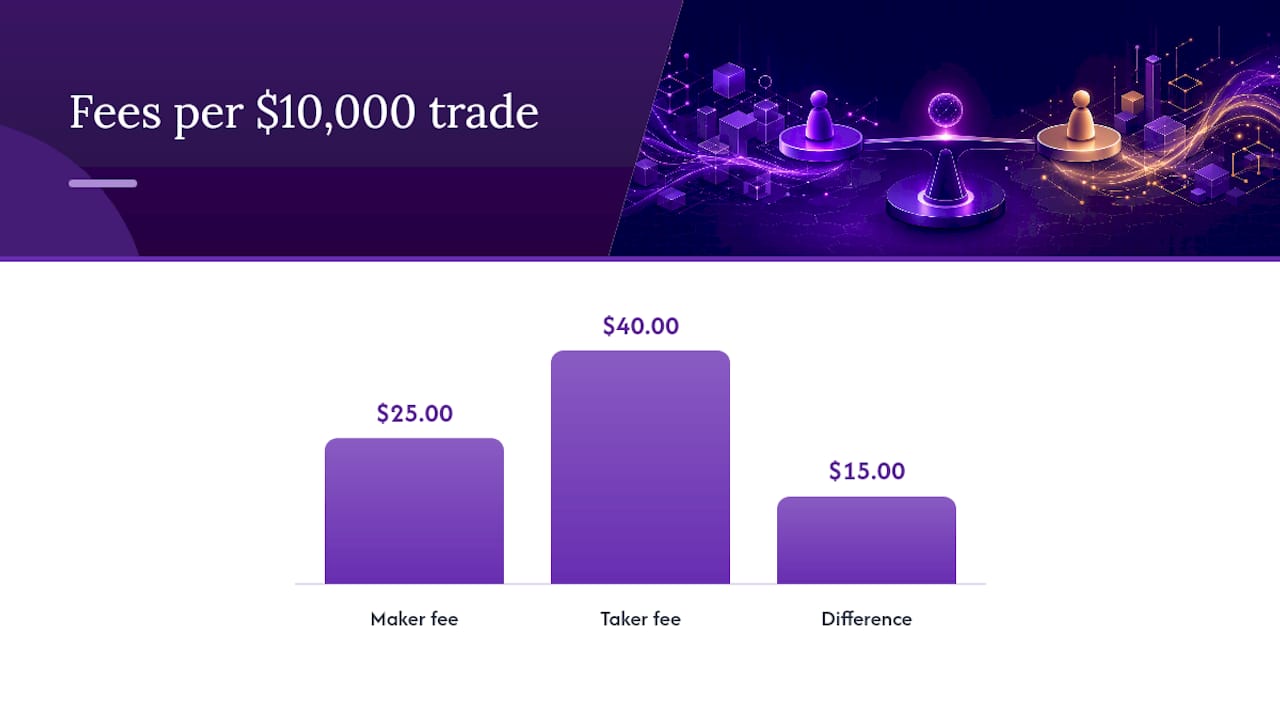
- Maker fee: $10,000 × 0.0025 = $25.00
- Taker fee: $10,000 × 0.0040 = $40.00
- Difference per trade: $15.00
That fee difference can add up significantly over many trades. For example, running multiple trades each month at similar volumes can produce substantial savings by achieving maker classification.
Stable-pair and institutional books often carry separate, lower fee schedules. Check the official fee page for the specific pair you trade, not just the default schedule.
Practical tactics to get maker pricing on your orders
Getting maker classification consistently requires deliberate order placement, not just choosing limit orders.
- Enable post-only on every limit order where speed is not critical. Most exchanges expose this as an order flag in the UI and via API. The exchange rejects the order rather than filling it as a taker, so you never accidentally pay taker fees.
- Place limit orders inside the spread, not at the market. A buy limit at $0.50 below the current ask rests on the book; a buy limit at the ask or above fills immediately as a taker.
- Avoid IOC/FOK when maker classification matters. Both order types guarantee taker treatment for any filled portion. Use them only when immediate execution is the actual goal.
- Split large orders into smaller resting limits. A single large market order creates price impact and taker fees. Multiple smaller limit orders placed at staggered prices rest on the book and fill as maker over time.
- Use pegged-limit strategies for active markets. A pegged limit order adjusts its price to stay just inside the spread as the market moves, maintaining maker status without requiring manual repricing.
- Track your 30-day volume actively. Crossing a tier boundary mid-month changes your fee rate for all subsequent trades. Some exchanges update tiers in real time; others update daily.
For API traders specifically: set the post_only parameter to true in your order submission payload. On Kraken, this is the oflags=post parameter. On Coinbase Advanced Trade, it is the post_only boolean in the order request body. If the order would cross, the API returns a rejection rather than a taker fill, which your bot should handle as a repricing signal, not an error.
Pro Tip: Partial fills create mixed fee classifications. If a 10 BTC limit order fills 3 BTC immediately (taker) and the remaining 7 BTC rest on the book (maker), you pay taker fees on the 3 BTC and maker fees on the 7 BTC. Post-only prevents this entirely by rejecting any order that would produce an immediate partial fill.
How fees combine with slippage and price impact to determine true execution cost
The headline maker/taker rate is only one component of what you actually pay to execute a trade. Slippage in crypto captures the deviation between your expected price and your executed price, driven by timing, routing, and market movement. Price impact is the portion of cost caused by your trade size relative to available liquidity: a large order in a thin book moves the price against you as it fills.
Effective execution cost formula:
Effective cost = explicit fee + slippage + price impact + half-spread
Worked comparison: $50,000 BTC trade on a liquid CEX book
The market order costs roughly six times more in total, not just in headline fees. The tradeoff is time: the limit order may take minutes or hours to fill, or may not fill at all if the market moves away.
On DEXs, price impact is more visible and often larger. Uniswap surfaces a direct price-impact warning when pool liquidity is thin relative to your swap size. Wallets like Exodus also surface these warnings to prevent executing swaps with unusually high loss from pool price impact.
Slippage tolerance on DEXs is a separate control: it sets the maximum acceptable deviation before the transaction reverts. Setting it too tight causes failed transactions; setting it too wide exposes you to front-running and sandwich attacks.
For scalpers and high-frequency strategies, taker fees are often rational to pay because speed is the strategy. For position traders and systematic strategies, the cost difference between maker and taker execution compounds meaningfully over hundreds of trades.
When fees matter most and common mistakes that increase costs
Fees become material when:
- Trade size exceeds roughly $5,000 per order (the absolute dollar difference between maker and taker rates becomes significant).
- Trade frequency is high (10+ trades per week at meaningful size).
- The pair is illiquid, meaning slippage and price impact amplify the taker fee cost.
- You are in a low-volatility regime where the spread is tight and patience costs little.
Common mistakes that increase costs:
- Assuming all limit orders are maker. A limit order that crosses the spread on entry is a taker order. Check the spread before submitting.
- Ignoring partial fills. A partially filled limit order that had an immediate fill component incurs taker fees on that portion. Post-only eliminates this.
- Chasing tier thresholds with unnecessary trades. Trading extra volume to cross a tier boundary only makes sense if the fee savings on future trades exceed the cost of the additional trades used to qualify.
- Optimizing fees while ignoring slippage. Saving 0.15% in maker fees on a trade with 0.30% slippage is a net loss. Model both.
- Using market orders out of habit. Many traders default to market orders for convenience. On pairs with moderate liquidity, a patient limit order costs a fraction of the equivalent market execution.
A rough rule of thumb: if you execute multiple taker trades per month at meaningful size, the fee difference between taker and maker can result in significant cumulative cost before considering slippage.
How automation reduces effective execution costs
Systematic execution tools address the two main sources of avoidable cost: fee misclassification and slippage from large single orders. Treating fees as part of execution quality rather than an afterthought is the defining characteristic of professional algorithmic trading.
Capabilities that reduce effective cost:
- Post-only order flags via API: Bots can set post-only on every limit order, eliminating accidental taker fills without manual oversight.
- Order-slicing: Large orders are broken into smaller tranches placed as resting limits, reducing both price impact and taker fee exposure.
- Adaptive pegged limits: The bot reprices limit orders to stay just inside the spread as the market moves, maintaining maker status across volatile sessions.
- Rate-limited execution: Spacing order submissions to avoid hitting exchange rate limits, which can force fallback to market orders.
- Backtesting with maker/taker cost models: Strategy performance should be evaluated using realistic fee assumptions, not zero-fee or flat-fee approximations.
Feature checklist when evaluating an automation platform:
- API access to supported exchanges with post-only order support
- Configurable maker/taker fee inputs in the backtesting engine
- Order-slicing and tranche-based execution logic
- Slippage tolerance controls for DEX integrations
- Real-time fill reporting that distinguishes maker vs taker classification per trade
Pro Tip: When backtesting a strategy, run it twice: once with maker fees only, once with taker fees only. The spread between those two equity curves is your execution-quality budget. A strategy that is only profitable under maker-fee assumptions is fragile; one that survives taker fees has genuine edge.
Systematic traders compute a break-even that includes explicit fees, slippage, partial-fill effects, and the opportunity cost of resting orders. They use API access to order books and historical fills to optimize for liquidity rather than just the lowest advertised maker/taker percentages. The goal is not the cheapest fee rate — it is the lowest total execution cost per unit of edge captured.
Crypto bot strategy optimization and fee-aware backtesting are the two practices that separate systematic traders from those who discover fee drag only after reviewing their monthly P&L.
The part most traders skip
Most discussions of maker vs taker fees stop at the rate comparison. The more consequential question is whether your execution process is designed to produce the classification you intend, consistently, across hundreds of trades.
A single misclassified order costs a few dollars. A bot that defaults to market orders because post-only was never configured costs that amount on every trade it executes. The fee structure is not the variable; the execution discipline is. Exchanges publish their fee schedules transparently. The gap between what traders pay and what they could pay is almost entirely a process problem, not an information problem.
The same logic applies to slippage tolerance on DEX integrations. Professional execution means making that number explicit, understanding what it costs, and choosing it deliberately.
Automation does not solve this by itself. A bot configured without post-only flags, without realistic fee inputs in its backtest, and without order-slicing logic will replicate the same avoidable costs at higher frequency. The discipline has to be built into the configuration.
Darkbot automates disciplined maker-favoring execution
Reducing taker fees and slippage at scale requires consistent process, not manual vigilance on every order. Darkbot connects directly to supported exchanges via API and executes strategies with configurable post-only flags, order-slicing logic, and maker/taker fee inputs built into its backtesting engine. Every strategy can be evaluated against realistic fee assumptions before it runs live, so the cost model is explicit from the start.
Portfolio-level analytics show fill classification per trade, making it straightforward to audit whether your bots are achieving the maker execution rate your backtest assumed. For traders who want to move from manual order placement to systematic, fee-aware execution, Darkbot offers a free entry tier and a 14-day money-back guarantee on paid plans. Start with a backtest that models both maker and taker costs, then let the platform enforce the execution rules your strategy requires.
Sources
- Understanding Maker-Taker Fees: Impact on Traders and Market Liquidity
- Crypto Maker vs Taker Fees Explained: How Trading Fees Impact Your Profits
- Exchange fees | Coinbase Help
- What is price impact? — Uniswap Support
- Chain
This article is general information, not a substitute for advice from a qualified financial advisor. Consult a qualified financial professional about your own circumstances before acting on anything here.
Recommended

Start trading on Darkbot with ease
Come and explore our crypto trading platform by connecting your free account!
Free plan available • No credit card required