Multi-Pair Trading Bots Compared: How to Choose in 2026

A multi-pair trading bot runs one rule set across many crypto markets at once, scanning each pair, sizing positions against your account and placing orders through exchange APIs. The best choice depends on four things: which exchanges it connects to, how it controls risk across pairs, how you can test it, and what it costs. Below we compare the main options on those criteria, and we include Darkbot, our own platform.
TL;DR
- A multi-pair bot applies the same rules to many pairs, so the real work is portfolio-level risk control, not signal generation.
- Compare bots on exchange support, strategy and risk controls, testing tools and pricing model (flat subscription, percentage fee or profit share).
- Darkbot is an AI-based automation platform with backtesting, paper trading, multiple simultaneous bots and risk tools. Standard is $12.50 per month and Premium is $25.00 per month.
- Test with backtesting and paper trading first, use trade-only API keys, and cap total exposure before you go live.
- No bot removes market risk. Judge a platform by execution quality and control, not by promised returns.
What a multi-pair bot does
A multi-pair bot monitors, analyzes and trades many pairs concurrently, following predefined rules. According to one overview of AI pairs trading bots, the loop is: scan pairs for opportunities, generate signals from set criteria, size positions against account balance and risk tolerance, then place and manage orders through exchange APIs. That overview is a general description of the category, not of any single product.
The value is consistency. A person can watch a handful of charts. A rule-driven system applies the same logic to dozens of pairs without fatigue, and it logs every decision. Machine learning, where a platform uses it, is best understood as probabilistic pattern evaluation and rule-driven adaptation. It does not predict prices, and it cannot assure profit.
Two meanings of “multi-pair” are worth separating:
- Parallel pairs. The bot runs independent strategies on BTC/USDT, ETH/USDT, SOL/USDT and so on. Each pair has its own entries and exits.
- Relative-value pairs. The bot trades the spread between two related assets, long one and short the other. This is classical pairs trading and usually needs margin or futures.
Most retail platforms mean the first. This article focuses on it, and notes where the second differs.
The criteria that separate the options
Exchange coverage
A bot is only as useful as the venues it reaches. Some platforms connect to many exchanges through API keys. Others are built into a single exchange. Multi-pair trading across several venues also raises capital-allocation questions, which we cover in our guide to multi-exchange integration.
Strategy and order logic
Common strategy types in this category are grid trading, arbitrage, trend following, mean reversion and smart order routing. A good multi-pair bot lets you assign a strategy per pair rather than forcing one template on every market. Our overview of trading bot types explains how these differ.
Portfolio-level risk controls
This is the criterion that matters most with many pairs. Ten positions in ten altcoins are often one correlated bet on the same market direction. You want position-size limits, a maximum total exposure setting and stop logic that works per pair and for the whole account.
Testing tools
Backtesting shows how rules would have behaved on historical data. Paper trading shows how they behave on live prices without real funds. A platform with neither forces you to learn on live capital.
Pricing model
Models differ: flat monthly subscription, a trading fee built into an exchange, or a share of profit. Fincode’s November 2026 pricing review shows paid plans ranging from $15 to $149 per month, with several free offers. The structure affects how cost scales as you add pairs and volume.
Comparison of leading multi-pair bots
The table uses the November 2026 DailyCoin roundup for exchange support and the Fincode review for free offers. Darkbot’s details come from our own pricing page. Check each provider’s current page before you subscribe, since plans change.
| Platform | Exchange support | Free option | Pricing model |
|---|---|---|---|
| Darkbot | API-key connection to supported exchanges | Free plan with limited features | Subscription: Standard $12.50 per month, Premium $25.00 per month, Enterprise on request |
| 3Commas | Multiple exchanges including Binance, Bybit, OKX, Kraken and Coinbase | Not listed in our sources | Subscription |
| Pionex | Built into its own exchange | No bot fee | 0.05% spot trading fee |
| Cryptohopper | Binance, Kraken, KuCoin and HTX | Not listed in our sources | Subscription |
| Coinrule | 10+ centralized exchanges plus on-chain protocols | 2 running rules | Subscription |
| Bitsgap | 17 exchanges including Binance, Kraken, KuCoin, OKX and Coinbase | 20 demo bots | Subscription |
| Gainium | Not listed in our sources | 250 bot credits | Credits and subscription |
| Freqtrade, Hummingbot | Self-hosted, exchange connectors | Open source | Free software, you host and maintain it |
| Veles | Not listed in our sources | No subscription | 20% of profit up to $250, then $50 per month and trading type |
How to read the table
Exchange-native bots such as Pionex are simple to start with, but they tie you to one venue. Multi-exchange platforms such as 3Commas, Bitsgap and Cryptohopper let you keep funds where you already trade. Open-source frameworks give full control and need programming skill, a server and ongoing maintenance. Profit-share models align cost with results on paper, but the fee grows as you succeed, so compare it with a flat plan at your expected volume.

Where Darkbot fits
Darkbot is a subscription platform for automated crypto trading. It is not a signal provider. It executes rules you define, and the AI layer supports consistency and systematic evaluation rather than forecasting.
The features relevant to multi-pair work:
- Multiple simultaneous bots, so different pairs can run different strategies.
- Strategy customization and fine-tuning per bot.
- Backtesting and paper trading before live capital is used.
- Risk management tools and automated rebalancing for portfolio-level control.
- Real-time analytics to review what each bot did and why.
- API-key exchange integration with direct order routing, and human oversight in how we approach the system.
Plans are Free (limited features), Standard at $12.50 per month, Premium at $25.00 per month and Enterprise. A 14-day money-back guarantee applies. Current details are on the Darkbot pricing page.
For a small account, a flat fee matters. Against a 0.05% fee or a percentage of profit, a subscription is a fixed line you can model in advance. The right choice depends on your volume, so run the numbers for your own trade count.
How to test a multi-pair bot before using real funds
A structured test beats intuition. Academic work on multi-pair crypto strategies shows what a rigorous sequence looks like. A paper by Lebiedź and Ślepaczuk uses four tiers: a single-pair monthly backtest, a multi-pair monthly portfolio (20 pairs by default), 12 rolling multi-pair iterations, and a full analysis with 2024 as in-sample data and 2025 as out-of-sample data.
You can adapt that logic at retail scale:
- Start with one pair. Confirm the rules behave as intended on a single market.
- Expand to a basket. Add pairs in stages and check how combined drawdown differs from the single-pair results.
- Test across periods. Run the rules on rolling windows, not one favorable stretch. Keep the most recent data aside as an out-of-sample check.
- Include costs. Enter realistic exchange fees and slippage. Backtests without them overstate results.
- Paper trade. Run the bot on live prices without funds. Compare its fills with what the backtest assumed.
- Go live small. Use a fraction of intended capital and scale only after live behavior matches the tests.
Our strategy optimization guide covers the parameter-tuning side, including how over-fitting creeps in when you tune to past data.
Managing risk across many pairs
More pairs do not automatically mean more diversification. Crypto assets often move together in stress, so correlated exposure is the main hazard. Practical controls:
- Risk per trade. Set a small fixed percentage of account equity per position. Our 1-2% rule checklist walks through the sizing arithmetic.
- Total exposure cap. Limit how much capital can be deployed across all pairs at once, regardless of how many signals fire.
- Correlation awareness. Group pairs that move together and treat the group as one position when you set limits.
- Liquidity filters. Prefer pairs with enough depth that your orders do not move the price. Thin pairs raise slippage.
- Drawdown limits. Define in advance the account-level loss at which the bots pause for review.
For a broader framework see our guide to risk management in crypto trading bots and our notes on portfolio management and automation.
Security checks before connecting any bot
Connecting a bot means giving software access to your exchange account through an API key. Handle it with least privilege:
- Enable trading only. Leave withdrawal permission off. Exchange education material such as BloFin’s API safety guide makes the same recommendation.
- Restrict by IP where the exchange supports it, so a leaked key is useless from other addresses.
- Use a separate key per bot or platform, so you can revoke one without disrupting the others.
- Turn on two-factor authentication on the exchange account itself.
- Review the audit trail. Check which orders the bot placed and confirm they match your settings.
- Keep funds proportionate. Keep on the trading account only the capital you intend to run.
Perspective
Most problems with multi-pair automation are not caused by the entry logic. They come from unbounded exposure, untested assumptions and unclear accountability when something goes wrong.
Our view is that a bot should be a disciplined executor. You define the rules, position limits and exposure caps. The system applies them consistently across pairs, around the clock, and records every decision. We use machine learning for probabilistic pattern evaluation and rule-driven adaptation, not for prediction. Nothing in a bot can promise an outcome, and we do not present it that way.
That is why Darkbot puts backtesting and paper trading in front of live capital, runs multiple bots with separate settings, and keeps risk tools and human oversight in the design. For a trader running several pairs on a modest account, repeatable process and visible control are worth more than complexity.
Grisha
Start with a plan you can afford to test
If you want to run several pairs under one set of risk rules, Darkbot’s Free plan lets you explore the platform with limited features. Standard ($12.50 per month) and Premium ($25.00 per month) add capacity for more active setups, and the 14-day money-back guarantee covers the early evaluation period.
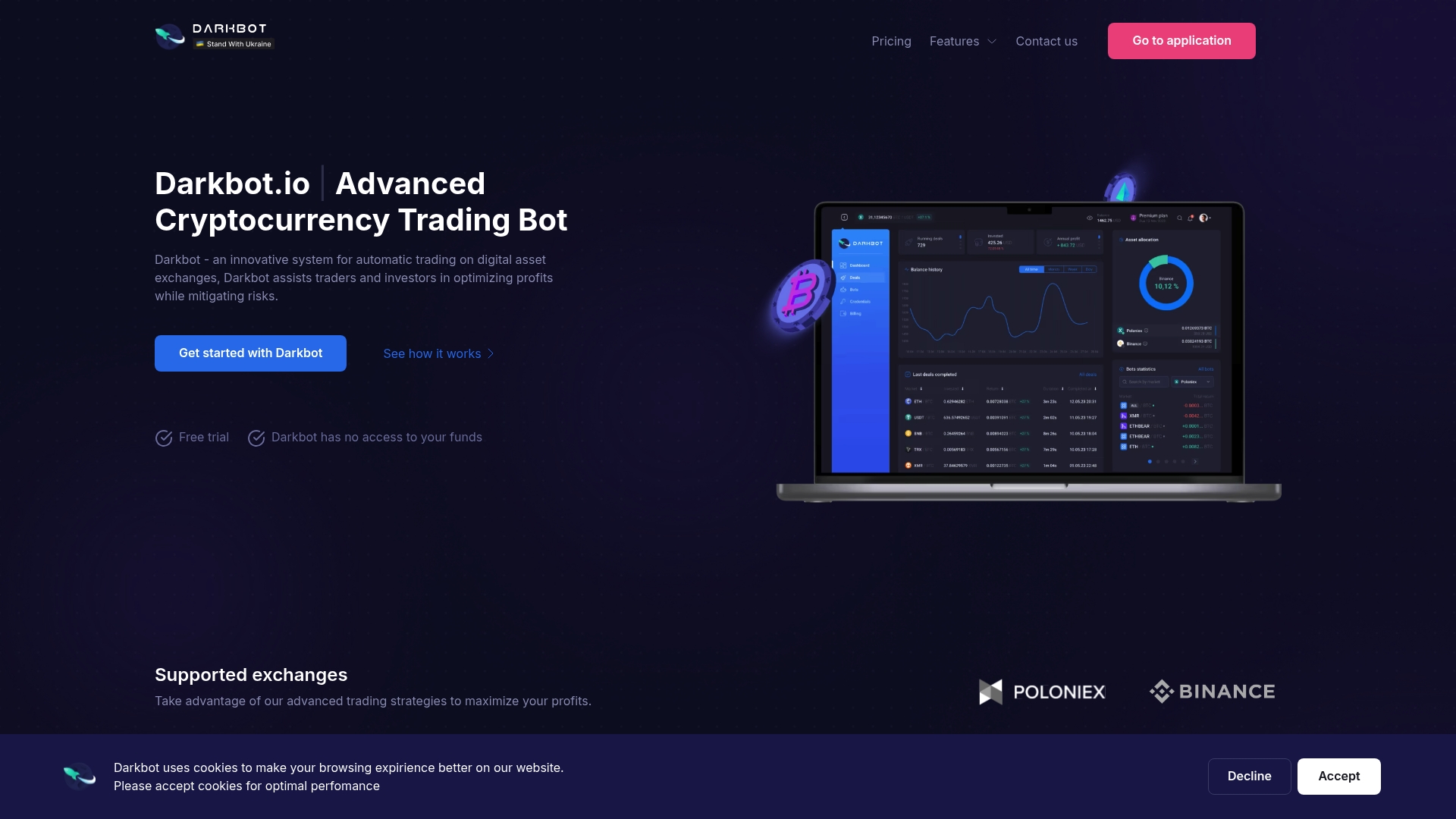
See what each tier includes on the Darkbot plans page, or read the overview at darkbot.io. If you are new to the topic, how to automate crypto trading is a good starting point.
FAQ
How many pairs should a multi-pair bot trade?
There is no universal number. Start with a few liquid pairs, confirm that combined drawdown stays within your limit, then add pairs gradually. Research designs may use 20 pairs, but a small account is usually better served by fewer, more liquid markets.
Is a multi-pair bot the same as pairs trading?
No. A multi-pair bot runs strategies across many markets. Pairs trading is a specific strategy that trades the spread between two related assets. A multi-pair platform may support both, but the setup and risks differ.
Do I need to leave my computer on?
Not with a cloud platform, which executes on its servers through your exchange API. Self-hosted tools such as Freqtrade and Hummingbot run on hardware you maintain, so uptime is your responsibility.
Can I start for free?
Several platforms offer free entry points. Darkbot has a Free plan with limited features, and Bitsgap, Coinrule, Gainium and the open-source frameworks have free offers as well, according to Fincode’s review. Confirm current limits on each provider’s page.
What is the safest way to connect a bot?
Create a dedicated API key with trading permission only, withdrawals disabled, and IP restriction if available. Pair it with two-factor authentication on the exchange account.
Sources
- How to Use AI Bots for Pairs Trading in Cryptocurrency
- 5 Best AI Crypto Trading Bots, DailyCoin
- Crypto trading bot price: subscriptions, fees, build cost, Fincode
- Dynamic Multi-Pair Trading Strategy in Cryptocurrency, arXiv
- API Trading Safety: Protecting Keys, Permissions, and Rate Limits, BloFin Academy
Recommended

Start trading on Darkbot with ease
Come and explore our crypto trading platform by connecting your free account!
Free plan available • No credit card required