AI trading bots vs human traders: the crypto trader's guide
TL;DR:
- AI trading bots often lose capital in competitive markets because they lack human judgment and adaptability.
- Hybrid systems, combining human strategy with AI execution, deliver significantly higher risk-adjusted returns and discipline.
Most crypto traders assume the answer to “AI trading bots vs human traders” is obvious: the machines win. They’re faster, emotionless, and never sleep. But recent 2026 competition data tells a different story, one where most AI bots bleed capital and only a handful of well-designed hybrid systems actually generate meaningful returns. If you’re trying to decide whether to automate, trade manually, or combine both, the real answer is more nuanced than any headline suggests.
Key Takeaways
| Point | Details |
|---|---|
| AI bots excel in execution speed | AI trading bots operate in milliseconds, capturing opportunities too fast for humans. |
| Humans provide essential judgment | Human traders bring adaptability and crisis management that AI currently lacks. |
| Hybrid strategies outperform alone | Combining human oversight with AI execution yields better returns and risk control. |
| Overtrading harms AI performance | Excessive trading by AI bots often erodes profits through fees and poor timing. |
| Disciplined risk management is critical | AI bots typically enforce stop-loss rules better than manual traders, reducing losses. |
How AI trading bots operate versus human traders
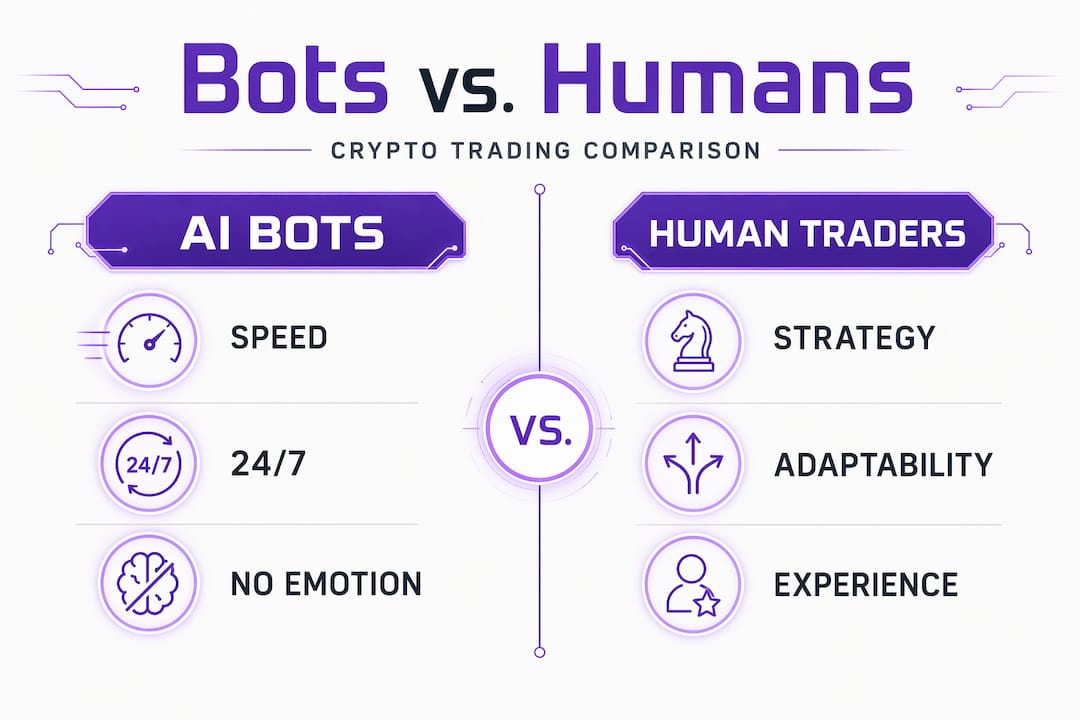
The most obvious difference is speed. AI bots execute trades in milliseconds while human traders take seconds to minutes, which matters enormously in crypto markets where price gaps open and close faster than a manual order can process. But speed alone does not equal profit.
Beyond execution, the operational differences between AI and humans run deep:
- Data processing: AI bots scan hundreds of price feeds, order book depth, volume patterns, and technical indicators simultaneously. A human trader realistically tracks a handful of signals at once.
- Emotional bias: Humans are wired to feel fear during drawdowns and greed during rallies. These feelings corrupt judgment. AI bots follow rules regardless of how uncomfortable the market feels.
- Context and intuition: Here’s where humans have a genuine edge. When a central bank makes an unexpected announcement or a major exchange halts withdrawals, a human trader reads the situation and adapts. An AI bot sees price movement and responds to patterns, but it has no framework for interpreting something it has never seen before.
- Consistency: AI executes the same logic on trade 1,000 as it did on trade 1. Humans get tired, distracted, and second-guess themselves.
The advantages of automated crypto trading are real, but they come with a specific caveat: the bot is only as good as the logic it runs on. Garbage strategy executed perfectly is still a losing strategy.
Performance comparisons from recent AI trading competitions
Numbers cut through the hype fast. In 2026, Alpha Arena ran controlled experiments placing major AI models into live trading scenarios. The results were sobering: eight AI models lost roughly one-third of their capital, with only 6 profitable outcomes across 32 trading sessions. One bot placed over 1,400 trades in a short window, which is not aggression, it’s fee suicide.
The trading bots performance comparison changes when humans design the strategy and AI handles execution. Hybrid AI systems delivered median 6-month returns of +23.1% compared to +6.4% for manual trading, with a Sharpe ratio (a measure of return per unit of risk) of 1.47 versus 0.51 for pure human traders.
Here’s how the three approaches stack up across key performance metrics:
| Metric | Pure AI bot | Human trader | Hybrid AI-human |
|---|---|---|---|
| 6-month median return | Variable, often negative | +6.4% | +23.1% |
| Sharpe ratio | Low (overtrading drag) | 0.51 | 1.47 |
| Stop-loss compliance | 94% | 22% | 94% |
| Adaptability to new events | Poor | Strong | Strong |
| Fee drag risk | High | Low | Moderate |
The most telling pattern across these AI trading strategies examples is that pure AI without human guardrails tends to overtrade. More trades mean more fees, and in volatile crypto markets, fee drag compounds into serious losses.
Advantages and limitations of AI bots and human traders in crypto markets
With that performance context in mind, let’s be specific about where each side actually wins.
Where AI bots have a clear edge:
- Stop-loss discipline: AI bots maintain 94% compliance on stop-loss execution compared to a 78% violation rate among manual traders. That gap alone accounts for a massive difference in downside exposure during volatile markets.
- Speed in trending markets: When momentum is clean and directional, AI systems capture moves that humans simply cannot react to in time.
- 24/7 operation: Crypto markets never close. Human traders sleep; bots don’t.
- Backtesting at scale: An AI system can test a strategy across years of data in minutes. A human backtesting manually would take weeks.
Where human traders still hold their own:
- Unprecedented events: Flash crashes, exchange hacks, regulatory announcements, and macro shocks do not fit historical patterns. Humans recognize these as outliers and adjust. AI bots often double down on the wrong side.
- Regime changes: Shifting from a bull market to a sideways grind requires a fundamentally different strategy. Humans feel this shift. AI needs explicit reprogramming or a well-built adaptive model.
- Relationship and information networks: Experienced traders access context through community signals, news interpretation, and judgment calls that no algorithm currently replicates.
AI systems need persona-based approaches to better align with human expectations in reliable live trading, particularly around trust and adaptive decision-making. A bot that runs a clean stop-loss strategies analysis and enforces it without hesitation still needs a human to decide whether the overall strategy fits current market conditions.
Pro Tip: Before running any AI bot live, paper trade it across at least one significant volatility event. A bot that handles a 30% drawdown correctly in simulation is far more trustworthy than one only tested in calm market conditions.
The automated trading advantages are most pronounced when the bot’s rule set was written by someone who deeply understands the market it’s operating in.
Using AI bots and human judgment together: the hybrid approach
The data points to one clear conclusion: neither pure AI nor pure human trading is optimal. The hybrid model, where humans design strategy and AI handles execution, outperforms both.
Here’s how a functioning hybrid setup actually works:
- Human assesses market regime. Is the market trending, ranging, or in a high-volatility shock phase? This context shapes which bot strategy runs.
- Human sets parameters. Entry conditions, position sizes, stop-loss levels, and take-profit targets are defined by a trader who understands risk.
- AI executes without emotion. The bot fires orders at machine speed, holds discipline on stops, and monitors dozens of signals simultaneously.
- Human monitors for anomalies. API outages, exchange issues, or unexpected macro events trigger human intervention. The bot doesn’t pause for context. You do.
- Human tunes and iterates. After each trading period, a human reviews performance, adjusts parameters, and updates the strategy to reflect what the market is doing now.
“The best-performing hybrid systems in 2026 achieved Sharpe ratios nearly three times higher than manual trading, not because AI is smarter, but because it never disobeys the rules humans set for it.”
Hybrid human-AI models consistently outperform both pure AI and pure manual approaches by combining human strategic intelligence with AI’s execution discipline. At the same time, pure AI trading bots trail in complex scenarios where adaptive judgment matters most, which is exactly what human oversight compensates for.
Pro Tip: Set a weekly review cadence for your bot’s parameters. Markets evolve, and a strategy tuned for last month’s conditions can become a liability next month without adjustment.
Building smarter crypto strategies is less about finding the perfect algorithm and more about building a disciplined process where AI does the repetitive execution and humans do the thinking.
Practical considerations for crypto traders choosing between AI bots and manual trading
The choice between AI vs manual trading effectiveness is not purely academic. There are real infrastructure, skill, and risk factors that determine which approach fits your situation.
Consider these critical factors before committing to either path:
- Configuration expertise matters enormously. 73% of automated crypto accounts fail within six months. Most failures trace back to poor configuration, not bad AI. Running a bot you don’t understand is not automation, it’s expensive guessing.
- API reliability is a real risk. Bots depend on stable API connections to exchanges. An outage during a volatile market event can freeze your bot mid-trade, creating unintended open positions.
- Manual trading demands emotional discipline most traders genuinely lack. Knowing you should hold your stop-loss and actually holding it when your portfolio is down 20% are very different things.
- Adaptive AI beats static rules. AI bots that adapt to regime changes improve risk-adjusted returns by 34% over static rule-based systems. If your bot runs fixed logic regardless of market conditions, you’re running a rule engine, not an adaptive system.
Here’s a quick comparison to guide your evaluation:
| Factor | AI bot | Manual trading |
|---|---|---|
| Execution speed | Milliseconds | Seconds to minutes |
| Emotional discipline | Built-in | Requires significant self-control |
| Adaptability to anomalies | Limited | Strong |
| Setup complexity | Moderate to high | Low |
| Fee risk | High if overtrading | Controlled |
| Overnight/weekend coverage | Full | None unless you’re awake |
The key risks in automated trading are real and often underestimated. Bots don’t protect you from bad strategy, poor configuration, or exchange-level failures. They amplify whatever you build into them, good and bad.
Why the hybrid model is the practical future for crypto trading
Here’s the perspective that most AI trading content won’t give you: the narrative that AI bots will replace human traders entirely is a sales pitch, not a forecast grounded in current data.
LLMs fundamentally cannot make money on their own, as researchers and practitioners working directly on these systems have stated clearly. What they need is sophisticated data infrastructure and human scaffolding to function effectively in live markets. That’s not a limitation that will disappear next year. It reflects a structural reality about what pattern recognition systems can and cannot do without human-level contextual understanding.
What we’ve seen across real trading data is this: the traders who perform best in 2026 are not the ones who handed everything to an AI and walked away. They’re the ones who understood enough about market dynamics to configure AI tools precisely, monitor them actively, and intervene when conditions changed.
The dangerous middle ground is traders who use AI bots as a substitute for learning. They run a bot they don’t understand, see early losses, assume the AI is broken, and either abandon it or start chasing a different bot. The problem was never the AI. It was the absence of human judgment wrapped around it.
At Darkbot, we build around the idea that automated crypto trading advantages are only accessible when the human element is part of the design. That means giving traders tools to set clear parameters, monitor in real time, and adjust strategy without needing a computer science degree. AI handles the execution. You bring the judgment.
Explore DarkBot’s AI-powered crypto trading automation platform
The data in this article points to one conclusion: AI is most effective when paired with human strategic oversight. That’s exactly what DarkBot is built for.
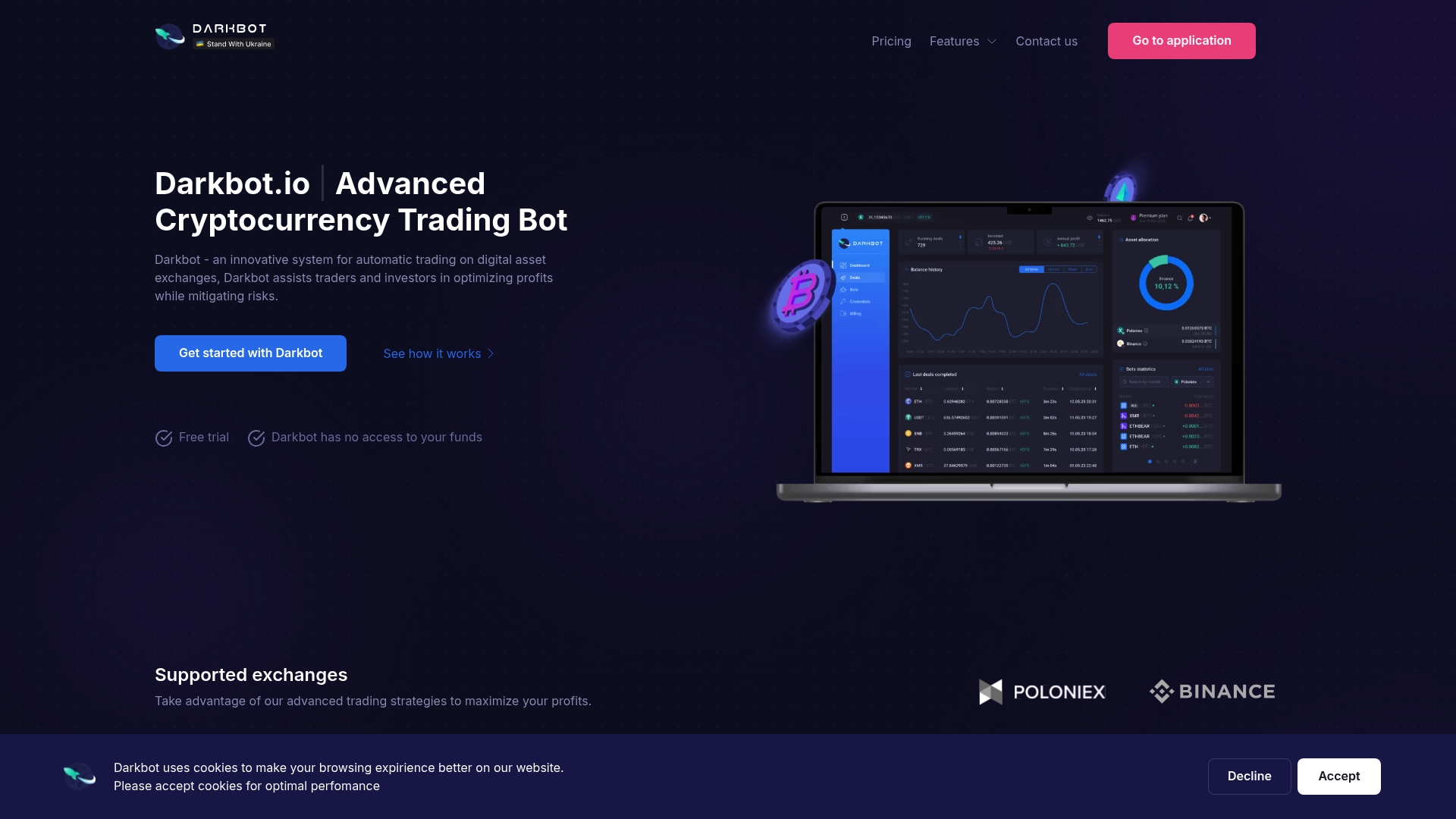
DarkBot gives you customizable AI-driven bots that run systematic, rule-based strategies across major crypto exchanges, with real-time analytics and 24/7 market monitoring built in. You set the logic, DarkBot executes it with consistency no manual trading approach can match. Whether you’re building your first automated strategy or managing a complex cryptocurrency portfolio management setup across multiple assets, DarkBot provides the infrastructure for disciplined, repeatable execution without the emotional pitfalls that erode manual trading returns.
Frequently asked questions
Can AI trading bots consistently outperform human traders in cryptocurrency markets?
Currently, most AI bots do not consistently beat skilled human traders because they struggle with timing, overtrading, and adapting to unprecedented market events. No AI bot tracked has demonstrated a lasting edge; hybrid approaches remain the strongest performing model.
What are common mistakes manual crypto traders make that AI bots avoid?
Manual traders frequently break their own stop-loss rules when emotions run high. AI bots achieve 94% stop-loss compliance versus a 78% violation rate among manual traders, which directly reduces average losses during volatile conditions.
Why do some AI trading bots lose money despite rapid execution?
Fast execution without disciplined strategy creates a fee problem. Overtrading by AI bots eroded profits in controlled competitions, with some systems placing over 1,400 trades in short periods and losing capital to fees alone.
What is the recommended approach for using AI bots effectively in crypto trading?
Pair human strategic oversight with AI execution. Hybrid human-AI models outperform both pure AI and manual approaches by combining disciplined execution speed with human judgment on strategy and risk parameters.
Are AI trading bots suitable for novice crypto traders?
They can be, but only with genuine effort to understand the bot’s logic and risk settings. 71% of retail traders using AI bots underperform basic strategies because they misunderstand what the tool can actually do, treating automation as a substitute for market knowledge rather than a tool that requires it.
Recommended

Start trading on Darkbot with ease
Come and explore our crypto trading platform by connecting your free account!
Free plan available • No credit card required