Safeguard Your Crypto Trades: Proven Safety Measures

TL;DR:
- Automation accelerates crypto trading but does not inherently improve safety; poor security measures can lead to quick losses. Implementing fundamental risk management, securing API keys, and thoroughly testing strategies are essential to prevent preventable failures. Adopting a structured safety framework like NIST CSF and conducting regular audits can effectively close operational gaps and enhance long-term resilience.
Automation doesn’t make crypto trading safe. It makes it faster, and that can cut both ways. A well-configured trading bot can execute dozens of smart decisions per hour while you sleep. A poorly secured one can drain your account in minutes. Most traders who suffer significant losses aren’t victims of bad market timing alone. They’re victims of overlooked API permissions, untested strategies, or a single security gap that sat unaddressed for weeks. This guide covers every critical layer of crypto trading safety, from foundational risk controls through to operational safeguards, exchange hygiene, and structured frameworks that keep your entire setup resilient.
Key Takeaways
| Point | Details |
|---|---|
| Risk management is foundational | Position sizing, stop-losses, and diversification are vital for every crypto trader. |
| APIs require strict security | Only grant minimum necessary permissions and protect API keys with regular rotation and 2FA. |
| Operational guardrails avert disaster | Bots need testing, live monitoring, and instant kill-switches to prevent catastrophic losses. |
| Defend against scams and human error | Harden all ecosystem layers with strong passwords, withdrawal whitelists, and scam awareness. |
| Use structured frameworks | Ongoing use of a risk management framework elevates safety and ensures nothing is overlooked. |
Core risk management practices every trader must know
Before any bot ever places a trade, you need a solid risk management foundation. This isn’t optional. Whether you trade manually or through full automation, the same fundamental principles apply, and ignoring them is the fastest route to a wrecked portfolio.
Risk management in crypto trading starts with capital preservation. That means deciding in advance how much of your total capital you’ll expose to any single trade or asset. The 1-2% rule is a proven approach: never risk more than 1-2% of your total portfolio on a single position. This sounds conservative until a sudden 40% crash reminds you why discipline matters.
Core crypto trading risk-management practices include capital preservation via position sizing, stop-losses, diversification, and hedging where appropriate. These are the tools that keep a bad trade from becoming a catastrophic loss.
Here are the foundational controls every trader must have in place:
- Position sizing: Calculate your position size relative to account balance before entering any trade, not after.
- Stop-loss orders: Always define your exit before you enter. Bots can execute stop-losses automatically, but you have to set them first.
- Diversification: Spread exposure across multiple assets and strategies. Concentration risk is a portfolio killer.
- Hedging: Using options or futures to offset downside risk is no longer just for institutional traders.
- Volatility awareness: Markets can shift their character overnight. Strategies that worked in low-volatility conditions can fail spectacularly in high-volatility regimes.
“The goal of risk management isn’t to avoid losses entirely. It’s to ensure that no single loss, or sequence of losses, can remove you from the game.”
Emotional trading is a known hazard even for experienced professionals. Bots remove emotion from execution, but they don’t remove emotion from strategy design. If you build a bot around a fear-driven or greed-driven strategy, the bot will execute that bad strategy perfectly. The fundamentals of crypto risk management must be understood and respected at the design stage, not patched in later.
Pro Tip: Before you automate any strategy, run it on paper for at least two weeks. If it bleeds capital in manual testing, it will bleed capital faster in live automation.
One common mistake is overexposure to correlated assets. If you hold BTC, ETH, and several altcoins that all move in the same direction during a market shock, diversification is an illusion. You need genuine correlation analysis, not just a spread of ticker symbols. Defining crypto risk management properly means accounting for how assets behave together, especially under stress.
Automated trading: API security and technical safeguards
Once your risk philosophy is solid, the next layer is your technical infrastructure. This is where many confident traders trip up badly. Automated trading depends on API keys to connect your bot to an exchange. How you manage those keys determines how exposed you are.

Automated trading safety depends heavily on how exchange API access is scoped and protected, specifically through least privilege principles, no withdrawal permissions, and restricting where keys can be used. This isn’t just a best practice. It’s the difference between a stolen key causing a minor inconvenience versus a total account wipe.
Follow these steps for secure API configuration:
- Create dedicated API keys for each bot or strategy. Never reuse the same key across multiple bots or platforms.
- Disable withdrawal permissions. Unless your bot explicitly needs to move funds off-exchange (which is rare), this permission should never be enabled.
- Restrict keys to known IP addresses. Most exchanges let you whitelist specific IPs. Use this feature religiously. It means a stolen key is worthless without access to your specific server.
- Enable two-factor authentication on your exchange account. This protects the root account even if an API key is compromised.
- Rotate keys regularly. Set a schedule: monthly or quarterly, audit and regenerate your API keys.
- Store keys in environment variables or a secrets manager. Never hardcode API keys in your bot’s source files, and never commit them to version control.
Understanding API-based exchange integration is essential before you plug your bot into a live account. The surface area for attack grows every time you add an integration, a server, or a cloud storage bucket that contains sensitive configuration data.
A sobering reality: many crypto bot security incidents aren’t clever hacks. They’re straightforward exploitation of overpermissioned API keys left exposed in a public repository or shared carelessly. GitHub alone has flagged thousands of accidental credential leaks from crypto traders.
Statistic callout: Security researchers consistently find that the majority of crypto API key compromises involve keys with unnecessarily broad permissions, particularly enabled withdrawals, rather than sophisticated attack vectors.
Pro Tip: Treat every API key like a physical key to your house. You wouldn’t give a housecleaner a key that also opens your safe. The same logic applies to bot permissions. Learn more about API key integration best practices before your next setup.
Operational safety: Testing, deployment, and real-time fail-safes
Locking down your API is necessary but not sufficient. The way you build, test, deploy, and monitor your trading bots determines whether your operation is truly resilient or just waiting for a disaster.
Failures in algorithmic trading often come from governance issues, poor release and deployment hygiene, missing testing and documentation, and the absence of real-time risk controls and surveillance alerts. These aren’t edge cases. They’re the norm for traders who focus only on strategy and ignore operations.
| Safety measure | Without it | With it |
|---|---|---|
| Paper trading / forward testing | Strategy risks discovered after capital loss | Risks identified before going live |
| Kill-switch | Runaway bot can’t be stopped quickly | Instant shutdown on trigger or manual override |
| Automated risk checks | Position sizes drift outside limits unnoticed | Automatic halt when limits are breached |
| Version control | Rollback after bad deployment is difficult | Clean recovery to last stable version |
| Real-time alerts | Problems detected hours or days later | Immediate notification of anomalies |
Robust safety in crypto trading bots still requires explicit risk controls: paper trading and forward testing, Monte Carlo-style stress testing for overfitting and parameter sensitivity, and monitoring and alerting in live deployment. Monte Carlo testing, in particular, is underused. It randomly varies your strategy’s parameters and starting conditions to see how performance holds up under uncertainty. If your strategy only works under one narrow set of conditions, that’s luck, not skill.
Here’s what a safe deployment process looks like:
- Backtest on historical data to confirm basic logic, but don’t over-optimize for past conditions.
- Forward test (paper trade) on live market data without risking real capital.
- Run Monte Carlo analysis to stress-test parameter sensitivity and identify fragile assumptions.
- Deploy incrementally: start with small position sizes in live conditions before scaling up.
- Set hard kill-switches that automatically halt your bot if drawdown exceeds a defined threshold.
- Configure alerts for abnormal trading volume, unexpected position sizes, or connectivity failures.
Managing automated trading strategies safely means treating your bot as a piece of production software, not a side project. Version control, change logs, and staged rollouts are standard engineering practices for good reason.
Statistic callout: Studies on algorithmic trading failures show that the majority of costly incidents are preventable through basic deployment controls, not exotic security measures.
Bot-specific risk management adds another layer. It means explicitly programming your bot with its own internal risk rules: maximum drawdown limits, maximum daily loss caps, and circuit breakers that pause trading during extreme volatility events.
Beyond trading bots: Defense in depth for exchanges, wallets, and scams
Technical and operational safety cover a lot of ground, but your overall security posture also depends on how you manage your exchange accounts, wallets, and your own behavior against social engineering.
Defense in depth for crypto safety includes account-level security settings, wallet and exchange handling practices, and scam-resistance measures. Think of it as overlapping layers: if one layer fails, the next one holds.
| Threat vector | Key control | Common mistake |
|---|---|---|
| Exchange account compromise | Strong 2FA (hardware key preferred) | Using SMS-based 2FA only |
| Unauthorized withdrawals | Withdrawal whitelist enabled | No address whitelist configured |
| Phishing attacks | Bookmark exchange URLs, never click email links | Clicking “urgent” login links in emails |
| Social engineering | Verify any support contact independently | Sharing screen with “support” offering help |
| Wallet errors | Double-check addresses, test with small amount | Sending large amounts to unverified address |
| Rug pulls / scams | Research projects thoroughly before investing | Investing based on social media hype alone |
A few critical behaviors to build into your routine:
- Enable withdrawal whitelists on every exchange account. This means funds can only go to pre-approved addresses, adding a vital delay for any unauthorized attempt.
- Use a hardware security key for 2FA where possible. Authenticator apps are acceptable. SMS is not secure enough for significant holdings.
- Never share your screen with anyone claiming to be exchange support. Legitimate support doesn’t need this.
- Crypto transfers are irreversible. There is no chargeback, no dispute process. A single mistake sending funds to a wrong or fake address is permanent.
“The most sophisticated security system can be bypassed by a single well-crafted social engineering attack. Human factors require human-focused defenses.”
Pro Tip: Before you move any significant amount, send a test transaction with a minimal amount first. It takes 60 extra seconds and can save you from a catastrophic, unrecoverable error.
Partnering with finance security compliance experts can also help larger operations formalize their security posture across infrastructure, access controls, and incident response planning.
Structuring safety: Applying risk-management frameworks in crypto
Individual controls are powerful. But connecting them into a structured, repeatable system is what separates reactive traders from genuinely resilient ones. A risk management framework gives you a checklist-based approach that evolves with your operation.
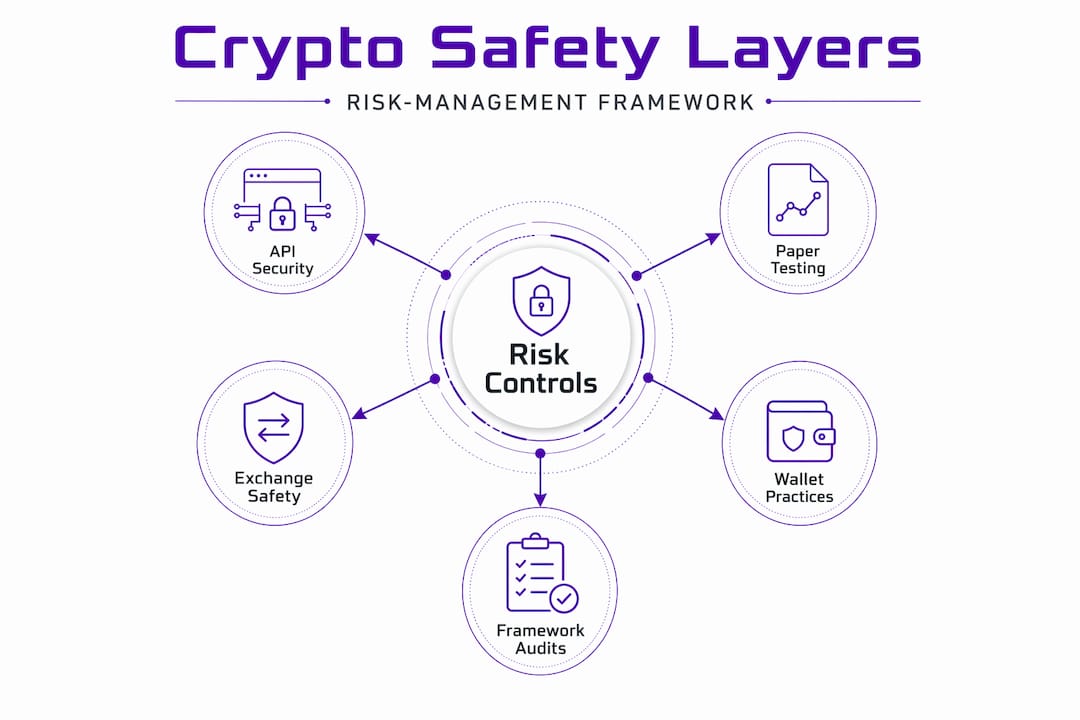
The NIST Cybersecurity Framework (CSF 2.0) is designed to help organizations structure safety work as a continuous, prioritized risk process for systems and automation. Adapted for crypto trading, it maps cleanly onto the practical concerns covered above.
Here’s how NIST CSF’s five core functions apply to your trading setup:
- Identify: Catalog all assets (exchange accounts, wallets, bots, servers, API keys). Know what you have before you can protect it.
- Protect: Implement your controls: 2FA, IP whitelists, position sizing rules, kill-switches, encryption, and access controls.
- Detect: Set up monitoring and alerts for anomalous behavior: unusual trade sizes, unexpected API calls, login attempts from new locations.
- Respond: Define your incident response plan in advance. If a key is compromised, what are your first five steps? Who do you contact? What gets shut down immediately?
- Recover: After an incident, document what happened, restore secure operations, and update controls to prevent recurrence.
Statistic callout: Organizations using structured cybersecurity frameworks report significantly faster detection and containment of security incidents compared to those operating without defined processes.
Most crypto traders operate without any formal framework. That’s an enormous gap. Even a simplified, personal version of NIST CSF applied consistently will catch more risks than a reactive, ad hoc approach.
Why most safety failures happen between “the cracks” and how to close them
After working through every layer of crypto trading safety, here’s the uncomfortable truth we’ve observed consistently: the biggest losses rarely come from the areas traders focus on most. They come from the gaps between those areas.
You can have perfect stop-losses on every position, a well-backtested strategy, and strong exchange account security, and still suffer a devastating loss because one API key had withdrawal permissions enabled “just temporarily” during a setup phase, and you forgot to revoke them. That key gets leaked through a misconfigured environment file. The bot’s stop-losses don’t fire because the funds are already gone.
This is real. It happens regularly. The boundary between your bot’s operational scope, your infrastructure security, and your account permissions is exactly where attackers focus and where most traders focus the least.
Our strong recommendation: periodically audit your entire setup as if you were an adversary trying to extract funds. Ask yourself: what permissions exist that shouldn’t? What keys are stored insecurely? What monitoring gaps would hide a slow, quiet attack? This kind of red-team thinking, even done informally by yourself, surfaces problems that systematic checklists often miss because checklists only cover what you already thought to check.
Crypto Trading Bot Security reviews should be scheduled events, not just reactions to close calls. Once per quarter at minimum. More frequently if you’re deploying new strategies or integrations.
The traders who stay safe long-term aren’t necessarily the most technically sophisticated. They’re the ones who treat safety as an ongoing practice rather than a one-time setup. Complacency is the most dangerous exploit in crypto.
Unlock advanced safety: Trade smarter with powerful tools
Everything covered in this guide points toward one actionable conclusion: safer trading requires layered controls, consistent execution, and tools designed with security built in from the ground up.
Darkbot operationalizes the risk controls discussed throughout this guide, from automated stop-loss execution and position sizing rules to secure API key handling and real-time portfolio monitoring. Instead of stitching together manual processes across disconnected tools, you get an integrated environment where crypto portfolio optimization and risk management work together seamlessly. Whether you’re running your first automated strategy or managing multiple bots simultaneously, Darkbot’s platform gives you the guardrails and visibility to trade with genuine confidence. Start with the free tier and experience how structured automation protects and grows your capital.
Frequently asked questions
What is the safest way to store crypto for trading?
The safest storage combines a reputable exchange with strong account security (2FA, withdrawal whitelist) for active trading funds, and a hardware wallet for long-term holdings not needed for immediate trading. A defense in depth approach covers both layers simultaneously.
How can you test a crypto trading bot before risking real money?
Paper trading and forward testing on live market data (without real capital) are your primary tools, combined with backtesting on historical data and Monte Carlo stress testing. Robust bot testing before live deployment identifies performance weaknesses and parameter sensitivity that only show up under varied conditions.
What are common mistakes when setting up API keys for trading bots?
Granting withdrawal permissions unnecessarily and failing to restrict keys to trusted IP addresses are the two most critical mistakes. API access should be scoped tightly with least-privilege principles from day one, not after a problem occurs.
Do algorithmic trading bots guarantee profits or limit losses?
No, bots are execution tools and are only as effective as the risk controls and strategies built into them. Sound risk management practices including stop-losses, position sizing, and diversification must be explicitly programmed into every automated strategy.
How does using a risk-management framework improve crypto trading safety?
Frameworks like NIST CSF provide a structured, repeatable cycle to identify assets, implement protections, detect anomalies, respond to incidents, and recover effectively. The NIST Cybersecurity Framework turns one-time security actions into an ongoing safety practice that catches overlooked risks before they become losses.
Recommended

Start trading on Darkbot with ease
Come and explore our crypto trading platform by connecting your free account!
Free plan available • No credit card required