Boost Crypto Trading with MQL5 Machine Learning
TL;DR:
- Most crypto trading failures stem from misapplied models and poor validation, not ideas themselves.
- MQL5 offers comprehensive built-in tools for machine learning, enabling development within a single environment.
- Successful crypto ML strategies require robust data labeling, regime detection, adaptive risk controls, and ongoing validation.
Most automated crypto trading failures don’t come from bad ideas. They come from misapplied models, non-portable backtests, and workflows borrowed from equity markets without adapting them to the brutal realities of digital assets. MQL5 is a genuinely powerful environment for machine learning, but most traders underestimate how much domain-specific work is required to make it perform reliably. This guide cuts through the noise and walks you through designing, training, and deploying MQL5 machine learning strategies that hold up in live crypto markets, not just in backtests.
Key Takeaways
| Point | Details |
|---|---|
| Built-in ML features | MQL5 offers matrix and neural network tools directly for expert advisor automation. |
| Labeling matters most | Accurate, volatility-adjusted labeling is critical to high-performance crypto ML models. |
| Portfolio-first approach | Diversified ML strategies spread risk and adapt better to regime changes in crypto. |
| Validation is key | Cross-broker and out-of-sample testing are crucial for reliable ML trading strategies. |
| Control for volatility | Dynamic position sizing and volatility filtering help manage risk in fast-changing crypto markets. |
Understanding MQL5 machine learning: What’s inside the toolkit?
With the big picture set, let’s establish exactly what MQL5 brings to algorithmic traders wanting machine learning firepower.
MQL5 is not just a scripting language for indicators and expert advisors (EAs). It has evolved into a full-featured environment for building and deploying machine learning models directly inside your trading infrastructure. The built-in matrix methods include activation functions like ReLU and Swish, loss functions, derivative support, and neural network primitives that let you build and train models without leaving the platform.
This matters because it removes a significant bottleneck. You don’t need to constantly shuttle data between Python and MQL5 for every iteration. You can prototype, test, and refine models within the same EA environment where they’ll eventually execute live trades. That tight feedback loop is something most retail traders overlook when building smart trading strategies.
Here’s a snapshot of the core ML tools available natively in MQL5:
- Matrix operations: Full support for matrix and vector math, essential for neural net computations
- Activation functions: ReLU, Swish, Sigmoid, Tanh, and more built in
- Loss functions: MSE, cross-entropy, and custom loss support
- Derivative support: Backpropagation-ready gradient calculations
- ONNX model import: Load externally trained models directly into EAs
- Neural network layers: Dense, convolutional, and recurrent layer support
“MQL5 provides built-in matrix methods, activation/loss functions, and neural network support, making it a self-contained environment for model development and deployment.”
Understanding the impact of machine learning on crypto trading starts here. The toolkit is capable. The question is whether you’re using it correctly.
Labeling, training, and deploying ML models in MQL5 for crypto
Understanding the toolkit is just step one. Putting ML to work means mastering the pipeline from idea to live trade.
The most common mistake traders make is jumping straight to model training without a rigorous labeling strategy. In crypto, where price regimes shift fast, your labels define what the model learns. Garbage labels produce garbage signals, regardless of how sophisticated your architecture is.
Savitzky-Golay smoothing, volatility normalization, threshold buy/sell labeling, CatBoost or K-Means clustering, ONNX export, and finally MQL5 EA integration form a proven end-to-end pipeline. Each step has failure points, and skipping any of them compounds errors downstream.
Here’s the full ML pipeline in order:
- Label your data: Define buy, sell, and hold zones using smoothed price or volatility-normalized thresholds
- Preprocess: Normalize features, handle missing data, and remove look-ahead bias
- Train externally: Use Python (scikit-learn, CatBoost, PyTorch) for model training
- Export to ONNX: Convert your trained model to the ONNX format for MQL5 compatibility
- Integrate into EA: Load the ONNX model inside your expert advisor and wire it to execution logic
- Validate live: Run on a demo account with real tick data before going live
| Strategy type | Best for | Strength | When to deploy |
|---|---|---|---|
| Mean-reversion | Stable, range-bound pairs | Consistent signals in low-volatility regimes | Sideways markets, low ATR periods |
| Trend-following | Breakout assets like BTC | Captures large directional moves | High momentum, clear macro trends |
Trend-scanning labeling gives adaptive horizons that avoid lookahead bias, which is one of the most insidious problems in crypto ML. Static labeling windows assume the market moves at a fixed pace. It doesn’t.
Pro Tip: Use clustering algorithms like K-Means to group market regimes before labeling. This reduces the chance of training a model on mixed-regime data, which is a leading cause of poor out-of-sample performance.
Python-based workflows are valuable for heavy model training, but data consistency between your Python environment and MQL5 is critical. Even small differences in how you calculate features can cause the live model to behave differently from what you tested. Understanding crypto automation explained helps bridge that gap effectively, and keeping trading efficiency with ML top of mind ensures your pipeline stays lean.
Taming volatility: ML strategies for risk and portfolio management in crypto
Having built and trained your model, protecting capital and managing risk is where real-world viability is won or lost.
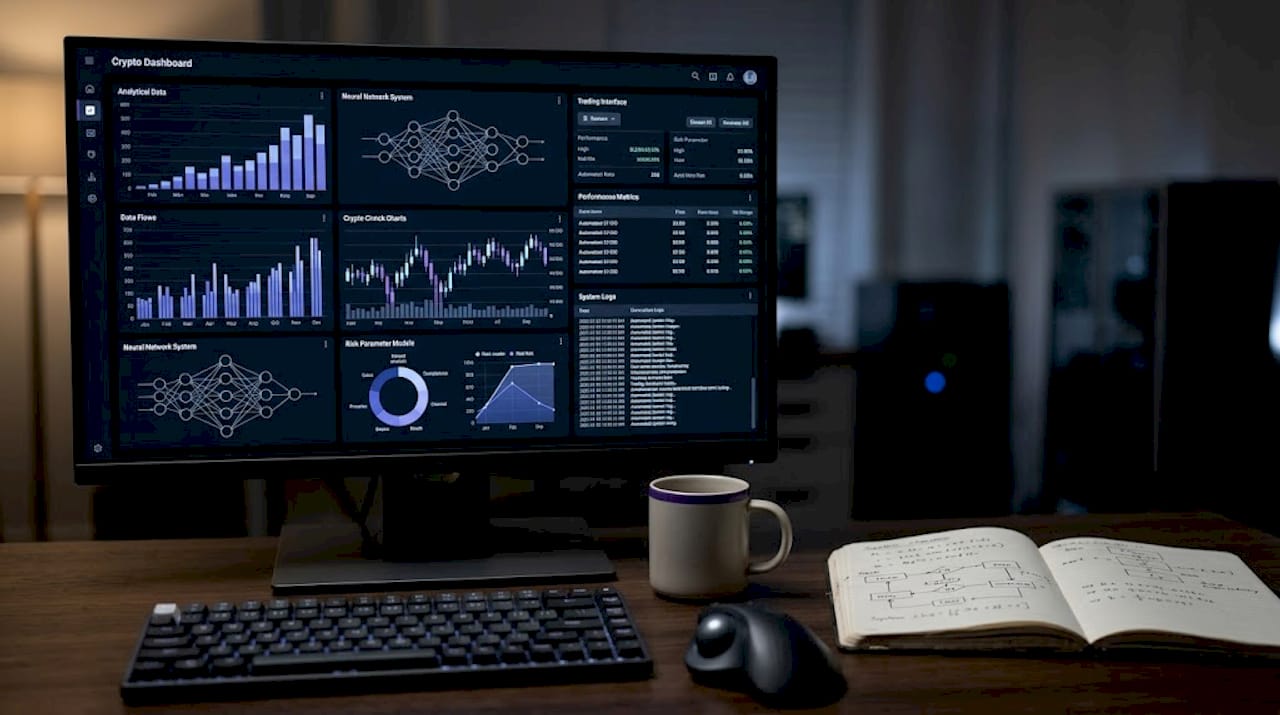
Crypto’s volatility isn’t just a feature of the market. It’s a regime in itself. A model trained during a bull run will behave erratically during a consolidation phase unless you’ve built regime detection into your risk layer. Remote-trained ML models for assets like BTCUSD, ETHUSD, and XRPUSD already incorporate diversification logic and volatility handling, and they offer a useful reference point for what production-grade portfolio EAs look like.
| Approach | Traditional | ML-based |
|---|---|---|
| Stop loss | Fixed percentage | ATR-adaptive, regime-aware |
| Position sizing | Equal weight or fixed lot | Q-learning adaptive sizing |
| Regime detection | Manual rule-based | Clustering and classification |
| Rebalancing | Scheduled | Signal-triggered, dynamic |
For smarter automated trading, your risk layer needs to be as adaptive as your signal layer. Here are the core ML risk controls worth implementing:
- Volatility filters: Use ATR to gate trade entry during extreme volatility spikes
- Regime classifiers: Detect trending vs. mean-reverting conditions before deploying strategy logic
- Q-learning lot sizing: Reinforcement learning adjusts position size based on recent performance feedback
- Grid-based averaging: Controlled averaging with hard stop buffers prevents runaway drawdowns
- Correlation filters: Avoid stacking correlated positions across multiple crypto pairs
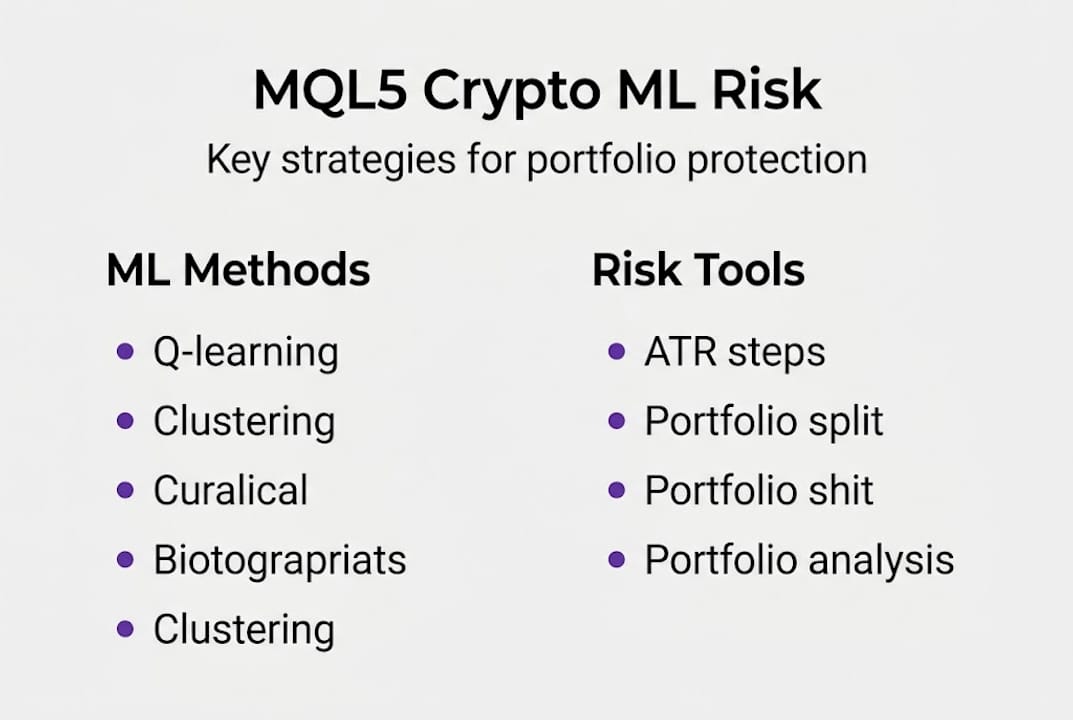
SL/TP management, ATR-based steps, and Q-learning for adaptive sizing together form a risk framework that responds to the market rather than fighting it.
Pro Tip: Dynamic portfolio allocation across three or more uncorrelated crypto pairs smooths equity curves significantly. A single-asset ML strategy is fragile. A portfolio-level ML strategy is far more robust, especially when you treat the complete crypto investing guide as a living document rather than a one-time setup.
Pitfalls, trade-offs, and getting robust results with MQL5 machine learning
Even strong models can underperform in crypto. Let’s spotlight the pitfalls and how experts address them for lasting results.
M1 timeframes are a trap for crypto ML strategies. The signal-to-noise ratio on one-minute bars is extremely low, and spread decay eats into any edge you think you’ve found. Scalping on M1 fails because the noise overwhelms the signal. Hybrid approaches using H1 volatility filters to gate M1 entries perform meaningfully better.
Overfitting is the silent killer. A model that achieves 80% accuracy in-sample and 52% out-of-sample isn’t a good model. It’s a memorization exercise. Preprocessing pipelines, weighted samples, and regime clustering are all required to prevent this, not optional extras.
“ML excels in regime clustering but struggles with broker data discrepancies and non-stationarity. Cross-broker validation isn’t optional—it’s the minimum bar for claiming a model is deployable.”
Here are the actionable tactics that separate robust models from fragile ones:
- Use tick-bars instead of time-bars to normalize for volume and activity
- Apply uniqueness weighting to reduce the influence of overlapping samples
- Reject models that don’t pass cross-broker validation before live deployment
- Run walk-forward optimization, not just static backtests
- Monitor model performance monthly and retrain when regime shifts occur
Generalization and cross-broker variance is a documented problem. The same model can produce wildly different results on different brokers’ data feeds. If you’re not testing across multiple data sources, you’re not actually validating your model. Exploring option trading with ML and reviewing AI trading strategy examples can sharpen your instincts for what robust validation looks like.
From theory to live trades: Real-world success factors in MQL5 machine learning
With both strengths and stumbling blocks revealed, here’s what real-world use has shown about making ML work on a crypto trading desk.
One of the most striking findings in live deployments is how sensitive trend-following strategies are to data quality. Mean-reversion is viable on flat pairs, while trend-following strategies are highly sensitive to the specific data used for training. This isn’t a minor caveat. It fundamentally changes how you should approach strategy selection.
Broker discrepancies can cause return differences of up to 147% on the same instrument. That’s not a rounding error. That’s a completely different strategy outcome depending on where your data comes from. Reproducibility is the hardest problem in systematic crypto trading, and most retail implementations ignore it entirely.
Here’s a stepwise process for incorporating robust ML into your daily crypto trading:
- Start with a portfolio of three or more pairs to reduce single-asset regime dependence
- Use adaptive labeling that responds to volatility rather than fixed time windows
- Validate across at least two brokers before treating any backtest as meaningful
- Build a regime classifier as a pre-filter before running your main signal model
- Set a monthly retraining schedule to keep models aligned with current market conditions
- Track live performance vs. backtest performance and investigate any divergence immediately
The traders who succeed with optimizing crypto trading using ML share one trait: they treat their models as hypotheses, not facts. They stay humble about out-of-sample data and keep adapting. If you want to go deeper on the execution side, the AI for crypto trading resources at Darkbot offer a practical next layer.
Why most crypto ML trading fails—and what actually works in 2026
Here’s the uncomfortable truth: most retail ML trading implementations fail not because the math is wrong, but because the process is broken. Traders optimize for backtest metrics instead of real-world robustness. They treat overfitting as a sign of a good model rather than a warning sign.
Cross-broker variance alone kills a huge percentage of strategies that look great in testing. Add regime shifts, non-stationarity in crypto price series, and the constant temptation to add more features to a model that’s already memorizing noise, and you have a recipe for consistent underperformance.
What actually works is less glamorous than most traders expect. It’s broad portfolio ML with regime-aware filters, conservative assumptions about out-of-sample performance, and a genuine commitment to ongoing adaptation. The winners we’ve observed don’t chase the highest Sharpe ratio in backtesting. They build systems that stay alive through multiple market cycles.
Blending ML signals with interpretable risk controls is not a compromise. It’s the only approach that survives contact with real markets. If your model can’t explain why it’s taking a trade in terms a risk manager would understand, it’s probably overfit. Explore crypto ML wisdom to keep refining your edge with that mindset.
Take your crypto trading further with Darkbot’s MQL5 automation
Ready to put theory to work and boost your own crypto trading results?
Darkbot extends the logic of MQL5 machine learning into a live, portfolio-driven execution environment built specifically for crypto markets. Whether you’re managing risk across multiple pairs, automating rebalancing, or deploying adaptive ML signals at scale, the platform handles the operational complexity so you can focus on strategy.

With seamless AI trading automation and dedicated crypto portfolio management tools, Darkbot gives you the infrastructure to run sophisticated ML-driven strategies without building everything from scratch. From position sizing to multi-asset coordination, the platform is designed for traders who take systematic crypto trading seriously. Start with a free tier and scale as your strategies mature.
Frequently asked questions
Can I use MQL5’s built-in machine learning for live crypto trading?
Yes, MQL5 supports core machine learning operations, allowing direct neural network integration in live expert advisors for crypto trading. The platform’s built-in matrix methods and neural net support make this practical without external dependencies.
How do I avoid overfitting my ML models in crypto trading?
Use cross-broker validation, out-of-sample testing, volatility filters, and avoid relying solely on backtest results. Reproducibility is low without broker-specific validation, so treat every backtest as a starting point, not a conclusion.
Are mean-reversion strategies effective with MQL5 machine learning for crypto?
Yes, mean-reversion strategies work on flatter pairs and benefit from MQL5 ML integration, though results vary by asset. Mean-reversion is viable on stable pairs like EURGBP, but performance degrades on highly volatile crypto assets without additional filters.
What preprocessing is essential for robust ML trading models in crypto?
StandardScaler, MinMaxScaler, and RobustScaler help prepare non-IID data and prevent overfitting in ML models. Preprocessing pipelines are key to handling the non-stationary nature of financial time series in crypto markets.
Why do ML trading strategies generalize poorly between brokers?
Broker data discrepancies, such as significant differences in EURUSD returns, make ML models perform inconsistently without broker-specific retraining. EURUSD returns can vary 147% across brokers, making cross-broker validation a non-negotiable step in any serious deployment.
Recommended

Start trading on Darkbot with ease
Come and explore our crypto trading platform by connecting your free account!
Free plan available • No credit card required