5 Steps to Verify a Trading Bot: Bitsgap vs Coinrule

For most multi-exchange traders who want predefined strategy types with backtesting, Bitsgap is the stronger fit, while traders who prefer building their own condition-action logic will likely prefer Coinrule’s rule builder. The real choice is architectural: specialized bots versus a rule engine you configure yourself. Whichever you pick, run a demo or paper-trading session before committing live capital, including with our own platform.
TL;DR:
- Using a demo or paper-trading session is essential for both platforms to verify performance before risking live capital, especially under real market conditions.
- Bitsgap’s predefined bot families excel in quick setup for grid, DCA, and arbitrage strategies, but higher-tier plans are necessary for extensive backtesting on small accounts.
- Coinrule offers flexible rule creation suitable for event-driven strategies, but requires correct logic setup, which increases initial effort compared to using specialized bots.
- Costs such as exchange fees, slippage, and spreads often surpass subscription fees, making testing on small amounts critical to achieve break-even.
- Always confirm exchange connectivity, particularly for the platforms’ specific automation types, and prioritize security by generating trade-only API keys without withdrawal rights.
How Bitsgap and Coinrule Stack Up Against the Field
Automated trading platforms split into a few recognizable categories: specialized bot suites, no-code rule builders, signal-and-copy hybrids, and terminal-style aggregators. Bitsgap and Coinrule sit at opposite ends of that spectrum, and the other platforms covered here fill in the middle.
Bitsgap’s advantage is a defined set of specialized bot families that reduce setup time for grid, DCA, and arbitrage-style strategies. Coinrule’s advantage is flexibility: you write the condition and the action, which suit event-driven strategies that do not map cleanly onto a predefined bot type.
Subscription cost is never the full cost of running a bot. Exchange trading fees, bid-ask spread, and slippage on execution all erode returns, and for small accounts the subscription fee itself can dominate the break-even calculation before a single trade is placed.

Platform Snapshots: What Each Tool Actually Automates
Each platform below automates a different slice of the trading process. The summaries are factual, not comparative rankings.
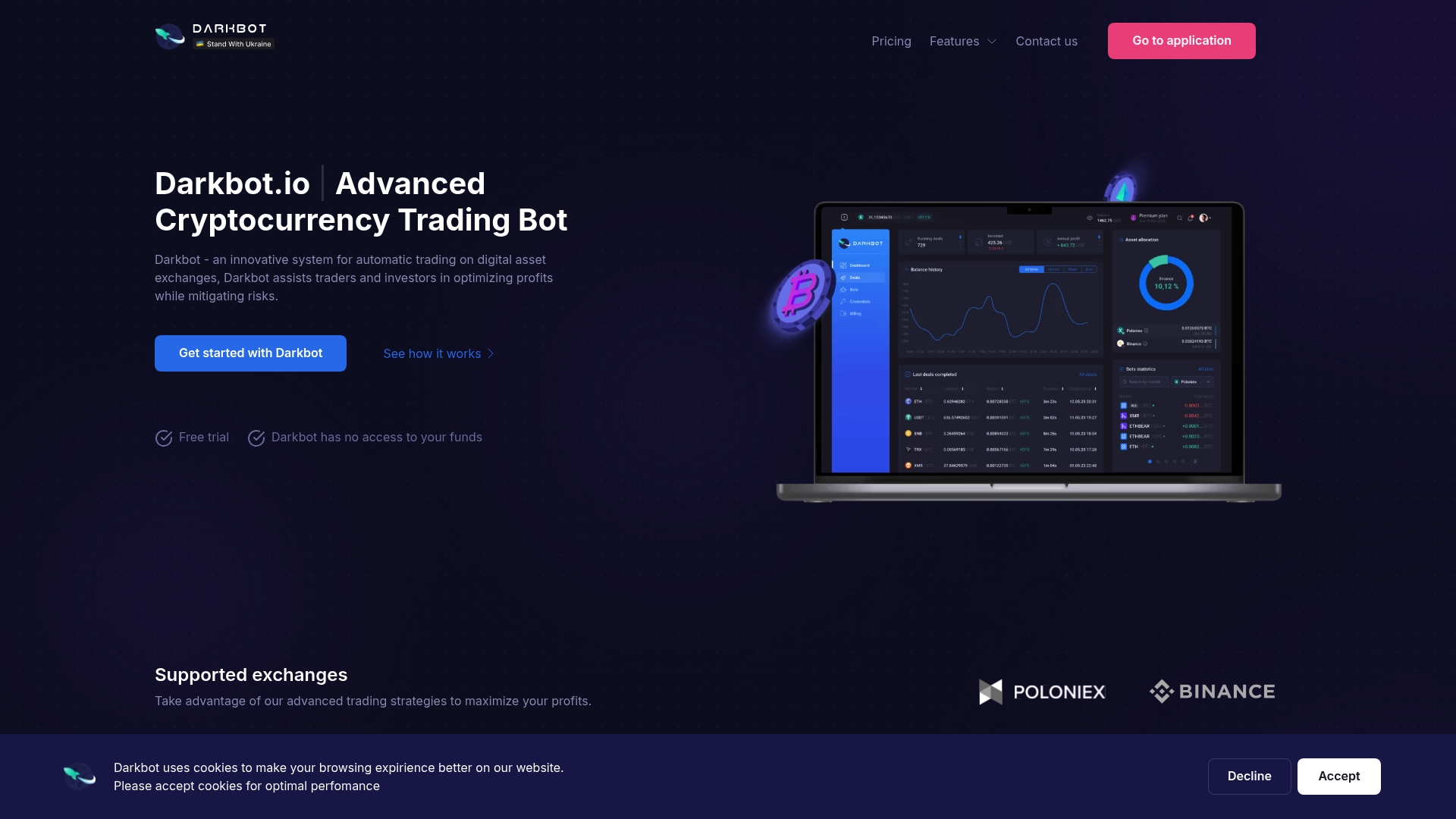
- Darkbot: automates multi-exchange execution through API integration, with strategy customization, backtesting, and paper trading across Free, Standard ($12.50/month), Premium ($25.00/month), and Enterprise plans. The platform supports multiple simultaneous bots and portfolio rebalancing, suited to traders who want AI-assisted pattern evaluation paired with manual risk limits. Caution: as with any automation tool, backtest results are simulations and require live-sample verification before scaling.
- Bitsgap: automates grid, DCA, BTD, LOOP, QFL, and COMBO strategies plus DCA Futures, with AI Portfolio tools and tiered backtesting. Standout is the breadth of predefined bot types for multi-exchange arbitrage scanning. Security model is non-custodial via API connectivity. Caution: higher tiers unlock longer backtests, which raises the cost hurdle for smaller accounts.
- Coinrule: automates condition-action rules through a no-code IFTTT-style builder. Standout is rule templates for fast event-driven setup. Trial access includes rule templates and backtesting. Caution: rule engineering still requires the trader to define logic correctly, which shifts setup effort rather than removing it.
- 3Commas: automates DCA bots, copy trading, and TradingView webhook signals. Standout is signal integration breadth across a wide exchange directory. Offers paper trading. Caution: signal-driven automation depends on the quality of the external signal source.
- Cryptohopper: automates template and marketplace-based strategies with backtesting and paper trading. Standout is a strategy marketplace for traders who want to adapt existing templates. Caution: marketplace strategies vary widely in transparency about past performance.
- ArbitrageScanner: automates detection and execution of cross-exchange arbitrage opportunities. Standout is the scanning layer itself rather than a general-purpose bot suite. Caution: arbitrage margins are thin and sensitive to withdrawal and transfer delays.
- Coinigy: functions as a charting and multi-exchange terminal with limited automation depth. Standout is a unified view across many exchanges. Caution: automation features are secondary to its charting and monitoring role.
- HaasOnline: automates custom strategies through HaasScript, a scripting layer for advanced users. Standout is backtesting and simulated trading for script-based logic. Caution: the scripting requirement raises the technical bar compared to no-code builders.
How to Choose and Test a Trading Bot Before Funding It
Selecting a platform is only half the decision. Verifying it behaves as expected under real market conditions is the other half.
- Match the automation type to your strategy: grid and DCA bots fit range-bound markets, rule builders fit event-driven logic, and script engines fit custom quantitative models.
- Check exchange coverage against where you actually hold capital, since a platform’s bot quality means little if it does not connect to your exchange.
- Weigh subscription cost against account size: a $25 monthly plan on a $500 account carries a different break-even hurdle than on a $20,000 account.
- Run a paper or demo session first, then backtest across varied parameter ranges to check sensitivity rather than relying on one favorable result.
- Sample live execution on a small position size, then compare realized fills and slippage against the backtest before scaling further, a method also outlined in guidance on testing trading strategies.
Ask vendors directly about withdrawal permissions, fee transparency, and historical uptime. Treat a missing demo mode, a requirement for withdrawal rights on your API key, or repeated unresolved execution complaints as reasons to stop evaluating that platform.
Pro Tip: Generate a trade-only API key, disable withdrawal permissions, and apply IP whitelisting where the exchange supports it before connecting any bot, as described in our guidance on trading bot security.
What We Built Into Darkbot and Why It’s Testable
Our platform is designed around verifiable mechanics rather than promises. We built it for traders who want to evaluate automation the same way they would evaluate any other execution tool.
- API integration: connect multiple exchanges through trade-only keys without granting withdrawal access.
- Strategy customization: configure multiple simultaneous bots with defined risk parameters.
- Backtesting and paper trading: review historical performance and run simulated trades before funding a bot.
- Tiered plans: Free, Standard, and Premium tiers, plus Enterprise for larger operations.
We recommend starting every strategy in paper-trading mode and reviewing fills against your backtest before moving to live capital.
When a Rule Builder Beats a Specialized Bot, and When It Doesn’t
A rule builder suits traders who think in conditions and actions: novices and event-driven strategists benefit from that flexibility. A specialized bot suits multi-exchange arbitrage traders and systematic futures users who need parametrized strategies tuned for a specific market structure. Either way, test on paper for several weeks before scaling capital.
— Grisha
Start Testing Automation on Your Own Terms
We offer multiple subscription plans, including a free tier and higher tiers available at published or on-request pricing. Every tier supports backtesting and paper trading, so you can verify execution before committing funds.
| Plan | Monthly price | Best starting point |
|---|---|---|
| Free | No published price | Testing core features |
| Standard Plan | $12.50 | Traders running a few bots |
| Premium Plan | $25.00 | Traders running multiple simultaneous bots |
| Enterprise | Available on request | Larger-scale operations |
- Review plan details and feature breakdowns on our pricing page.
- Run a demo session before assigning live capital to any strategy.
Compare the tiers directly on our pricing page and start with a paper-trading run.
FAQ
Is Coinrule a legitimate platform?
Independent reviews describe Coinrule as a no-code rule builder operating on a non-custodial, API-based model, which is consistent with how legitimate automation platforms are typically structured. Legitimacy of the software model does not guarantee trading results, so a demo run remains the practical verification step.
What is the most successful AI trading bot?
There is no single most successful bot, since outcomes depend on strategy fit, market conditions, and costs like fees, spread, and slippage, not on the software alone. Independent commentary consistently frames backtests as simulations that require live-sample testing before any performance claim is meaningful.
What are the risks of using Bitsgap?
Risks include exchange-side execution issues, slippage and fees that erode returns, and a higher cost hurdle on smaller accounts since advanced backtesting and bot types sit behind higher-tier plans. Using trade-only API keys and testing with small position sizes first helps limit exposure while verifying behavior.
Is Bitsgap a legitimate company?
Reviews describe Bitsgap as an operating software platform with exchange API connectivity and a non-custodial structure, dating back to around 2017. Operating history and a non-custodial model support legitimacy, though they do not guarantee any specific trading outcome.
Recommended

Start trading on Darkbot with ease
Come and explore our crypto trading platform by connecting your free account!
Free plan available • No credit card required