Shrimpy Alternatives by Job: 4 Feature Groups to Match Your Trading
For most traders who used Shrimpy, Darkbot works as a direct alternative because we combine multi-exchange portfolio management with automated bot execution and transparent pricing. If your priority is rebalancing, look at portfolio-focused tools; if you trade actively, active-bot platforms fit better; if you want execution tied to one exchange, exchange-native bots cover that job.
TL;DR:
- Darkbot combines AI-driven strategy orchestration with automated rebalancing and active trading across multiple exchanges, offering plans from free to enterprise.
- It routes orders directly to exchanges using API keys, avoiding holding customer funds, unlike exchange-native or self-hosted options.
- Realistic backtesting should incorporate slippage and costs, as strategies often underperform in live trading due to execution issues.
- Prioritize platforms that support all your exchanges, offer paper trading, and allow for controlled API permissions before committing capital.
- A small initial live allocation after confirmed paper results minimizes risk, with scaling guided by consistent performance across market cycles.
Top Shrimpy Alternatives by Job to Be Done
Shrimpy built its reputation on portfolio rebalancing and index-style allocation across exchanges. Its alternatives split into four functional groups: portfolio rebalancers, active trading bot platforms, exchange-native bot marketplaces, and portfolio trackers. Matching your primary job to the right group narrows the field before you compare individual features.
We built Darkbot around AI-driven strategy orchestration that combines portfolio rebalancing with active bot execution, so it spans two of these groups rather than sitting in one. Our platform connects to major exchanges through API keys, lets traders customize strategies, and applies risk management controls including position sizing and stop logic. We offer a Free plan, a Standard Plan at $12.50 per month, and a Premium Plan at $25.00 per month, with an Enterprise tier priced on request. Each paid tier scales the number of simultaneous bots and the depth of backtesting available before you commit capital.
Portfolio rebalancers keep allocations aligned with a target without actively trading on signals:
- Mudrex runs a marketplace for algorithmic strategies and managed strategy bundles, suited to investors who prefer curated allocations to building their own rules.
- Holderlab focuses on portfolio rebalancing for long-term holders who want periodic allocation correction rather than frequent trades.
- Finestel packages portfolio and copy-trading management aimed at funds and managed-account providers.
Active trading bot platforms execute strategies continuously against market conditions:
- Gunbot offers a configurable, strategy-driven bot with self-hosting options for traders who want full control over where their bot runs.
- 3Commas provides a cloud dashboard for DCA, grid, and copy-trading bots, popular for its accessible setup.
- Cryptohopper runs a cloud-based marketplace of strategies with beginner-friendly onboarding.
- HaasOnline targets advanced quants with scripting and backtesting tools built for high-frequency and complex logic.
- Altrady combines a trading terminal with automation features for active traders managing multiple positions.
- Coinrule uses a point-and-click rule builder, aimed at retail traders who want automation without writing code.
- Trality supports both Python-based coding and no-code strategy creation with sandboxed testing.
- Tealstreet offers a terminal-style interface for derivatives and spot trading automation.
- CryptoRobotics provides bot automation with a focus on technical-indicator-driven strategies.
- Jet-Bot and CryptoHero both run cloud-based bot automation with simplified strategy templates for smaller accounts.
- Quad Terminal and ProfitFarmers add trade signal and execution tools oriented toward manual-to-automated workflows.
- Dealerify, Coinmatics, and Growlonix each offer bot subscription services with varying degrees of strategy customization and managed execution.
- Kryll uses a visual strategy builder with a community marketplace for sharing bot templates.
Exchange-native bot marketplaces execute directly on an exchange’s own infrastructure:
- Pionex bundles built-in bots with a flat 0.05% fee on bot trades, an example of how on-exchange execution can lower per-trade costs compared to subscription models.
- OKX and BingX both offer native bot features (grid, DCA, and copy trading) tied to their own order books and liquidity.
- eToro centers on copy trading and social investing rather than configurable bot logic.
Portfolio trackers and supporting tools round out the category: BestRate, Staked, Wall of Traders, Aperium, TokenBot, ZIGDAO, PENDAX, GoodCrypto, BitCopy, Bidsbee, and CCXT Pro serve narrower roles, from tracking and copy-trading infrastructure (CCXT Pro is a connectivity library developers use to build custom integrations) to smaller regional platforms offering bot or signal services. These fit traders with a specific, limited need rather than a full portfolio-management replacement.
Side-by-Side Feature Comparison
Before testing any platform, compare how it handles custody, execution, and cost. The dimensions below determine how much operational risk you take on and how much control you keep over your funds.
| Platform | Pricing model | Deployment | Primary focus | Exchange coverage | API key custody |
|---|---|---|---|---|---|
| Darkbot | Subscription: Free, Standard ($12.50/mo), Premium ($25.00/mo) | Cloud | Rebalancing + active bots | Multiple major exchanges | API-key based, direct order routing |
| Gunbot | One-time license | Self-hosted or cloud | Active bots | Multiple via connectors | Local, user-controlled |
| 3Commas | Subscription tiers | Cloud | Active bots + copy trading | Multiple major exchanges | Cloud-held API keys |
| Pionex | Flat 0.05% per bot trade | Exchange-native | Active bots | Pionex exchange only | Exchange account, no external keys |
| Cryptohopper | Subscription tiers | Cloud | Active bots + marketplace | Multiple major exchanges | Cloud-held API keys |
| HaasOnline | Subscription | Self-hosted or cloud | Advanced scripted strategies | Multiple via connectors | User-controlled |
| Coinrule | Subscription tiers | Cloud | Rule-based automation | Multiple major exchanges | Cloud-held API keys |
Darkbot leads this table because our subscription structure is published in full on our pricing page, unlike several platforms that disclose cost tiers only after signup. We route orders directly to connected exchanges rather than holding funds ourselves, a custody model worth confirming with any vendor before you link an account.
Pricing shape matters as much as the number itself. Subscription platforms like Darkbot, 3Commas, and Cryptohopper charge a flat recurring fee regardless of trade volume, which rewards active use and predictable budgeting. Fee-per-trade platforms like Pionex charge a flat 0.05% fee on every bot trade, which can cost less at low volume but scales with activity and offers less flexibility outside that exchange’s own bots.
Darkbot provides AI-driven pattern evaluation and rule-based adaptation across multiple exchanges, giving traders one system for both allocation and execution logic. Custody design is the second major tradeoff. Self-hosted tools like Gunbot and HaasOnline keep API keys on your own infrastructure, which limits a vendor’s access but puts the setup and maintenance burden on you. Cloud platforms simplify onboarding but require trusting the vendor’s key storage and order-routing practices, so ask directly how orders reach the exchange and whether the vendor can see or move funds beyond the permissions you grant.
Exchange coverage shapes which tools are even viable. A platform tied to one exchange, like Pionex’s native bots, cannot help if you hold assets elsewhere, while connector-based platforms depend on how reliably those connectors stay updated as exchange APIs change. Our own portfolio balancing guide walks through how rebalancing logic adapts across connected exchanges, which is worth reviewing if allocation drift is your main concern.
Free plans across this category typically carry real limits. Portfolio management roundups note that free tiers commonly restrict advanced analytics, with paid plans unlocking deeper reporting and strategy options, a pattern that holds across Darkbot’s own Free plan as well as competitors.

How to Choose: Checklist and Test Plan
Picking a platform without a structured evaluation is how traders end up with mismatched tools or avoidable losses. Work through the following before connecting any API key.
Decision checklist:
- Identify your primary need: rebalancing, active execution, or exchange-native automation.
- Confirm the platform supports every exchange where you hold assets.
- Check whether custody is cloud-held or local, and whether order routing goes directly to the exchange.
- Verify backtesting and paper trading are available before live deployment.
- Read the full pricing page, not just the headline tier, for fee structure and plan limits.
- Assess support channels: documentation depth, response time, and whether personalized support is offered.
Questions to ask before funding an account:
- Which exchanges does the connector support natively, and how often are connectors updated?
- Does the platform route orders directly to the exchange, or does it hold and manage funds internally?
- What cost and slippage assumptions does the backtesting engine use?
- Can you run a paper-trading cycle that mirrors live execution conditions before committing capital?
- What permissions does the API key require, and can you restrict it to trading only, with withdrawals disabled?
Pro Tip: Create API keys with trading permissions only and disable withdrawal access, regardless of which platform you choose.
A short test plan reduces exposure while you validate fit: start with a free or paper-trading tier to confirm the strategy logic behaves as expected, move to a small live allocation once paper results track closely with backtest assumptions, and only scale up after you have observed at least one full market cycle of consistent execution. Our risk management guide covers how to set escalation triggers, including drawdown thresholds that pause a bot automatically rather than waiting for manual review.

Security and Performance Pitfalls to Check
Backtests and live results diverge for predictable reasons, and most of them trace back to how a platform models execution rather than the strategy itself.
- Slippage and liquidity mismatch: a backtest that assumes instant fills at the quoted price overstates performance; real orders move the market, especially on thinner pairs.
- Model fragility: a pre-registered multi-year study found that simple, retail-accessible strategies failed to beat buy-and-hold Bitcoin out-of-sample once realistic costs and fill models were applied, underscoring why backtest performance alone should never justify live deployment.
- Execution transparency gaps: research on autonomous DeFi agents documents limited verifiable execution and observability gaps across many agent-based platforms, which is why confirming a vendor’s execution logs and order-routing model matters before funding an account.
- Minimum API permissions: grant trading access only, never withdrawal rights, and rotate keys periodically.
- Monitoring controls: set daily profit-and-loss checks, a maximum drawdown alarm, and a defined rollback step if a bot deviates from expected behavior.
Adding more safety gates to an automated strategy reduces trade frequency and, in strict configurations, can produce very few trades at all, a tradeoff documented in research on autonomous trading systems weighing safety against measurable activity. Our overview of common risks in automated trading addresses several of these failure points in more detail, including how to interpret a gap between paper and live results.
Why Darkbot Fits the Portfolio-Plus-Execution Job
We built Darkbot around AI and machine learning applied to pattern evaluation and rule-driven adaptation, not price prediction. The platform connects to major exchanges through API keys, supports multiple simultaneous bots, and applies automated rebalancing alongside configurable risk controls.
- API-based integration across multiple major exchanges with direct order routing.
- Strategy customization and backtesting before any live deployment.
- Automated portfolio rebalancing alongside active bot execution in one account.
- Risk management tools including position sizing and stop logic.
- Four plan tiers: Free, Standard ($12.50/month), Premium ($25.00/month), and Enterprise (priced on request).
Before subscribing, review our pricing page for full plan details and confirm which features unlock at each tier relative to your trading volume and the number of exchanges you need connected.
What This Comparison Gets Right (and What It Misses)
The dominant mistake in this category is ranking platforms by feature count rather than by job fit. A platform with twenty strategy templates is not better than one with five if the five map to how you actually trade. Start from your primary need: rebalancing, active execution, or exchange-native automation, and let that narrow the list before you compare pricing or interface polish.
The second mistake is trusting backtest results without asking how they were built. Realistic cost and slippage modeling changes outcomes substantially, and a strategy that looks strong in isolation often performs differently once fees and fills are applied honestly. Treat any backtest as a starting hypothesis, not a performance guarantee.
What gets underweighted across this category is custody and order routing. Traders focus on strategy logic and overlook who actually holds the keys and how orders reach the exchange. That detail determines your real exposure far more than which indicators a bot uses.
— Grisha
Getting Started with Darkbot
We offer a Free plan as an entry point, which lets you connect an exchange account, review the interface, and try paper trading before committing any capital. Use that period to confirm order routing behaves as expected and that strategy logic matches your intended allocation or execution approach.
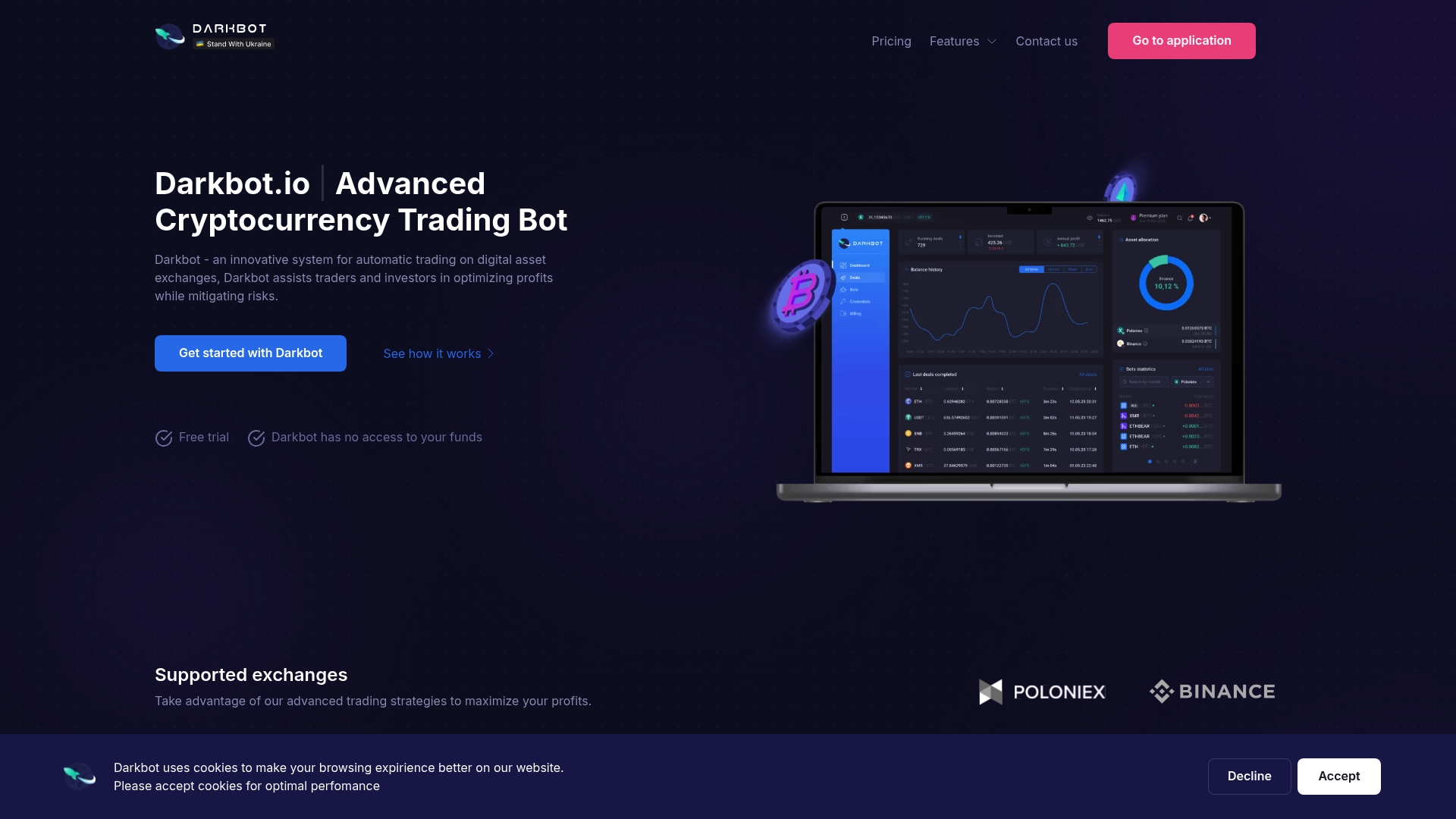
Once paper results align with your expectations, move to a small live allocation on the Standard Plan and monitor daily profit-and-loss alongside a defined drawdown threshold. Scale up only after observing consistent behavior across a full market cycle. Full plan details, including Standard at $12.50 per month and Premium at $25.00 per month, are listed on our pricing page.
FAQ
Which crypto bot is most profitable?
No bot guarantees profitability, and any platform claiming otherwise should be treated with caution. Performance depends on strategy logic, execution quality, and realistic cost modeling, which is why a pre-registered study found simple strategies often fail to beat buy-and-hold Bitcoin once real costs are applied.
What is the main difference between Shrimpy and active bot platforms?
Shrimpy focused on portfolio rebalancing across exchanges rather than continuous active trading. Platforms like Gunbot, 3Commas, and Darkbot add active bot execution, with Darkbot combining both rebalancing and bot execution in one account.
Is it safer to use a self-hosted bot or a cloud platform?
Self-hosted platforms like Gunbot or HaasOnline keep API keys on your own infrastructure, limiting vendor access but requiring you to manage setup and maintenance. Cloud platforms simplify onboarding but require confirming how the vendor stores keys and routes orders.
How much does Darkbot cost compared to other alternatives?
Darkbot offers a Free plan along with a Standard Plan at $12.50 per month and a Premium Plan at $25.00 per month, with Enterprise pricing available on request.
Why do backtested strategies often underperform in live trading?
Backtests frequently assume ideal fills and underestimate slippage, which overstates expected returns; for more details on backtesting and historical data, see the resources available in the BacktestMarket blog. Research applying realistic cost and fill models found that several retail strategies failed to outperform buy-and-hold Bitcoin out-of-sample, reinforcing the need to test with conservative assumptions before trading live.
Sources
- Paper Agents, Paper Gains: An Empirical Analysis of DeFi Investment Agents — arXiv
- cbenitezpy/chocotrader-research
- Pionex review — Coin Bureau
Recommended

Start trading on Darkbot with ease
Come and explore our crypto trading platform by connecting your free account!
Free plan available • No credit card required