Machine learning stocks: boost your crypto portfolio in 2026

TL;DR:
- Machine learning stocks offer diversification and stability when crypto markets decline.
- Key ML stocks like Nvidia and Palantir provide exposure to AI infrastructure influencing trading tools.
- Tree-based models outperform neural networks in crypto prediction, highlighting practical model choices.
Most crypto traders obsess over token picks, chart patterns, and automated bots while completely ignoring one of the most powerful diversification moves available right now. Machine learning stocks represent companies where AI revenue isn’t a side project but the core engine driving growth. For traders who live in crypto markets, these equities offer something genuinely rare: portfolio ballast when Bitcoin dips, plus direct exposure to the same AI infrastructure powering the tools you already rely on. This guide walks you through exactly which ML stocks matter in 2026, how they stack up, and how combining equity exposure with automated crypto trading gives you an edge most traders simply don’t have.
Key Takeaways
| Point | Details |
|---|---|
| Diversify with ML stocks | Investing in machine learning stocks gives crypto traders exposure to AI sector growth and lowers portfolio risk. |
| Prefer tree-based models | Ensemble ML methods like XGBoost and Random Forests work best for crypto price prediction. |
| Beware of market efficiency | Sophisticated ML models sometimes underperform naive methods due to efficient market dynamics. |
| Monitor stock valuations | Comparing price-to-earnings ratios is key—Nvidia offers relatively attractive valuation compared to many ML peers. |
| Leverage ML tools | Using AI-driven bots and analytics platforms can enhance your crypto trading decisions. |
What are machine learning stocks and why do they matter?
Machine learning stocks are shares in companies that derive significant revenue or competitive advantage from ML technologies. This isn’t just firms that use software internally. It means businesses where ML is the product, the differentiator, or the primary growth driver. Think GPU chips that train neural networks, AI platforms that analyze enterprise data, and cybersecurity tools that detect threats through pattern recognition.
For crypto-focused investors, these stocks matter for two distinct reasons. First, they offer portfolio diversification that moves differently from Bitcoin or Ethereum. When crypto markets correct hard, ML stocks tied to enterprise software contracts often hold steadier. Second, the infrastructure powering your favorite trading bots and signal generators runs on this exact technology.
Top machine learning stocks in 2026 include the following names worth tracking:
- Nvidia (NVDA): The dominant hardware provider for ML model training
- Tesla (TSLA): Applies ML aggressively to autonomous systems and energy
- Accenture (ACN): Deploys ML solutions across enterprise consulting
- ServiceNow (NOW): Embeds ML into IT and workflow automation
- Snowflake (SNOW): ML-powered cloud data platform for analytics
- CrowdStrike (CRWD): Threat detection powered by behavioral ML models
- Palantir (PLTR): AI-driven data analytics for government and enterprise
What makes this list relevant for crypto traders specifically is the overlap between these companies’ products and the tools shaping modern trading. Platforms that deliver real-time analytics, risk modeling, and predictive signals increasingly license infrastructure from exactly these firms. Holding these stocks isn’t just a passive bet on tech growth. It’s positioning yourself alongside the same AI wave that’s reshaping how markets operate.
Top machine learning stocks for crypto traders
Now that you know why ML stocks are valuable, let’s break down which ones stand out and why.
Nvidia remains the clearest play in ML hardware. With a market cap of $4.5 trillion, it supplies the GPU infrastructure that virtually every major ML model trains on. No other company controls this chokepoint in the AI supply chain quite like Nvidia does.

Palantir takes the software route, focusing on AI-driven data analytics for both government contracts and commercial enterprise clients. Its market cap exceeds $300 billion, reflecting enormous investor confidence in its long-term platform approach.
Valuation matters when you’re choosing between these two. Nvidia trades at roughly 25x forward P/E, while Palantir exceeds 100x forward P/E, making Nvidia the more attractively priced option for value-conscious investors. That gap is significant.
| Stock | Focus area | Market cap | Forward P/E |
|---|---|---|---|
| Nvidia (NVDA) | ML hardware | ~$4.5T | ~25x |
| Palantir (PLTR) | AI software | $300B+ | 100x+ |
| ServiceNow (NOW) | Workflow automation | $200B+ | ~50x |
| Snowflake (SNOW) | Cloud data analytics | ~$60B | ~70x |
| CrowdStrike (CRWD) | Cybersecurity ML | ~$100B | ~60x |
Key insight: Nvidia’s lower P/E ratio relative to its growth trajectory makes it the standout value pick among ML stocks heading into 2026, especially for traders who want AI exposure without paying a premium for pure-software multiples.
For traders exploring ML trading strategies built on top of these platforms, understanding who builds the underlying infrastructure becomes an investment thesis in itself. The companies optimizing crypto trading tools depend heavily on this ecosystem.
How machine learning stocks enhance crypto trading strategies
Knowing the leaders, let’s see how ML stocks actually benefit your strategies and portfolio.
The connection between holding ML stocks and improving your crypto performance isn’t obvious at first. Here’s how it actually works in practice:
- Indirect infrastructure exposure: When Nvidia sells more GPUs to AI companies, those companies build better prediction tools. You benefit as both a stockholder and a trader using those tools.
- Portfolio hedging: During sharp crypto drawdowns, ML stocks tied to enterprise contracts can provide stability, smoothing your overall equity curve.
- Signal about tech shifts: When Palantir or Snowflake report strong quarters, it often signals accelerating enterprise AI adoption, which historically precedes new capabilities in crypto automation strategies.
- Diversification discipline: Holding a small allocation to ML equities forces portfolio thinking beyond pure token speculation.
Holding ML stocks like NVDA and PLTR for portfolio diversification works alongside tree-based ML models such as XGBoost for crypto price prediction. However, you need to watch for overfitting and understand that market efficiency limits how far any model can go. Understanding the ML impact in crypto markets helps you set realistic expectations for what these tools can actually deliver.
Pro Tip: Set a calendar reminder to review Nvidia’s and Palantir’s quarterly earnings reports. These often contain forward guidance on AI infrastructure spending that directly previews capability improvements across trading platforms over the following two quarters.
One important caution: don’t assume that because these stocks are labeled “AI companies,” their products translate to guaranteed trading alpha. The tool is only as effective as the strategy built around it.
Key machine learning methods used in crypto trading
So, which ML models drive crypto trading and what does that mean for stock picks and trading bots?
Understanding the actual models gives you a real advantage when evaluating both trading tools and the companies behind them. Here are the most relevant methods ranked by practical performance:
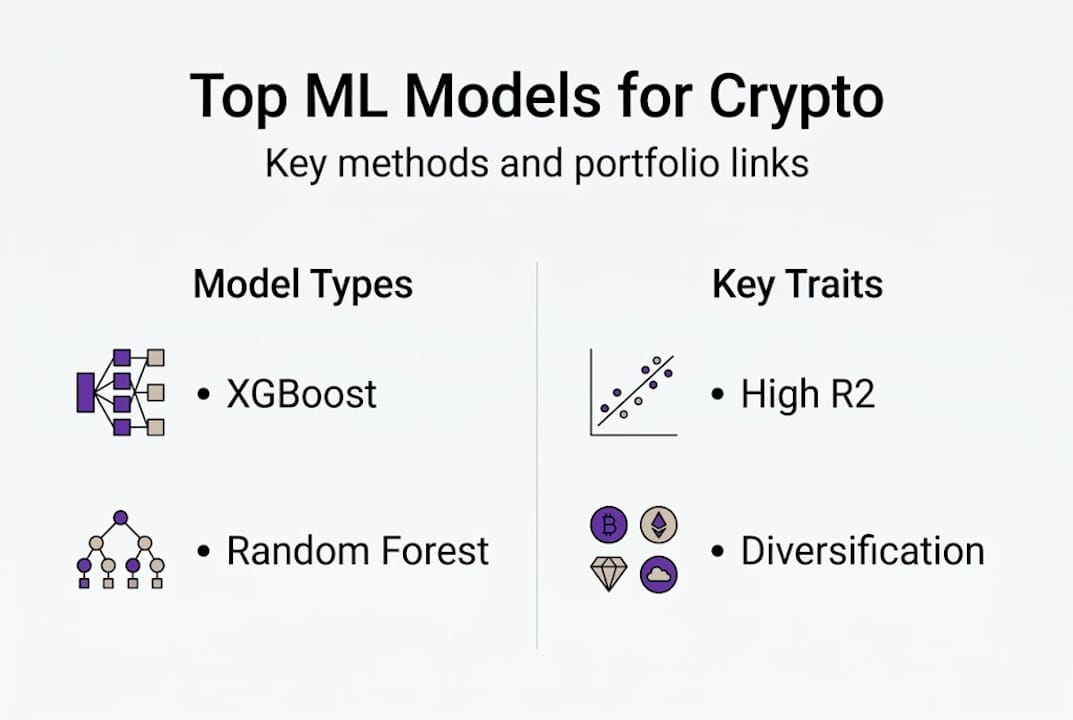
- Gradient Boosting and XGBoost: Currently the strongest performers for crypto price and return prediction
- Random Forests: Excellent for feature importance analysis and return classification
- LSTM (Long Short-Term Memory): Popular for sequence modeling but often overhyped relative to results
- Support Vector Regression (SVR): Useful in stable market conditions but inconsistent in volatility
- Wavelet-Transformer models: Theoretically advanced but often struggle to beat simpler baselines
The performance differences are striking. Gradient Boosting and XGBoost achieve R2 scores around 0.98, significantly outperforming LSTM and SVR approaches in crypto forecasting tasks. That’s not a marginal gap. That’s a model architecture producing near-perfect variance explanation on historical data.
| Model | R2 score | Best use case | Overfitting risk |
|---|---|---|---|
| XGBoost | ~0.98 | Price prediction | Medium |
| Random Forest | ~0.95 | Return classification | Low |
| LSTM | ~0.85 | Sequence patterns | High |
| SVR | ~0.80 | Stable conditions | Low |
Tree-based models including Random Forests and XGBoost outperform neural networks for crypto return prediction, which challenges the common assumption that deep learning is automatically superior.
Here’s the uncomfortable part. Sophisticated ML models frequently fail to beat naive persistence in short-term crypto forecasting because markets are more efficient than most traders assume. A naive model just predicts tomorrow’s price equals today’s price. Sometimes that beats your complex Wavelet-Transformer.
Pro Tip: When evaluating any trading bot or signal service, ask whether it uses ensemble methods like XGBoost rather than deep learning alone. Ensemble approaches are more robust and less prone to overfitting in the real-world noise of crypto markets.
This connects directly to your ML investing guide and to broader decisions about maximizing ML trading efficiency without chasing theoretical models that collapse under live market conditions.
Why most traders overlook machine learning stocks and how to profit anyway
After exploring the models and their value, here’s a more personal take on what most traders miss.
The crypto community has a bias toward direct asset exposure. Buy the token, run the bot, watch the chart. It’s visceral and immediate. ML stocks feel abstract by comparison, almost like watching a game from outside the stadium. But this framing is exactly wrong.
The traders who outperform over multi-year cycles are almost always the ones who think in systems, not just positions. Combining ML equity exposure with ML-powered trading tools isn’t diversification for its own sake. It’s recognizing that the same technological shift creating trading opportunities is also creating investable companies.
Some studies demonstrate strong ML edges with Sharpe ratios reaching 2.4, while others show that even ensemble models struggle against naive baselines under market efficiency constraints. Both findings are true simultaneously. The lesson isn’t to dismiss ML. It’s to apply it where it actually works and ignore the hype where it doesn’t. Ensemble methods with proper validation beat flashy deep learning models in practice. And holding Nvidia while running an XGBoost-powered bot beats holding only one or the other. Address trading efficiency challenges by building this dual-layer approach, not by doubling down on a single strategy.
Take your trading further with AI-powered tools
If the research above has you thinking about how to actually implement ML-driven strategies rather than just read about them, Darkbot.io is built for exactly that moment.

Darkbot’s AI trading bot connects directly to major exchanges via API, runs multiple simultaneous strategies, and uses automated rebalancing to keep your portfolio aligned with your risk targets. You get real-time analytics, strategy customization, and the kind of ML-backed execution that most traders only read about. Explore the built-in portfolio management tools to see how automated rebalancing and live performance tracking can reduce manual effort while keeping your edge sharp across volatile market conditions.
Frequently asked questions
Which machine learning stocks are best for crypto traders in 2026?
Nvidia and Palantir lead the category for AI utility and market dominance, but ServiceNow, Tesla, Snowflake, Accenture, and CrowdStrike all offer strong growth exposure depending on your risk tolerance and focus area.
Do tree-based ML models outperform neural networks for crypto trading?
Yes. Random Forests and XGBoost outperform neural networks for predicting crypto returns, primarily because they handle noisy financial data better without overfitting to historical patterns.
Can sophisticated machine learning models beat simple strategies in crypto forecasting?
Not reliably in short-term forecasting. Naive persistence models often outperform complex ML architectures in short-horizon crypto prediction due to inherent market efficiency, which is a critical reality check for any trader building automated systems.
How do ML stocks provide diversification for crypto portfolios?
Holding ML stocks reduces reliance on pure crypto asset performance by adding equity positions that respond to different market forces, balancing risk while keeping you positioned in the AI-driven technological growth cycle.
Recommended

Start trading on Darkbot with ease
Come and explore our crypto trading platform by connecting your free account!
Free plan available • No credit card required