Cross-Exchange Rebalancing: A Practical Guide for Crypto Traders

Cross-exchange rebalancing means keeping one set of target allocations across assets that are spread over several exchanges. The practical answer is to treat the combined holdings as a single portfolio, measure drift against the targets, and correct it with trades on each exchange wherever possible. Moving coins between exchanges is the expensive, slow and riskier option, so it is reserved for cases where trading cannot close the gap. A rule-based system that connects to each exchange through API keys can run this routine consistently, which is the problem automation is suited to.
This guide covers the mechanics, the cost structure, the trigger rules supported by research, and the security controls that matter when software trades on your behalf.
TL;DR
- Define targets for the whole portfolio, then measure drift using combined balances from every exchange, not one account at a time.
- Correct drift with trades inside each exchange first. Transfers between exchanges add withdrawal fees, network fees, delays and operational risk.
- Use a written trigger: a calendar schedule, a drift threshold, or both. Research on crypto portfolios found rebalanced strategies differ measurably from buy-and-hold on a risk-adjusted basis.
- Give automation trade-only API keys with withdrawals disabled and, where the exchange allows it, an IP allowlist.
- Backtest and paper trade the rule set before it manages real balances.
What cross-exchange rebalancing is
Standard rebalancing restores a portfolio to its intended proportions by selling assets that have grown beyond their target weight and buying those that have fallen below it. If you target 50% BTC, 30% ETH and 20% stablecoins, and a rally pushes BTC to 62%, rebalancing sells part of the BTC and buys the underweight assets.

The cross-exchange version adds one complication: the holdings are not in one place. A typical trader may keep BTC and ETH on one exchange for liquidity, altcoins on a second because of listings, and stablecoins on a third for lower fees or a different region. Each account has its own balance, its own fee schedule and its own order book. The portfolio you actually own is the sum of all of them.
The discipline has three parts:
- Aggregate. Add up every balance, in a single quote currency such as USD, to get true weights.
- Compare. Measure each asset’s actual weight against its target.
- Correct. Place the smallest set of trades or transfers that brings the weights back within tolerance.
The third step is where cross-exchange work differs from a single-account rebalance, and where most of the cost sits.
When it is useful
A single account does not need any of this. The approach becomes relevant in specific situations:
- Capital is split by design. You hold assets on different venues for liquidity, product access or counterparty diversification, and want one allocation policy to govern them.
- Multiple accounts run different strategies. Market-making, hedging and arbitrage setups often hold inventory on several exchanges, and inventory drifts as trades fill.
- Risk is managed at portfolio level. Concentration is a portfolio property. A position that looks modest on one exchange may be the majority of your net exposure once everything is added up.
- Larger or more active books. Frequent trading shifts weights on each venue at different speeds, so manual tracking falls behind.
For a very small account on one exchange, simple single-venue rebalancing is enough. Our guide on what rebalancing is in crypto covers that foundation.
Setting targets across venues
Before choosing a trigger, decide what the targets mean. Three decisions matter.
Portfolio-level targets. Set weights for the combined portfolio. A target such as 40% BTC applies to total BTC across all venues, regardless of where it sits.
Venue constraints. Decide how much value each exchange may hold. This is a risk rule, not an allocation rule: for example, no single exchange holds more than a fixed share of total value. Venue limits and asset targets interact, so write both down.
Tolerance bands. A target is a point and a tolerance is a range. A 50% target with a five-percentage-point band means no action while the weight stays between 45% and 55%. Bands prevent constant small trades whose fees exceed the benefit.
A tracking tool helps with the aggregation step. A crypto profit and fee calculator is useful for estimating what a planned set of trades costs before you commit, which matters once several fee schedules are involved.
A worked example
Suppose a $10,000 portfolio is split across two exchanges with these targets: 50% BTC, 30% ETH, 20% USDT.
| Asset | Exchange A | Exchange B | Total | Weight | Target |
|---|---|---|---|---|---|
| BTC | $4,200 | $1,800 | $6,000 | 60% | 50% |
| ETH | $1,000 | $1,400 | $2,400 | 24% | 30% |
| USDT | $300 | $1,300 | $1,600 | 16% | 20% |
BTC is 10 points overweight, ETH 6 points underweight, USDT 4 points underweight. The correction is to sell about $1,000 of BTC and buy about $600 of ETH and $400 of USDT.
The cheapest route is to sell BTC where the BTC sits, and buy ETH and USDT with the proceeds on the same venue. Exchange A holds $4,200 of BTC, so it can sell $1,000 there. It can then buy $600 of ETH and keep $400 as USDT, all without a transfer. Both exchanges end up with different mixes, but the combined portfolio matches the targets. Nothing needs to move between venues.
That result is the central idea of the whole topic: the portfolio is balanced in aggregate, even if no single exchange mirrors the target.
Trade or transfer: the main decision
Most drift can be corrected by trading within each exchange, using the pairs it lists. A transfer is needed only when an exchange lacks the asset you must buy, or when a venue limit forces you to shrink a balance there.
Compare the two routes:
| Factor | Trade inside each exchange | Transfer between exchanges |
|---|---|---|
| Cost | Trading fee plus spread and slippage | Trading fees, plus withdrawal and network fees |
| Speed | Seconds | Minutes to hours, depending on network and exchange review |
| Price exposure | Brief, at execution | Exposure while funds are in transit |
| Operational risk | Low | Wrong address, wrong network, held withdrawals |
| Automation | Straightforward through API | Usually restricted, and should be |
Withdrawal and transfer fees are set by each exchange and network, so they change and differ by asset. A breakdown of bridging and transfer fees shows how much costs can vary across routes, with components such as protocol fees, source-chain gas and spreads that are often not published up front. Always read the current fee page of the exchange and network you plan to use.
A practical rule: design your venues and holdings so that rebalancing seldom needs a transfer. Keep a stablecoin buffer on each venue to absorb purchases, and hold each asset on the venue where you are most likely to trade it.
Choosing a trigger: calendar, threshold or both
A trigger decides when to rebalance. There are two standard families.
Calendar rebalancing acts at fixed intervals: daily, weekly, monthly. It is simple and predictable, but it trades even when drift is trivial and waits even when drift is large.
Threshold rebalancing acts only when an asset moves beyond a set distance from its target, for instance five percentage points. It trades less in calm markets and responds faster in volatile ones.
A combined rule, such as checking daily and acting only on breaches of a threshold, captures both properties.
What the research says
A 2024 peer-reviewed study in the Journal of Finance and Banking Review simulated 10,000 seven-asset crypto portfolios and found statistically significant risk-adjusted differences between buy-and-hold, daily rebalancing and 5% and 10% threshold strategies. Daily rebalancing showed a higher Sharpe ratio, and lower thresholds produced better risk-adjusted returns in that sample. The Sharpe ratio is return per unit of volatility, so it measures efficiency of risk, not raw gain.
The same paper reviews earlier work. One study of equity portfolios found that monthly and quarterly calendar rules and 5% threshold rules monitored monthly or quarterly all outperformed buy-and-hold with little difference among them, and that threshold rules triggered few events. Another showed that continuous rebalancing is optimal in theory, but the excess return over less frequent rebalancing is very limited.
Two cautions follow from this. The simulations used a single trading cost assumption, and your real costs depend on your exchanges. And a result from a historical sample describes that sample, not the future. The useful lesson is structural: frequency is a trade-off between tracking the target tightly and paying costs more often. In a multi-exchange setup, where each correction can involve several fee schedules, that trade-off is sharper, so the threshold should be set above your round-trip cost per correction.
Setting the numbers
A workable procedure:
- Estimate the all-in cost of a typical correction: fees on both legs, expected spread and slippage.
- Set the band wide enough that a breach implies a correction worth that cost.
- Choose a check frequency (hourly, daily) that is independent of the action rule. Checking is free; trading is not.
- Add a minimum trade size so dust adjustments are skipped.
- Backtest the rule on historical data, then run it in paper trading before real funds.
For more on the method itself, see our explainer on portfolio rebalancing for crypto traders.
The costs that decide whether it pays
Rebalancing is cost-sensitive. Each correction has these components:
- Trading fees. Maker and taker rates differ by exchange and often by volume tier. Using limit orders can lower the rate but may leave an order unfilled.
- Spread and slippage. Thin order books move against you, particularly with smaller altcoins. Slippage grows with order size relative to depth.
- Withdrawal and network fees. Charged per transfer and mostly fixed, so small transfers are disproportionately expensive.
- Transfer delay. Funds in transit cannot be traded, and prices can move meanwhile.
- Tax events. In the United States, selling a crypto asset can be a taxable event, so rebalancing sales belong in your records. Confirm treatment with a tax professional.
A small account feels fixed costs most. If a correction costs $3 in fees and moves $50, it is not worth doing. Wider bands and a minimum trade size protect small portfolios from rebalancing themselves into losses.
Risks specific to multiple exchanges
Counterparty risk. Funds on an exchange are exposed to that exchange’s solvency and security. Spreading balances across venues reduces dependence on any one, and a per-venue cap turns that into a rule.
Liquidity risk. An asset that trades well on one venue may be thin on another. Rebalancing orders should respect each venue’s depth.
Stale balances. If your aggregate view lags, the system acts on wrong weights. Balance data should refresh before each decision.
Partial execution. A rebalance of several legs can fill partly. The rule set needs a defined behavior for incomplete runs, such as recalculating from fresh balances instead of retrying blindly.
Rate limits and outages. Exchanges cap API request rates and occasionally go offline. A well-built routine pauses and re-measures rather than forcing orders.
Automating it safely
Manual cross-exchange rebalancing means logging into several accounts, adding up balances in a spreadsheet and placing orders by hand. It is slow, easy to get wrong and tends to lapse in volatile conditions, when drift is largest. Automation addresses the consistency problem: the same rule is evaluated the same way every time.
Safe automation depends on how you set up the connection.
API permissions. Create a separate API key for each exchange. Enable reading balances and spot trading only. Leave withdrawal permission off. A key without withdrawal rights cannot move funds out of the exchange even if it leaks, which is the single most important control.
IP allowlisting. Where the exchange supports it, restrict the key to the IP addresses the platform provides, so the key is useless from anywhere else.
Account hygiene. Use two-factor authentication on the exchange account, preferably an authenticator app rather than SMS, and never share your exchange password with any tool.
Monitoring. Review order history and balances regularly. Set alerts for failed orders and unusual activity, and rotate keys periodically.
Staged rollout. Backtest the rules, run them in paper trading, then start with a small allocation before extending to the full balance.
These steps hold regardless of the software you choose. They also set a clear boundary: the system trades and rebalances, while the movement of funds between venues stays under your direct control.
How Darkbot fits this routine
Darkbot is an AI-based automation platform for crypto trading, not a signal provider. It connects to exchanges through API keys, supports multiple simultaneous bots, automated rebalancing, portfolio management, real-time analytics, backtesting and paper trading. The AI component is used for consistency and probabilistic pattern evaluation within rules you define, not for forecasting prices. Our approach to order handling is direct order routing, with human oversight, and risk management tools are part of the product.
For related reading on structuring allocations, see our cryptocurrency portfolio balancing guide and our overview of crypto portfolio management.
Perspective
Cross-exchange rebalancing is a process problem before it is a trading problem. The decisions that matter are made in advance: the targets, the tolerance bands, the venue limits and the permissions given to software. Once those are written down, execution is repetitive, and repetitive execution is where rule-based automation is most useful.
We build Darkbot around that view. Each exchange connects through its own API key, strategies are defined by explicit parameters, and you can backtest and paper trade them before real capital is involved. Our focus is on execution quality and structured risk control, with a human able to oversee and adjust the rules. The AI evaluates conditions probabilistically within those rules. It does not claim to predict markets, and no setup removes the risk of loss.
For a trader with balances on more than one venue, the practical gain is consistency: the same measurement and the same correction logic applied on every check, without relying on attention or a spreadsheet.
Grisha
Getting started with Darkbot
Darkbot offers a Free plan with limited features, a Standard Plan at $12.50 per month and a Premium Plan at $25.00 per month, plus an Enterprise tier. The pricing page lists what each plan includes, so you can match the number of simultaneous bots and tools to the number of exchanges you run.
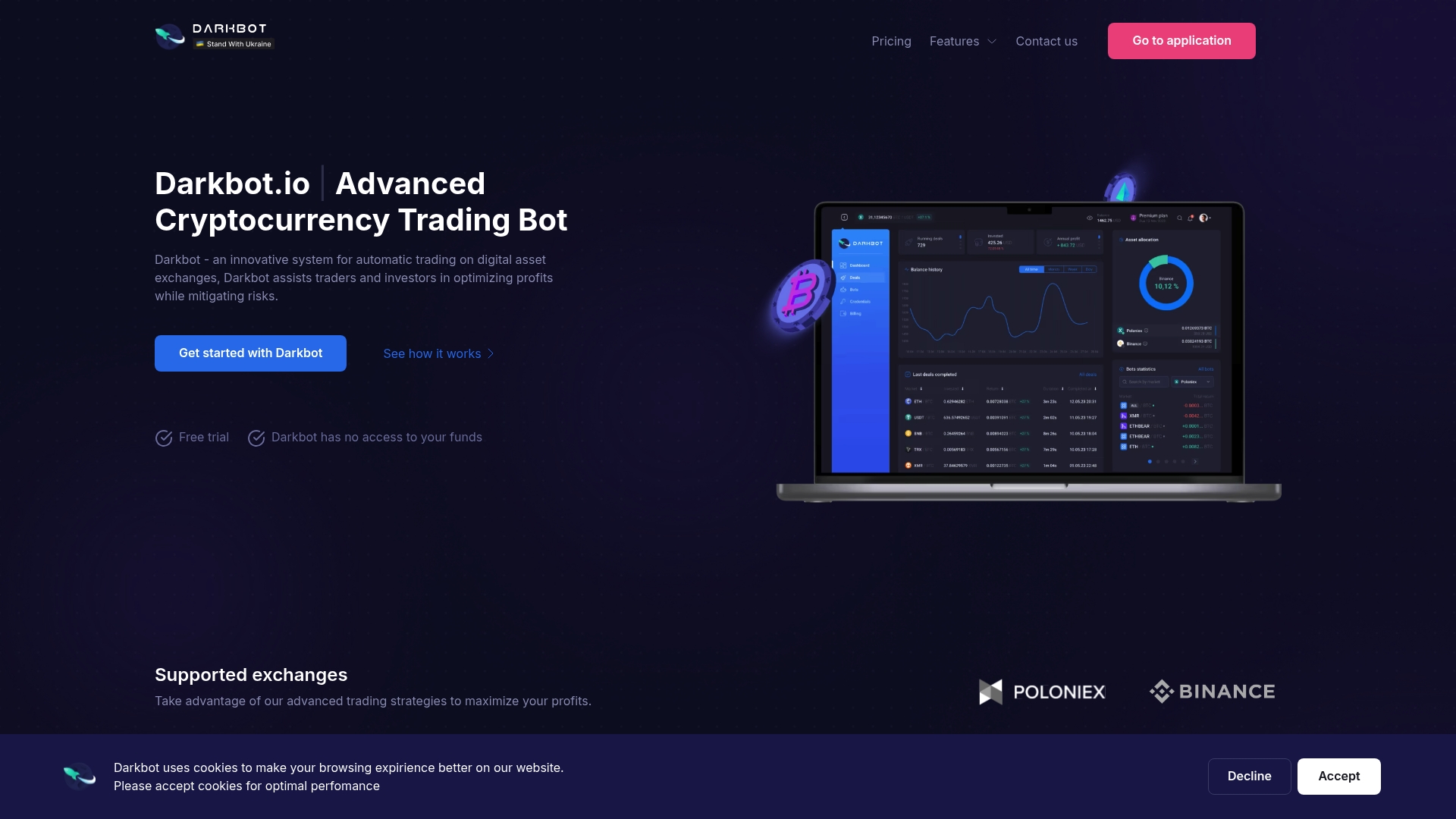
A sensible first step is to connect one exchange with a trade-only key, define target weights, and paper trade the rebalancing rule before extending it to a second venue. You can read more about the platform at darkbot.io, and our guide to maximizing results with portfolio rebalancing covers parameter choices in more detail.
FAQ
How often should I rebalance across exchanges?
There is no universal answer. Research on crypto portfolios found that daily rebalancing and tight thresholds scored better on risk-adjusted measures in simulation, while other studies found little difference among monthly, quarterly and threshold rules. Choose a check frequency that suits your tools and set the action threshold above your round-trip cost per correction.
Do I have to move coins between exchanges to rebalance?
Usually not. If each exchange lists the assets you need, you can sell overweight assets and buy underweight ones on the same venue, so the combined portfolio reaches its targets without transfers. Transfers become necessary only when a venue lacks an asset or exceeds your per-venue limit.
What API permissions does an automated rebalancer need?
It needs permission to read balances and to place trades. Withdrawal permission should stay disabled, and an IP allowlist should be used where the exchange offers one. This keeps funds in your exchange account even if a key is exposed.
Is a threshold or a calendar rule better?
A threshold rule trades only when drift is meaningful, which usually lowers costs. A calendar rule is simpler and more predictable. Many traders combine them by checking on a schedule and acting only when a threshold is breached.
Sources
- Optimizing Cryptocurrency Portfolios: A Comparative Study, Journal of Finance and Banking Review, 2024
- Crypto Bridging Fees: Why They Vary 10x
Recommended

Start trading on Darkbot with ease
Come and explore our crypto trading platform by connecting your free account!
Free plan available • No credit card required