Peer-to-Peer Crypto Trading: A Beginner's 2026 Guide
Peer-to-peer crypto trading connects two individuals directly to exchange digital assets without a centralized platform acting as the counterparty. You set the price, choose the payment method, and negotiate terms with another person. The platform’s job is to hold the crypto in escrow and step in if something goes wrong. That’s the core of P2P crypto trading — and it is meaningfully different from buying on a standard exchange.
A few terms worth knowing before going further:
- Maker: the trader who posts an offer, specifying price, payment method, and trade limits
- Taker: the trader who browses existing offers and accepts one
- Escrow: a neutral holding mechanism that locks the seller’s crypto until payment is confirmed
- Settlement: the moment the crypto is released to the buyer after payment verification
- Reputation system: a track record of completed trades and ratings that helps traders assess counterparty reliability
Unlike a centralized exchange, where the platform matches orders automatically and holds custody of funds, a P2P marketplace functions more like a classified ad board. Sellers post offers with their own terms; buyers pick the one that fits. Payment can happen via local bank transfer, mobile wallet, cash, or dozens of other methods — whatever the two parties agree on.
How does peer-to-peer crypto trading work, step by step?
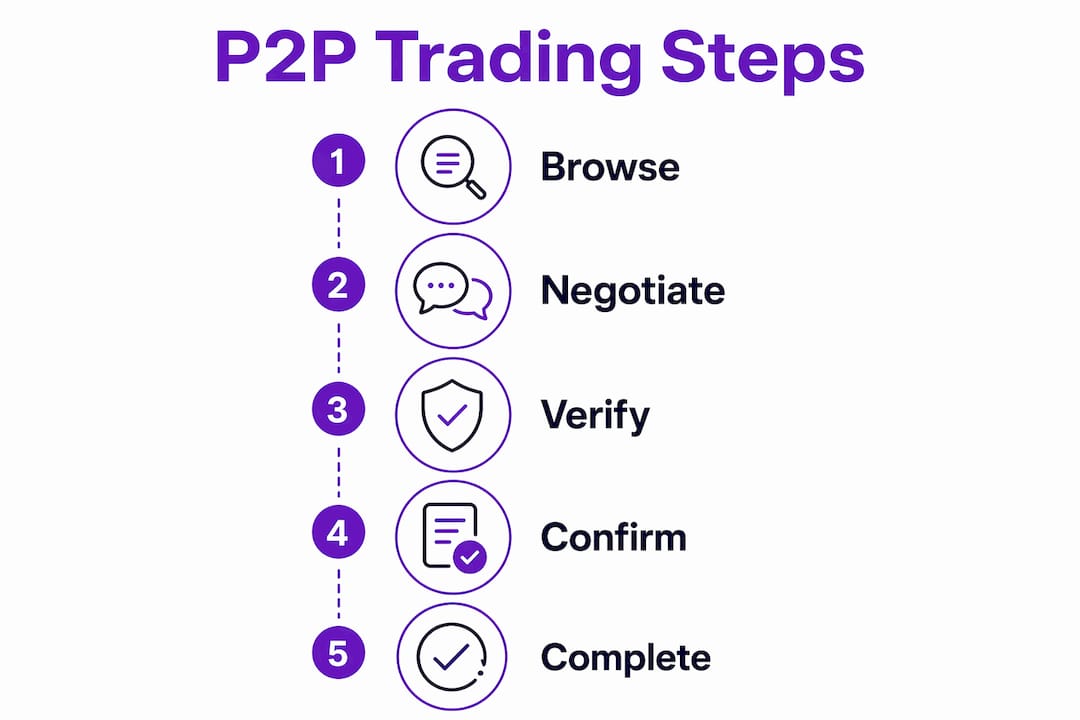
The mechanics are straightforward once you see the full sequence. Here’s how a typical trade flows on a P2P platform:
-
The maker posts an offer. A seller lists the amount of crypto available, the price (often a percentage above or below market), accepted payment methods, and trade limits. Buyers can do the same in reverse, posting buy offers for sellers to accept.
-
The taker selects an offer. The buyer browses active listings, filters by payment method or price, and initiates a trade by clicking “Buy.” The platform notifies the seller.
-
Escrow locks the crypto. The moment a trade begins, the platform locks the seller’s crypto in escrow. Neither party can touch it until the trade resolves. This step is what separates P2P trading from a raw wallet-to-wallet transfer.
-
The buyer sends payment. Using the agreed method — bank transfer, PayPal, Zelle, mobile money, or cash — the buyer sends the fiat amount and uploads proof of payment within the trade window.
-
The seller verifies payment. The seller checks their account, confirms the funds arrived, and marks the payment as received inside the platform.
-
Crypto is released. Once the seller confirms, the escrow releases the crypto to the buyer’s account. The trade closes, and both parties can leave ratings.
-
Dispute resolution (if needed). If the buyer claims to have paid but the seller disputes it, the platform’s support team reviews evidence — chat logs, payment screenshots, bank confirmations — and arbitrates. Platforms like Binance P2P have dedicated dispute teams for exactly this scenario.
Pro Tip: Always communicate inside the platform’s chat, never through external messaging apps. Off-platform conversations are invisible to dispute teams and can leave you without recourse if a trade goes wrong.
Payment method flexibility is one of the defining features of this model. P2P marketplaces support local bank transfers, mobile wallets, and other regional options that centralized exchanges often don’t accommodate — particularly useful in areas where card access is limited.

What are the real advantages and risks of P2P trading?
P2P trading has genuine strengths, but it also carries risks that centralized exchanges largely absorb on your behalf. Both sides deserve an honest look.
Advantages:
- Payment flexibility. You can trade using methods a standard exchange won’t touch: Zelle, Venmo, cash deposits, regional mobile wallets, or local bank transfers. This makes P2P a practical on-ramp and off-ramp in markets where card-based crypto purchases are restricted.
- Lower platform fees. P2P platforms typically charge lower direct fees than centralized exchanges, though the maker’s spread is built into the offer price.
- Privacy. KYC requirements vary by platform. Some P2P setups require minimal identity verification, offering more privacy than a fully regulated centralized exchange.
- Global accessibility. P2P acts as a critical bridge in regions with limited banking infrastructure, connecting buyers and sellers who have no other practical path to crypto.
- Price negotiation. Unlike a fixed order book, P2P lets you negotiate directly. A motivated seller may accept a price below the listed rate.
Risks:
- Counterparty fraud. The person on the other side is a stranger. Scammers use fake payment screenshots, manipulated receipts, and social engineering to pressure sellers into releasing crypto before payment clears.
- Third-party payment risk. A payment sent from someone else’s account — not the verified trader — can be flagged as unauthorized later. The result: the bank freezes your account even if you did nothing wrong. This is one of the most serious P2P risks, and it’s why matching the sender’s name to their verified identity matters every time.
- Regulatory uncertainty. P2P trading in the US sits in a gray zone for platforms that don’t enforce KYC. Traders themselves carry tax and reporting obligations regardless of platform compliance.
- Dispute resolution delays. Even on well-run platforms, disputes can take days to resolve, leaving funds locked in escrow during that window.
Experienced traders assess counterparty reliability primarily by completion rate and trade history rather than total volume. A trader with a strong completion rate and many completed trades is a more reliable signal than one with high volume but a spotty record.
How does P2P trading compare to centralized and decentralized exchanges?
The three main exchange structures solve the same problem differently, and the trade-offs are real.

Centralized exchanges (CEXs) use automated order books to match buyers and sellers anonymously. The platform holds custody of funds, enforces KYC, and settles trades in seconds. Speed and liquidity are the strengths. The trade-off is that you hand custody of your assets to the platform and accept its payment method restrictions.
Decentralized exchanges (DEXs) use smart contracts to execute trades without a central operator. You retain custody of your wallet throughout. DEXs offer strong anonymity and censorship resistance, but they operate on-chain, which means gas fees, slippage on thin liquidity pairs, and a steeper learning curve. Even DEXs aren’t purely peer-to-peer in the strict sense — the smart contract is still an intermediary.
P2P platforms sit between these two models. The platform provides escrow and dispute resolution but does not act as the trading counterparty. Unlike a CEX’s automated order book, P2P platforms focus on diverse local payment methods and rely on reputation systems rather than algorithmic matching. Fee structures differ too: CEXs charge maker/taker fees on each trade, while P2P spreads are set by the individual merchant and baked into the offer price.
Key structural difference: On a CEX, the exchange is always the counterparty. On a P2P platform, another human is — and the platform only holds the escrow.
For traders who need payment method flexibility or operate in markets where card-based purchases are restricted, P2P fills a gap that neither CEXs nor DEXs address well. For high-frequency trading or deep liquidity, a CEX is the more practical choice. Understanding spot trading fundamentals helps clarify where each model fits in a broader trading approach.
Is P2P crypto trading legal in the United States?
P2P trading itself is not illegal in the United States. What matters is how it’s conducted and whether participants meet their compliance obligations.
The Financial Crimes Enforcement Network (FinCEN) treats P2P platforms that facilitate exchanges as money services businesses, subject to anti-money laundering (AML) and counter-terrorism financing (CTF) regulations. Platforms operating without proper registration and KYC enforcement have faced enforcement actions. For individual traders, the obligations are primarily on the tax side: the IRS treats cryptocurrency as property, meaning every trade — including a P2P exchange — is a taxable event that must be reported.
The practical implications for traders are clear. You are responsible for tracking your cost basis, calculating gains or losses on each trade, and reporting them accurately. The platform’s compliance posture doesn’t change your individual tax obligations. Using a P2P platform that lacks KYC doesn’t exempt you from IRS reporting requirements.
The regulatory landscape is still evolving. FinCEN has signaled continued scrutiny of P2P platforms that operate without AML controls, and state-level money transmission laws add another layer of complexity. Staying current with FinCEN guidance and consulting a tax professional familiar with digital assets is the practical approach for anyone trading P2P with any regularity.
How AI and automation complement your crypto trading strategy
P2P trading is inherently manual. You browse offers, negotiate terms, verify payments, and manage disputes one trade at a time. That’s fine for occasional on-ramping or off-ramping, but it doesn’t scale well for active portfolio management across multiple assets and exchanges.
AI-powered automation addresses a different problem: consistent, rule-driven execution across volatile markets without the emotional interference that affects manual traders. Platforms like Darkbot automate strategy execution across multiple exchanges via API integration, applying predefined logic to entry, exit, and risk parameters without requiring constant manual input.
The role of AI here is worth stating precisely. It’s not prediction. It’s consistency. An automated system evaluates market conditions against a defined rule set and executes accordingly, every time, without hesitation or second-guessing. That kind of disciplined repetition is difficult to maintain manually, especially in fast-moving markets.
Key capabilities that AI-driven platforms bring to the table:
- Multi-exchange integration via API keys, letting a single strategy run across several exchanges simultaneously
- Customizable risk parameters, including position sizing, stop-loss logic, and exposure limits per asset
- Real-time analytics that surface portfolio performance data without requiring manual reconciliation
- Backtesting and paper trading to evaluate a strategy against historical data before deploying real capital
- Automated rebalancing to maintain target allocations as market prices shift
For traders who use P2P for fiat conversion and then move assets to exchange accounts for active management, the two approaches are complementary rather than competing. P2P handles the on-ramp; automation handles the strategy layer. Darkbot’s multi-exchange integration covers the execution side, and its risk management framework keeps position sizing within defined bounds regardless of market conditions.
Applying a structured risk management framework to any trading activity, whether P2P or automated, is the baseline for protecting capital over time.
Key Takeaways
P2P crypto trading gives individuals direct control over price, payment method, and counterparty selection, but that control comes with personal responsibility for fraud prevention, tax compliance, and due diligence.
| Point | Details |
|---|---|
| Escrow is the safety mechanism | The platform locks the seller’s crypto until payment is confirmed, preventing either party from defaulting. |
| Completion rate beats volume | Assessing a counterparty by completion rate and trade history is more reliable than looking at total volume alone. |
| Every P2P trade is taxable | The IRS treats crypto as property; each trade creates a reportable gain or loss regardless of platform KYC status. |
| Third-party payment risk is serious | Payments from unverified senders can trigger bank account freezes even when the trade itself was legitimate. |
| AI automation complements P2P | Platforms like Darkbot handle systematic strategy execution across exchanges, while P2P handles fiat conversion. |
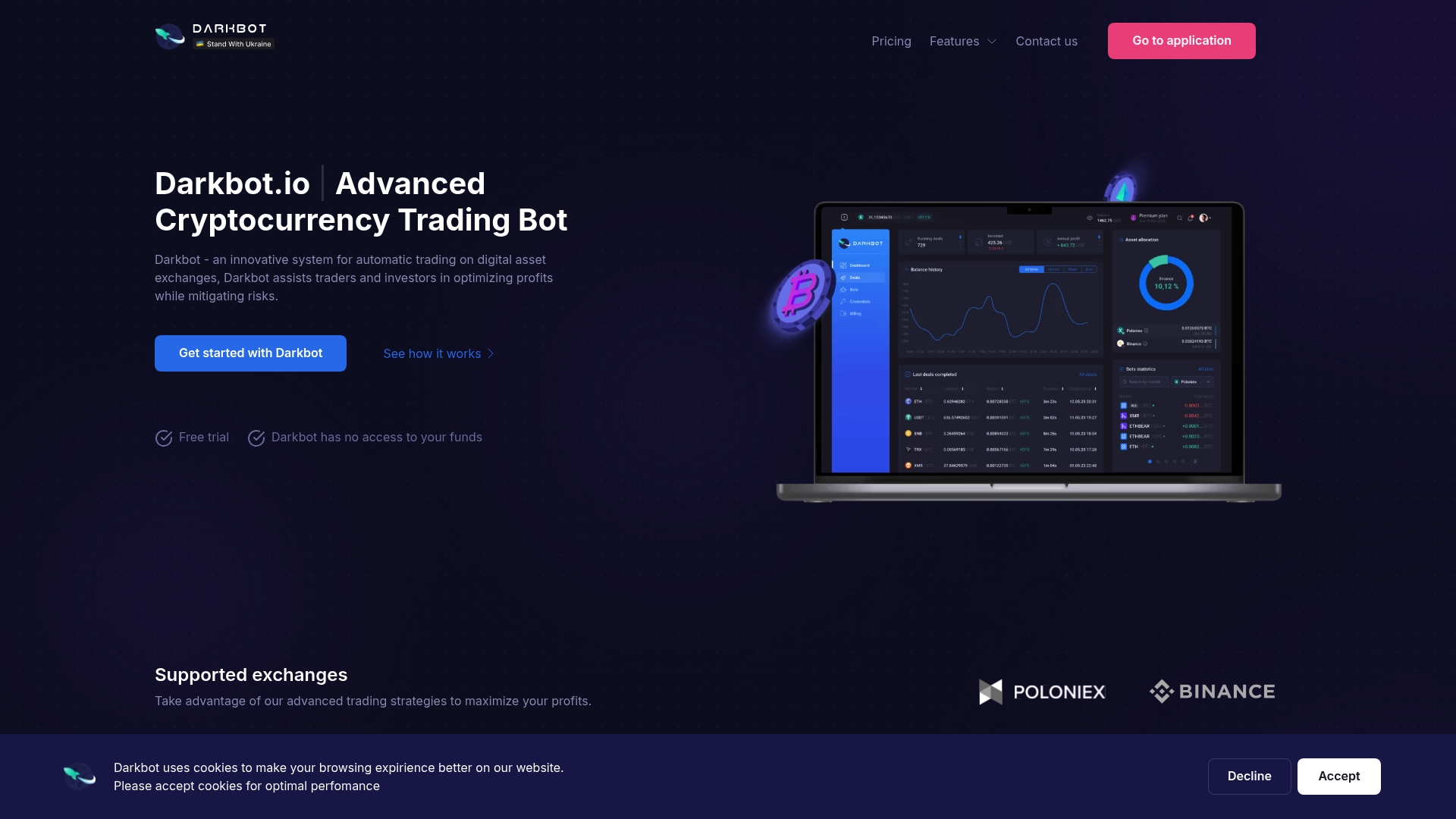
Darkbot is built for traders who want systematic, rule-driven execution across multiple exchanges without the manual overhead. From customizable strategies and real-time analytics to automated rebalancing and risk controls, the platform handles the execution layer so you can focus on the decision layer. Explore Darkbot’s full capabilities and see how AI-driven automation fits into your trading approach.
Recommended

Start trading on Darkbot with ease
Come and explore our crypto trading platform by connecting your free account!
Free plan available • No credit card required